Showing posts with label Australian Food. Show all posts

Sunday, March 21, 2021

Another Look at Australian History


Dark Emu is a very dark book. Author Bruce Pascoe clearly lays out the case that pre-contact Australian peoples were highly organized and accomplished in many ways. In order to explain what the many tribes that lived in Australia were capable of, Pascoe must show the reader how utterly and irresponsibly the English colonizers destroyed their cultivated fields, their stone and wood houses, their fields of native grain, the baking ovens that they used to make bread from the grain, the carefully-built and elaborate structures that trapped fish as they swam in waterways, and many other artifacts that the native Australians had been using for thousands of years. The author then shows how the European heirs of colonial Australia were carefully taught that these great achievements never existed at all, but that the Aboriginals lived in a sort of primitive vacuum. The brutality of the destruction is outdone by the brutality of the denial of what was destroyed. Pascoe writes:

"It is clear from the journals of the explorers that few were in Australia to marvel at a new civilisation; they were there to replace it. Most were simply describing a landscape from which settlers could profit. Few bothered with the evidence of the existing economy, because they knew it was about to be subsumed." (p. 9).

Pascoe examines the diaries and published accounts by many of these early explorers and colonizers of the land, and shows how their testimony bears witness to the existence of agriculture, carefully and beautifully arranged landscapes, and many other accomplishments. Reading the book, I was completely impressed by the descriptions of what the native people produced and how they lived -- and completely depressed at the way it was ruined in the name of English civilization. Pascoe writes;

"If we look at the evidence presented to us by the explorers, and explain to our children that Aboriginal people did build houses, did build dams, did sow, irrigate, and till the land, did alter the course of rivers, did sew their clothes, and did construct a system of pan-continental government that generated peace and prosperity, it is likely we will admire and love our land all the more. Admiration and love are not sufficient in themselves, but they are the foundation of a more productive interaction with the continent. 

"Behaving as if the First Peoples were mere wanderers across the soil and knew nothing about how to grow and care for food resources is a piece of managerial pig-headedness. Smart business people rule nothing out, especially if the seeds of success are obvious. The songlines of Aboriginal and Torres Strait Islander people connected clans from one side of the country to another. The cultural, economic, genetic, and artistic conduits of the songlines brought goods, art, news, ideas, technology, and marriage partners to centres of exchange." (p. 140). 

A few weeks ago, I wrote a post about the book The Future Eaters by Tim Flannery. Several of my Australian blogger friends suggested that I read Dark Emu to obtain a balanced view of the history of pre-contact Australian peoples. I'm grateful to them for this, and I feel that many things I thought I knew have been questioned and corrected.

An illustration of early Australian agriculture: Yam diggers at Indented Head, Victoria, 1835
Yams were a staple of the First People’s diet. (p. 18). 

Blog post © 2021 mae sander for mae food dot blog spot dot com


Tuesday, February 16, 2021

"The Future Eaters"

"It makes an enormous amount of sense... to see the lack of agriculture by Australian Aborigines as a fine-tuned adaptation to a unique set of environmental problems, rather than as a sign of 'primitiveness.'" -- The Future Eaters, p. 282

My previous review is here:
The Future Eaters
Imagine a human society that became stable tens of thousands of years ago in an environment that differs widely from that of the European or North American temperate climate zones. Members of this society own no fertile fields where grain grows, no large domestic animals raised for food like pigs or cows, and no great forests. Small bands of these humans hunt exotic game such as large lizards or marsupials -- the limited resources of the Australian continent. Until European settlers arrived, several years after the 1770 visit of James Cook and his ship Endeavor, these bands of highly adapted people managed the continent. They utilized the available resources in an efficient but unexpected way that's hard for us to grasp. 

Rereading the 1994 book The Future Eaters: An Ecological History of the Australian Lands and People by Tim Flannery made me think about how totally this unfamiliar reality differs from ours  -- a whole way of life that seems more like fiction than like history.

Members of the small bands of people throughout Australia during the 60,000 years or so of their history lived by gathering bush foods from a variety of sparse woodlands and scrublands in the large territories that belonged to them. They managed the game and the growth of the woodlands by "firestick" -- that is, controlled burns of the forest, which over thousands of years had evolved to ensure the continuity of plant and animal species that they depended on. These were not plentiful, so as my initial quote mentions, agriculture, with its intensive use of localized resources, would not have been practical as an extension of their culture.

Although these bands of people lived in widely dispersed areas, they would gather from time to time to celebrate, to socialize, and to finalize marriages between couples who had long ago (even before they were born) been destined for each other. Individuals in one area might know the family tree of another group living a thousand miles away. This activity, like most of the things they did, contributed to the survival of their way of life, adding to the genetic diversity and collective wisdom of each separated group.

The lifecycles of animals and plants used by these groups were partly dependent on the seasons, as they are in the Northern Hemisphere. However, there were other cycles, often less predictable. Because the vegetation in the extremely dry territories grew very slowly, some plants produced edible fruits only every several years. Animal lifecycles could also vary; for example, one breed of sea lions -- a possible prey species for seacoast dwellers -- had their young every 15 months; that is, at varying times of the seasonal year. The most critical non-seasonal variation in Australia was the periodic drought caused by changes in Pacific Ocean currents: the El Nino Southern Oscillation (ENSO), which to this day affects the Australian continent drastically. 

Living in this environment for such an eternity (compared to our few thousand years of settled agriculture and what we call civilization) the Australians were very much in tune with the resources that they needed, and they manipulated many things. They used controlled fires, and they paid careful attention to the life cycles of the species that they depended on. They had religious prohibitions on hunting in certain sacred places, for example, which gave some prey animals a chance to breed undisturbed, and thus prevented over-hunting. 

In 1845, the explorer Edward John Eyre made a prediction which Flannery finds very accurate. He wrote that Aboriginal culture was:
"so varied in detail, though so similar in general outline and character, that it will require the lapse of years, and the labours of many individuals, to detect and exhibit the links which form the chain of connection in the habits and history of tribes so remotely separated; and it will be long before any one can attempt to give to the world a complete and well-drawn outline of the whole." -- The Future Eaters, p. 271.

Explaining the extraordinary extent of the Aboriginals' coexistence with their natural environment is the central, eye-opening subject of Flannery's book, which also includes much more information. He covered the pre-human evolution of Australia. He documented the early era of humans in Australia, during which the newly arriving Aboriginals disrupted the prior status quo, and in fact drove a number of native species to extinction. Further, he provided a general history of the human settlement of the lands of the South Pacific. Finally, Flannery described the tragic destruction that occurred when the English took over the continent.

Some of the scientific basis for this book has probably changed since it was written in 1994. I'm sure that the much more accurate methods of gene sequencing that have been developed since then will have added much, and perhaps changed interpretations of natural and human history. The chapters about the way that present-day Australians cope with the special features of their environment have no doubt also been made somewhat obsolete by the drastic nature of climate change as we have experienced it since publication; also by the greater impact on Australia of our warming world. Despite these doubts about the continued accuracy of the book, I think it is most fascinating. I'm glad I have reread it, as I have often thought about it in the years since I first became acquainted with it.

I dedicate this blog post to my Australian blog friends, including Sherry, Francesca, Johanna, and all the others. I very much hope I can again visit Australia and see some of the landscapes and animals that are described in the book.

Review © 2021 mae sander. 

Saturday, August 19, 2017

"Barbecue" -- new documentary available on Netflix


"Barbecue" is a newly-released film by Australian director Matthew Salleh. It begins with a portrayal of a South African who created the barbecue stand shown above by cleaning up a trashed corner shop.


The life of the hard-working black man makes a considerable contrast with the white South Africans who are shown barbecuing and having picnics on their beautiful lawns as a social activity. Their attitudes reflect their privilege, in contrast to the working man with his hard-earned livelihood.

One unusual feature of this documentary: there's no narration, only the voices of the people who are interviewed. Sometimes their words seem a little strange and out-of-context, but on the whole it's an effective way to convey the contrasts among the 12 cultures that are represented in the film.

The focus jumps from culture to culture and continent to continent -- Japanese yakitori chefs, Maori pit barbecues, Mexican mescal preparation, young Swedish men & women with disposable grills, older men in Uruguay, central Texas pit masters, and many more. You watch fire-building, charcoal-making, animal slaughter, meat being chopped with axes and beaten with mallets, whole animals being placed on skewers, and much more. Occasionally a vegetable sneaks into the action, but mostly it's meat, meat, meat.


This is a Mongolian family, one of the most interesting segments of the hour and 40 minutes of the film. 
Another scene in Mongolia -- preparing a marmot for the cooking fire.


Mongolia: yurts, trucks, motor cycles, and the open sky.
In Armenia, several men talk about how they enjoy cooking over a fire.
In a refugee camp on the border of Syria and Jordan, we watch a schwarama cook preparing and flaming the meat,
and talking about how he would like to return to his home.
Maoris in New Zealand prepare a barbecue...

And one of the very few women who is interviewed in the course of the 12 cultures describes how women used to be
the ones who cooked over open fires, and how people didn't sit down for fear they would be attacked.
Netflix just released this documentary a few days ago. It's too long to watch in just one sitting: we stopped after approximately the first half, and then watched the rest later. Some of the segments are definitely better than others, but on the whole it's quite interesting.

Also, I found the music weird -- often it seemed to have nothing at all to do with the content of the visuals and interview topics. In one scene, you see street Mexican or South American musicians and dancers, but the music is entirely different and not synchronized or at all related to the action.

Wednesday, February 01, 2017

Good Food in the News

Because I'm getting ready to leave town, I'm not cooking anything ambitious. However, I'm still finding time to read the current fast-paced news of the nation and the world. Calm food news is a nice distraction from the more serious stuff that's currently possessing me.

Three items especially caught my eye. I'm saving them for when I get back and start shopping for food and cooking again. The images are screen shots from the articles.

"Tim Tams, an Australian Favorite, Arrive in America" by Florence Fabricant in the New York Times. I often read blogs by Australians, so I definitely know about this popular treat. I hope I find some in one of the stores where I shop: "Crisp chocolate biscuits coated in chocolate hug a creamy filling. They are sold in 40 countries now that they have arrived in America."


"How to Make Schnitzel Like an Israeli" by Vered Guttman in Ha'aretz. This is a simple, delicious way to make chicken breast: "how a European classic took a distinctly Jewish and Middle Eastern turn." I've had it in Israel, and also made it myself. This is a good reminder that I should do it again. I especially like the serving suggestion: "Serve immediately with mashed potatoes, ketchup or pickles, or serve in a pita spread with hummus and stuffed with French fries."


"Slow Cooker Green Chicken Chili" by Rhoda Boone, a new recipe in Epicurious this month. I'm tempted by the variation of some classic ways to make chili: "With chicken, sweet potatoes, tomatillo salsa, and pinto beans, it's more of a cross between chile verde (usually made with pork) and white chicken chili."

Sunday, July 19, 2015

Culinary Historians' Dinner

Arepas con Pollo Adobado from Columbia or Venezuela
Earlier this evening, we attended the summer dinner of the Culinary Historians of Ann Arbor (CHAA), held at the Ladies' Literary Club of Ypsilanti clubhouse that was built in the 1840s. While this was our first time attending this event, most of the other people present have been participating in CHAA dinners for years or even decades. Tonight's theme was "Under the Southern Cross: Foods from Countries on the Equator or Below."

Contributions ranged widely around the lower half of the globe: African peanut soup, South American chicken and beef dishes, a dish from Borneo, Indonesian salad with peanut sauce, and several selections from Australia and New Zealand. I didn't keep careful notes about all the foods, but I enjoyed every one that I tasted, especially those flavored with the spices from the spice islands and other southern places. A really delicious selection!

Aussie vegemite sandwiches cut in the shapes of kangaroos and koala bears.
Explaining vegemite: "We hope nobody has tasted it before. Because if
you have, we'll be taking these all home."
Each contributor presented a brief summary of his or her dish and its history.
Appetizers.
Chilean Pastel de Choclo: "a very fancy shepherd's pie."
Topped with a special type of young sweetcorn called choclo. Flavored with basil and layers of beef and chicken.
Behind that: Passover Haroset from Surinam made from a variety of cooked dried fruit and spices.
Explaining the arepas.
Pavlova: a meringue cake topped with lemon curd or cream and strawberries -- my contribution.
This dish was invented in New Zealand in the 1920s, claimed by Australia, and is now very popular in the US and many other places.
It's often made with whipped cream, but we had very hot weather today so I used lemon curd, which holds up better.
Anzac biscuits, supposedly invented during World War I to survive several weeks on a ship
supplying the Australia-New Zealand Army Corps, or ANZAC, who were fighting in Europe.
Explaining carrots with honey and cheese from Chile.

Friday, January 02, 2015

"One Continuous Picnic"

The first book I have read in the new year is One Continuous Picnic: A History of Eating in Australia by Michael Symons (1982). I didn't pick it for any reasons of significance -- it's been on my shelf for a while. I read the original edition, though it appears to have been updated in 2007.

Symons covers an incredible amount of material in this book, beginning with the arrival of the first convict ships in January, 1788, continuing with the early settlers, the development of cities in the 19th century, and the impact of the two World Wars on Australian food and agriculture. His chapters on the 1950s through 1970s show how trends familiar from American food history also affected Australian cuisine. Twentieth-century industrialization and mass production of food is one of Symons' recurring themes. I found it interesting how much this process followed the lead of European and especially American inventors and business developments.

I had been aware that American bases in northern Australia during World War II were a significant force for change. I was very interested in details of how the American military imported food processing plants (in particular a Coca Cola bottling plant) and how they changed Australian food processing and agriculture. The Yanks made quite an impact with their demands for beef and pork instead of the Australian choice of mutton and with their consumption of more fruit and vegetables.

The Pavlova, a meringue-based cake with fruit, is often claimed as a truly original Australian contribution to world cuisine from around 1929. Symons documents that New Zealand's counter-claims to have invented the Pavlova have merit. A winner of a baking contest in an Australian women's magazine was from New Zealand: she submitted a popular New Zealand recipe for a nearly identical cake. The Australian chef who "invented" the Pavlova soon after the contest was very likely to have read the magazine. Although the name Pavlova in New Zealand referred to a slightly different meringue cake, Symons concedes that Australia can't claim sole creation of the dish.

Symons seems amazed at how few native Australian plants or food products became mainstream or were adopted outside Australia: basically, the macadamia nut is the only native plant to go global -- and it was first shipped worldwide from plantations in Hawaii. Early versions of the Pavlova used passionfruit -- more recent versions use strawberries or other fruit. While the passionfruit was extremely popular and grown widely in Australia by the 19th century according to Symons, it was a South American import.

Maybe the updated version of the book reflects the recent popularity of raising emus for eggs and meat in the US, though I don't think it's a very high-impact trend!

I had heard of this book long ago, and I'm glad I have finally read it!


Wednesday, November 12, 2014

Australian Cookbooks

Suppose that you wanted to cook a kangaroo. Or a goanna (Australian lizard). What if you had some unfamiliar small native Australian fruits, what could you do with them? Bush Food: Aboriginal Food and Herbal Medicine by Jennifer Isaacs presents detailed information on Australian native foods and how the Aboriginal tribes cultivated, hunted, or gathered them, processed them, and cooked them.

This book, which I bought at the bookshop of the Australian National Botanic Gardens, is not exactly a cookbook, but it could serve that purpose if you wanted to live on native foods the way Aborignal people once lived. The author explains:
"There are different techniques for preparing and cooking each food. The most common methods are roasting on the coals, cooking in the ashes, steaming in a ground oven and boiling. Some foods, such as turtles, stingrays and sharks, are cooked by a process unique to themselves." (p. 51)
Specialized knowledge enabled the natives to produce safe and tasty food. For example, cooks had to know which species of wood made good fires for cooking, and which produced bad tastes or even toxic smoke. Many plant foods required soaking or other preparation to remove toxins as well, and traditional knowledge of processing enabled the use of many otherwise poisonous items. Bush Food describes many of these procedures.

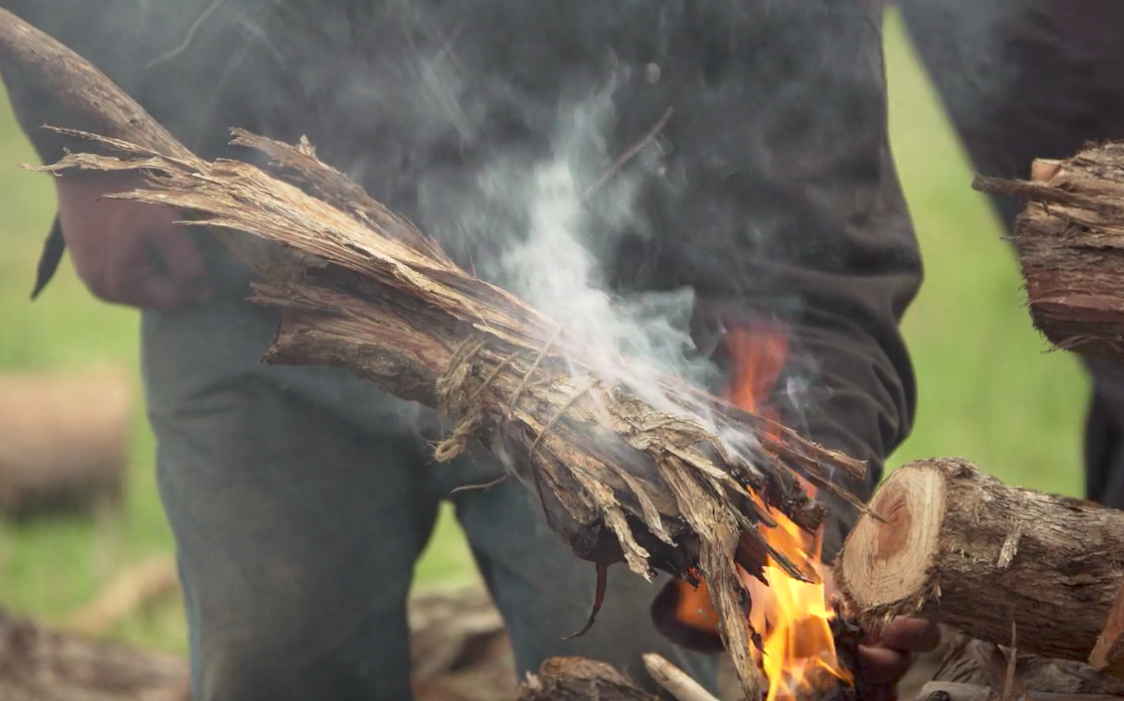
An important technique for native cooking involved using a ground oven -- a pit lined with hot rocks. Vegetables, fish, or meats wrapped in paper bark or leaves were covered with hot sand and steamed or roasted in the covered pit. Each tribe had its own special methods for building these ovens, and knowledge about how long to cook each type of food. Ground ovens are sometimes still used, according to the author, though aluminum foil often replaces the traditional wrappers. Also, hardware-store covered billies (pots) made from modern materials now offer a much more efficient way to steam foods over a campfire.

"Aboriginal people have an encyclopaedic knowledge of Australian plants and animals and of seasonal changes in the Australian environment," the author points out. These traditions are little known among European and Asian immigrants who have largely displaced the original inhabitants from their long-time lands and replaced native species with often-harmful imports. "Most Australians have never even tasted bush foods." (p. 13 & 11)

Doyle's Fish Cookbook in my collection is full of really nice-sounding recipes.
It was a gift long ago from my niece Ellen who ate shrimp at Doyle's.
Australian waters are full of wonderful fish and shellfish,
which I remember eating on our two visits to the Great Barrier Reef.
The 200 years: History of Australian Cooking, a more conventional cookbook in my collection, embodies the view that Australian food consists of borrowed dishes from all the immigrant cultures that arrived there from 1788 until 1988 when the book was published. It's definitely an example of ignoring native knowledge and native foods. As I understand it, this view has been changing in the years since the book's publication, and more nuanced views have emerged.

Searching for a better overview of really Australian foods, I found that CNN once published a list of 40 Australian foods. These mostly don't appear in The 200 years. Some examples: Australia's native Macadamia nuts, now grown in many other places; emu and kangaroo meat; a number of fish and seafood dishes made from the local catch; the Pavlova, a meringue and cream cake (disputed for origin between New Zealand and Australia); and several other favorite commercial and home-made pastries.

Number 1 on CNN's list of typical Australian dishes is a hamburger served with a large slice of beetroot. "Vegemite on Toast" is number 10 -- "As Australian as it gets." And item number 40 is Witchetty grubs, labeled the "most authentic of bush tucker." The article explains: "The grub is a nutty-flavored bite that has been enjoyed by indigenous Australians for thousands of years. The wider Australian nation has often struggled with eating it raw, but two facts remain -- it actually tastes good and it belongs to the land."


Recommended Reading

The three Australian cookbooks that I own are quite limited in their reflection of Australian cooking, as I acquired them years ago without making systematic choices. Therefore I asked two Australian food bloggers, Johanna of Green Gourmet Giraffe and Gaye at Laws of the Kitchen, for their recommendations.

They both suggested one Australian classic of culinary advice: The Cook's Companion: The complete book of ingredients and recipes for the Australian kitchen by Stephanie Alexander. It's available, though quite expensive, from online booksellers in the US and Australia. Johanna also recommended a series of cookbooks from the Australian Women's Weekly. There are dozens of them, on many topics, published over at least the last 20 years.

Covers from a few of the Australian Women's Weekly
cookbooks listed on amazon.com.
"My fave Australian cookbook is The Margaret Fulton Cookbook (Margaret is a legend)," wrote Gaye. Amazon's description of this cookbook: "Margaret Fulton is credited as the woman who taught Australians how to cook with the first edition of her revered volume, published in 1968." Fulton's book has been updated recently, and is available in paperback, hardcover, or Kindle edition.

Gaye also wrote: "A favourite from my grandmother's era was The Schauer Australian Cookery Book." Editions of this book are now rare. "Miss Schauer's excellent book first appeared in 1909 under the title of 'Theory of Cookery', and went into 12 editions, with a facsimile edition published in 1991," says another book dealer, adding the following:
"Amy Schauer taught cookery at the Brisbane Technical College, gave classes in invalid cookery at the Mater Hospital, and, during the 1914-18 war gave courses in basic field, camp and invalid cookery. ... Practical, public-spirited, involved in many charitable activities, she ended her days at Strathfield, Sydney, dying in in 1956."
My selection of Australian cookbooks today celebrates Cookbook Wednesday, invented by Louise at Months of Edible Celebrations, and joined now by several other food bloggers.

Monday, November 10, 2014

Picnics in Australia

Upper left: Murray and Bruce, our hosts, building a fire. Right: Emus approach the cooks, hoping for a handout.
Lower left: The picnic. Note emu, waiting in the center of the photo. 
Another picnic, this time without emus. Hosts: David and Edie.
Thinking about Australian food, I've been fondly remembering two picnics at the Tidbinbilla Nature Reserve near Canberra with our various hosts on our two visits there. Most memorable were the emus that approached us hopefully as our hosts roasted our hot dogs. I wasn't quick or careful enough, and an emu did in fact steal mine -- fortunately there were many more of them.

We did quite a bit of sightseeing on both occasions. The reserve includes two historic sites that I mentioned yesterday: the Birrigai Rock Shelter (oldest known Aboriginal site in the ACT region which contains evidence of occupation dating back to the last ice-age 21,000 years ago) and the Bogong Rocks (a Bogong moth resting site with evidence that the moth was an important seasonal food source for Aboriginal people). I remember visiting a cave with early cave paintings, and we saw quite a bit of wildlife.

Saturday, November 08, 2014

The Moth Eaters

"Moth Hunters of the Australian Capital Territory: Aboriginal Traditional Life in the Canberra Region" is a brief booklet written by Josephine Flood. It includes several photos of the last tribesmen of the territory, who unfortunately died out approximately 100 years ago.*

The long history of these native people began when the caves, mountains, and open lands of the Australian Capital Territory (ACT) became their home, at least 21,000 years ago. Human habitation of the Australian continent began in the north, around 50,000 years ago.

In an ACT archaeology site called the Birrigai rockshelter, anthropologists like Flood have found stone tools and remnants of their campfires dating to the earliest times. More recent evidence documents their continued presence until the arrival of the Europeans, who arrived in the 19th century. Introduction of European farming practices, grazing animals, cities, and diseases quickly and brutally disrupted native plants and animals and ended the aboriginal way of life.

In their early days thousands of years ago, the aboriginal tribes adapted to the mountain landscapes of the area, exploiting a wide variety of potential foods from trees, grasses, birds, reptiles, marsupials, and insect life. A few European eyewitnesses and native oral histories described one of the most interesting of their foodways: the hunt for swarms of Bogong moths.

During migration, these moths fly from their breeding areas in the plains up to the mountains. They spend the summer in a semi-dormant state on the walls of caves or rock shelters, an activity called estivation (in the Australian spelling, aestivation).

The moths leave their breeding grounds in late September or October, that is, in the Australian spring. During the summer, these areas are hot and dry, and appropriate food becomes scarce. Moths thus go up into the mountains where they search for "the coolest, driest, darkest crevices on the western, windward side of the granite tors, .... In late summer, about March, those which have survived predators and parasites commence the return flight to the breeding grounds" (p. 12-13).

Members of the aboriginal tribes who lived in the area watched for the annual moth aggregations, especially hoping for high density of moths. Abundance varied considerably, according to Flood. Moths were nutritious and easy to collect -- especially compared to the effort that these stone-age people had to exert to kill large prey like an emu or a kangaroo.

When observers who lived close to the mountains saw that the moths were arriving, the local tribe sent runners with message sticks to far-flung tribes, who came from as much as 300 kilometers away. As they gathered, an advance party climbed up to the summit to check for the settled swarms. At the right time, they signaled to those waiting below with bull-roarers: instruments which they whirled around their heads on a string to make a "weird high-pitched whining noise." The gathering of tribes could include 500 people, who enjoyed eating their fill of roast moths, and who also engaged in "initiation ceremonies, arrangement of marriages, coroborees and exchange of goods" (p. 14).

Observers in the 19th century mentioned that during moth-eating season, the usually thin and undernourished aboriginal people became plumper and healthier looking. The moths were rich in fat and protein, and evidently tasted deliciously like chestnuts or maybe almonds. Since moths covered the rock walls in enormous numbers, gathering them was as simple as scraping them off the walls with a stick into a collecting dish or net. A heated stone on which a blazing fire had been set would be ready for roasting them -- "about a minute on each side" (p. 13).

Some sources mention that the hunt was limited to men; evidently the women waited in the valley for their return. Roasted moths could be ground up with round grinding stones, making a paste into "moth cakes" to bring back from the hunt. These round stones have been identified with campfires dating back as much as 1000 years, so the hunts were customary for a very long time. "Ceremonial stone arrangements on mountain tops adjacent to moth aestivation sites in the ACT bear vivid testimony to the links between ritual life and moth hunting." The last recorded moth hunt was in 1865 (p. 17).

*Joanna at the blog Green Gourmet Giraffe wrote this comment: "As for the claim that the Aboriginal people died out 100 years ago, I am not sure because there is an Aboriginal community in the NT. When I was a child I saw a film about the last of the Tasmanian Aboriginal people and was quite surprised years later to be working with a number of people with Tasmanian Aboriginal heritage. So I wondered when this booklet was written as I know attitudes have changed over time." Answer: the booklet dates to the 1980s, and claims that the 500 people of the moth-hunting tribes died out.

Wednesday, January 05, 2011

The wide, wide world

In the New York Times today: an article about a Brazilian town where eating a particular species of ant is a tradition: Pesticides Threaten Ant-Eating Tradition in Brazil. I appreciated the tone of the article, which describes the ant-hunting methods of the people in the town without prejudice against their choice of food. They enjoy the flavor. That's it. Although I have no particular wish to taste this, I am very interested in how varied human nutrition can be.

I've read other books and articles about foodways that challenge my comfort levels. One is:
Product Details
Shark's Fin and Sichuan Pepper: A Sweet-Sour Memoir of Eating in China.
The author, Fuchsia Dunlop, describes her process of learning to cook and eat a number of foods that are unusual in her native England and elsewhere in European food traditions, but completely common and appreciated in China. The reader gets a positive picture of how another culture might differ in a basic way about food.

I've also read a book about Australian natives' annual feast on the Bogong moth. These moths were gathered during their migration. Moth hungers roasted the moths individually on a hot stone; "their peanut-sized abdomens are full of protein, with an oily texture and a taste not unlike roast chestnuts." As many as 500 people from different tribes would gather to eat moths during the season when they were available. People from many tribes also socialized, exchanged goods, and arranged marriages. Needless to say, these customs are no longer possible in modern Australia. (Moth Hunters of the Australian Capital Territory by Josephine Flood, 1996)

It's a wide, wide, world.

UPDATE: For a much more amusing version of weird things people eat, see this.

Saturday, December 20, 2008

Inspector Napoleon Bonaparte Cooks

What is life like in the kitchen in the Australian outback?
Cooking on an Australian station does not induce placidity of mind. In the first place it is a seven-day-a-week job; in the second it very often happens that one or more of the men are late to meals having been delayed by sheep-work in a paddock; and in the third place the hours are long, and the cement or wooden floor of a kitchen is particularly hard on a cook's feet.
On account of those drawbacks cooks are scarce, good cooks are priceless, and all cooks are martinets. A cook's uncertain temper is, therefore, regarded with the indulgence given to lumbago, or gout, the sufferer receiving all consideration and sympathy. (p. 59)
So begins Chapter 14, "The Passing of a Cook," in The Sands of Windee by Arthur W. Upfield (originally published 1931). The cook on the particular station in the book, called Alf the Nark, was ready to leave his position on a remote sheep station in the wilds of Australia; the date is 1924. At the last meal he cooks:
After beating his triangle calling the men to dinner, Alf the Nark began to cut up two roast legs of mutton. Usually the first man entered the kitchen-dining-room precisely ten seconds after the triangle was struck, but this day the men were in bed and asleep, and it was fully ten minutes before the first of them arrived...
"Soup?" snarled Alf.
"Please," came the sleepy answer.
"Soup?" snarled Alf to the next man, and so on... Then "Ive 'ad enough of this. If yous think I'm going to be on deck orl the blasted day and 'ang about 'ere arf the night waiting for yous to grease yer 'air, you're mistaken. There's yer tucker. Eat it or chuck it art. I'm finished." (p. 60)
And so Alf leaves for the nearest tiny town "visions of whiskey-bottles drawing him on." Bony, or Police Inspector Napoleon Bonaparte is already on the scene. He's presented himself as a horse trainer and laborer, but Bony is actually a man of many talents -- and in fact has a university education. His reason for being at this station is to investigate the mysterious disappearance and presumed murder of a man who had recently visited the owner of the sheep station. He's hiding his position as an inspector, but he is open about his education and talents.

Bony quickly volunteers to take over the cook's job:
At six o'clock he was up cooking the men's breakfast; and the men, who thought they would have had to cook their own meals, were highly gratified. (p. 62)
Bony uses his new position to advantage; as the author describes his work, we learn a lot about the outback:
The vacancy in the men's kitchen ... presented to Bony a sure avenue of winning his way to the hearts, via the stomachs of Moongalliti and his tribe. ... Had he been a full-blooded aboriginal they would never have accepted him as one of themselves.... As a half-caste, and a strange half-caste, he would at all times be regarded with suspicion; but as a station cook, with somewhat of their racial blood in him, he could successfully bribe them and win a measure of friendship with food, for food and the getting of food occupies far more of the native mind than any other subject. (p. 63)
Bony bakes bread, serves morning lunch, midday lunch, afternoon lunch, and dinner. When asked to explain why he wants to be in the bush. He says:
"I wanted to go ahunting as my mother's father had hunted, and I wanted to eat flesh, raw flesh, and feast on tree grubs, and then lie down in the shade and go to sleep, fed full and feeling the wind play over my naked skin." (p. 65)
In the course of the book, the author at least briefly describes many meals, from genteel teas and marriage celebrations to native feasts. The clanging of the kitchen triangle, calling the workers to their meals, punctuates the passing time for the workers and owners. The portrayal of Bony and his dual identity uses food in what I find a most interesting way. Of course the plot is really the key, as Bony discovers the full story of the mysterious disappearance.

The overt and indirect attitudes of characters in the book toward the aboriginal natives -- and clearly, also, the author's attitude -- are really condescending and even demeaning. However, the details are of great interest, as they refer to a time now lost, when the native people were still free to live as they pleased, and hadn't been forcibly settled on reservations in the unfortunate and unhealthy conditions that followed. I hesitate to judge the attitudes that the author held so long ago in the terms that are now familiar and politically correct. The use of food to portray this lost civilization, even disrespectfully by modern standards, is very interesting.