Tuesday, September 20, 2022

Donna Leon’s Brunetti

Commissario Guido Brunetti finds that nothing is as he perceives it, all things are falsified. What’s more, he and his colleagues are constantly being watched, so they must create indirect ways — false ways — to communicate with one another. In Give unto Others, which is book 31 of the series by Donna Leon, Brunetti’s job is even more depressing than he found it in the earlier books. 

For example, early in the book, a colleague sends Brunetti a suspicious arrest report where officers behaved dubiously. But when the colleague phones him, Brunetti can see that he’s being asked not to speak freely: the phone must be bugged.

The friend says, “‘Did you watch that film on Netflix I told you about?’ Making his voice as disgruntled as he could, Brunetti said, ‘Yeah, I watched it, but I didn’t like it very much.’ Then, as though the thought had just come to him, Brunetti explained, ‘Maybe it was the opening scene that ruined it for me: really clumsy, I thought.’ After a short pause, he added, ‘Sort of gave the whole story away.’ ‘Ah,’ Tamiello said, drawing the sound out. ‘That’s what I thought, too. But I did find some of the later scenes interesting.’ ‘Useless, Pietro. I’ve watched other films like that, and none of them has ever been any good at all after an opening scene like that. Frankly, it ruined the film for me.’” And so they go on pretending to discuss a film when they are really signaling that the arrest report is totally phony and that the officers abused an innocent man. But listening devices are everywhere, and conversations throughout the novel have to be veiled or disguised because everyone is suspect. (p 70)

Brunetti is so depressed that for the first time ever, says his beautiful and beloved wife Paola, he doesn’t respond when she asks him what he wants for dinner, but says she should cook anything she wants. She answers by saying: “In all these years, this is the first time I’ve known you – when given the chance to choose what to have for dinner – to decline to do so.” All these meals that have been so lovingly described in the earlier books! (p. 201)

Though earlier Brunetti had enjoyed a meal of the type that appears so often in the series: “a risotto with radicchio di Treviso he’d been requesting for days, both delighted and satisfied him. Paola placed a large platter of cheese on the table after it, explaining that she’d been delayed after her morning class and had only had time to get this on the way home.” (p. 67)

The realities of life in Venice are even more difficult after the pandemic has swept through Italy. Friendly gestures — a touch on the arm, shaking hands, a pat on a shoulder — not acceptable in post-covid life. The mask is a Venetian trademark; that is, the artistic masks related to the famous carnival celebration, and sold to tourists in shops throughout the city. But now. Masks… another thing entirely. Yes, they protect from germs, but there's much more going on with masks. Throughout the first thirty books of Donna Leon’s series, more and more normal life in Venice has been pushed aside by tourist traps — grocery stores, local coffee shops, travel agents, and sellers of everyday clothing or kitchen tools have been driven out of business, replaced by shops selling the artistic masks that the tourists want. But now, after the pandemic, these shops are all dark, with remaining goods left helter-skelter.

Well, I haven't even mentioned the plot of this novel, and it's really a very good one, involving Brunetti and a couple of colleagues. Again we meet the increasingly remarkable Signorina Elettra who can get any information that exists anywhere in Italy, though she's not as critical in this novel as in some of the earlier ones. Together, Brunetti and these colleagues undertake to do some unofficial sleuthing for an old friend of his. I'll just say that I really enjoyed the clever way that Donna Leon unfolds what's happening, and how she shows what Brunetti learns from his activities. The strong theme of nothing being what it appears to be is beautifully developed in this novel -- it's a bit unusual compared to the earlier novels in the series, which is amazing.

Review © 2022 mae sander.
 

Monday, September 19, 2022

Sunday, September 18, 2022

Kir


Last week, in my post about a disappointing book on French culinary history, I included the photo above, showing the start of a meal we enjoyed several years ago in Avignon. The drink was Kir, a combination of white wine and Crème de Cassis. While I have had this delicious drink often in France, and have from time to time made it at home, I realized that I’ve never really written about it here. I’ll start with a bit about the origin and history of this popular aperitif:

"Kir originated in Burgundy, France. It is named after the priest Canon Félix Kir, who was a hero in the French Resistance during the Second World War, and also the Mayor of the Burgundian town Dijon from 1945 to 1968. He was much revered, and history tells us that he was also a big fan of local products and hence created the drink by mixing the local white wine made from the Aligoté grape (bone dry, acidic, with fairly neutral aromas and flavors and unoaked) with the local blackcurrant liqueur ‘Crème de Cassis’." (Source: The Kitchn)

Google images of Kir— it’s been a fashionable drink on and off in the US for a couple of decades.

Here is what I wrote about Kir and other drinks in the restaurants where we ate during our year-long stay in Paris in 1989-1990 — maybe by now things have changed, as most things do! At the time, French restaurants didn’t seem to need a special license to serve alcohol — even McDonalds' outlets there sometimes offer beer. Typically French restaurants, bistros, or brasseries offered aperitifs such as Port, various sorts of sweet white wine, or Kir, a mixture of white wine or champagne and Creme de Cassis. Brasseries served special beers associated with their Alsacian cuisine, but any restaurant would serve you a beer if that's what you wanted. American-style mixed drinks or cocktails were available in larger restaurants, although Spanish sherry — an English and American favorite — seemed rare. As in an American restaurant, the proprietors offered a variety of pre-dinner drinks, including Kir, which boost the final cost of a meal. 

During our stay in Paris we went often enough to our favorite neighborhood place, La Gitane, that the propietor began to offer us a pre-dinner Kir with a little plate of crackers at no charge. Our French friends, when they invited us to dinner, usually served aperitifs, including sometimes Kir, with a few little crackers, or in some cases, a few delicious “amuse gueules.” Well, that’s the way it was! And it was before I started taking photos of my meals, so I have none of my own to show.

The corner where we lived in 1989-90, showing La Gitane, our apartment, and my favorite butcher shop!
The courtyard behind our apartment was also the back door of the restaurant kitchen.
(I can’t believe I found this photo on the web!)

I’m dedicating these memories of my French experiences and beverages to bloggers Elizabeth, Nicole, Iris, Kate, Erika, Valerie-Jael, Lisca, Chris, and all the others who share their thoughts and their beverages each week.

 Blog post © 2022 mae sander.

Friday, September 16, 2022

The Blue Fox

The Blue Fox is a short novel by Icelandic author Sjón, which was published in 2004, and translated into English in 2008. The events of the novel take place in 1883, in a rural and mountainous area in Iceland. The beginning of the novel to me seems very poetic:

“Blue foxes are so curiously like stones that itis a matter for wonder. When they lie beside them in winter there is no hope of telling them apart from the rocks themselves; indeed, they’re far trickier than white foxes , which always cast a shadow or look yellow against the snow.

“A blue vixen lies tight against her stone, letting the snow drift over her on the windward side. She turns her rump to the weather, curls up, and pokes her snout under her thigh, lowering her eyelids till there’s the merest hint of a pupil. And so she keeps an eye on the man who has not shifted since he took cover under the overhanging drift, here on the upper slopes of Asheimar, some eighteen hours ago. The snow has drifted and fallen over him until he resembles nothing so much as a hump of ruined wall.

“The creature must take care not to forget that the man is a hunter.” (The Blue Fox, p. 3) 

Thus the author sets up the situation: a man hunting a fox. She’s a sly vixen who doesn’t want to be shot. For quite a while, the narrative concentrates on just the interior thoughts of man and fox. A determined contest, most fascinatingly portrayed. 

Eventually, we get to the back-story of the man. We learn that this is a kind of a moral tale, in its special sort of prose-poetry. Indirectly, through the story of several other characters, we learn what kind of man this hunter has been in his life. We learn that he has been a clergyman, but an intolerant and problematic one. We learn this through the story of another man: one who is more sympathetic. And through a mentally disabled woman named ABBA, who has suffered quite a lot of abuse. Their stories are interesting, and they come up close to the hunter and his fate, which is what we finally learn. But here no spoilers. It’s the story of a blue fox — a special type of arctic fox whose coat does not turn white in winter, but remains dark. 

It’s a short and thought-provoking book, and it’s really about a fox. I think. I’ve seen it classified as “fantasy” but that seems to me to miss the point. To me, it seems to be more of an allegory about good and evil, but I think it really doesn’t fit into any standard model: it’s original and very penetrating. 

The Arctic Fox Center 

The Arctic Fox Center, Sudavik, Iceland. (TripAdvisor)

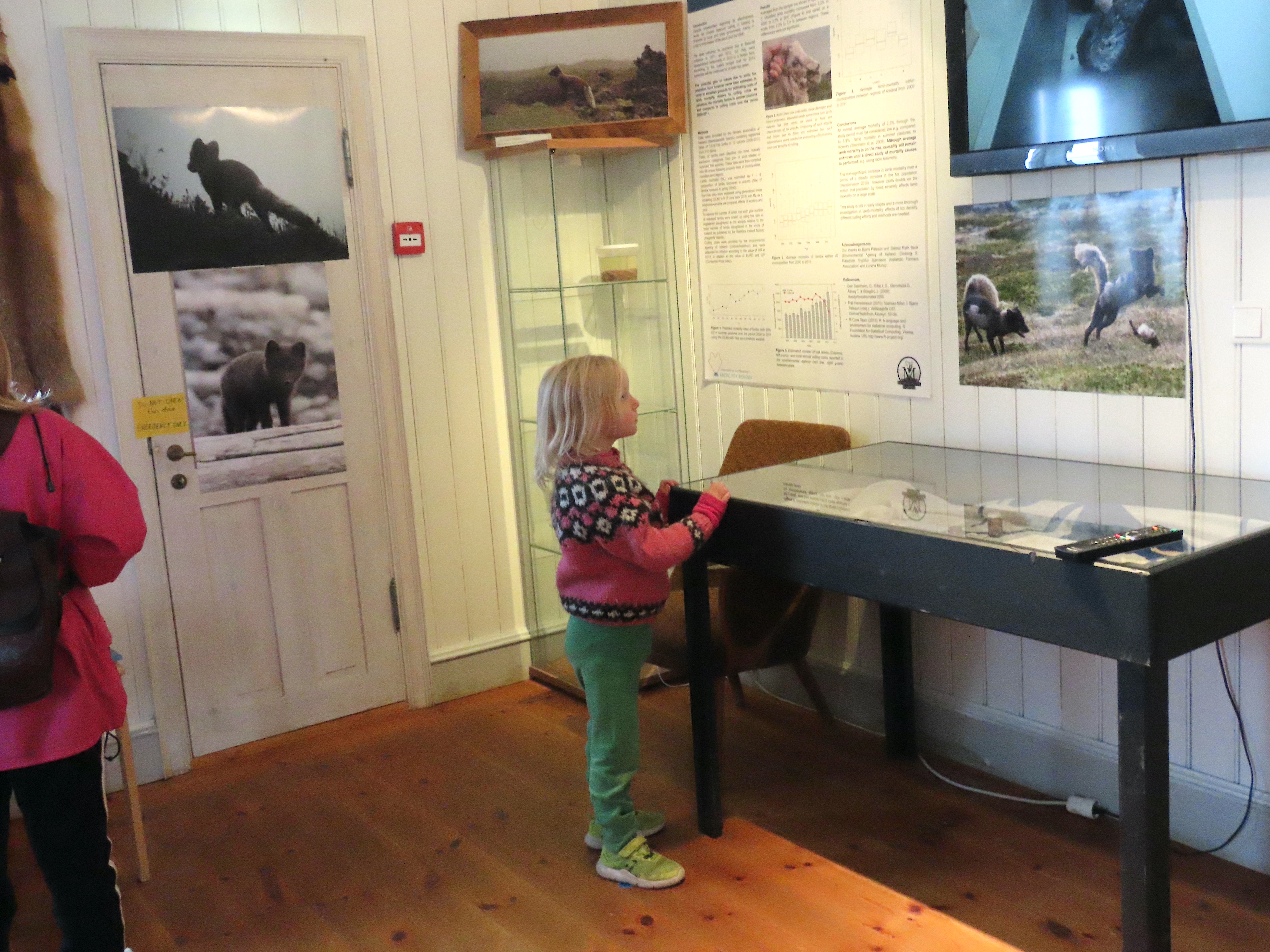
Reading The Blue Fox made me think of our visit last month to the Arctic Fox Center. This novel has multiple meanings, but on one level, it’s really about the Arctic Fox, a very special creature, that changes its color as the seasons change, and also depending on its habitat. Foxes that live on the shore are darker, foxes that live in the tundra or on the mountains are lighter, and many of the foxes become white in winter. Just a few remain a silvery-blue color.

The Arctic Fox Center documents the history of fox hunting in Iceland, which is not at all like British sports hunting on horseback! At the moment only farmers are allowed to shoot foxes, and only if the foxes are a danger to livestock. On the whole, Iceland is very protective of wildlife, and a large preserve where there are many wild foxes is nearby.

Inside the Fox Center: we toured the exhibits and we
also had cake in the coffee shop.

On display: many large posters of foxes.

A blue fox.

In a large enclosure outside the center, two baby foxes
were being taken care of. Their mothers were shot by hunters.


Arctic foxes are very special in Iceland. For one thing, they are the only real native terrestrial mammal. Reindeer were introduced; horses, sheep, etc. are domestic animals; and polar bears only appear accidentally when an ice floe brings them from Greenland. Marine mammals and birds are much more abundant.

In addition to being the center of the novel The Blue Fox, a fox is also very important in the novel Kalmann: the narrator of this novel is tracking a fox that he has named “Schwarzkopf, like the shampoo.” Kalmann explains: “He was a badly behaved fox, a young male, who had ventured right up to the houses looking for something to eat.” (Kalmann by Joachim Schmidt, p. 16)


Blog post and photos © 2022 mae sander

Talking and writing about French Food

French Gastronomy: The History and Geography of a Passion (published 2002) is a book about the development of a concept: Gastronomy. The author Jean-Robert Pitte is a much-published academic in France, but little known here. Of his many books, only this and one other seem to have been translated into English. He writes with authority and certainty, beginning with a question: how did the French develop the best cuisine in the world? He expresses no doubts about this: the French are incontrovertibly the best, and all that’s left for him to do is ask what made it so. (I’m not questioning this, just stating the premise of the book. French food probably is the best, but I suspect that there’s room for discussion.)

Update: I had no information about the author of this book, but my friend the blogger Kwarkito informed me in a comment that Pitte is “one of the most reactionary figures in the academic french world. He has consistently supported the most unfair and unequal reforms. He is also a climate sceptic, a proven one, in short, from my point of view, a notorious moron despite his academic titles. Besides, this obstinacy to consider that French cuisine is the best in the world is ridiculous. Here again, culinary nationalism in the XXIst century is an obvious lack of discernment.” So, dear readers, please read the rest of my post while being aware that I did not know any of this.

The early chapters of French Gastronomy are fairly interesting. However, I didn’t learn much new history in Pitte’s coverage of the development and appreciation of cuisine at court, the emergence of regional excellence in farm products, and eventually the development of the institution of the restaurant at the end of the Old Regime. In part restaurant culture was due to the destruction of the nobility by the Revolution, but not entirely caused by it. “One Revolution can hide another,” he writes: “Destroying statues or guillotining the royal family did not stand in the way of enjoying truffles; on the contrary, it was a people’s victory.” (p 118)

With the invention of the restaurant and its embrace of high cuisine for a wider and more diverse audience came the invention of restaurant criticism and thus came gastronomy. Here’s where things get more interesting, though much of Pitte’s history is rather familiar. At this point, writing about food became part of French food culture: chefs and theorists of gastronomy began to work together — and in Pitte’s view, this continued the creation of unique French cuisine, the best in the world. In fact, he seems to be saying that the excellence of French food is due not just to fine materials and techniques, but to the fact that they talked and wrote about it.

The first restaurant critic was Grimod de La Reynière. He began writing at the end of the Revolution, as restaurants in the modern sense were founded — Grimod is a fascinating character that I’ve read and blogged about several times. Pitte doesn’t have that much new to say about him, but nevertheless, I enjoyed his presentation of how restaurant food in all its forms and food criticism, also in various forms, developed together throughout the 19th century and much of the 20th century. He talks about the usual inventors and promoters, from Carême through Ritz and Escoffier, then Curnonsky, and more — to me mainly familiar from many other food historians as well as through reading their own works.

At the end of the 1960s another very famous food revolution took place. Pitte writes: “At the origin of nouvelle cuisine we find a few chefs determined to become famous and two imaginative journalists, Henri Gault and Christian Millau.” Millau was the writer, Gault the editor, who “wanted to leave the beaten paths and wrote with a brisk, even impertinent style. He won immediate success and managed to pack restaurants that had been totally unknown before.” The Gault-Millau guidebooks and other publications went hand in hand with the recognition of the most famous nouvelle cuisine chefs. (p. 144) 

Again, Pitte tells a familiar story with a few added insights into how food writers and culinary creators teamed up to create something big in French cuisine and in this case in worldwide cuisine, especially through interaction with Japanese chefs and food ways. And again, while I enjoyed reading Pitte’s presentation, I was left with a feeling that there is simply not enough here that I have not read before. I expected a more daring and insightful read when I decided to read this book. 

Here’s what I think: The French probably have had the best cuisine in the world, or at least in Europe. But they do not have the best food writers.

The start of a classic French meal that we ate in Avignon in 2016.

OK: Now to watch the just-made-available Great British Baking Show from 2022!!!
Maybe not the best food -- definitely the best TV Baking Show.


Review © 2022 mae sander.
Wednesday, September 14, 2022

"Let the Meatballs Rest"

"The recovery of peasant foods has overturned symbols and meanings: the 'poor' foods of the past have become the mark of new wealth." (Let the Meatballs Rest, p. 14)

"Because history is often called in as the guarantor of our identity, our 'traditions,' our 'roots,'  it is the duty of the historian to point out that history teaches us exactly the opposite. It shows us that alimentary traditions never remain the same but change with time, becoming modified as they come into contact with other traditions. Identities, traditions invent themselves, in the literal sense of the word: they find themselves, they construct themselves." (p. 157)

"'Whatever can be fried is good to eat,' assures a proverb common in various regions of Italy." (p. 49) 


Let the Meatballs Rest and Other Stories about Food and Culture by Massimo Montanari is a highly amusing book that combines observations about Italian and sometimes other food cultures with lots of diverse historical facts. He begins with a story about meatballs:

"We were making meatballs in the kitchen one evening: boiled beef, cooked cardoons, parmesan, bread crumbs, two eggs, salt, pepper. Once the mixture was done, we shaped the meatballs and arranged them neatly on a plate. At that point, Marina advised: 'Now, before cooking them, let us leave them to rest for a few hours. That way they firm up and get thoroughly blended.'

"It occurred to me that letting meatballs rest is much like what happens in our minds when we work out an idea. Ideas are the result of experiences, encounters, reflections, suggestions: many 'ingredients' that come together and then turn into a new thought. Before that can happen, it is useful to let those ingredients rest, to give them time to settle, to become blended, to firm up. The resting of meatballs is like the resting of thoughts. After a while, they turn out better." (p. ix)

As it  happened, after reading Montanari's very amusing thoughts and ideas all day, I was cooking meatballs for dinner -- and I did indeed let them rest! 


My meatballs, resting in the refrigerator.

A dish of rested, then cooked meatballs
with separately-made vegetables and gravy.
But wait! These aren't real meatballs, they are Impossible Meat Balls made from the mystery non-meat that tastes so much like actual beef that it's kind of uncanny. In fact, Impossible meat is made from soy protein concentrate and a number of other laboratory-type things that aren't found in a normal person's kitchen. There's no such thing as a perfect, a "real" meatball, in my world. I especially like Montanari's observation: 

"I have always been diffident about any pretension of codification, standardization, uniformity: the 'true' recipe for meat sauce, the 'true dimensions for tagliatelle,' the 'true filling for tortellini.... There is too much ambiguity in that terrible adjective true that would brand as false any variation, any inventiveness, any departure from the rule." (p. 40)

Montanari's discussion of peas gives me an idea. I let this idea rest, and then had the following thoughts: Impossible meat to me is much better than Beyond Beef, which has pea protein instead of soy, so I was amused at one of Montanari's ideas about peas in Italian history.  He points out that  "patrician tables ... were  not averse to presenting dishes from the peasant tradition, but with suitable adjustments." (p. 21)

Peas with salt meat, for example, in a fifteenth-century recipe cited by Montanari, is similar to peasant cuisine -- and similar to the still-typical dish of peas with prosciutto. In the historic recipe, the peas also had cinnamon and sugar and grape juice. Another example is a recipe from the fourteenth century where peas were cooked with salt pork, and the juice was made into soup with onion, bread crumbs, spices, and herbs -- to be served in a hollowed-out loaf of bread.  The high-end diners liked their peas small and tender, and cooked the whole pod; peasants, on the other hand, "could not allow themselves to forego the volume and the nutrition of full-grown peas by 'wasting them' while they were still growing." The mature peas could be dried  and made into flour with other cereals or legumes, for which there were various recipes. 

And so we get something related to our fake meat, don't we? And we are creating something special and expensive out of a pretty ordinary food, aren't we?

I really enjoyed Montanari's brief and interesting bits of food history and the messages he derives from them. "The primary concern of agricultural societies," he says, "has always been how to stave off hunger. At times it was a question of real famine caused by poor harvests. More often it was the fear of hunger that could appear at any moment." (p. 71) He explores how development of many food choices -- of biodiversity -- such as many types of grain, was a response to this need -- or to political circumstances. 

In contrast, in modern times, Italian farmers in the 19th century were: "forced to cultivate corn for their own use because the entire wheat harvest was being shipped to urban markets: in Ireland, at the same time, farmers were eating nothing but potatoes, while choicer products were flowing into the markets of neighboring England... The monoculture of coffee, cacao, bananas, sugar cane replaced the variety of local cultures and exposed the farmers to hunger far more dramatic than had ever been experienced in the past." (p. 72)

His insight about the history of food is to observe "the extraordinary ability of humans to transform anxiety over survival into occasions of pleasure." (p. 90) So anxieties over eating meat (about health, animal welfare, humane treatment of workers, survival of the planet…) turn out to involve soy and pea protein made into fake meat? Or something. It’s a good book by a classic author.

Blog post © 2022 mae sander
 

Tuesday, September 13, 2022

Fresh and Local!

Peach and apricot cobbler, just out of the oven.
I've made this many times. I'm repeating the recipe that I posted in 2008.


... with real cream, whipped by hand.

Peach (or Apricot) Cobbler

A cobbler is a baked fruit dish with a layer of fruit and a pie-crust or biscuit-like topping.

Make the filling first:
9 to 10 ripe peaches or 1 1/2 lb ripe apricots
1/2 cup sugar
2 tablespoons all-purpose flour (1 for apricots)
1 1/2 teaspoons fresh lemon or lime juice
3/4 teaspoon almond extract

Preheat oven to 400°F. Peel the peaches and cut in 6-8 slices each, or cut apricots in quarters. Toss all the ingredients together in a 9-inch round or square glass or ceramic baking dish. Let stand until juicy, about 30 minutes or as long as it takes to make the topping.

For topping:
3/4 cup all-purpose flour
3/4 teaspoon baking powder
1/4 teaspoon baking soda
1/4 teaspoon salt
1 teaspoon sugar mixed in
2 tablespoons cold unsalted butter, cut into bits
1/2 cup well-shaken buttermilk
2 or more teaspoons of cinnamon-sugar for sprinkling.

Sift together the flour, baking powder, baking soda, salt, and 1 teaspoon sugar in a bowl. Blend in the butter with your fingertips or a knife until the mixture resembles coarse meal. Stir in the buttermilk with a fork just until combined. Do not overmix.
(Substitutes for buttermilk: Best: kefir. Acceptable: 2% or whole milk plus a few drops of lemon juice or vinegar)

Drop rounded tablespoons of dough on top of the filling; leave spaces in between the blobs to allow topping to expand. Sprinkle with remaining 2 teaspoons cinnamon-sugar.

Bake cobbler in 400 degree oven until fruit is tender and topping is golden, about 30 minutes. Cool slightly, about 15 minutes, and serve warm with ice cream or whipped cream.

A few of my wonderful fruits from the farm store.
In three days we almost finished eating the tomatoes & apricots,
and we used up all the plums & peaches!

Local Scenes


A quiet day at Four-Mile Lake.


Blog post and photos © 2022 mae sander

Monday, September 12, 2022

"The Flatey Enigma"

The historic church on Flatey Island.

The Flatey Enigma by Viktor Arnar Ingolfsson is a very strange mystery novel. The setting is the Icelandic island called Flatey, which is a very small island in Breiðafjörður Bay in the northeast of the country. The novel was meaningful to me especially because I toured the small island on both of my recent visits to Iceland, in 2021 and 2022. 

The events in the novel take place in 1960, when the residents of Flatey lived a very different life than the summer visitors who now occupy the colorful houses and the only hotel on the island. Today, only one or two families still live there throughout the dark and very cold winters, but back then, as the author explains, the islanders lived a very challenging and different life -- I found this material to be the most interesting part of the novel.


A visitor to the island in 1960, as described by Ingolfsson, would find no rooms to rent and no restaurants. He could only ask for a bed and meals in a local household. The island’s inhabitants lived in rather cramped homes, and made a living from fishing, hunting, or raising animals, or by being employed by the government, for example as the operator of the generator-powered telephone exchange, which operated only a few hours each day. Some of the farmers raised cows, and shared the milk with people like the pastor of the church. They ate mutton from their sheep; they also ate fish and wild birds like puffins, wild birds' eggs, seal meat, dried fish, and in general, whatever they could eke out of the forbidding island and the even smaller nearby islands. A regularly scheduled ferryboat (still connecting Flatey to the mainland) brought visitors and also supplies from the mainland.


A key to the novel is a beautifully illustrated, hand-written medieval manuscript, called the Flatey Book, which was written and compiled by a scribe on Flatey in the fourteenth or fifteenth century. This manuscript, which in 1960 was in the Danish National Library in Copenhagen, contains the best and most complete text of several of the Icelandic sagas and other historic material. It was repatriated to the Icelandic national library in Reykjavik in 1971, and is still there. In Flatey in 1960, the library next to the church held a facsimile of the manuscript, which fascinated some of the characters.

Illustration from the Flatey Manuscript (source)

The novel begins with the discovery by seal-hunters of a dead man on one of the nearby islands. A rather large number of local people, plus one government lawyer who has just arrived expecting to work on some record-keeping, become involved in trying to identify the body and then to learn who killed him. What's unusual about this novel is that at the end of each chapter is a contrasting story of efforts to solve a riddle called "The Flatey Enigma," which is a few sheets of paper from the 19th century containing a set of mysterious hints. These papers had been tucked into the facsimile manuscript at some unknown time. Each chapter-end explains one of the 40 clues to the challenge, which is to complete a particular poem. Two main characters, who turn out to be scholars of medieval Icelandic literature, are engaged in a competition to solve this "enigma."  I don’t think any normal readers of the novel could possibly solve the enigma; I could scarcely understand the clues or even the solution. It makes for very strange reading! 

Houses on the island -- you can also see the nearby islands.


A lighthouse, visible on a neighboring island.

These girls were selling painted rocks to the tourists from the National Geographic Explorer,
which brought us to the island. They were enthusiastic about having their picture taken.

The Flatey Enigma is widely respected, and a spin-off was
a TV series that's actually a sequel to the novel's plot.


Flatey's inhabitants ate the foods that they could get from their environment, along with some imports brought in on the ferry boat. Here are a few quotes about food:

“Those are great black-backed gull eggs from the spring,” she said as he picked one up to examine it. “There’s no need to spare any of those eggs in these recipes. There’s plenty of them at this time of the year, and they’re fine for baking, even if they’re a bit old and have started to gestate,” she added. (p. 102)

“There’s no farming for them there, apart from their potato patch, but they go to Ketilsey and the skerries around there. They just about scrape by; it’s a long way to go, and there aren’t many eggs to be found. But they catch some seal and puffin there, too. They also do some line fishing and work at the fish factory when it’s in operation.” (p. 20)

“Ingibjörg received them with a ready dinner: boiled puffin breast with potatoes and a knob of butter.” (p. 47)

Finally, a description of the end of a meal that the hosts offered to the visitor:

"Lunch was now over in Flatey’s district officer’s home, and his wife placed a pot of coffee on the table. The men poured the boiling coffee into their empty glasses of water and snorted snuff. Kjartan also poured some coffee into his glass but declined Ingibjörg’s offer of sugar and milk. The men sipped the hot coffee, sighed, and burped." (p. 24).  

One of the characters in the novel is an alcoholic, and he drinks alcohol constantly, but the meals were always accompanied by plain water, and coffee (which obviously had to be imported on the ferry boat)! 

Most fun on the island: seeing puffins. I find it hard to imagine, but people still hunt and eat them.
One of the characters in the book complains because the tourists do nothing but gawk at puffins.

Blog post and photos © 2022 mae sander.


Sunday, September 11, 2022

Mona Lisa Everywhere

It's easier to find Mona Lisa than to find Waldo, as I've known for many years of collecting a variety of appropriations, interpretations, and re-uses of her famous face. Here are a few of her recent appearances in a variety of websites (none of these are my original photos). Of course the original sites are likely to disappear from the web eventually, but I've saved the images.

On the side of a building in Paris

“The New Mona Lisa” on a building in the 13th arrondisement

In a Japanese Rice Paddy

From the Spoon and Tamago blog: "Seven different varieties of rice are planted in early June....
They take roughly 1 month to grow, slowly filling out and completing the artwork."

On the cover of the New Yorker


On an album cover at Spotify

Listen at this site: Spotify - Mona Lisa.

In NonFungibleToken Art (whatever that means)

This image is labeled "Auction Failed," so I guess no one wanted it.

From "Digital Artists Take On the Mona Lisa in New NFT Exhibit"

More of the usual parody images

From Singulart by Jamie Lee.

"Smile, Mona Lisa"

In a Bolivian art studio

Mona Lisa in traditional Cholita clothing.

Having a Glass of Wine

From Twitter

And in Brussels this summer

From an exhibit at the Comics Art Museum, Brussels.

This image collection assembled for mae’s food blog.