Friday, August 26, 2022

Foods of Iceland

An Icelandic Hot Dog Roast on the Explorer — Hot Dogs are a local favorite.

During our trip to Iceland this year, as well as our trip in July of 2021, the ship’s excellent kitchen served foods from many different cuisines all over the world. At least a few of the meals were Icelandic or Scandinavian-themed, though, and as the chef is Swedish, I assume his interpretation of Iceland specialties is good. They tasted good! We also had a couple of meals off the ship while transferring to and from the airport.

Dessert buffet at a hotel in Reykjavik.

Iceland was settled by Vikings, beginning in the 10th century, and the people of Iceland have always been Nordic people, connected to Norway and Denmark. Locally-available foods are of course important as well, and there are a number of specialties that combine Nordic traditions with local ingredients from the sea and native plants, as well as from Icelandic farms and geothermally-heated greenhouses. Some of the favorites are quite familiar — like hot dogs or a special version of fried donuts (which we tried on last year's trip). Other Icelandic foods are extremely exotic, such as the sheep’s head shown on the cover of the cookbook below, or the fermented shark meat, Hákarl, that’s said to smell horrendous but taste great to those who love it. 

An Icelandic Cookbook

I bought the kindle edition of this little book which was in the ship’s library.

Traditional Icelandic Food by Gudrun Helga Sigurdardottir describes many Icelandic special foods, basically none of which I would actually cook, though several of them are appealing to eat, and we also tried some last year, when we spent a week in Iceland, also on the Explorer. 

Here's what it says about skyr, the yogurt-like Icelandic cheese that has recently been popular here in the US:

"The fresh cheese product skyr [scihr:] is authentic Icelandic cuisine, and has been traditionally made in Iceland since the time of the settlement. Through the history of Iceland it was made inside the homes, but nowadays it is produced in dairy factories. The skyr tradition has survived all sorts of changes in society, and has probably never been as popular as today." 

And about a few other exotic foods: 

"Selkjöt, sealmeat, has always been caught and eaten in Iceland." 

"The dried fish harðfiskur has been equivalent to bread in Iceland. It has often been eaten with butter instead of bread, for example with stew at dinner time." 

"Hangikjöt – smoked lamb – is one of the national dishes in Iceland, a tradition that was brought to Iceland from Norway at the time of the settlement. The meat used to hang from the ceiling in the kitchen of the turf houses in the old days, drying in the smoke rising from the kitchen hearth."

Tasting Icelandic Food 

My very first time in Iceland was a stop on the way to France many years ago, when Icelandic Airlines was the cheapest way to fly to Europe. I had almost no experience eating anything but my mother's cooking and a few very conventional American restaurant meals. The meal served to the stop-over passengers (who were bused from the airport into the city because the terminal was still being built) was baked cod, and I couldn't really eat much of it: too unfamiliar. Now I really appreciate Icelandic fish!  

A particularly nice plate of fish & chips that we had on
our final day in Iceland before flying home.
The starter was a wonderful bowl of lobster soup.

Icelandic halibut on the Explorer.

Happy Marriage Cake.

Happy Marriage Cake (Hjónabandssaela) is a very special Icelandic recipe that a new bride was supposed to make for her husband. If he liked it, the marriage was foretold to be a success! We were served this at the visitor center on Vigur Island (in photo), and at the Arctic Fox Center. I would describe this as an oatmeal bar made with brown sugar, flavored with cardamom, and filled with jam. Our samples were probably made with jam from local berries; rhubarb jam is traditional.

Pea soup: a Scandinavian favorite!

Important: a shot of Aquavit!


Iceland is of course a major supplier of fish for the entire world, and has been a fishing nation for a long time, so as I say, I am very fond of Icelandic fish dishes, but I'm glad to learn about so many others. My future posts will describe the foods of Greenland and the foods we ate on the ship. This post is copyright © 2022 by mae sander.


Thursday, August 25, 2022

Two Viking Settlements in Greenland

The foundation of a Viking church at Brattahlid Greenland, abandoned in the 15th century.

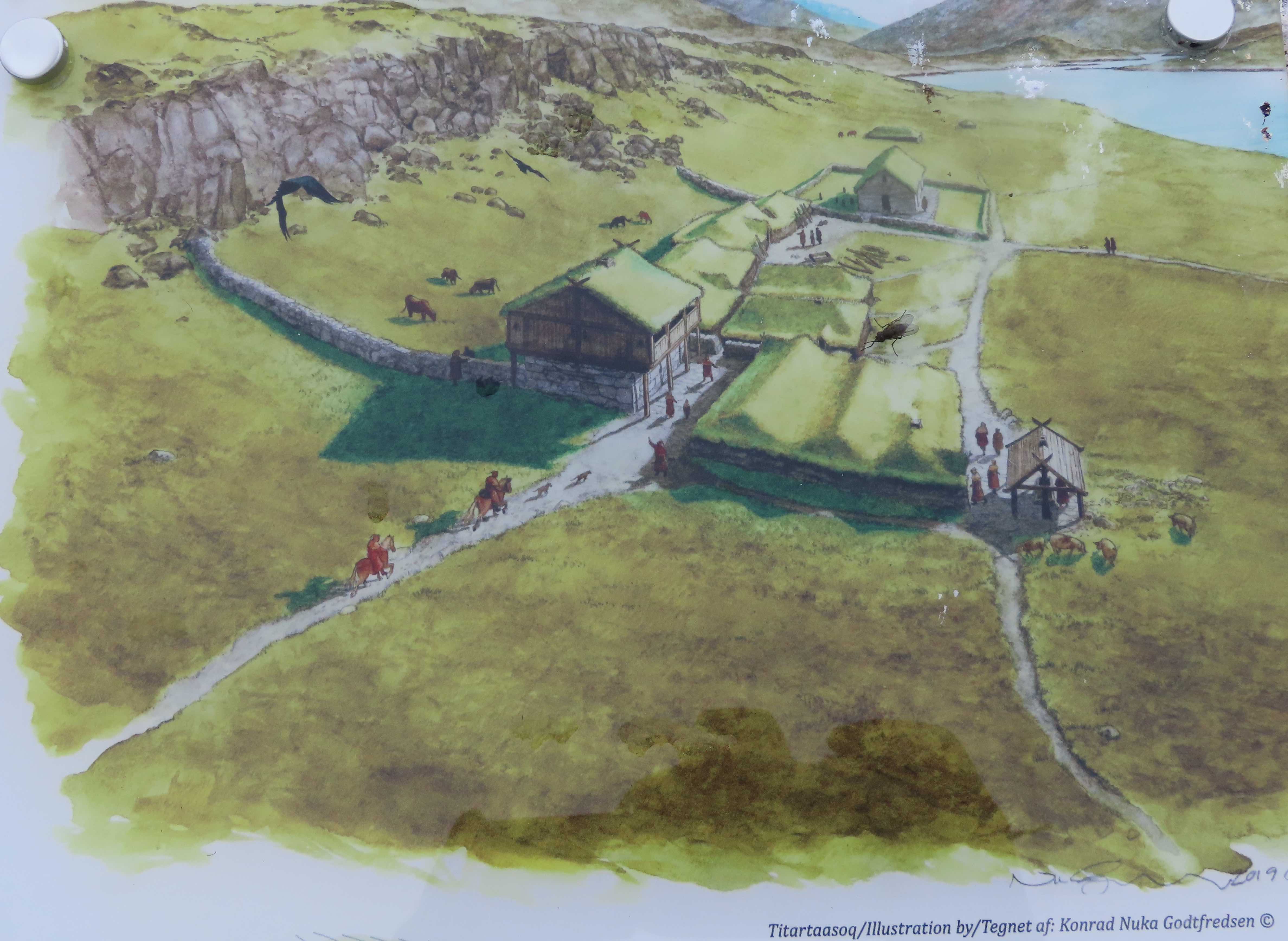
We visited the sites of two different Viking settlements in Greenland: the farms of Eric the Red and of his good friend Thorkell Farserk, both founded in the 10th century. A Viking farmstead was a large enterprise. The main structure was a long-house where many people lived and worked. There were outbuildings for keeping the animals, and a big farm also had its own church, and a banqueting hall for gatherings with other local farmers. These smaller farmers nearby were tenants of the large farms, and would come from the surrounding area to attend church services or celebrations. Their recognized ruler was the king of Norway: the settlers functioned as a colony. The farms were dependent on ships from Norway for essential building materials, new residents, and other materials. Inuit natives of Greenland may have had contact or trade with the Norse settlers, but the evidence of this isn't clear.

Hvalsey Farm


The church.

The banqueting hall.

Hvalsey was a wealthy farm founded in 985. It belonged to the close friend and drinking buddy of Eric the Red, named Þorkell Farserkur (Thorkell Farserk). Thorkell came to Greenland after his neighbors in Iceland threw him out because he was so violent. Eric was also a violent man! The famous Icelandic sagas, written quite a bit later, describe the character traits and the accomplishments of these men and also of the remarkable women who were involved in the heroic Viking voyages. The archaeological remains at these sites confirm the literary descriptions. 

Farmers at Hvalsey continued to produce food and wool, which was spun and woven into cloth, a major export from the Viking colonies. The settlement lasted for around 400 years. By the early 1400s, the climate became cooler and drier. Crops like barley that had grown in earlier centuries (and made beer possible) no longer were viable. Sheep could survive but not goats or pigs, and few cows. It became more difficult to grow hay to feed the animals over the long winters. Economic and political conditions also changed, affecting trade with Norway and Iceland. 

One imagines the sad end of the descendants of the family that had once been prosperous, and had had tenant farmers in the area who came to their farm for worship and for banqueting, struggling to survive. The last recorded contact with Hvalsey is the record of a boatload of Icelanders, who were stranded there for four years because of ice in the sea. They sailed on when it became possible, but nothing was ever again heard from the farm.

Lecturer Hafsteinn Sæmundsson telling us the history of this church.

The last recorded event in Viking Greenland was a marriage between two of the Icelanders from the stranded boat. This event was celebrated in the church of Hvalsey in 1408, and the marriage certificate still exists in an archive in Denmark.

A reconstruction of Hvalsey Farm as depicted on one of the information placards on site.

Brattahlid Farm

Another day, we went ashore at the very beautiful site of another famous farm: Brattahlid. Today the site, far into a fjord and away from the sea, includes a working farm and a small modern settlement including a school and other buildings, along with reconstructions of the Viking farm. The original farm of on the site belonged to Eric the Red, who arrived here in 985. The foundations of several farm buildings stand here, along with the reconstructions of a long house and a small chapel. Eric himself was faithful to Thor and other Norse gods, but his wife Tjoldhilde became a Christian and built the chapel. Eric may have converted to Christianity on his death bed.

Tjoldhilde's very small church at Brattahlid Farm.

The Long-House, made from sod and some wood,
which would have been brought from Norway.

The door into the long-house.

Inside, it's dark and would have been very crowded
with many people on the sleeping platforms and work areas.

A fireplace in the long-house.


The loom for weaving the wool: of critical economic importance for local use and for trade.

The sod walls were very thick, as shown at
this entrance/exit to the long-house.


Farming goes on at the location today,
with sheep grazing on the rough hills as they did in Viking times.

In the course of our voyage on the Explorer, we learned a good deal about the history of the Viking era from Hafsteinn Sæmundsson, the onboard guest speaker. At the end of this era, the climate was growing colder and dryer, and many other factors also contributed to the disappearance of the Viking settlements. Archaeological explorations are still seeking these causes. The whole story involves many more locations than just these two farms that we visited, and much more about the Vikings' dependence on seal and walrus hunting and other activities besides farming.

Location of Viking settlements in Greenland (source).
Brattahlid farm is also in the Eastern Settlement.

Greenland may be the most difficult environments where we strange humans have ever settled. Almost the entire land mass is covered with the Greenland Ice Sheet and glaciers and icebergs are visible from almost any site where the Norsemen farmed or where the Inuit have their homes. According to the "Book of the Icelanders," one of the sagas, Eric the Red chose the name Greenland "because he said people would be more inclined to go there if it had a nice name."

I may write another post about the Vikings' lives in Greenland after reading more about this mysterious era. One particularly useful article is "Why did Greenland's Vikings Disappear?" by Eli Kintisch. I'm also rereading the book The Far Traveler: Voyages of a Viking Woman by Nancy Marie Brown, which I read and reviewed a few years ago  (See: A Viking Hearth in Iceland, Greenland, and Vineland.)

Blog post and photos © 2022 mae sander


Wednesday, August 24, 2022

Icebergs and Glaciers

Watching Icebergs from the Observation Room of the Explorer


MORE Icebergs and Glaciers


A really big iceberg!

Whales in front of another huge iceberg.


All photos © 2022 mae sander for mae food dot blogspot dot com

Tuesday, August 23, 2022

The Tundra and its Tiny Plants

No trees grow in Greenland! In some areas there are scrubby bushes that are members of the willow or the birch family, but I don't think anyone like me, with my midwest US background, would call them trees. In most of the areas where we walked, the permafrost that is just below the surface causes vegetation to grow in a strange, spongy form, with deep water holes and streams criss-crossing the bumpy surface. It's hard to walk on, and for 4000 years, it's been hard for people to live on, though they did so. They knew which berries to eat, which lichens had to be cooked to avoid poisoning, and how to hunt the few game birds and animals that were present.

Without trees, there is no locally-produced wood for construction -- only imported lumber. Special methods have been devised for creating structures on the permafrost. Modern industrial buildings in this climate often have strange-looking pipes surrounding them, that are meant to prevent the permafrost underneath from melting and making the buildings collapse. Earlier inhabitants located cabins or turf houses on rocky outcroppings to have a stable foundation. The Vikings built sod huts or stone churches with some structures balanced on the uneven ground. (Viking settlements were not on the most extreme tundra, but further south, though still treeless). The Inuit managed in a variety of ways, using skins, sod, animal bones, and the occasional lucky driftwood find for small, often temporary houses.

An abandoned cabin on a rocky outcropping.
The wood planks would have been imported to Greenland.

         The Kangerlussuaq airport was built on the tundra by American
troops in 1941, and was an American base until 1992.

Tundra vegetation is extremely beautiful, and well worth a close look, as many plants have colorful flowers that are the size of a fingertip or smaller. Lichens, mushrooms, and other unfamiliar life forms also grow on the spongy surface. Unfortunately, so do mosquitos and flies. We enjoyed a number of walks and hikes in this extremely strange environment, which is vividly colorful and beautiful, especially in sunshine.

Looking across the tundra and lichen-covered rocks, back towards the ship.

Eduardo, one of the naturalists, led us on a very beautiful tundra walk.
On one of the distant hillsides we could see a flock of Canada geese.

Dennis, another of the naturalists, loves the flora of the tundra.
Dennis knows the names of all these tiny flowers and lichens.

Amazing green colors create great beauty in the moss and lichens on the tundra.

A fox’s jaw. We often saw bones on the tundra.

Lake Ferguson is near the Kangerlussuaq Airport from which we left Greenland.
We had lunch at the Rowing Club, which offers these canoes (not kayaks!)
 Kangerlussuaq is above the Arctic Circle, and you can see the scrubby "trees" that grow in the area.

More glimpses of life on the tundra

These delicate flowers are extremely small.


Hundreds of thousands of insects swarmed us when we were hiking.
A windy day meant we had a wet crossing on the small zodiac boats,
but wind was welcome because it also meant the insects would not be so pesky.

We saw a wide variety of fungus and lichens.


Next to the little flowers: an old bone.

Two musk ox in the standing water above the permafrost, among the dwarfed trees.

A reindeer in the tundra -- one of the favorite game animals.

All photos © 2022 mae sander