Sunday, July 31, 2011

Chinese Woodblock Prints


This afternoon we saw a remarkable exhibit of Chinese woodblock prints all dating to the past decade. I was especially impressed by this image of a family eating dinner, reflected in a spoon. I loved the detailed imagery of dishes and foods, and the suggestion of family life. My photo isn't good at all: the print is around 6 feet tall, so I took it from across the room.

We also heard a fascinating lecture about the meaning of the prints, especially about a conceptual artist, Xu Bing, who used to work in New York but is now in China.

The Ego Trip

Last night I saw the BBC film "The Trip." The title should really be "The Ego Trip" because it's all about two boring men who think they are celebrities. The actors are supposed to be famous -- they wish. Well, maybe they are famous somewhere, not here.

A lot of "The Trip" is improvised, with them congratulating themselves all over the north of England as they supposedly are dining in famous restaurants in order to write about the food. In fact, as Len pointed out, it's too chaotic to be fiction. Mocumentary is the best description I've seen for the genre.

The claim that the two egomaniacs are exploring something about fine restaurants is a sham. There's no way they could ever write about what they were eating because all the time they are tasting the food, they are competing to do impressions of truly famous film stars and also competing to quote famous poetry about the places they are traveling. They sit in front of painstakingly plated little morsels of fish, duck, pigeon, chocolate cake, or whatever that's just come out of the kitchen of whichever restaurant they are in.

There are lots of shots of the kitchen staff painstakingly sauteing and arranging the food which the two characters shovel into their mouths without seeming to notice it. Although they are supposedly in 5 different restaurants I suspect that all the shots were taken in only one kitchen. Repetitiveness is another annoying feature of "The Trip."

A few images of their posturing:


Fortunately the evening started better. We ate at Seva, which has been Ann Arbor's principal vegetarian restaurant for nearly 30 years. I think it's improved since I was last there -- a marvel for a local restaurant. Our 4 dinners were nicely plated but not to the extremes of the awful film:


Sunday, July 24, 2011

What's the carbon footprint of your dinner?

First, here's a graphic that's getting a lot of attention, just published by The Environmental Working Group, a Washington lobbying organization:

Full Lifecycle Greenhouse Gas Emissions from Common Proteins and Vegetables

carbon-ftprint

Here's a graphic (thanks, Len!) showing some of the same foods with their carbon footprint for 1000 calories instead of for one kilo:

Greenhouse Gas Emissions for 1000 calories of Common Proteins and Vegetables
carbonftp_1000cal

The first graph comes from the EWG's "Meat Eater's Guide," discussing the impact of meat eating on the environment. It illustrates the carbon footprint of common foods, measured in kilograms of carbon expended to produce a kilogram of edible food. I find the idea of comparing various foods by their carbon footprint be effective, but comparing the foods by weight seems misleading. Comparing a kilogram of tomatoes to a kilogram of edible beef seems rather naive: after all, the kilo of tomatoes supplies you with around 180 calories, while a kilo of steak is 2010 calories. Comparing these to cheese is even less helpful: a kilogram of cheddar has just over 4000 calories. To me, calorie content is a better measure of nutritional value than weight, and if you look at some of the foods from this point of view, the profile is very different, as you can see in the second graphic.

Comparing beef to lentils still gets the same result: the carbon footprint of beef is over 30 times as high as the carbon used to deliver a plate of lentils to a diner. However, in between, the differences don't come out so consistent -- cheese turns out to be a much more responsible carbon-conserving choice if you look at its calorie value.

Note: calorie values are based on the information in the USDA online calorie counter.

Saturday, July 16, 2011

Appreciation of Food in Fiction

In the Guardian food blog:

Food writing, glorious food writing


The author, Sarah Crown, describes the use of food by a number of authors, many new to me. I loved this passage:
All books, in my opinion, benefit from a bit of food – and I've been a connoisseur since childhood. During my Blyton phase, it was the luxurious descriptions of midnight feasts, and the Famous Five's acquisition of "new rolls, anchovy paste, a big round jam tart in a cardboard box, oranges, lime-juice, a fat lettuce and some ham sandwiches" (Five Get Into Trouble, in case you're interested) that hooked me. In Laura Ingalls Wilder's Little House in the Big Woods I was enthralled by the descriptions of meat smoking, butter-churning and the putting away of provisions against the long, cold winter. My mouth still waters at the thought of the homemade ice cream with burnt toffee which Roald Dahl remembers eating at his grandmother's house in his childhood memoir, Boy.

Friday, July 15, 2011

The Lone Ranger and Tonto...

Sherman Alexie's story collection The Lone Ranger and Tonto Fist Fight in Heaven is a collection of brief glimpses of Indians (his term) living on and off the Spokane reservation. Their lives are tragic, but their view is often to see the humor in what they experience. "Laughter through tears" was a classic description of the works of Sholem Aleichem -- who wrote about Jews on the reservation. I mean in the shtetl. The similarity is odd.

Sometimes the humor is open, sometimes indirect. In one story, a character named James Many Horses is abandoned by his wife because he makes too many jokes about death; another story says "even the other Indians got tired of his joking." (p. 203)

Food and hunger are both repeating themes in Alexie's stories, among the many themes that make the work vivid and poignant. Also beer, vodka, whiskey, and (unexpectedly) Diet Pepsi. One character thinks that "one more beer could save the world. One more beer and every chair would be comfortable. One more beer and the light bulb in the bathroom would never burn out. ... " (p. 88)

A few examples of the foods Alexie mentions: macaroni with commodity cheese, fry bread (of which the best recipe was lost when the older generation died), cheap hamburgers, Green Giant mushrooms (in absence of magic mushrooms), and a creamsicle (one of many items from the 7-11). In the delivery room a new mother has just one question about her baby son: "Will he love to eat potatoes?" (p. 81) Another character says:
... eating potatoes every day of my life, I imagined the potatoes grew larger, filled my stomach, reversed the emptiness. My sisters saved up a few quarters and bought food coloring. For weeks we ate red potatoes, green potatoes, blue potatoes. ...[We told] stories about the food we wanted most. We imagined oranges, Pepsi-Cola, chocolate, deer jerky." (p. 151)
Some of the characters have diabetes, and must politely refuse candy that a policemen offers them. One junior high kid says to a bulimic girl in his school "Give me your lunch if you're just going to throw it up." But the girls "Grow skinny from self-pity." (p. 177) An empty refrigerator begins one story. The narrator of one story is locked in the 7-11 refrigerator by a robber, who "pulled the basketball shoes off my feet, and left me waiting for rescue between the expired milk and broken eggs." (p. 150)

Poverty, hunger, exclusion from education, and being able to see the mainstream without joining it might be common points between Sholem Aleichem's village and Sherman Alexie's reservation, but the real nexus is laugher through tears. And they all ate potatoes.


Thursday, July 14, 2011

Jason's Birthday Cake

Lemon with notes of ginger and strawberry candle holders...

Tuesday, July 12, 2011

Pop Food


In the 1960s, commercial images of food inspired the Pop Art movement to depict food in a completely different way from the artists that preceded them. Claes Oldenbourg was among the early pop artists, and he often made gigantic sculptures of food (like the spoon bridge with a cherry in Minneapolis). He also made soft sculpture or moulded sculpture of meat, pastry, sandwiches, and other foods, like the case of Danish Pastry above. When I first saw Pop Art I felt as if it had showed me a whole new way to see the things around me. I still find these representations of ordinary foods to open my eyes in a special way. The context of Oldenbourg's representations is defined not by painting or sculpting the surroundings (as earlier artists usually did) but by using the same type of case in which real food in a diner or restaurant would be displayed to someone about to eat. Playful! Artful!

Andy Warhol started as a commercial artist, and combined the Pop Art vision with the commercial vision, as in the hamburgers below, which are re-drawn from ads. Of course his soup cans are much more famous, and even one remove from the food: you only see the label, not the soup itself.

Pop Art really differs from what came before, in my opinion. Artists like Jan Steen, Velazquez, Manet, Bonnard, and many others painted food in a social context: people were cooking, about to eat, or otherwise to engage in cooking or taking a meal. Van Gogh's potato eaters and Picasso's frugal diners put dining in the context of poverty, perhaps making a political point about the subjects. Still-life painters (whether classic, cubist, or romantic) made studies of the shapes and colors of foods, fruits, serving dishes, and related objects, at times also referring to symbolism associated with the objects in their pictures. Pop Art referred to another visual dimension of modern life.

Saturday, July 09, 2011

Two Sad Meals by Picasso


It's well known that in his early days in Paris Picasso was often hungry, maybe even offering paintings in exchange for something to eat. The first of these two works, "The Frugal Meal" is often reproduced; the second, "The Blindman's Meal," is less famous, I think. The people depicted during Picasso's blue period are often depressed looking, but these works seem even sadder. Both suggest the desperation of hunger and poverty.

I need to look more thoroughly for later Picasso paintings of people eating, perhaps even enjoying food. I would not expect to find a painting of food preparation, at least my current knowledge of Picasso's biography wouldn't lead me to expect such subjects. He did later paint still-life subjects, but that's more for the shape and color of fruit and other objects on a table, not really about eating them.

Friday, July 08, 2011

Velazquez paints food

We're home again from our long trip out west. And I'm again looking at the topic of how artists (maybe not many of them) have pursued the topic of food and cooking. It seems that one such painter was Velazquez (1599-1660). I am especially interested in the picture above, "Old woman cooking eggs," painted when Velazquez was very young. I have little information about what he was thinking or any meaning beyond a realistic depiction of a simple subject. The contemporary Dutch painters' still life works had a great deal of symbolism in them. Here? I don't know.

There are quite a few more, including this one:

Wednesday, July 06, 2011

George Lang 1924-2011

The New York Times today published the obituary of George Lang, a cookbook author and an impressario of restaurants, most famously the Cafe des Artistes in New York, and the post-communist reincarnation of the historic restaurant Gundel in Budapest. Lang was born on July 13, 1924, in Szekesfehervar, Hungary. He originally studied music, and intended to be a musician. His first deviation from his plan was to be in the resistance in World War II after escaping from a Nazi prison camp. As a Jew, he had little choice but resistance, but by joining the fascist Arrow Cross militia was able to assist other Jews in hiding. His parents died in Auschwitz.

Lang escaped to New York and resumed his intended career as a musician, but eventually discovered his talent for designing and running restaurants and also for writing cookbooks. The Cuisine of Hungary is one of my favorite ethnic cookbooks, which the obituary says was the first Hungarian cookbook in English.

According to the Times:
"Mr. Lang often enjoyed constructing fantasy meals, including his last. The ideal final meal, he told The Village Voice in 2007, would include some of the great dishes from his restaurant career but above all his Hungarian favorites: fisherman’s soup, stuffed goose neck, sour cherry soup, layered cabbage, stuffed peppers, plum dumplings, pancakes with apple meringue, and whipped-cream strudel.

"'And then I will have what it takes to get to another world,' he said."

Friday, July 01, 2011

Picnic Game Day

Happy picnic day: don't forget to check Louise's blog for a complete list of 26 picnic foods in alphabetical order! My post,

A-Apricot Cobbler

has been up for around a week. There are 16 recipes for desserts and sweet baked goods, and a very interesting Portuguese dish that starts with "X" among the delicious foods for this virtual picnic.

Thursday, June 30, 2011

Aspen Water Tastes Better

The insistent marketing of Fiji Water in Aspen has infuriated me. Aspen tap water comes from local mountain springs, and trucks aren't necessary to bring it up the mountain, nor boats to bring it from distant exotic islands. Fiji Water sponsors many of the Aspen events, thus buying the right to have its logo all over town. I think it's shameful! Aspen tap water is delicious.

Today I was happy to read (here) that the city of Aspen is rolling out an effort to create appreciation for their own local water. According to a city official: "When people talk about bottled water, they have this image that comes from mountain streams and pristine environments, and they don't realize that's exactly where Aspen's tap water comes from."

Like several national parks that I visited lately, Aspen is installing "filling stations" where tourists and locals are encouraged to fill their re-usable water bottles instead of buying plastic ones and throwing them away. The city is selling stainless steel bottles with the logo "Aspen Tap" and the words “Better Than Bottled.” The national parks have also instituted a policy that park-located shops sell only re-usable bottles, not bottled water, a policy that wouldn't work in a city with private enterprise. I hope that they can counter the pernicious advertising efforts.

Wrap up: Simple Cooking

During our 3 weeks in Aspen (we leave Sunday), I've been paying a lot of attention to the contrast between elaborate restaurant meals and simple, more healthful home cooking -- as I've mentioned. When we arrived, I set myself a challenge: to cook without many condiments, spices, and extra ingredients; that is, I've been trying to buy only plain, unprocessed foods that are intended to be eaten at one or two meals. I'm avoiding a lot of food that normally remains on the shelf or in the refrigerator and would go to waste when I leave. Even peanut-butter-and-jelly sandwiches or hot dogs with crisp rolls and mustard qualify for my simple fare.

Here are a few things I've done. One night, I flavored pan-fried lamb sirloin with strips of red pepper, and served it with mustard, a few tomato wedges and sprigs of cilantro, and a side of steamed broccoli.

For dessert we ate fruit: cut-up cantaloupe, and strawberries. The cantaloupe was unadorned, but I glazed the berries with a mixture of 1/3 cup apricot jam (initially destined for PB&J) and 2 tablespoons of my wonderful wine vinegar made from Italian Pinot Grigio. I heated the glaze in a pyrex cup in the microwave so that it would melt together and be able to coat the strawberries. Sugar would be easier -- but bulk items like sugar or flour weren't on my very short list of pantry staples.

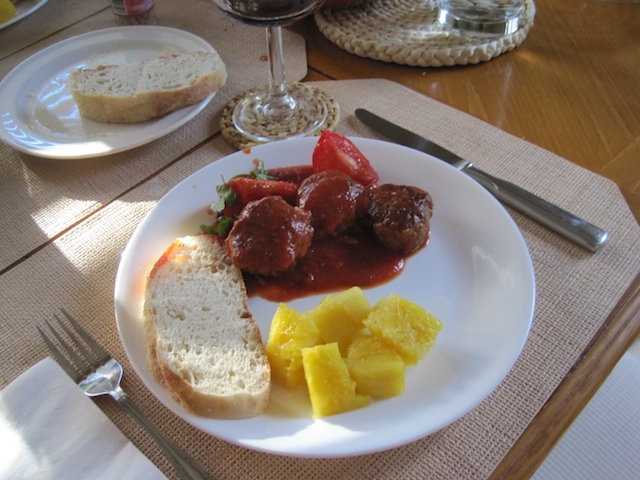
Another day, I made meatballs with sweet-sour sauce from some moderately low-fat ground beef.

To make the meatball mixture, I had no flour or prepared bread crumbs, but I crushed a few AkMak sesame crackers to serve that purpose. Besides fixing the texture, this gave the meat balls a bit of sesame flavor. Other ingredients: an egg, some chopped onion, and of course my Spanish smoked paprika and Trader Joe's salt, the two trusty spices I brought with me. The meatball mixture also had a tablespoon or two of the sweet-sour sauce I made. In this: a can of prepared organic tomato sauce, a drizzle of my wonderful vinegar, a shake of salt and paprika, and 2 purloined packets of brown sugar from a cafe (yes, that's cheating, I know, but I did buy a cup of coffee). I sauteed the meatballs in a bit of olive oil and added the sauce, which I'd heated in the microwave. Garnish again: tomato and fresh cilantro. On the side: fresh pineapple chunks also from the supermarket.

Not all restaurant cooking is that much different, though it frequently has considerably more added fat and salt. Here is an admittedly delicious restaurant salad at Mezzaluna restaurant that wasn't that much more complex than my concoctions:


The restaurant salad did contain quite a few more ingredients than most of my productions. The price was also a lot higher than cooking at home -- the overwhelming cost of restaurant meals is another motivating factor here in Aspen more than most places.

Tuesday, June 28, 2011

Aspen Restaurants Again

Last night we celebrated Elaine's birthday at a restaurant called "Elevation." It was excellent. Seating was in a courtyard above the actual restaurant, which seems to be in a basement. The food was excellent, and so was the service. The first course, charcutrie, was house-made and wonderful:

elaine&larry7318

One of our main courses:

elaine&larry7316

Elaine's dessert with a birthday sparkler:

elaine&larry7322

Click on any of these to see the flickr set with more photos.

Thursday, June 23, 2011

Eating Out in Aspen

The restaurants in Aspen are all very good. Some are famous, and some are known for their famous clients. I've already described how we also like quietly eating simpler things in our condo -- tuna and vegetable salad, chicken strips, seared lamb chops with broccoli, and always cereal for breakfast.

The first time we ate out, we tried a very nice but unremarkable Mexican restaurant called Palapa, which didn't seem very photogenic. I'd be surprised if it's frequented by the Aspen elite either, but one never knows around here.

Last weekend, we bicycled to the very quirky Woody Creek Tavern, around 6 miles down the extraordinary Rio Grand Trail. Woody Creek Tavern is known for home-style food in an eccentric atmosphere. The walls are entirely covered with trinkets, photos, notes from customers, and posters -- such as one of their most famous customer, the late Hunter Thompson, who ran for sheriff in 1970.

aspenrestaurants14 aspenrestaurants 11

We also ate dinner one night at the famous Ajax Tavern at the foot of the Gondola which carries skiers in winter and hikers in summer. I suspect that celebrities do come here but I'm not much good at spotting them. Ajax Tavern's green gazpacho was delicious.

aspenrestaurants 6

Here's the Ajax Tavern kitchen/staging area:

aspenrestaurants 5

The Ajax Tavern has a lot of trendy dishes, such as truffle-oil-flavored french fries and reimagined ice cream bars:
aspenrestaurants 3

For lunch one day, right near our condo, I tried Mezzaluna, a small cafe with a very nice patio and very appealing menu. I love the way the trees cast shadows on the big cafe awnings. My salad was very good, and I hope to go back and try their pizza.

aspenrestaurants 2

For access to the entire Flickr photo set -- lots more photos of each place -- click on any photo here.

Saturday, June 18, 2011

The Picnic Game from Louise


Louise at the blog Months of Edible Celebrations is hosting a picnic!! She just announced this game today, inviting bloggers to celebrate by bringing a full alphabet of picnic treats. Louise assigned me the letter A: I'm "baking" for the picnic even though my reality right now is a condo in Aspen, Colorado, where I have no pantry supplies whatsoever. I'm looking forward to getting home in a few weeks, and baking in my own kitchen where I keep flour, baking powder, and where I have many baking dishes!

Well, I'm going on this virtual fantasy picnic, and I'm bringing:

A -- APRICOT COBBLER

Other bloggers will be bringing foods from B to Z.

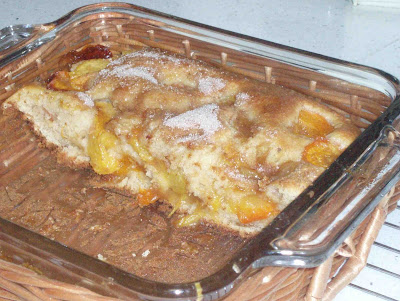
Here is a photo and recipe:

Apricot (or Peach) Cobbler
Preheat oven to 400°F.

Make the filling first:

1 1/2 lb ripe apricots or 9 to 10 ripe peaches
1/2 cup sugar
1 tablespoon all-purpose flour (2 for peaches)
1 1/2 teaspoons fresh lemon or lime juice
3/4 teaspoon almond extract

Cut apricots in quarters. (Or peel the peaches and cut in 6-8 slices each). Toss all the ingredients together in a 9-inch round or square glass or ceramic baking dish. Let stand until juicy, about 30 minutes or as long as it takes to make the topping.

For topping:
3/4 cup all-purpose flour
3/4 teaspoon baking powder
1/4 teaspoon baking soda
1/4 teaspoon salt
1 teaspoon sugar mixed in
2 tablespoons cold unsalted butter, cut into bits
1/2 cup well-shaken buttermilk OR 1/2 c. milk plus a few drops of lemon juice or vinegar
2 or more teaspoons of cinnamon-sugar for sprinkling.

Sift together the flour, baking powder, baking soda, salt, and 1 teaspoon sugar in a bowl. Blend in the butter with your fingertips or a knife until the mixture resembles coarse meal. Stir in the buttermilk with a fork just until combined. Do not overmix.

Drop rounded tablespoons of dough on top of the filling; leave spaces in between the blobs to allow topping to expand. Sprinkle with remaining 2 teaspoons cinnamon-sugar.

Bake cobbler in 400 degree oven until fruit is tender and topping is golden, about 30 minutes. Cool slightly, about 15 minutes, and serve warm with ice cream.

APRICOT CAKE
While I'm thinking about apricots and what I could do with them -- another good picnic dish with apricots would be a traditional Polish fruit cake. Similar recipes appear in many traditional Eastern European cuisines -- I always knew it as a Jewish tradition before friends gave me a Polish cookbook a couple of years ago.

I include a scan of the cake recipe, with my notes on how to make the depicted cake:


Click on this copy of the cake recipe with my notes to see a full-sized version.

Even Simpler

Continuing to report on how I cook in condo with good cooking equipent, but starting with a completely empty pantry and frige -- last night, I made the least-demanding dish there could be: scrambled eggs with red peppers, mushrooms, and chopped cilantro, seasoned only with salt. On the side: a salad and some French bread. As I've mentioned, the oil and vinegar for the salad are the basics that I always get for a temporary kitchen. Instead of mustard I used some Colorado goat cheese -- a very nice cheese that I've not seen outside the state.

Thursday, June 16, 2011

Water


As I walked around the streets near our condo, I noticed this Fiji water being delivered to the Aspen Food and Wine Classic. Several drums of it stood under a huge semi-truck -- one of many delivering supplies to the big tents in several locations. All over Aspen, I see preparations for this event, which is happening this weekend. I'm not a food professional: no one would pay the $1200 admission fee for me to attend. So I'm outside the big tents.

Fiji water in Aspen: this is apppaallling!!!! Think of the energy this big truck expended bringing the water up to the Rocky Mountains, and the energy expended bringing the water by boat from Fiji. I know the owners of Fiji Water are really good at promotion, and sometimes questioned about its ethics; but really, how did they sell this...

Aspen has the most delicious pure water I've ever tasted running out of the taps. It wells up in fountains in the streets:


All around us are high mountains, and the snow is melting and pouring down in little rushing trickles, rivulets and bigger streams. I'm sure it's purified a bit before going into the city water system, but probably needs very little.


Thursday morning we took a long hike to the Maroon Bells, where water was running through the meadows and coursing through the little mountain lakes. Water everywhere -- and somehow they are bringing it from Fiji. Maybe it's emblematic of the type of thing that's going on at the Food and Wine Classic, but I'll never know.

Cooking with basic ingredients


Last night I cooked two dishes: baked chicken with Spanish smoked paprika (I brought it with me from Santa Barbara) and Gratin Dauphinoise, my favorite potato dish. I learned this Alpine dish when I was in Grenoble, France, so it's appropriate to make it here in the Rocky Mountains, I think. Also, it requires no special condiments or spices. It's made of sliced potatoes, a chopped shallot (could be onion or garlic), milk (I discovered long ago that it's good with skim milk though the authentic version uses cream), real gruere cheese, and butter. I heat the milk with a bit of salt and pour it over the vegetables, cheese, and butter, which are layered in the baking dish. After baking it for an hour at 300, I turned it up to 425 and put the chicken in the oven. That's it: very basic.

So far, here are the only condiments I have:

Mayonnaise, olive oil, white wine viengar, Dijon mustard. And you can see my temporary kitchen.

Tuesday, June 14, 2011

Food and Art in Spain

In today's New York Times I read an article about Spanish restaurants: After El Bulli, Spain Looks Forward. The description of Spanish restaurants that may become famous or popular after El Bulli closes included a description of a dish called the Mondrian. It intrigued me with its intersection of food and art.

The Mondrian comes from a restaurant called Sant Pau where: "dishes like a gorgeous, lightly jelled Mondrian made from green almonds, red peppers and olives, and a juicy chunk of roasted foal (horsemeat is not unusual on local menus) are jammed with flavor."

Obviously I'm not among the few hundred people per year who have eaten at El Bulli during its long season of fame (or notoriety), and I'm not really that interested in its closing. However, it was an example of the most extreme gap between restaurant food and what I am tempted to call real food. I'll get back to blogging about my basic, limited-ingredient, not-at-all-like restaurant cooking tomorrow. Today was the group picnic for the workshop Len is attending -- to which we brought some quite good sausages and crisp rolls. The organizers supplied us with relish and catsup -- not even those are currently in my small larder.