Saturday, February 03, 2024

What’s Happening? Not Much

Friday the sun came out for the first time in weeks!

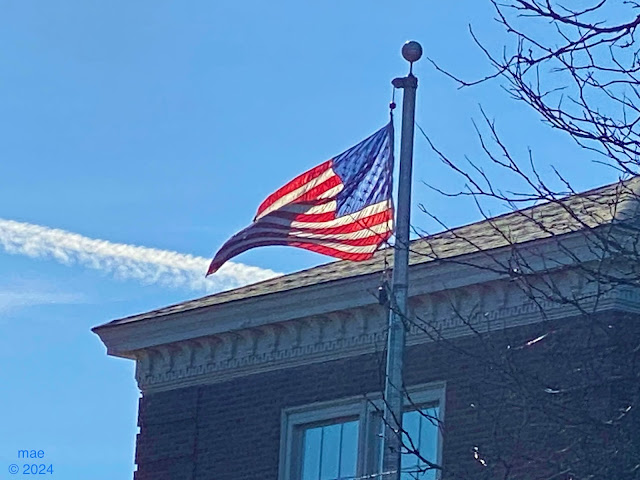
The flag at the nearby elementary school looked bright in the sunlight.

The kids were enjoying themselves.

Mainly, it has been very quiet around here.


  • Snow by Viveca Sten is too perfect for our depressing January weather. As the police detective Hanna Ahlander tries and fails to find a missing girl, and then determinedly searches for her murderer, very heavy snow is falling constantly. Incredibly much snow! It’s a dark and stormy book, very sad. Hanna has lost her job with the Stockholm City Police, and joins a small police force in a ski resort near the Norwegian border. There’s a pleasing amount of local color — and there’s Swedish food: “they dig into homemade meatballs served with lingonberry preserve, mashed potatoes, and gravy ….” (p. 311)
  • The Rigor of Angels: Borges, Heisenberg, Kant, and the Ultimate Nature of Reality by William Egginton makes a pretty sweeping claim in the title. I found it pretty tough to read, somewhat tedious and digressive. The author covers not just the philosophy, science, and biographies of the three thinkers of the title, but also discusses many other great men: the ancient Greeks, the early Christian scholar Boethius, Moses Mendelssohn, Einstein, Nils Bohr, and many more. (He might also have mentioned one or two women.) As I read, I was overwhelmed by the complex and intertwined ideas from physics, literature, and history, and by constant jumping around among all the different writers, abstract presentations about how we know what we know, and different time frames. Consider this quote from  Heisenberg  “we have to remember that what we observe is not nature in itself but nature exposed to our method of questioning.” (p. 114)
  • The Widow of Bath by Margot Bennett, a classic British mystery from the early 1950s, is a little too full of clever banter and class-oriented observations for my taste. It had a good ending, though. As in many English mysteries, the word I find myself thinking is “arch.” For example this: “The corridor was dark and odorous. The smell could be divided into five per cent furniture polish, fifteen per cent tomcat, and eighty per cent cooking. All the smells seemed to have been there for a long time. They had no way of escape.” (p. 183)


Dreaming of Paradise

The island of Moorea, as seen from the hotel in Tahiti on our trip in 2019.
 
Albatross nesting on the Galapagos, 2010. (I think the nesting area has been closed to humans now.)

Sunset in Maui, 2003.

Note: I seem to write a blog post with beautiful beach photos almost every winter and complain about how I wish I were there. Here it is again.

Blog post © 2024 mae e. sander.
Photos © 2003-2024.
Shared with Sunday Salon at Readerbuzz.

Friday, February 02, 2024

A Walk Downtown


My friend Anne and I went for a walk in her neighborhood recently. Her favorites there are the old Victorian houses with gingerbread trim that have been painted in interesting color combinations, while I love the murals on several buildings along the walking route we followed. Some time I’ll go back and take some photos of the “painted ladies,” including her house for which she selected special colors. Despite a drizzling rain and heavy clouds, we managed to walk for at least an hour. Next time I hope the sun will shine!

The historic walls of the Washtenaw Dairy, a popular ice cream shop, are decorated with neat murals.


Next time I hope I’ll be there at the right moment to eat some ice cream.

Blog post and photos © 2024 mae e. sander
Shared with Eileen’s Critters and Sami’s Murals
 

Wednesday, January 31, 2024

In My Kitchen, January 2024

We started the year in Costa Rica, as I’ve said, at the birding lodge called Rancho Naturalista. I'm starting my January kitchen wrap-up with photos of the kitchen there. 


On the table beside the stove in the first photo are two trays of stuffed baked potatoes, one of the dishes we enjoyed at a couple of dinners. The main Costa Rican dish served from this kitchen was Gallo Pinto, which was offered each day at breakfast: black beans, rice, onion, and spices. Several bottles of salsa were always available to flavor the rice and the various sorts of eggs and other breakfast dishes or whatever was served at other meals. The food at lunch and dinner was good, but more North American in style, like the roast turkey dinner for New Year's Eve, or a simple grilled steak or breaded fish filet, almost always with salads and vegetable dishes. (For more about the cuisine, see "What is Costa Rican Food?" in Eater.)

Before breakfast was served, coffee and small snacks were available on the balcony 
where guests gathered to watch the early-morning bird life.

Back in Ann Arbor

Since we returned home, we’ve been trapped indoors by some of the worst weather we have ever lived through. January has been sunless, freezing cold and icy or just chilly and damp, and very depressing. We haven’t seen a ray of sunshine since our return to Michigan. So we have cooked a lot. Here are some photos from our own kitchen and dining room.

A New Sauce from Costa Rica

We bought some of the special Lizano brand sauce that we had in Costa Rica.
Also a new chili sauce from Trader Joe’s.

Soup for Cold Nights

A Costa Rican specialty is Aztec Soup — a tomato and tortilla soup. (link)
This is the only Costa Rican dish we have tried at home.

I tried this dish in Costa Rica-- it's also popular elsewhere in Central America.

Also at home: this corn chowder mainly made from leftover vegetables and a can of cream-style corn.

Weather like ours demands lots of flavors of soup! Mostly, I make soups without a recipe.

Winter Salads

Preparing broccoli salad with the new sauce. No recipe!


Champignons à la grecque: a French classic dish of mushrooms with cilantro and lemon.
We had this as a side dish with chicken legs and vegetables. 
Julia Child's recipe, which I wrote about in the past, is more complicated. (link)


Main courses with or without meat


From Fuchsia Dunlop's book Every Grain of Rice.


Crispy potatoes: we ate them as a main course with a salad. Another New York Times recipe.
I haven't given links to NYT recipes because they are behind a paywall.


Sweet Pastry


A “Pompe” — that is, a large apple turnover in flaky pastry.
Details of the two apple pastries that Len made were in yesterday’s post (link).

These cardamom buns were a nice treat on a snowy afternoon.


Tuna and Salmon for Salads


I make tuna or salmon salad often. No recipe.
Mayo and pickle relish are essential!

New Refrigerator Magnets

From our trip to Costa Rica: magnets of sloths, birds, a bat, and a folkloric painted farm cart.


That’s my kitchen for January — not much new "stuff." I’m sharing my kitchen post with Sherry’s once-a-month blog party “In My Kitchen.” All photos © 2024 mae e. sander.


Tuesday, January 30, 2024

Apple Pastry

Making Tarte Tatin 

Len tried two new recipes for French apple pastries this month. First: Tarte Tatin.
Puff Pastry recipe from Bruno's Cookbook. Tarte recipe from the New York Times.

Dough and apples. A Tarte Tatin is made by cooking apples in a skillet to caramelize the sugar,
and then putting a round of dough on top and baking it.


Just our of the oven. After cooling the tarte for a little while, it's turned over onto a plate.


This upside-down tart is conventionally attributed to two sisters named Caroline and Stéphanie Tatin, who ran a hotel in in Lamotte-Beavren, a town in the Sologne region of the Loire valley in France. There are several versions of the creation of the tart. The sisters retired in 1906. Their creation thus had to be earlier than that: presumably in the late 19th century. Some years later, in the 1920s, the tart appeared on the menu at the famous Maxim's restaurant, and was also promoted by the food writer Curnonsky. 

"One should note, however, that most accounts of the dish's history point out, and other scholars agree, that upside-down fruit tarts were an ancient specialty of the Sologne region long before the 'Tarte Tatin' became famous. And the sisters never called their tart 'Tarte Tatin,' but 'Tarte solognote,' after that ancient specialty. It said to have been food writer Curnonsky, who named it Tatin, and Maxim’s who referred to it on its menu as 'La Tarte des Demoiselles Tatin ..." in hommage to the sisters." (source)

A post card of the hotel owned by the Tatin sisters.

Pompe aux Pommes, a traditional pastry from Auvergne


A "pompe" is a large apple turnover that was made for harvest celebrations in Auvergne, a region of France.
Like the Tarte Tatin, it starts with puff pastry and cooked apples. One layer of pastry underneath, one on top.

Len's Pompe aux Pommes was beautiful!

This is an even more buttery pastry than the Tarte Tatin: a very rich dish indeed !


Photos © 2024 mae e. sander