Saturday, June 27, 2015

The National Geographic Explorer

The National Geographic Explorer is rated for the highest level of going into the ice (just below an ice breaker)
After pushing into the ice, the ship leaves its own shape as it departs.
This was the site of one of our quests to see polar bears.
Around the ship the passengers enjoy access to lots of interesting spaces. The cabins are roomy, the lounge is comfortable and has many video screens for watching the visual part of presentations. A library and a variety of observation points are quite convenient. Zodiac landings and hikes are the high points, but one spends quite a lot of time on the ship! All the crew members and guides are willing to have interesting conversations.

Though it's cold, lunch and afternoon barbecues are often served on the rear deck...
The ship's hotel manager (left) and head chef (right) served a reindeer barbecue
there one afternoon.
Eating out on the deck is fun in spite of the cold.
The kitchen is off-limits to passengers -- but I took a photo through the door.
The food is delicious -- lunch and breakfast are served as a buffet.
A polar bear skull decorates the lounge where there's room for all 165 passengers and
some of the guides and crew to gather each afternoon.
The captain at the final cocktail party that he hosted.
The bridge is open to passengers, who often watch the wildlife
from there. Note the mascot.
Our cabin as we waited to leave.

Friday, June 26, 2015

The Quest for Polar Bears

On the bow of the ship, looking for polar bears.
During our week-long trip around the Svalbard islands last week, we spent many hours searching the pack ice for polar bears. The staff and crew of the ship were on the lookout day and night. They knew that most of the passengers had signed up for the trip because they wanted to see the bears.

The first two bears we saw were very far away.

Distant polar bear on the pack ice.
All the passengers secretly hoped to see a polar bear when we landed for our hikes. The guides hoped the opposite because in fact polar bears are very dangerous. In fact, every guide carries both a rifle and a flare gun whenever on shore, and guides in zodiac boats patrol the coast watching for swimming bears, which are very hard to see. If a bear approaches the hikers, the guides first try to frighten it away, but they are prepared to shoot if the bear appears to threaten the people. They really don't want to do this!
Guides with their rifles and flare pistols.
After days of more and more impatiently waiting and hoping for polar bears, the lookouts finally spotted one that wasn't as far away, and called all the passengers to watch him (or less likely, to watch her -- most female bears at this time of year are accompanied by one or two cubs). First he walked back and forth on the ice for a while. He found some gulls that were eating a bird they had caught, chased them, and stole it. As he was chewing it, he decided to check out the ship.

Walking on the ice.
Eating the prey he had scavenged from two gulls.

The polar bear immediately below the rail of the ship.
Walking away from the ship, still accompanied by one of the gulls he had robbed.
Polar bear warning sign.
Even within the town of Longyearbyen, largest settlement on the Svalbard islands, polar bears are a danger. The sign above warns people that they are leaving the town and should always carry a gun to protect themselves. Last winter a bear wandered through the town, leaving nose prints on some of the windows of the houses. The bear raided the food supplies of the sled-dog kennels; after eating 80 kg of seal meat, he came back for more the next night. Obviously, he thought he'd found a wonderful source of food... so he was trapped and sent to a distant island.

Direction signs and bear warning at the Longyearbyen Airport: the north pole is 1309 km. away.


Wednesday, June 24, 2015

Svalbard Highlights

Midnight sun
Brunnich's guillemots in a nesting colony
A glaucous gull eating one of the guillemots from the colony
Barbecue on the deck of the National Geographic Explorer
Polar bear eating a bird that it stole from some gulls. The bear, walking on the ice, came right up to the ship.
Walruses at 4 AM --
an announcement woke us up to come up on deck to see them.
Arctic Tern
Arctic fox 
And delicious desserts every night on the ship.
This morning we left the National Geographic Explorer and flew back from the extreme north to Oslo, where we once again have internet access. We have our boarding passes and luggage tags for tomorrow's flight from Oslo to Detroit via Amsterdam. I'll post more details about our voyage when I get home.

Tuesday, June 16, 2015

Around Oslo

Last night's dinner at Stortovets Gjaestgiveri, a restaurant since 1700 -- my halibut had a topping of fish roe,
Len had a splendid fish soup with some shellfish.

The kitchen of the ship Fram, which went to both the North Pole and the South Pole
in the late 19th century. The entire ship is now in a museum, which we
toured this afternoon, our first activity with our cruise.
From the ship museum. Explorer Fridtjof Nansen was the expedition leader. He later became an important figure in the League of Nations, and especially tried to rescue many refugees after World War I and the Armenian Genocide.

How the Fram traveled for 3 years through the Arctic Ocean -- it was designed to have a shape that could be pushed by the ice and currents. All 13 men on board survived the ship's incredible journeys.
In addition to the Fram Ship museum, our tour included a walk through the Vigeland sculpture garden, the work of the sculpture Gustav Vigeland (1869 – 1943), whose life work is the 900 sculptures, iron work, and plantings on display here, almost all of them human figures in a variety of poses. According to our guide, this park is very popular with Oslo residents of all ages.


After tomorrow we'll be on a ship around Svalbard island without internet access most of the time.

Sunday, June 14, 2015

Where we've been

Runde, Norway, from a boat trip we took yesterday.
Runde Lighthouse from the boat. We also saw colonies of nesting gannets and puffins.
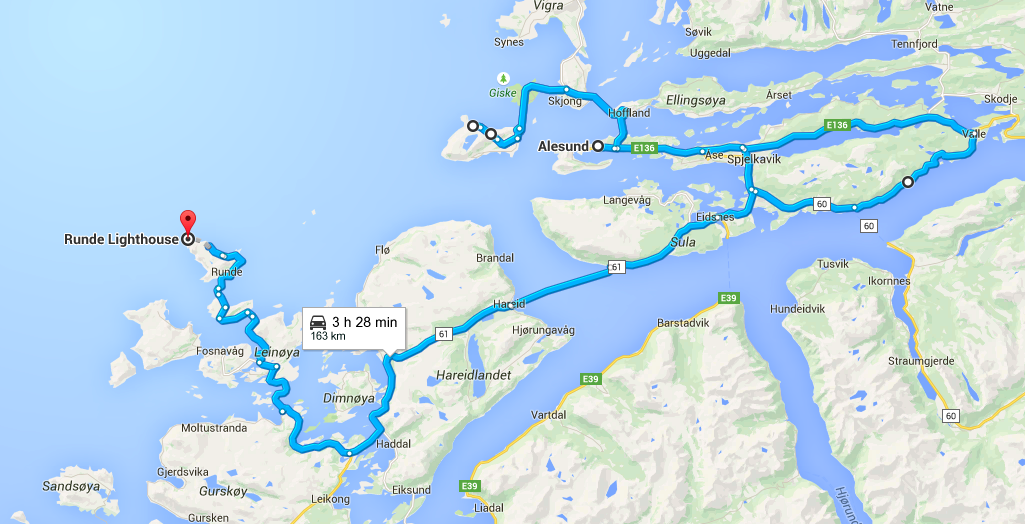
Where we drove today: from Runde Island
to the city of Alesund with detours around several other islands.

The Nature Center where we stayed was not quite all the way to the lighthouse, which is not on a road.
What I ate for dinner: salmon and vegetables in cream sauce.
I think of this as very Norwegian.
Where we ate: Søstrene Fryd Cafe and Restaurant near our hotel in Alesund. 
We've been very busy looking at the magnificent scenery, driving through tunnels, over bridges, and beside the fjords, and enjoying 20 hours of full daylight and no darkness at all. Well, sometimes it keeps us up during the night. At the Nature Center, we cooked in our kitchen using food from a grocery store quite a distance away, but we've also enjoyed several restaurant meals.  Too busy seeing things, not much time to blog!

Want more photos? We are continuously adding to Flickr:


Wednesday, June 10, 2015

"Feed Me" ... Birding in Oslo

Gyrfalcon chick on its nest
Moorhen chicks
After feeding the babies, mother bird leaves nesting box to get more food.
Swans with chicks
Wednesday our bird guide Simon took us around Oslo to wonderful fresh-water lakes where ducks, geese, and swans are breeding, and to open fields and wooded areas. He told us how he'd been watching an owl's nest (the owlets were all fledged and gone so we didn't visit). He showed us a beaver dam and a gyrfalcon chick waiting in its huge nest for its parents to feed it, and a woodpecker hole from which the chick was incessantly chirping to remind its parents to bring food, and several active nesting boxes of other birds. He was really excited to see a colorful butterfly that normally doesn't migrate up here from Africa until much later in the season. He found a wren's nest on the side of a bluff, almost invisible to the numerous passers-by.

Simon showing Len a bird
Simon is English, and reminded me sometimes of Shakespeare's character Puck, immersed in nature and creatures.
Black-faced gull with chicks almost as large as it is.
Grebe chick taking a ride on parent's back.

Sunday, June 07, 2015

Utopia in a Dystopia

In The Subprimes, a very recent satiric novel by Karl Taro Greenfeld, the setting is not far in a future in which all our worst fears have been realized. American life has become an orgy of rampant greed untempered by government regulation, including cancellation of all government-provided benefits: schools, health care, road maintenance (except for exclusive roads for rich people), police protection, civil rights, basic freedoms. Renewable energy is illegal, as are hybrid cars; the energy industry owns everything.

Climate change has resulted in punishing heat waves, packs of coyotes preying on humans and housecats, and distressed whales washing up on the beaches. In California, the view from the once-beautiful shoreline is mainly of large numbers of oil rigs. Food is scarce, and many types of food are simply not available any longer. Brutality of the rich against the poor includes debtors prison or worse for the "subprimes," that is, citizens with a bad credit score.

The subprimes have lost their jobs and have been routed out of their former middle-class neighborhoods. Large numbers of them roam in disintegrating SUVs and old cars from one "Ryanville" to another -- most of them underneath derelict freeway overpasses. In case you have forgotten this: in the Great Depression similar encampments where homeless people congregated were called "Hoovervilles." Yes, it's a very political satire!

The novel includes several vividly drawn individuals and families from each of the new classes of society including of course the subprimes. Sometimes the story is told by an omniscient narrator, sometimes by a writer who is still almost managing what's left of a middle-class lifestyle. As the novel progresses, these compelling characters all gather in a utopian communal experiment located in an abandoned subdivision in the desert near Las Vegas. With a mysterious woman leading them, they create a utopian living space where they raise vegetables, rehabilitate the decaying housing, cooperate to provide health care and nutrition, establish ways to educate their children, and above all, reclaim their dignity.

Communal meals particularly serve to unite them -- as individuals most of the subprimes have had to live on canned beans (heated when they were lucky) and tortillas as they fled from one Ryanville to another. In the small emerging settlement, they pool their resources and cook together. When the writer first arrives at the settlement, the residents feed him from their stew pot. It's a major contrast to the food in fast-food outlets, and a major contrast in attitude:
"Gemma and I both sit down on a log bench and spoon the stew into our mouths. The food is earthy and smoky, and while the first bite seems bland, the flavors grow on me, some kind of meat, seasoned with cilantro, onions, chipotle, garlic, and salt, so that after a few mouthfuls, I can’t imagine anything I would rather be eating. We wash it down with cups of water. 
"'What’s the meat?' I ask Sargam. 
"'Rabbit, goat, maybe snake,' she says. 'Definitely some lobster. Cans of the stuff have been donated— by the pallet.'" (Kindle Locations 3889-3894).
In the end, as one would expect, a violent clash pits the residents of this utopia against the goonish security guards hired by the representatives of the greedy society which has oppressed them. The leaders of the oppression are a pair of twins -- the Pepper sisters -- who own the biggest energy corporation in America and their ally, a smarmy evangelistic preacher who assures the public that all misfortunes, from those of beached whales to those of deprived subprimes, are the will of God. These representatives of the greedy rich plutocrats seem to me to be the most amusing of the novel's broad satiric streak.

I'm not going to tell you who prevails, but the end is dramatic if a little exaggerated. The whole book, especially the ending, is fun to read.

Friday, June 05, 2015

"The American Way of Eating"

“What’s a foodie?” was the start of a conversation related to Tracie McMillan by one of her neighbors, Martina, one of many examples of acquaintances whose ways of eating she profiles in her book The American Way of Eating.

“It’s someone who’s really, really into food, and grows their own, and then does things like make preserves and pickles and cans their food,” was the answer from the man Martina was describing. She answered him: “'Oh, like my mom, she does that,' but now she’s old. But, when I was a kid, she used to grow all these herbs and tomatoes and chiles and everything, just like back on the rancho in Mexico."

"That used to be all food. And it was a pain, man, to help with that. But it was real good, too. ... Right. That’s totally the same thing! Right! ...

"And so this guy, he says, 'Oh no, not like that.' and I can’t get him to tell me what the difference is, he just keeps saying, 'It’s just, like, you really, really like your food,' and I keep saying 'Like. My. Mom.' And we go back and forth like this, and finally I just told him, straight up, 'That’s classist, you just don’t get it.' And all he could say was, 'Foodies really care about what they eat.'" (p. 141)

It's kind of a cliche that many Americans have little choice in what they eat even though they in fact might prefer to eat more fresh produce and fewer meals of soft drinks or beer and a bag of chips -- and elitists don't get it. Many working people lack the time, access, and money to choose what they most wish for. This is the American way of eating that Tracie McMillan explores.

Though much of the statistical and general social information in the book has often appeared elsewhere, the development of relationships with fellow workers, landladies, or roommates, even in the short spans of time she worked each job, was one of the most interesting elements of the book -- like her relationship with Martina, whose mother loved food but didn't qualify for an elite definition of "foodie."

In order to learn about American food, McMillan decided that picking peaches and digging up garlic in the California fields, stocking the produce counters or the baking-supply aisles at Walmart, and working in the kitchen at Applebee's would help her to understand how poor and lower-middle-class Americans eat. While doing so, she had few financial or other resources to distinguish her from her fellow workers. They accepted her as a peer and a friend, and she also felt the same way about them.

McMillan herself grew up in a family that didn't always cook, though her grandmother taught her a bit. Both her background and her education led her to expect poorer people not to value cooking, good food, and fresh produce as much as wealthier Americans do. She clearly shows how very much these peers did love fresh food and home cooking.

One of McMillan's Walmart jobs was in Detroit, where she described her fellow workers and some of their food habits thus:
"Patti and Marvin reminded me how much people care about their meals. There were signs of it all around me in Detroit. There was Chris and her ceviche, for instance. The woman largely subsisted, so far as I could tell, on high-fiber breakfast bars, quesadillas, and Michelob Ultras, but she would also spend an hour cutting through five pounds of raw fish so that we could eat it all week. ...  
"Really, though, all I would have needed to do was look out my bedroom window. In the balm of springtime evenings, I’d watch my neighbors work in the community garden, crouching low to yank out weeds or ambling up the sidewalk behind a creaking wheelbarrow in the long shadows of twilight. Our garden wasn’t that big, maybe half a lot, but there were hundreds of them throughout the city .... Since the early 2000s, Detroit’s limited supermarkets and an overabundance of vacant land have inspired city residents to start growing their own food, in gardens ranging from tiny corner lots with collards and tomatoes to a four-acre expanse complete with a mushroom patch. They’ve churned out such an abundance of greens, herbs, and tomatoes that the most prodigious among them have formed a cooperative, Grown in Detroit, to sell their excess at farmers’ markets and restaurants around town. (p. 171)
Where does your food come from? Not a simple question. The process of bringing fresh vegetables and fruits from the fields in California or Mexico to the produce department at Walmart or to the kitchen of a fast-casual restaurant is complicated and adds most of the cost of these products. The author's experiences at Walmart were especially discouraging, as the produce there was very badly managed and poorly conserved, and she points out that Walmart supplies far more people with produce than any other source.

In today's New York Times a very closely related article, "Closing the Broccoli Gap" by Tina Rosenberg discusses the exact problems that are laid out in McMillan's book. It describes a program called Health Bucks, which enables people using food stamps (the SNAP program) to purchase considerably more produce for the same amount of money and credits. The program attempts to overcome two problems: poor people's access to markets where good produce is sold, and their inability to afford it.

The emphasis in the article is on an advocacy organization titled Fair Food, headquartered in Ann Arbor and their efforts in southeastern Michigan, right where I live:
"In 2013, the group worked with three independent grocery stores in Detroit to run a Double Up Food Bucks program from July through October. A SNAP customer who spent $10 on fruit and vegetables received a $10 gift card to spend on Michigan-grown produce. The next year, four new Detroit stores started the program, along with two groceries in Western Michigan."
McMillan makes a highly political point about social responsibility in her book. Perhaps the efforts described in today's article are making a tiny bit of headway in dealing with the issues of better and more nutritious food for all socio-economic classes in our society.

Monday, June 01, 2015

"Twain's Feast" by Andrew Beahrs

John James Audubon's painting of the Greater Prairie Chicken.
Author Beahrs watched the mating dance of the once-plentiful birds in one of their
last nesting places in Illinois, and described the factors that have nearly extinguished them.

A homesick Mark Twain, bored with a European cuisine he found tasteless, once wrote a wish list of the American foods he longed for.

Food writer Andrew Beahrs used Twain's list as the jumping-off place, a combination of research on historic recipes, on 19th century agriculture and transportation, on the natural history of the game birds and animals Twain enjoyed eating, on the role of some of the foods in Twain's literary works, on menus from banquets Twain attended, and even on the way ice was used in 19th century America. Beahrs described a number of his own experiences seeking to eat the foods or to see the now-rare species in the wild. I loved this well-written book for its variety!

Beahrs' description of his visit to the rare nesting site of a few surviving prairie chickens fascinated me, as I love to see wild birds; he explains how the taming of the prairies and the conversion of grassland to farmland gradually destroyed the vast habitat of the bird. Once killed by the hundreds and shipped in barrels to American cities, the prairie chicken is now mostly protected from any hunting at all -- so of course he never tasted any.

Other now-rarely-eaten game included raccoon, possum, and terrapin, all enjoyed by Twain. Beahrs did manage to taste raccoon, but doesn't recommend it, while the traditional way to boil a live terrapin made Beahrs decide not to follow Twain's example. Oysters on the East coast, the West coast, and the Gulf coast were all popular in Twain's day, and Beahrs documents their history and how few of them remain as they were then. On an early trip west, Twain loved the now probably extinct species of trout from Lake Tahoe, whose natural history appears in the book.

In contrast to the fraught history of fish and game in early American life, maple syrup and cranberries, which Twain loved, are still quite available and not at all obscure. Two fabulous flavors, in my opinion! Beahrs presented both the history and the current methods for preparing these two favorites.

Beahrs researched the methods that Native Americans used to gather maple sap, with its 2% sugar, and concentrate it into a much more intense sweetener. Lacking iron kettles, they hollowed-out felled tree trunks, poured sap into them, and then dropped hot rocks into the sap to bring it to a nearly-explosive boil and turn it to syrup. An interesting bit of historical background: abolitionist Benjamin Rush, at the time of the American Revolution, encouraged the substitution of maple sugar for cane sugar -- because it would help defeat the slave-intensive production of refined cane sugar.

I was delighted and fascinated by the wide variety of past and present food information that's assembled in this book. I loved the way he tried to find both the similarities and the differences between how things probably tasted to Mark Twain and how they taste now.