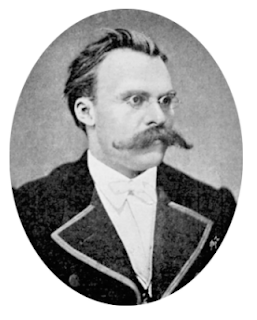
The famous Monty Python "Philosophers' Drinking Song"
Immanuel Kant was a real pissant
Who was very rarely stable
Heidegger, Heidegger was a boozy beggar
Who could think you under the table
David Hume could out-consume
Wilhelm Friedrich Hegel
And Wittgenstein was a beery swine
Who was just as sloshed as Schlegel
There's nothing Nietzche couldn't teach ya
'Bout the raising of the wrist
Socrates, himself, was permanently pissed
John Stuart Mill, of his own free will
On half a pint of shandy was particularly ill
Plato, they say, could stick it away
Half a crate of whiskey every day
Aristotle, Aristotle was a bugger for the bottle
Hobbes was fond of his dram
And René Descartes was a drunken fart
"I drink, therefore I am"
Yes, Socrates, himself, is particularly missed
A lovely little thinker
But a bugger when he's pissed
Performed first in 1973 by Graham Chapman, John Cleese, Terry Gilliam, Eric Idle, Terry
Jones and Michael Edward Palin.
I've shared this drinking song before, but it seems worth repeating, and I've added some images of the philosophers in the song. I'm sending this to the bloggers at Elizabeth's weekly blog party who share what they are drinking. We can all use a little humor, so it’s fun to revisit the Monty Python oeuvre.
In the year 1287, a manuscript was published that included the first recorded version of a classic student song titled "Gaudeamus Igitur." It's a cheerful meditation on the brevity of life and the need to enjoy it while one can. The medieval manuscript with the first reference to the song is in the National Library of France. Some of the lyrics in it are similar to a few of the very numerous verses of the song as it is still sung: for example in the video above, by students at the Jagiellonian Universtiy in Krakow, Poland in the Youtube-presented pandemic singing exercise from last spring. The sentiment of the song somehow seems very apt for the current global threat to long life and carefree youth!
The best-known verse, in Latin, which you may recognize from some almost-forgotten high school class:
Gaudeamus igitur
Iuvenes dum sumus.
Post iucundam iuventutem
Post molestam senectutem
Nos habebit humus.
And in translation if you like me have forgotten Latin itself, as well as the high-school class:
Let us rejoice, therefore,
While we are young.
After a pleasant youth
After a troubling old age
The earth will have us.
Many references to the song have appeared throughout history -- sung when students got together to drink beer or wine — or when glee clubs and singing groups met and sang student songs. You thought college drinking was a recent phenomenon? Think again!
A bit more history comes from Wikipedia (of course):
"The first appearance in print of the present melody was in Lieder für Freunde der Geselligen Freude ("Songs for Friends of Convivial Joy"), published in Leipzig in 1782, together with Kindleben's German lyrics; however, the tune was evidently well known before this date. The first publication of the present Latin text together with the present melody was probably in Ignaz Walter's 1797 operatic setting of Doktor Faust. It is also heard in Berlioz' Damnation of Faust." (source)
Many other classical composers wrote versions of the song, or included snatches of the melody in other compositions, including Johannes Brahms, Franz Liszt, and Johann Strauss. The Wikipedia article includes an incredibly long list of films, popular songs, and other entertainments where the tune or the words have been referenced.
According to the Williams College Alumni site: "'Gaudeamus Igitur' is one of the oldest 'college songs' in the Western Hemisphere and has a long history of association with many colleges and universities. Though the Latin text, the occasions at which it is often performed, and the quality of the melody give the song a formal air, it is in fact a light-hearted take on university life." (source)
But for something completely different, here's the Monty Python Philosophers' Drinking Song:
Immanuel Kant was a real pissant
Who was very rarely stable
Heidegger, Heidegger was a boozy beggar
Who could think you under the table
David Hume could out-consume
Wilhelm Freidrich Hegel
And Wittgenstein was a beery swine
Who was just as schloshed as Schlegel
There's nothing Nietzsche couldn't teach ya
'bout the raising of the wrist
Socrates, himself, was permanently pissed
John Stuart Mill, of his own free will
On half a pint of shandy was particularly ill
Plato, they say, could stick it away
Half a crate of whiskey every day
Aristotle, Aristotle was a bugger for the bottle
And Hobbes was fond of his dram
And Rene Descartes was a drunken fart
"I drink, therefore I am."
Yes, Socrates himself is particularly missed
A lovely little thinker, but a bugger when he's pissed
Here are the Monty Pythons singing it at the Hollywood Bowl, with repeats and audience participation:
Are you in principle opposed to alcoholic beverages? Then I guess this post isn't for you. Sorry. Also sorry if you aren't a Monty Python fan. I'm neither a big drinker nor a teetotaler. But I'm definitely a big Monty Python fan!
"Mr. Parker was a bachelor, and occupied a Georgian but inconvenient flat... for which he paid a pound a week. His exertions in the cause of civilization were rewarded, not by the gift of diamond rings from empresses or munificent cheques from grateful Prime Ministers, but by a modest, though sufficient, salary, drawn from the pockets of the British taxpayers. He awoke, after a long day of arduous and inconclusive labor, to the smell of burnt porridge." (Dorothy Sayers, Whose Body, Pocket Book edition, p. 65)
It's easy to see how much Parker, the plain-clothes detective, differs from the very aristocratic Lord Peter Wimsey, star of the Dorothy Sayers mystery series. Lord Peter's wealth and privilege allow him to regard detecting as an amusing hobby. He enjoys life in a luxurious flat with an attentive personal servant, his valet Bunter. He can even afford to support Bunter's hobby of photographing crime scenes, buying Bunter cameras and darkroom equipment and leaving the valet's time free to develop his photos, though of course always photos of use to himself. In contrast, Parker can barely afford a decent breakfast.
While Parker is getting ready to eat his porridge -- clumsily prepared by his daily char woman Mrs. Munns -- he contemplates the "sordid absurdity of the human form." Before he gets to the porridge, though, he receives a phone call. It's Bunter with the message: "His lordship says he'd be very glad, sir, if you could make it convenient to step round to breakfast."
Sayers continues: "If the odour of kidneys and bacon had been wafted along the wire, Parker could not have experienced a more vivid sense of consolation." Parker's anticipation highlights difference between an aristocratic and a lower-middle class breakfast. Parker hurried to Lord Peter's flat, viciously saying to Mrs. Munns who was making bad tea: "You can take the porridge home for the family." On the social ladder in an English mystery story, there's always someone lower down. And when Parker arrived at Lord Peter's house, "Mr. Bunter served him with glorious food, incomparable coffee, and the Daily Mail before a blazing fire of wood and coal." (p. 65-66)
The culinary contrast between the social levels of the two detectives had come up the previous day while Parker was continuing his analysis of a complex murder and disappearance and eating "a plate of ham sandwiches and a bottle of Bass." Leaving Parker at work on the case, Lord Peter went to a restaurant named Windham's to meet a friend. I suspect that Sayers believes her readers will recognize this dining establishment; obviously I don't. The menu there clearly doesn't tend towards ham sandwiches and Bass! Lunch at Windham's, in fact, is consommé Polonais; a filet of sole; "the Montrachet '08" about which Lord Peter complains; and a salmis of game, which he declares "not bad." He also complains about a bit of cork in the wine glass. The Montrachet by the way, is from 1908 -- this mystery takes place in 1923! (p. 56-57)
Lord Peter's lifestyle, as portrayed in these small food scenes and throughout the book, might now, nearly 100 years later, be seen as immature and irresponsible. His nonchalance about work led me to suspect that he was very young -- but I now know that in Whose Body he was around 32 years old, just still without mature responsibilities! Moreover, in The Unpleasantness at the Bellona Club (which I wrote about here) he was in his late thirties.
Food characterizes yet another random possible witness: "The Indian Colonel on the first floor was loud but unexpectedly friendly," Parker reports to Lord Peter as they are finishing breakfast. "He gave me Indian curry for supper and some very good whiskey." (p.68)
Monty Python's Cheese Shop didn't have any named cheeses either.
As Whose Body continues, Lord Peter again suffers for the sake of his detecting hobby when he has to eat in Salisbury in a dining establishment not at all up to his standards. "As he sat sadly consuming that impassive pale substance known to the English as 'cheese' unqualified (for there are cheeses which go openly by their names, as Stilton, Camembert, Gruyère, Wensleydale or Gorgonzola, but 'cheese' is cheese and everywhere the same), he inquired of the waiter [about a person of interest in his case]" (p. 80) Reminds me of the Monty Python cheese shop episode.
The most extreme example of food in relation to class concerns the missing man in Parker and Lord Peter's case: Sir Reuben Levy, a Jewish businessman. Levy is married to a woman once known to Lord Peter's mother, the Dowager Duchess. Needless to say, the wife's long-ago marriage to a Jew had caused quite a bit of objection among the antisemitic upper class to which she belonged. The Dowager Duchess speaks of this couple at some length:
"I used to know her quite well, you know, dear, ... when she was a girl. Christine Ford, she was then, and I remember so well the dreadful trouble there was about her marrying a Jew. That was before he made his money.... she fell in love with this Mr. Levy and eloped with him. ... I'm sure some Jews are very good people, and personally I'd much rather they believed something, though of course it must be very inconvenient, what with not working on Saturdays and circumcising the poor little babies and everything depending on the new moon and that funny kind of meat they have with such a slang-sounding name, and never being able to have bacon for breakfast." (p. 42-43)
Clearly Sayers, like her contemporary Agatha Christie, has a lot of casual antipathy towards Jews, based on half-truths and general prejudice -- and absolutely incorporates food stereotypes into the mix. I really wonder what she was referring to by "that funny kind of meat they have with such a slang-sounding name." I looked around on the web, and this passage is often quoted but the funny kind of meat is never explained.
From the rest of Sayers' portrayal of the character of Sir Reuben Levy, I would say that the Dowager Duchess reflects the author's own attitudes towards Jews -- purportedly well-meaning, badly-informed, and carelessly prejudiced. Agatha Christie can be even worse. Quite a lot has already been written about the prejudices reflected in these two famous mystery authors, but I'll end my say-so here. I wonder, as a Jew, why I tolerate their outdated bigotry instead of finding some other mysteries to read, or instead of watching the cleaned-up TV versions!