Showing posts with label Leah Chase. Show all posts

Saturday, November 18, 2017

Saturday Night Supper: Meatloaf

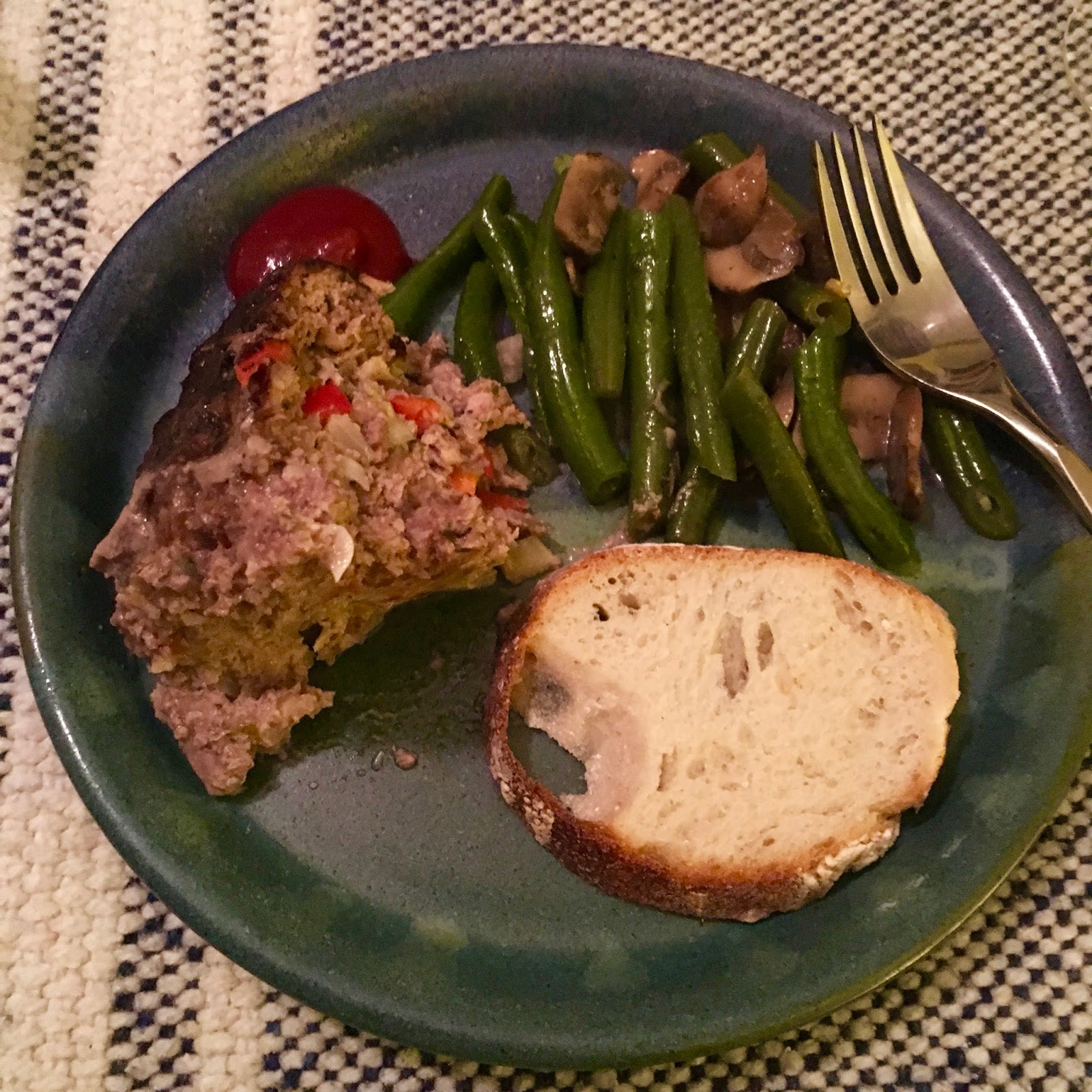
Meatloaf is something I rarely make, but tonight I decided to do it. I also made green beans with mushrooms.
I was thinking of meatballs, but I decided to find and follow a real meatloaf recipe!
I chose the recipe in the Dooky Chase Cookbook by Leah Chase.
I substituted red bell pepper for green pepper, and keffir for Pet milk.
Otherwise I made the recipe pretty much as it appears on the page above.
It's hard to take a photo of a meatloaf in a baking dish! But it was quite tasty.
Leah Chase's restaurant in New Orleans is famous for its cooking, as well as for having
been a gathering place for Civil Rights activists over the years. I've written about her,
about the cookbook, and about the restaurant before. 

Wednesday, December 03, 2014

Louisiana Cookbooks for Cookbook Wednesday

My favorite Louisiana cookbook is The New Orleans Cookbook by Rima and Richard Collin, first published in 1975. It begins with lists. First, ingredients -- alphabetical from Absinthe through Tabasco, Tomatoes, and Yam. Second, techniques from Boiling to Smothering. Its recipe organization is just as indicative of the unique New Orleans cuisine: Chapter 1, Gumbos and Soups; Chapter 2, Red Beans and Rice! and Jambalya; then chapters titled Crabs, Crawfish, Oysters, Shrimp, and so on until Desserts and Drinks. I've written about New Orleans and Louisiana cookbooks before, starting with this, and I've based today's post on my earlier ones. 

The New Orleans Cookbook's illustrations of historic food ads, restaurants, and menus are fascinating, and the descriptions are lushly appealing:
"The steaming aroma of fresh caught crabs, shrimp, and oysters; the smell of butter and flour browning slowly in a large iron pot over an open fire; the sizzle of freshly chopped onions, green peppers, and 'shallots' added at just the moment the flour and butter turn a rich brown; the scent of chicken or duck slowly cooking into the mixture of onions, vegetables, and roux; the taste of good fresh okra or exotic sassafras -- this adds up to a good Louisiana gumbo." (p. 15)
For simpler home cooking, people from Louisiana recommend River Road Recipes, which is published by the Junior League of Baton Rouge, LA. It's another book with staying power. The number of copies was already in the hundreds of thousands when I bought one of 20,000 copies in the forty-fourth printing (November 1976).

My copy of River Road Recipes is yellowed and marked up. First, there's a little red check-mark next to many recipes, indicating the favorites of a woman we met in Baton Rouge (the mother of my brother's college friend). She recommended, for example, the Sauce Meuniere or Remoulade Sauce (p. 119) on trout. Over the years I've tried a large number of cakes and cookies from this book, and found most of them quite nice. As in many charity collections, some of the contributors were much more skilled at cooking, baking, and recipe writing than others.

Both of these books reflect the old-style Creole, Cajun, and New Orleans traditional cooking styles. Just reading through them is a fascinating reprise of one of our rapid trips into the city, when I seem to recall we ate three large meals between noon and evening, because our host wanted us to sample everything we possibly could. The dish that most impressed me was the bread pudding with rum sauce at a little home-style restaurant a bit away from the tourist area, but I've never had another bread pudding that delicious again.

Evelyn's Gumbo from Tiana's Cookbook: 
Evelyn says the recipes are good & amazingly easy to follow!
Another New Orleans cookbook in my collection is a spin-off of Disney's film "The Princess and the Frog." 

Tiana's Cookbook: Recipes for Kids,
includes quite a few serious recipes that kids may like to eat, but it takes a grownup to really cook them. Tiana's two most special dishes: beignets, which are deep-fried and gumbo.

There are also some very Disney things such as cupcakes frosted to look like frogs and a cake made in the shape of an alligator, which aren't precisely New Orleans cooking, more like Disney movie cooking. I wrote about the movie here: What do princesses eat?


Tiana's Cookbook includes versions of several recipes from another New Orleans classic: The Dooky Chase Cookbook which documents the life and recipes of Leah Chase, owner of the Dooky Chase restaurant in New Orleans. Leah Chase was a source of ideas for Disney studios when they planned the movie.

I did a full review of this fascinating cookbook and memoir in two posts -- Leah Chase: New Orleans Princess and Cooking.

The Louisiana Seafood Bible is the title of a series of cookbooks by Jerald and Glenda Horst. There are separate volumes for oysters, clams, crayfish, and two for fin fish, of which I have the first volume. There's an encyclopedic coverage of all types of information about fish, and lots of recipes. I've been meaning to try some of the recipes, but so far I have not, and I haven't written about it.


Finally, Tom Fitzmorris, a food journalist with a widely followed radio show originating in New Orleans, provided a great overview of the fascinating cuisines of New Orleans, along with a selection of recipes. When my culinary book club read his Hungry Town: A Culinary History of New Orleans, I'd never heard of him, but I read his book with enthusiasm. I wrote much more about this book here: "Hungry Town": All About New Orleans.

I liked Fitzmorris's view of food, food fads, food celebrities, and food hype. His observations of trends that started in New Orleans and were misappropriated elsewhere are interesting -- blackened redfish would be one of them. I've definitely eaten some bad burned fish as a result of that fad, and he suggests that I can't blame the originators as much as the pathetic imitations.

Again, this post celebrates both the wonderful food of Louisiana and New Orleans, and Cookbook Wednesday as invented by Louise at Months of Edible Celebrations.

Saturday, September 11, 2010

Cooking

dookey4070

At the farmers' market today I bought ingredients for trying out recipes from my new Dooky Chase Cookbook. (See my post on the book from a couple of days ago: Leah Chase, New Orleans Princess).

From Ernst Farm I bought chicken gizzards, from other favorite market stalls I bought green pepper, onion, and corn. I didn't find celery or other chicken at the market, but bought them elsewhere -- and above you can see that I made the very exotic dish "Giblet Stew" (p. 35). It was delicious, spiced with thyme, paprika, and parsley.

dookey4072


dookey4073

I have some okra from the market in reserve for another of Leah Chase's Creole recipes. And earlier in the day, for lunch we had a more usual salad of red and yellow tomatoes, basil, and yellow pepper from the market. We have apples, a disappointing melon, and some leeks that I already made into leeks vinaigrette. The Ann Arbor Farmers' Market strikes again!

Friday, September 10, 2010

Leah Chase, New Orleans Princess

The Dooky Chase Cookbook documents the life and recipes of Leah Chase, owner of the Dooky Chase restaurant in New Orleans. Her father-in-law, "Dooky" Chase, founded the restaurant in 1941, at a time when black people in New Orleans had few places other than home where they could sit down to a meal -- after years of selling lottery tickets door-to-door, Dooky Chase opened a "meager po'boy stand" where he sold both lottery tickets and food. She writes:
"With 'Dooky,' Sr., being so popular with the lottery and his wife, Emily, being such a good cook, before long they were outgrowing the little corner. Five years later the lottery passed from the scene but the shop was still a popular place to go. It was the only place of its kind for black people at the time." (p. 7)
Leah Chase's involvement with the family business started years later, but eventually she became the soul of the restaurant: owner, chief cook, and important local personality. During the Civil Rights era, the restaurant became a meeting place for activists as well as being popular with New Orleans establishment figures. Recent high-profile visits to Leah at her Dooky Chase Restaurant by George Bush and Barack Obama, and her long struggle to reopen after Hurricane Katrina are part of the story, but those events were long after she wrote the book. I enjoyed reading her description of her girlhood and her food memories, which interspersed with detailed recipes, which I look forward to trying.

Vegetables, for example, were the main dish for most family meals in the country atmosphere where she grew up. The family just couldn't afford much meat, though her mother loved fishing for perch and similar fish in local waterways, which were far from the sea.

"Coming up in the depression days," she wrote, "Daddy always planted everything. He planted greens, okra, and onions." The kids in the family had a lot of work to do, and she was often unhappy when her Daddy insisted on giving away tomatoes or onions that she had worked hard to cultivate. She's anything but nostalgic for her early labor:
"If you have ever grown vegetables yourself, you don't care if you grow another one in your life. I'd just as soon go down to the French Market and buy it off some vendor. Some of my sisters still grow herbs for me, but I don't care if I never grow another thing. Farming has got to be the hardest thing in the world. Having grown vegetables does make you more conscious of the quality of the things you are buying, though. There is nothing like fresh vegetables." (p. 168)
Since the original publication in 1990, Leah Chase has written another cookbook and also has been interviewed as a model for Disney's Princess Tiana, whose dream of owning her own New Orleans restaurant is a key plot item in the movie. Leah Chase is credited with one of the recipes in the tie-in cookbook -- which to our great surprise is actually a fantastic source of recipes:


For my previous posts on New Orleans cooking see: New Orleans Cookbooks, Alice's Birthday Cake, and What do princesses eat?