Showing posts with label Norway 2015. Show all posts

Friday, December 15, 2023

Reindeer

Christmas reindeer in my neighborhood

A reindeer in my neighbor’s yard last year — the whole ensemble of decorations is back now.


This Rudolph’s antlers should be around 4’ high.

Live Reindeer

Guess why I'm thinking about reindeer? I find reindeer to be a fascinating species that I’ve seen a few times. Here are some reindeer photos of actual wild animals that I've seen in the Arctic. My photos were taken inside the Arctic Circle.

A reindeer in Greenland, 2022. Both male and female reindeer have antlers.

A reindeer grazing on small tundra plants in Svalbard, 2015

Reindeer in the snow, Svalbard, 2015. These reindeer are smaller than those in other places, and especially well-adapted to the brutal climate this far north.

You can ride a sleigh behind a reindeer.

In the northern part of Finland, domestic reindeer are very common, and used for tourist transportation. 
I have never been there or done this. (source)

Santa's reindeer made their first appearance in 1821.

Probably the first image of Santa with reindeer (says Wikipedia) was in an anonymous publication titled "The Children's friend. Number III. A New-Year's present, to the little ones from five to twelve," published in 1821. The solo reindeer, shown parking Santa's sleigh on a rooftop, was unnamed.

Source: Wikipedia on Santa's Reindeer

Shortly after this, in 1823, came the famous poem "A Visit from St. Nicholas" by Clement C. Moore. Actual surveys show that a huge percent of Americans have the entire poem memorized!

The number of reindeer is eight, and they have names -- all of which most people can't remember, can you? Just in case, here's the list from the original poem:

Now! Dasher, now! Dancer, now! Prancer, and Vixen,
On! Comet, on! Cupid, on! Dunder and Blixem;
To the top of the porch! to the top of the wall!
Now dash away! dash away! dash away all!

Santa's sleigh with eight reindeer as invented by Moore in "A Visit from St. Nicholas"

For much much more information on the poem see "The Story Behind the Most Famous Christmas Poem of All" by Paul Hond.

One More Reindeer

Based on a book by Robert L. May from 1939, this record by Gene Autry was the number one hit at Christmas in 1949, and it's been a Christmas classic ever since.

Back to my neighborhood


A neighbor’s banner connects to the original reindeer story.

Reindeer have been playing a part in a completely different area of popular culture lately as well — TV crime dramas set in Lapland among the villages where the reindeer live. See this article: “Reindeer noir, the Finnish crime sub-genre influenced by Santa’s home town.” I’m intrigued!

UPDATE:One More Reindeer


Original photos © 2015, 2022, 2023 mae sander

Thursday, April 02, 2020

"You go out and talk to the dogs."

Suddenly, isolation is the reality of large numbers of people throughout the world -- and others are subject to great risks because they aren't isolated. As we adapt to this new and possibly rather long term reality, I've been thinking about the experience of many farmers, ranchers, explorers, pioneers on the frontier, long-distance solo sailors, and others who have lived in social isolation for various reasons in the past. Many of such individuals or families lived truly without contact, without the ability to obtain new food and supplies, and often faced dangers that we simply aren't going to encounter. Seemingly the only danger to us not them is contagious disease. 

Here's a little sketch of a person with this type of experience that we met a few years ago:

Kenneth Monsen onboard the Explorer, 2015.
Kenneth Monsen, a Norwegian naturalist and expedition guide, was one of the memorable staff members we talked to onboard the National Geographic Explorer on our trip to Svalbard in 2015. Kenneth lived for a winter with his wife in an isolated trapper cabin on one of the Svalbard islands. In a fascinating illustrated presentation he described how they traveled to their temporary home, gathered wood for the winter, trapped and hunted for food, managed their dogs, enjoyed the coming of light at the end of winter, and generally how they lived as much as they could in the old ways. Besides the danger of the extreme cold, they also risked attack by polar bears, which are terribly dangerous animals. I think they had a radio for emergency use, but no regular communication with the rest of the world.

We asked if trappers or couples like him and his wife, living together in close quarters, ever became violently angry with each other. Kenneth said 
"When you feel that way, you go out and talk to the dogs."
The Monsens' winter in isolation was several years before we met him on the ship. By the time we met him, Kenneth and his wife and children were living on a farm outside of Oslo. On the farm, they raise sled dogs for racing, and Kenneth served as a guide on National Geographic voyages like ours.

A cabin on the tundra in Svalbard used by trappers until polar
bear hunting became illegal in 1973.
Right now we are keeping ourselves distant from society in hopes that we can escape the growing danger from the coronavirus. But unlike people living in other isolating situations, as well as unlike many less fortunate souls in our society and in other countries, we have many advantages. We have ways to get at least emergency medical care if we need it. We can exchange emails and have other electronic interactions with our friends and family throughout the world as well as having access to news and entertainment on TV, ebooks, and online. We make contact, though at a distance, with neighbors. We are enjoying freedom from hunger, with several ways to get food and supplies and to cook, and we have a warm, large house to live in. We owe a lot to the people who are still taking dire risks so that we can have these advantages. We have a lot to be grateful for, not just freedom from polar bears!

A polar bear on the ice pack, from the Explorer, 2015.
Blog post and photos copyright © 2015 & 2020 by Mae Sander 
for maefood dot blogspot dot com.

Wednesday, July 01, 2015

Wrap up: Food in Norway

Outdoor dining on the ship -- cold!
Throughout the trip to Norway we enjoyed wonderful food at restaurants, breakfast buffets in hotels, and breakfasts, lunches, dinners, teas, barbecues and other meals both outdoors and indoors on the National Geographic Explorer. We ate lots of fish dishes, open-faced sandwiches, dairy products, bacon-and-egg breakfasts, exotic game like reindeer and seal meat, and other dishes that met our expectations for Norwegian cuisine. But when I asked one of the Norwegian guides to name their national dish he said "pizza"!

German sausage with Norwegian beer: another cold day for eating outside on the deck.
Reindeer stew: among the many types of game
we tasted on the ship and elsewhere.
Every meal on the Explorer was delicious, and the extra barbecues at 4 in the afternoon, such as the reindeer stew or German sausage, were an amusing extra meal. I was surprised when the chef told me that they had no set menu, but figured out what to cook day-by-day, depending on what their suppliers had provided for that particular voyage and what he and his line cooks thought of making. The staff and crew, he said, ate the same food as the passengers, except for the Filipino deck hands and maids, who had their own cook to prepare their own ethnic foods.

Waffles with sweet brown cheese --
a Norwegian snack at the kennels we visited in Longyearbyen.
Midsummer appetizer on shipboard, including smoked fish with dill,
half a small potato, cumin cheese etc. Served with two flavors of
Aquavit and wine chasers.
As one would expect in a country with all those fjords and islands and fishing villages, fresh fish, cured fish, and shellfish like shrimp dominate buffets and menus. Norwegian fish soup, which we had a couple of times, has a light cream broth, dill flavor, and generous chunks of salmon and white-fleshed fish and sometimes shellfish. Open sandwiches are piled with tiny shrimp and mayonnaise.

We helped ourselves to heaps of large shrimp and spiny lobsters at a lunch buffet in a hotel in Longyearbyen. Salted and dried cod created delicious main courses on many dinner menus, as did a large number of fresh fish. Breakfast buffets consistently offered several types of smoked salmon, other types of smoked and salted fish, and several varieties of herring, as well as the usual sliced meats, cheeses, and lovely whole-grain breads. I was always disappointed that I was unable to eat everything.

Fish soup in a courtyard restaurant in Oslo.
Potatoes garnish almost every dinner plate. Hash browns or roasted potatoes appear on the hot breakfast buffet along with the many types of egg dishes. Boiled potatoes and other root vegetables are almost always served with fish. I tasted several types of cold potatoes or potato salads with mayonnaise and often with dill. French fries seemed less common, but that's probably because we were eating in high-end places.

"A typical Norwegian dinner apparently hadn’t changed much in the past thousand years: a hunk of fish, plated beside a boiled potato, both served with only butter. ... the great Norsk storyteller Odd Børretzen invites the Lord to come down from heaven and 'have a potato' with him." So said a recent article in the New Yorker -- with shocking inaccuracy or maybe just with New-Yorker style humor. Actually the new-world potato arrived in Norway in the mid-18th century, not in the dim mists of imaginary history: but when you eat there it does feel as if potatoes have been on the menu for 1000 years! (At any rate, I checked out the intriguing Odd Børretzen, who died in 2012; amazon.com doesn't seem to have any of his works translated into English.)

I didn't systematically take photos everywhere we ate, especially on the ship where I was usually either tired out from hiking and watching for wildlife or rushed to get ready for the next adventure. Here are a few more examples of what we ate as we traveled:

Braised veal with vegetables, served atop boiled potatoes.
Midsummer dinner on the Explorer.
Oslo has many Asian restaurants. Our one experience
was eating delicious Thai food at a restaurant called Plah.
Stockfish, a type of dried cod, in Anno restaurant in Alesund. 
Beautifully plated dessert on shipboard: cake, ice cream, fruit, etc.
On the Explorer, the daily lunch buffets had a beautiful selection of cakes, creamy desserts like mousse, a variety of fruits, and one day fabulous individual pavlovas with lemon curd. Dinner, with table service, offered a choice of a composed dessert like the one above, a cheese course, or ice cream. Or "all of the above." In restaurants we usually ate too much to order dessert.

Cake at a pastry shop in Oslo.
Our adventure on the island of Runde included not only watching birds but also cooking our own meals.

Kitchen in the apartment in Runde.
When we arrived at the Runde Nature Center where we had reserved an apartment, we asked about the meals that were mentioned on their website. Oops: it turned out that meal service started two days later; we were in advance of the season. To get groceries, we had to drive to another island, crossing over three bridges via some very sketchy directions to a supermarket "in a building that used to be a fish-processing plant." Luckily we found the recommended supermarket, which was in a tiny town called Fosnavåg. Cooking in the apartment kitchen, we had bread and jam and orange juice for breakfast, a ready-made meatball dinner, a variety of sandwiches, potato chips, and fruit.

Bread with a logo in our Runde kitchen.
We even invited some acquaintances (a Dutch couple who took a boat tour of the island with us) to have a cup of coffee and some cookies in our temporary kitchen. They were happy to be inside our warm apartment for a while, as they were living in their camper as they toured Norway.

Len talking to our Dutch friends as we waited on the tour boat.
This wraps up my blogging about our two weeks in Norway on land and at sea, unless I think of another subject to write about. Links to documentation about our wonderful trip:
  • For Len's wildlife photos on Flickr, CLICK HERE.
  • For all my posts about our Norway trip on my travel blog, including posts about reindeer, the tundra, and a map, CLICK HERE.
  • For all food blog posts about Norway, including this one, CLICK HERE.
  • For the Lindblad Expeditions daily trip reports, CLICK HERE. (You will see the first post and can continue to go through them.)

Monday, June 29, 2015

Bird-Nesting Colonies


The vast numbers of birds in Arctic nesting colonies is overwhelming. Hiking at various places in Svalbard we saw a colony of kittiwakes, as shown above, and also a colony of dovekies (little auks). One morning on the ship, we approached a colony of Brunnich's guillemots (thick-billed murres). On the island of Runde, where we visited before our cruise, we saw two colonies: puffins and gannets.

Gannet colony at Runde.
As we approached each colony, whether by hiking or by sea, we first heard the racket of bird calls and saw the swirling flights of hundreds of birds. As we came closer, we could see the thousands of nests and roosting sites in niches or holes in the cliffs and observe a variety of activities in the colony. With binoculars we could view individuals a few at a time. So many birds!

Dovekies Flying
It was foggy as we approached huge cliffs where guillemots nest. We could see birds swimming and wheeling over the water, and slowly could see numerous ledges crowded with birds. The ship approached amazingly close to the sheer face of the cliff looming over us.

Guillemot colony on Svalbard.
Guillemots on the ledge -- streaks of droppings below. Note the egg under the bird just left of center.
Bird nesting colonies are all about food. Most of them are on rocky cliffs with no vegetation or other sources of nutrition for the birds and their chicks. Adult birds fly out to sea to catch fish or find other marine sources of food, returning to their rocky shelves or holes in the ground to lay eggs, keep them warm, and eventually to feed the hungry youngsters.

runde-boat-trip 4
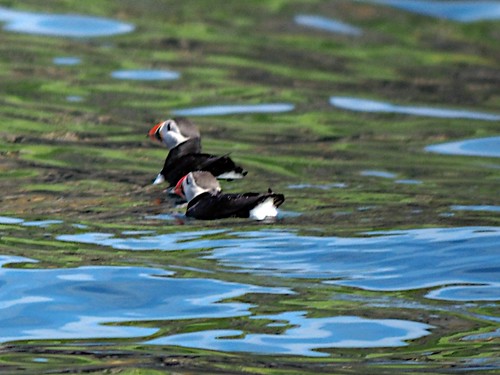
Puffins swimming in the sea near the colony at Runde. They dive down for fish.
runde 5
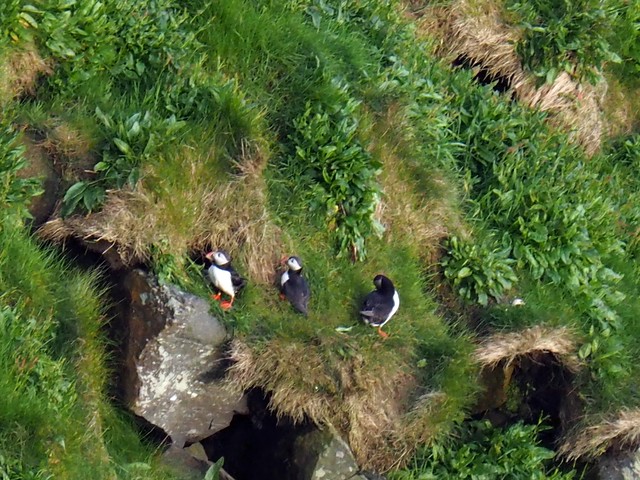
Three puffins at the Runde colony. The birds fly back from the sea and sit near their holes each evening. At around 11 PM the puffins go inside. If you want to see them you walk over the mountain top at 8:30. Runde is not in the Arctic, so the vegetation is much more lush and grassy than in Svalbard.
Kittiwake colony on Svalbard -- tens of thousands of birds.
Predators stalk the birds; thus the marine nutrition can reach members of other species. We saw male birds get into fights over mates, grabbing each other jealously. When the fighting birds spiral down to the rocks, opportunistic glaucous gulls, jaegers, skuas, or foxes are often waiting to grab them. Some younger individuals are not yet ready to nest, but they hang around the colony with the mated pairs. I've already posted a photo of a gull eating a guillemot from the colony we saw.

svalbard-wildlife-1 2
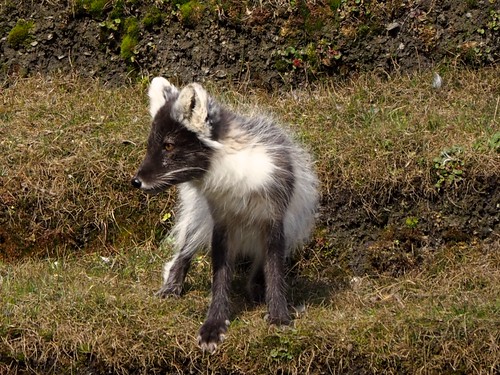
An arctic fox waiting below the kittiwake colony.
A glaucous gull waiting for these guillemots to make a mistake.
Our trip was early in the nesting season; birds were just pairing up or sitting on eggs. Once they hatch, the chicks will be even more vulnerable, and no doubt provide a very attractive source of food for the predators. To avoid predators, chicks leave the nesting areas when they are quite small, pushed down to swim in the safer sea by their parents.

One dovekie in the colony. Note how green the moss is!
As I said in my post about the tundra, moss and grasses below a nesting colony are visibly much greener and more lush than the areas that don't receive nitrogen-rich bird droppings from above. These green areas attract other birds and also reindeer to eat the especially nutritious lichens, so the fish eaten by the nesting birds ultimately feed other species as well.

Sunday, June 28, 2015

Trappers and Whalers in Svalbard

On hikes from the National Geographic Explorer last week we visited several uninhabited islands. After wet landings in Zodiac boats, we walked on the tundra or on snow fields -- visitors are few, so there are no paths to follow, just open land. Birds, harbor seals, reindeer, and a fox were the only living things we saw. However, almost every hike went past at least one wooden cabin or stone building that had been the temporary home of whalers or hunters who spent the winter trapping foxes and hunting polar bears.

Outdoor kitchen: a stove and kettle left by trappers near the kittiwake colony.
A cabin used by trappers until polar bear hunting became illegal in 1973.
The kitchen inside the cabin above.
Researcher groups sometimes still stay in it.
Remains of a trapper cabin.
Trappers frequently used wood to build their huts or cabins. Although no trees grow on the tundra, and the tallest plants are a few inches high, huge logs and dressed planks are piled up on every shoreline, washed across the Arctic by currents from Siberian rivers where logging is done. This wood is critical for both building cabins and for use as fuel to heat them. In older structures if anything remains at all, it's stone...

Stone structure left by whalers, probably centuries ago.
Stone foundation of a whaler hut, including a grave...
A whaler who evidently did not survive his stay on Svalbard. Graves are a common sight where these men once lived.
Whaling was the first commercial activity that brought Europeans up to the Arctic. Svalbard was discovered in the late 16th century, and English, Dutch, and other whalers began to come up frequently, chasing the numerous and valuable whales that inhabit Svalbard's waters. We were lucky to see several blue whales, fin whales, and humpback whales during the voyage.

A blue whale.
Kenneth Monsen, a Norwegian naturalist and expedition guide, was one of the memorable staff members we talked to on the voyage. Kenneth lived for a winter with his wife in an isolated trapper cabin; he gave a fascinating illustrated presentation about how they traveled to their temporary home, gathered wood for the winter, trapped and hunted for food, managed their dogs, enjoyed the coming of light at the end of winter, and generally how they lived as much as they could in the old ways. 

Kenneth Monsen.
Kenneth and his wife and children now live on a farm outside of Oslo where they raise sled dogs for racing. We asked him if trappers living together in close quarters ever became violently angry with each other -- Kenneth said "When you feel that way, you go out and talk to the dogs."

Sled dogs at a kennel we visited on our tour of Longyearbyen. The dogs sleep outside in summer: houses would be too warm for them.
In an interesting structure at the kennel, we enjoyed tea boiled over an open fire,
and Norwegian waffles with brown cheese.
A trapper's kitchen in the museum in Longyearbyen.