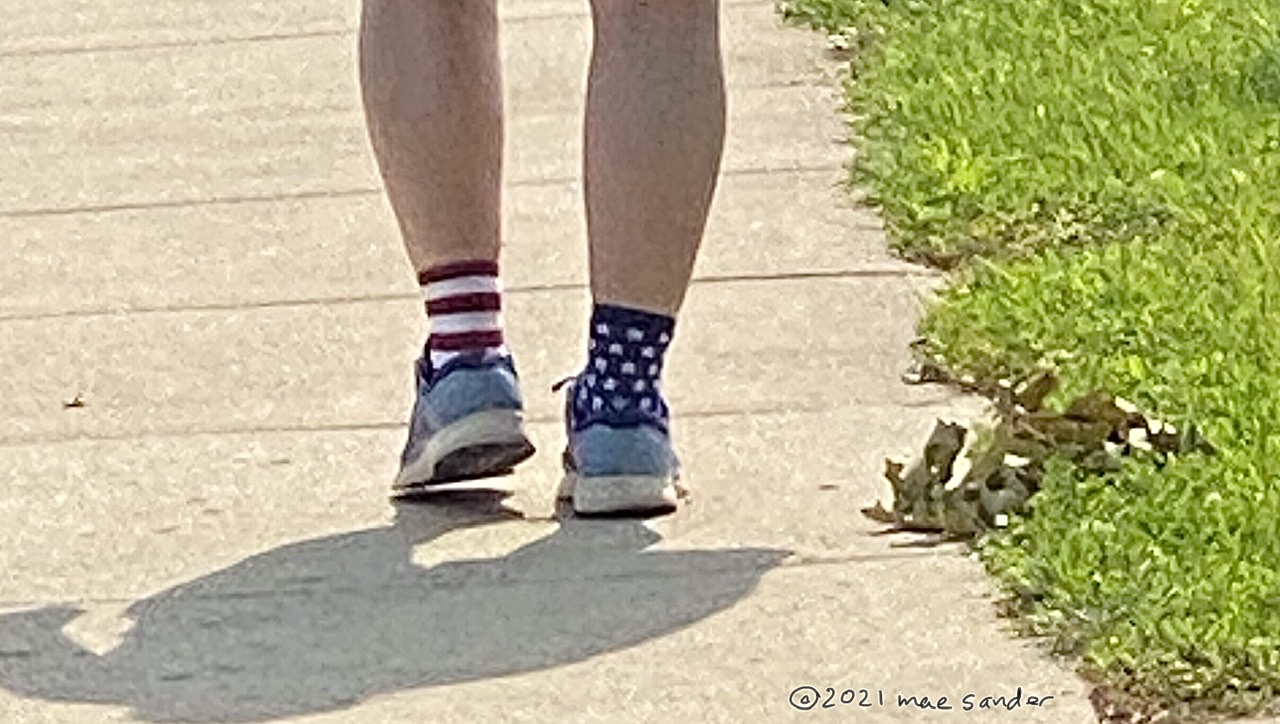
Sunday, July 11, 2021

Around Ann Arbor

Yellow things in the park: a goldfinch near the railroad tracks.


A yellow lane marker for little boats.

A yellow skull at practice.

A yellow flower with a fuzzy bee.


Drone’s eye view of the Huron River.

Spider in my backyard.

In the Arboretum: pink flowers


The Huron River also flows through the Arb, a favorite Ann Arbor spot.

The owners said this white dog doesn’t like to be muddy.
It was drinking from the river in quite a dainty way.


Blog post © 2021 mae sander.

Saturday, July 10, 2021

A Memory of French Life

After one of our long stays in Paris, I wrote down many of my memories of what we had experienced. The following is my memory of a French institution: the Sunday Lunch. We were invited to accompany French friends to their relatives' homes or to homes of other friends, as well as being invited to their house or apartments for this traditional meal. Our two stays took place around 30 and 45 years ago, and I don't know if things have changed. I thought it would be good to share it with this year's blog event Paris in July

Sunday Lunch 

Dining room in our friend Michelle's counry
house near Cotignac, France, 1994.
Imagine that you are visiting in France, and that a French family has invited you for Sunday lunch. This is still a family institution in France. You will probably come at around 1:00, as invited, perhaps with a friend whose family this is. You will find that there are already several women in the kitchen (if it's not too tiny) peering into covered dishes or pots on the stove, discussing the finishing touches on a lamb roast or a sauce, or making the dressing for the lettuce salad that often appears between the main course and the cheese course. Men and guests who aren’t in the inner family circle — such as you — will be talking to each other and possibly drinking an aperitif such as Pastis and water, port wine, or Scotch. You will be introduced to everyone, shake hands, and probably chat for a few minutes until you find out who you have the most in common with, or who is really interested in asking you something about the US and your impressions of France.

The grandmother will be there. She may be so old that her oldest daughter, sitting with her, looks just as old as she does. Or she may be a very young grandmother whose grandchild is a gurgling baby. Friends or relations of various generations will be invited, depending on the occasion, and will be arriving at various times. There will certainly be some teenagers or college-age children or grandchildren around, talking to each other, not talking much to the adults — but somehow always politely to their grandmother. One teenager will certainly have to dash to another event or join some friends somewhere shortly after lunch. Another will go off to do homework.

Lunch at a French country house in 1989.
Our host Jean is at left, next to Len.
The favorite place to have Sunday lunch is at a country house. It may be close or far away from the owners’ normal home. It may be shared by several siblings, or owned by a grandmother and effectively shared by her descendants, especially if it was originally the home of some of the older generation. The furniture will be somewhat old-fashioned, and if the house is really old and hasn’t been improved, the rooms may seem quite dark, and the plumbing may be rather primitive. The kitchen will always clearly be the emotional center of the house -- and usually much larger than the kitchens people have in the city.

Monet’s house at Giverny embodies the French dream of what a country house should look like. His kitchen and dining room must have been the scene of many country lunches on quiet Sunday afternoons. There were certainly meals outdoors — you can see them in paintings at the Musee d’Orsay. I suspect that the French families who line up at Giverny on Sunday afternoon, presumably after such a lunch, are fantasizing about how their family would use this beautiful and tasteful house, as well as looking over the garden where Monet painted the famous water lilies.

In the country, a few families cook on an open fire — for example, several kinds of steaks and chops or skewers with cubes of meat, a few onions, and smoked sausages. A student-aged members of the younger generation may be the one to build the fire, as barbecue is not the patriarchal institution in France that it is in the US. Sometimes various members of the family will bring an appetizer, potato or rice salad, or a dessert to supplement the hostess’s food. More distant guests, such as you, may have brought a bottle of wine.

Monet: The Luncheon (1873)
Even outdoors, there are often china plates with silver or stainless utensils and often cloth napkins, even for a large number of guests. If lunch is in the city or in case of rain or bad weather, there is usually a big dining room or space in the kitchen to serve the entire crowd. Outdoors, folding tables will be set up and covered with tablecloths. Picture everyone seated around the huge table in the beautifully decorated dining room at Giverny, with its yellow-painted chairs, yellow walls covered with Japanese prints, and yellow-rimmed plates and Chinese blue and white porcelain. Sunday lunches, both indoors and outdoors, are also often depicted in French films, so you may want to visualize your favorite actors and actresses around you delicately tasting the dishes and sipping their wine.


Our friend Michelle served this dessert at a Sunday lunch
at her apartment in Paris a few years ago.
When the call “à table” is finally heard, the women will bring out the food, and the host will open a bottle of wine or two, depending on the number of guests. Picture the first course, probably some delicious home-made terrine or special smoked meat or pate; in winter you may have soup, and in summer you may see some perfectly ripe, sliced tomatoes. Someone will cut up the long loaves of bread to be eaten with every course, and men are expected to fill empty wine glasses when they see them. Leg of lamb is very popular for the main dish on Sunday, often served with green beans or potatoes, but there may be a roast beef or the meat that was cooked on the open fire, and another vegetable dish such as ratatouille. Green salad follows, then a platter of cheeses from which you can sample any number. Home-made chocolate mousse or tartes, or a fruit salad, or a selection of such wonders are probably served for dessert. Coffee is served last, separately, with sugar lumps. In some families, the division of the meal into formal courses is somewhat relaxed on Sundays, especially if there are other activities or if a sporting event will soon be starting and the TV is beckoning some of the diners.

During the meal, you will probably discuss the food, the wine, the preparation of food, and other meals comparable to this one eaten in other places. Other topics of conversation vary of course depending on the interests of the guests. The teen-agers and students may tell about what they are doing. 

Very young children learn politeness and table manners at such meals; they are often expected to sit patiently throughout a great deal of the meal and to try each course. Children in France seem to lack the resistance to vegetables and to mixed dishes that American children get by with. However, for impatient or uncooperative children there may be an indulgent aunt or grandmother who will let them go directly to the dessert or will let them go away and play. 

At the end of the meal, there are a lot of plates, wine glasses, and utensils to be washed, dried, and put away. Electric dishwashers are now quite common in French country houses, probably because there are so many meals of this sort; otherwise several of the women and possibly men will go off to the kitchen to take care of the clean-up. Monet’s kitchen had a huge sink where I imagine the servants washed up, but I have never seen any sort of servant in a modern French home.

Blog post © 1991, 2021 mae sander. 

Friday, July 09, 2021

Food, Wine, Climate Change

A very important issue: food!

At the start of the pandemic it became clear that our systems of food production, processing, distribution, and reliability were quite fragile. However, as we Americans lived through the pandemic nightmare, our systems actually proved to be pretty resilient! The early problems with sick workers, sudden changes in demand (from restaurants to mainly home meal preparation), panic buying, glitches in the trucking industry, and many other issues seem to have been resolved. Retail food sources and restaurants figured out how to deliver food orders to consumers without requiring dangerous in-person pickups. Farmers and food processors produced products that were useful at home rather than in restaurants, schools, or business cafeterias. Lots of other changes made it easier to cook and eat at home, and people adapted. Finally, large-scale immunization has allowed safe working and shopping. By now a lot of us have probably forgotten the details of how we made it through!

Prices have gone up as the many problems with food production and distribution have occurred; however, aggregate American food prices have risen only around 2.2% in the past year, with variation, of course, in individual products. (source). Many other problems still exist: for an in-depth look at the American food system, see the report from the organization Food and Water Watch: "Well-Fed: A Roadmap To A Sustainable Food System That Works For All."

Although the USA may be doing pretty well, the world's food supply is still fragile for many reasons. In particular, global food prices are rising due to a variety of causes, and high prices are much more harmful to the vast numbers of people living in poverty. Further, the pandemic, we must remember, is ongoing in many regions where vaccination programs have not been widespread. 

Thus, the rest of the world isn't doing as well as the USA. According to the Washington Post: "Surging global food prices put staple meals out of reach, from Nigerian jollof rice to Russian pasta and Argentine steak." This article provides a lot of statistics:
"The U.N. Food and Agriculture Organization said its food price index, which measures the global price of select foods, had in May hit highs not seen since 2011, up 40 percent year-on-year.

"A variety of factors are to blame, including a surge in orders from China, fluctuating oil prices, a sliding U.S. dollar, and looming above all: the pandemic, and in some places, reopening."

The Food Supply and Climate Change

A new reason to worry about global food production and supply is looming before us. Climate change has quickly gone from an issue we can ignore to something that indisputably affects large numbers of people. Major heat waves have devastated large areas of western North America this summer, and many problematic weather situations have emerged in other parts of the world. For example:
"Heat can cause havoc with crop production. In Bangladesh, just two days of hot air in April this year destroyed 68,000 hectares of rice, affecting over 300,000 farmers with losses of US$39m (£28m). New heat-tolerant varieties of crops need developing and deploying. The alternative is higher food costs and food price spikes with the increased poverty and civil unrest that typically accompanies them." (Guardian"Canada is a warning: more and more of the world will soon be too hot for humans" by Simon Lewis)

The ramifications of global climate change are already being felt in the third world. This is  a very complex problem, with complex consequences, and the solution, if any, is unclear. Where will we all live? What will we all eat? How will we all survive? Or will we?

... and Wine

As I think of all these brain-busting global problems, my mind turns to all the beautiful vineyards I have visited over the years, and I wonder how climate change will affect them. We have always enjoyed visiting these wineries and vineyards, and love to drink wines from many sources. Maybe this is frivolous, but here are some details I've found.

A vineyard we visited near Santa Barbara, California, in 2014.
"California is at the frontline when it comes to rising temperatures and natural disasters and the pressure is on to find workarounds," according to an article titled "Climate Change Threat to Wine Regions." Droughts, wildfires, and changing rain patterns are all challenging the California wine industry to adapt to new conditions, but so far, they are adapting rather well. Of course we have been horrified when reading of the vast fires that destroyed many acres of vines and winery buildings in the Napa Valley, another place we have enjoyed visiting for many years.

UPDATE: Detailed article about impact of fires on Napa Valley wines:


A vineyard near Martinborough, New Zealand, in 2007.

We had a wonderful tour of the Martinborough wine country, near Wellington, while visiting New Zealand some time ago. We also could see the vineyards of the more famous Marlborough wine region from a train as we traveled through the South Island. New Zealand's climate is much affected by global climate changes:

"In Marlborough, the climate has not only got hotter but has slowly shifted from a clean, dry heat to one with more humidity, which is encouraging diseases like mildew to thrive. Due to its flat topography and proximity to the sea, another threat to the region is sea-level rise. ... 
"Martinborough is also set to change. As reported to local New Zealand news outlet, Stuff, the winemaker Clive Paton at Ata Rangi in Martinborough has long been planting grape varieties better suited to the heat and feels both Syrah and Tempranillo may become increasingly valuable players." (source

We also toured some wineries in Australia on a trip even longer ago -- but tragically, one of the vast and horrific fires there destroyed the area where we toured. I read this: 

"Although Australia is definitely on the frontline when it comes to climate change, it is also ahead of the curve in searching for ways to combat these issues and find solutions, whether it be experimenting with new vineyard sites or grape varieties." (source

Our friend Michelle's vineyard near Cotignac, France, 1994.

French vineyards have been experiencing unusual and very damaging weather fluctuations this year. In particular, the early spring was unseasonably warm, but then an extreme cold spell damaged the budding grape vines. Between 25% and 50% of the 2021 French wine crop could be lost because of these early changes. Such episodes are expected to become more common; moreover, the harvests have been coming in earlier and earlier in the past decade because of climate change. An article titled "French vineyards devastated by changing climate reportedly expect to lose up to 50% of their crops this year" summarized this difficult situation. 

Our tour guide with a map of the Washington vineyards in 2018.

A few years ago, on a trip to Seattle and the area, we toured some of the wineries near there which make wine from the grapes grown in Western Washington State. I'm particularly wondering how these growers are handling the record-setting heat wave and drought that's everywhere in the Pacific Northwest now.

The extreme heat this year fortunately came after the critical flowering stage of grape growth, and the harvests this year may be nearly unaffected. However, the future is delicate, and continued excess heat may alter the region's grape-growing capacity. An article in Time Magazine, "Pacific Northwest Wineries Are Shaking Off the Extreme Heat Wave, But Are Worried What It Means for the Industry’s Future," discussed the issues. Author Megan McCluskey interviewed Oliver May, the manager of Discover Vineyard in the Horse Heaven Hills. He says that while growers tend to prefer hot years, there’s a limit to what any grapevines can take:

“With the drought situations that are happening across the West right now, it’s going to get more and more difficult to manage these heat waves. Vines can adapt to drought conditions, but this is extreme,” he says. “The past few years, every year has been the hottest year. So at this point, this definitely isn’t the best place to grow grapes and it’s just going to become more and more difficult and maybe not even doable.”

Obviously, there's much more to be learned about the impact of climate change on the global food supply, the global wine industry, and indeed on the future of the world.

Blog post and all photos © 2021 and previously by mae sander 
for mae food dot blogspot dot com.

Wednesday, July 07, 2021

Zola's Paris


At the center of Zola's book La Curée (The Kill) is a not-very-devoted couple living in a very elegant private mansion adjacent to the Parc Monceau in what is now the 8th arrondissement. The time frame is the early 1860s, shortly before Zola composed the book. The post card view above dates from somewhat later than Zola's composition of the novel, but it captures the look of the park as it probably appeared when Zola was writing. 
The two characters in the quoted paragraphs are obviously lovers. Moreover, Renée, the woman, is her lover Maxime's stepmother. Their story is full of irony, as well as quite a lot of downright debauchery. The most amazing scene is when these illicit lovers attend a performance of a currently popular translation of the ancient Greek play Phaedra -- a play which, in his introduction, Zola says is his model: "to show the terrible social breakdown that occurs when all moral standards are lost and family ties no longer exist." (p. xi). 
"One night they went together to the Théâtre-Italien. They had not even looked at the programme. They wanted to see a great Italian actress, La Ristori, who was at that time the toast of Paris, and who was so much in fashion that they were forced to take an interest in her. The play was Phèdre. ... Phèdre was of Pasiphaé’s blood,* and Renée asked herself of whose blood she could be, she, the incestuous one of modern times. She saw in the play nothing but this tall woman dragging across the stage her antique crime. In the first act, when Phèdre confides her criminal affection to Œnone; in the second, when, burning with passion, she declares herself to Hippolyte; and later, in the fourth act, when the return of Thésée overwhelms her, and she curses herself in a crisis of dark fury, she filled the theatre with a cry of such wild passion, with so great a yearning for superhuman voluptuousness, that Renée felt every shudder of her desire and remorse pass through her own body. ... She was in agony, she was losing consciousness, when the last death-rattle of Phèdre, repenting and dying a convulsive death by poison, made her open her eyes. The curtain fell. Would she have the strength to poison herself one day? How mean and shameful her tragedy was compared with the grand epic of antiquity!" (pp. 179-180). 
 
"She told him how frightened she had felt in the Parc Monceau. Then she confessed another of her longings: she would like one night to go for a row on the little lake in the gardens in the little boat she could see from her windows, moored at the edge of a pathway." Émile Zola, The Kill (Les Rougon-Macquart Book 2) (p. 120). 
"Then, when springtime came, Renée’s feelings of melancholy returned. She made Maxime stroll with her at night in the Parc Monceau in the moonlight. They went into the grotto, and sat on the grass in front of the colonnade. But when she expressed a desire for a row on the little lake, they found that the boat they could see from the house, moored at the edge of a pathway, had no oars. These were evidently removed at night. This was a disappointment."  (p. 168).

Monet: A view of Parc Monceau.
Monet and the Impressionists were friends
of Zola, though later they had a falling out.
Zola, as he paints the portrait of the characters in the novel, constantly walks his readers through the streets of Second-Empire Paris. The very expensive neighborhood where Renée and her husband, Aristide Saccard, live -- and where she trysts with her lover Maxime -- is next to the Parc Monceau, which was often painted by Zola's contemporary Monet. The combination of the lovers’ awareness of the streets and the husband’s activity building them is played off one against the other:
“The lovers adored the new Paris. They often drove through the city, going out of their way in order to pass along certain boulevards, which they loved with a personal affection. The tall houses, with their great carved doors and heavy balconies, with inscriptions, signs, and company names in great gold letters, delighted them. As the brougham rolled on, they gazed fondly at the wide pavements, with their benches, their variegated columns, and their slim trees. This bright gap, which stretched as far as the horizon, grew narrower and opened upon a pale blue square of space; this uninterrupted double row of big shops.” (p. 168)
Zola's primary interests in the book are moral and social observations about a class of upwardly mobile and very cynical people like Renée and her husband, who uses the name Saccard, though his original name was Rougon. Saccard rises from poverty by marrying Renée, and becomes active, with two partners, in land speculation along with the development of the boulevards and new buildings of a Paris that was emerging from its past. 
Saccard, his partners, and most of the other characters belong this class of ambitious social climbers and fortune seekers of that era. Their attitudes towards the explosive development of a new city of Paris during the reign of Napoleon II, the Emperor, is central to the novel. Saccard imagines the development of a Paris very much like the one that actually emerged and still exists today:
"If Saccard was the animating spirit of the business, infusing it with his vigour and greed, Mignon and Charrier, by their matter-of-fact ways, their methodical, narrow management, saved it a score of times from being capsized by the extraordinary imagination of their partner. They would not agree to have superb offices, in a house he wanted to build in order to amaze the whole of Paris. They refused, moreover, to entertain the subsidiary speculative schemes that sprouted in his head each morning: the building of concert halls and immense baths on the building-ground bordering their boulevards; of railways along the line of the new boulevards; of glass-roofed arcades which would increase the rent of the shops tenfold and allow people to walk about Paris without getting wet." (pp. 97-98).


Another view of the Park Monceau by Monet, who painted it a number of times.
The Impressionists painted many views of the new Paris that Zola described.

The beauty and distinctiveness of central Paris today owes everything to the public works projects done in the Second Empire, the exact projects being described in Zola's novel. If you walk in Paris you see the broad avenues and boulevards, the spectacular architecture of buildings like the Opera and the big department stores, the clearing of space around the medieval buildings like Notre Dame, and the unified character of many apartment buildings and workplaces. A generation ago, you could also have seen Les Halles, the famous market, which was one of the first projects of this great renewal (but was torn down in the 1960s). Few older buildings still stand in the large residential neighborhoods along the Grand Boulevards, because they were torn down by speculators like the ambitious characters in The Kill.

The title of the book made me curious: the introduction explains: "The novel’s title gives the work its dominant image. A hunting term, la curée denotes, literally, the part of an animal fed to the hounds that have run it to ground." (p. x). 

I began this summer's Paris reading with the first book
 in Zola's 20-book series, which explains the humble origins
of Aristide Saccard and his family, the Rougons.

Blog post © 2021, mae sander, images from Wikipedia.


Tuesday, July 06, 2021

Dinner for the 4th of July on the 5th of July


In New England, we were told, the 4th of July menu includes salmon and peas. This makes sense
if you think about the season: when there were salmon in the Atlantic, that’s when they were being caught.
Here is our version: grain salad with peas, a tomato galette, and salmon in sour cream and mayo.

Close up: a salad of rice, quinoa, peas, mushrooms and garden herbs.


Dessert galette, with rhubarb. And patriotic tart.

Len and all our guests, ready to eat.


Icelandic Noir Again

Inspector Erlendur of the Reykjavík police department is a serious and somewhat humorless man. He's divorced, his children have grown up relatively estranged from him, his ex-wife detests him, and his career hasn't gone much of anywhere. Jar City, the first of a series of crime novels about Erlendur (published 2002), is a fast-paced yet kind-of broody tale by author Arnaldur Indriðason. I enjoyed reading it despite its rather lowlife cast of characters.

The murder victim at the center of the tale is a single man who lived in a rather insalubrious basement apartment. Investigation by Erlendur and his colleagues discloses more and more unappealing and even disgusting facts about him. As one reads, one learns about a lot of dissecting rooms and morgues, a lot of forensic and other science; maybe too much for my taste. Although the end is somewhat unexpected, the whole story isn't pleasant.

Erlendur's daughter Eva Lind is also a marginal member of society. Near the beginning of the novel she shows up at his apartment, needing his help because she is pregnant and drug-addicted, and her friends are pretty awful. And in fact, Erlendur's own living habits aren't especially good either. 

At one point, he gets home after a day of interviewing a psychopath resident of a high-security prison. He enters the apartment and:
"He’d called in at a takeaway and picked up a bag of fried chicken for dinner. He threw it down on a chair and was taking off his coat when he smelled the familiar old aroma of cooking. He hadn’t smelled something being cooked in his kitchen for a very long time. Chicken like that lying on the chair was his food, hamburgers, takeaways from the greasy spoon, ready meals from the supermarket, cold boiled sheep head, tubs of curds, tasteless microwave dinners. He couldn’t remember the last time he’d actually cooked himself a proper meal in the kitchen. He couldn’t remember when he’d last even wanted to." (p. 116).

Erlendur has a surprise coming:

"Slowly he made his way further into the kitchen and saw something simmering in a big pot. Lifting the lid, he looked down at a particularly delicious-looking meat stew. A slick of cooking oil was floating above turnips, potatoes, cubes of meat and spices, the whole thing giving off an aroma that filled his flat with the smell of real home cooking. He stooped over the pot and inhaled the smell of boiled meat and vegetables. 

"'I needed some more veg,' Eva Lind said at the kitchen door. Erlendur hadn’t noticed her enter the flat. She was wearing his anorak and holding a bag of carrots.

"...When they sat down to eat, Eva Lind poured water into the wine glasses and Erlendur ate so much that he could barely stagger into the sitting room afterwards. He fell asleep there in his clothes and slept badly until the morning." (p. 117-118). 

So goes his domestic life. He even eats the take-away chicken some days later, after it's been sitting on the chair waiting for him. However, he does seem to come to some agreement with Eva Lind about her future and his role in it.

There's quite a bit of local color about all the lowlifes who appear in the course of the investigation. Assuming that my much-anticipated trip to Iceland isn't cancelled, I still don't think I'll be encountering anyone at all like the people in the novel, or even seeing much of the neighborhoods where they live. It's still interesting to read detective fiction, though, no matter where it takes place. 

Review © 2021 mae sander.

Sunday, July 04, 2021

Fireworks in Burns Park


Neighborhood Parade for the 4th of July


The lead vehicle in the parade was a police car, followed by dozens of bikes, and ending with two firetrucks.

Gathering in the park.

Stragglers and the final firetruck in the park.

Watermelon and donuts for the bicycle riders.


We put our little flags in the flower pots.


Saturday, July 03, 2021

Outdoor Meals

In the back yard.


At Hudson Mills MetroPark


After lunch: flying the drone.


Drone photo.


Friday, July 02, 2021

"Leave the World Behind"


"An aerial image shows the remains of an armored
Los Angeles Police Department tractor-trailer
after fireworks exploded Wednesday evening." (source)
In the image from the L.A.Times, you can see the result of a fireworks explosion. The fireworks had been confiscated and placed in a containment truck. The expected containment didn't work, and you can see how the truck disintegrated in the blast, which shook the surrounding neighborhood, broke windows, and left some homes "red tagged" because they were no longer safe. People nearby thought it was a bomb or an earthquake.

This week, our lives are full of big and little catastrophes, from hundreds of deaths in the heat wave in the Pacific Northwest to homes and roads flooded by extraordinary rainstorms in the Detroit area where I live. Not to mention the giant catastrophe of a pandemic that changed life all over the planet and isn't over yet. The net result is that we live with constant dread. As Paul Krugman says: "if you aren’t terrified, you aren’t paying attention." (Yes, Krugman's comment was in a different context, but it applies to all kinds of things.)

This week, I read a book about the end of the world. It was fiction, but the disaster story also included a big and unexplained explosion as well as a horrible number of things that make one think of real life on a crazy planet. Leave the World Behind by Rumaan Alam  takes place in a remote part of Long Island where New Yorkers go to escape everything about the lives they lead in the crowded city.

Shopping, possessions, brand names, status, making money, being someone, going the right places -- these are their values. The characters who face the apocalypse together are typical New York Americans, at least typical of fiction. Although they are all said to have professions, there's little about them that distinguishes the college professor from the financial adviser or from the school administrator. Their educations and jobs don't define them, their material lives do. The four adults and two children in the book are completely oblivious before the unexplained catastrophe and unprepared to deal with it. And in a way -- they don't deal with it, it just swamps them.

The novel starts when a family of four from Brooklyn are settling into a relatively isolated rental house a 20 minute drive from some unspecified beachside town. The house is very luxurious, and would be far beyond their means except as a brief vacation getaway. The furnishings and kitchen set-up impress the renters. 

The first thing they need is to stock this beautiful kitchen with food, and the wife goes into town to a supermarket. Clearly, the choices she makes define her. The following is long, but I think it shows what kind of book this is:
"The store was frigid, brightly lit, wide-aisled. She bought yogurt and blueberries. She bought sliced turkey, whole-grain bread, that pebbly mud-colored mustard, and mayonnaise. She bought potato chips and tortilla chips and jarred salsa full of cilantro, even though Archie refused to eat cilantro. She bought organic hot dogs and inexpensive buns and the same ketchup everyone bought. She bought cold, hard lemons and seltzer and Tito’s vodka and two bottles of nine-dollar red wine. She bought dried spaghetti and salted butter and a head of garlic. She bought thick-cut bacon and a two-pound bag of flour and twelve-dollar maple syrup in a faceted glass bottle like a tacky perfume. She bought a pound of ground coffee, so potent she could smell it through the vacuum seal, and size 4 coffee filters made of recycled paper. If you care? She cared! She bought a three-pack of paper towels, and a spray-on sunscreen, and aloe, because the children had inherited their father’s pale skin. She bought those fancy crackers you put out when there were guests, and Ritz crackers, which everyone liked best, and crumbly white cheddar cheese and extra-garlicky hummus and an unsliced hard salami and those carrots that are tumbled around until they’re the size of a child’s fingers. She bought packages of cookies from Pepperidge Farm and three pints of Ben & Jerry’s politically virtuous ice cream and a Duncan Hines boxed mix for a yellow cake and a Duncan Hines tub of chocolate frosting with a red plastic lid, because parenthood had taught her that on a vacation’s inevitable rainy day you could while away an hour by baking a boxed cake. She bought two tumescent zucchini, a bag of snap peas, a bouquet of curling kale so green it was almost black. She bought a bottle of olive oil and a box of Entenmann’s crumb-topped doughnuts, a bunch of bananas and a bag of white nectarines and two plastic packages of strawberries, a dozen brown eggs, a plastic box of prewashed spinach, a plastic container of olives, some heirloom tomatoes wrapped in crinkling cellophane, marbled green and shocking orange. She bought three pounds of ground beef and two packages of hamburger buns, their bottoms dusty with flour, and a jar of locally made pickles. She bought four avocados and three limes and a sandy bundle of cilantro even though Archie refused to eat cilantro. It was more than two hundred dollars, but never mind. (pp. 11-12). 

Soon after dinner, the owners of the house show up in a panic, having fled from a New York city that's in the worst blackout imaginable. There's a scene where the white people (the renters) don't trust the black people (the owners), which is clearly central to the author's thinking, though I didn't find it that wonderfully done. Then there's the long decline as they hear a huge explosion or other noise and the situation deteriorates. The end of the world is clearly upon them, though I didn't find it that wonderfully done. The author never reveals what exactly caused the disaster, though he parenthetically tells how it was worldwide and very fatal. I didn't find that so wonderful either. 

But the shopping is superb. The author in my opinion is better at social satire than he is at dystopian end-of-the world writing. I would like it better if it hadn't been so vague; however, in an interview, he said: “If anything, I have learned to frustrate the reader. I hope people realise that you can’t make sense of it. You wouldn’t. And that is what is chilling.” This is from a very fascinating interview in the Guardian (Rumaan Alam: "What we are experiencing now is part of a bigger moment") which inspired me to read the book. I'm not sorry I read it, despite what I see as its flaws.

Review © 2021 mae sander, images as credited.