Showing posts with label Peru 2017. Show all posts

Tuesday, February 02, 2021

Groundhog Day

Woody the Michigan Groundhog making the 2020 weather forecast -- Mlive.

It's Groundhog Day. As the sun rises this morning, the Groundhog, known here in Michigan as Woody the Woodchuck, will come out of the hole where he spends the winter. If the day is sunny, Woody will look around and see his shadow and go back in and we'll have six more weeks of winter. If the weather is cloudy, Woody will not see his shadow. Unfortunately, we'll probably have six more weeks of winter anyway, though Woody is said to have successfully predicted many "mild" winters by failing to see his shadow. Groundhog Day superstitions (and similar beliefs about other burrowing animals) occur in many European traditions, and the explanations are numerous. 

UPDATE February 2, 2021: "Woody emerged from her house about 8 a.m. Tuesday. She did not stay out for 30 seconds, indicating she is forecasting six more weeks of winter." Also this news flash makes clear that Woody's preferred pronouns are "she" and "her." My bad. (source)

I have seen many wild groundhogs in the Ann Arbor area where I live, mostly in the spring and summer. I don't recall ever taking any photos of them. Googling for images of Michigan groundhogs, I mostly find advertisements for pest control services -- because groundhogs do a lot of damage to gardens, sheds, decks, patios, concrete work, and other structures that they ruin by burrowing and making tunnels. Not a popular animal except on February 2.

Woody the groundhog belongs to the 
Michigan Department of Natural Resources. (DNR)

While in past years, Woody the forecasting woodchuck has appeared to an admiring crowd at an early-morning event beside his hole in a DNR facility in Howell, MI. This year, the festival will be virtual (information here). For Ann Arbor and nearby Howell tomorrow's forecast is "partly cloudy." We'll see what happens!

Groundhog Day has another name and meaning in Catholic countries: February 2 is called Candlemas. This holiday commemorates the 40th day after Christmas with a variety of religious rituals, including blessings that involve candles. Outside the church, Candlemas celebrations involve food, dancing, and other enjoyments. In France, Switzerland, French Canada, and other French-speaking places, the favorite food for the holiday is crêpes. Some Candlemas festivals include tossing a partly-fried crêpe in the air and catching it in the frying pan; in some places these crêpes are wrapped around a gold coin. In past times, farm families used to preserve one of these crêpes in their wardrobe, believing that it was a way ensure good crops. In Marseilles, bakeries made little boat-shaped pastries to celebrate the holiday. In Spain, the food traditions were quite different, including small onions and barbecued meat. A very complete collection of Candlemas traditions appears here: "Candlemas" at Gourmetpedia.

In France, Candlemas is called La Chandeleur, which is often
 celebrated with crêpes. (Photo from a past trip to a Paris crêperie.)

In the main square of Lima, Peru, we watched a huge Candelaria parade on February 2, 2017.

When we toured downtown Lima, the Candelaria, or Candlemas, holiday had attracted hundreds of groups from towns and villages in the high Andes. Wearing elaborate and colorful costumes and headdresses, they were participating in parades and dancing in the streets. Normally our tour would have visited the cathedral (as seen in the background of the photo) but it was much more fun instead to see the many dancing groups, especially indigenous people, from all over Peru.

I will spare you my gripes about being trapped in a never-changing world where every day is the same and there's no escape, like the movie Groundhog Day. Eat a crêpe. Smile. Maybe spring will come and bring vaccine.

Blog post and original photos © 2021 mae sander for mae food dot blog spot dot com. Other photos as credited.

Sunday, February 03, 2019

Murals in South America

"Mural Monday" is a blogging event where a large number of lovers of street art share images on blogs from around the world. I've enjoyed the diversity of murals from every continent except Antarctica. This event is sponsored by Sami, who lives in Perth, Australia. For more murals, check her blog each Monday -- here: https://sami-colourfulworld.blogspot.com/

South America has been less well-represented among the many murals posted. So I decided to do something about that! First, I'll repeat a photo I took last year in Ushuaia, Argentina, the southernmost city in the world:

"Todos somos Fuentealba" -- political wall art which intrigued me on our brief tour of the small downtown (which is
mainly souvenir shops where I didn't go). A friend explained that Carlos Fuentealba (1966-2007) was a socialist/labor activist in Argentina. During a protest, he was shot in the back by a policeman.

This was the only mural I photographed during that trip, which was mainly dedicated to wildlife and other outdoor activities, not to cities. However, my birding friend Pam has been on a very long trip including both cities and wildlife in Chile, Argentina, the Faulkland Islands, Antarctica, and other destinations in South America. She photographed a number of murals, and kindly gave me permission to reproduce her photos here.

Pam's Photos of Murals in Valparaiso, Chile:


Pam's Photos of Murals in Buenos Aires, Argentina:


Finally, from our visit to the Upper Amazon in 2017.

Along the route from the riverboat landing to the airport in Iquitos.
Houses beside the road were vividly painted.
Also near the road, there were long walls covered with murals. Hard to see from the moving limo.


Decorating cities of all types with beautiful, interesting murals seems to be a worldwide trend at the moment. Historically, mural painting has some deep roots: for example, in Italy. A reproduction of some murals from ancient Pompeii appears in our local campus museum. Much later, Italian home owners often painted religious murals on their outside walls. The tradition continues: I once stayed in a hotel facing a building in Pisa, Italy, that had been painted by muralist Keith Haring (1958-1990).

In the early part of the 20th century, Diego Rivera (1886-1957) was famous for his murals -- a fine example of his work is in the central courtyard of the Detroit Institute of Arts. Regional American painter Thomas Hart Benton (1889-1975) produced some famous murals at about the same time. At present, the secret identity of the British muralist Bansky receives a lot of press. The more I think about this, the more I want to know.

Wednesday, April 05, 2017

Wordy Wednesday: The Three-Toed Sloth

This sloth has three visible clawed toes. We saw a number of sloths on our trip to the upper Amazon in Peru.
If this were wordless Wednesday, I would say nothing. But it's Wordy Wednesday ...
Our original Scrabble game.
A wonderful Scrabble find is the two-letter word "ai." It means a particular type of sloth that lives in the South American rainforest. I learned this word soon after my family got our first Scrabble game, and my mother wrote "AI" with a little drawing of three toes inside the box. I still have that game and can see her very faint writing. Anyone who has played Scrabble can see how useful it would be to use up a stray letter on this unexpected word.

Inside the box my mother wrote "AI" and drew 3 toes.
I doubt if she had ever seen a picture of a sloth's toes.
According to various dictionaries, the word "ai" has its origin in the Brazilian Portuguese aí, which was borrowed from Old Tupi, the language of the local people in Brazil and Venezuela where the sloth lives. In English, the word "sloth" was applied to the very slow-moving animal because it reminded people of the sin of sloth, one of the seven deadlies.

I was disappointed to realize that the three-toed sloths we have seen in Peru, Panama, and Costa Rica are not ai, but are members of one of the six other species of three-toed sloth. The word "ai" refers to the maned sloth, Bradypus torquatus. I think that the three-toed sloths we have seen are species Bradypus variegatus. We have also seen two-toed sloths, which belong to the Megalonychidae family, rather than the three-toed Bradypodidae family.

It's very amusing to watch these slow-moving tree dwellers. They eat leaves and also eat the algae which grows in their own fur, sometimes making them look greenish. I thought everyone had heard of sloths. But on our first day in Peru, when our guide pointed to a treetop and said "There's a sloth," one of our fellow tourists asked "Is that a kind of bird?"

Saturday, February 25, 2017

Peru Food Miscellany

In the Amazon village we visited, I saw these boys enjoying ice cream -- a definite sign of modern times, as it means
a freezer on site must be powered with electricity all the time! 
In the same village, we saw several gardens where people grew tropical plants, such as these fruit-bearing palm trees.
There were many chickens roaming around the village, which means, I assume that they eat eggs and chicken, though
we learned that chicken is a festival dish, and fish is more frequent. Another staple is manioc, which is also cultivated.

On the cruise boat we learned about the many local fruits, especially the vitamin-rich camu-camu, the sapote,
the various types of cacao (chocolate), and several others.


Often, when village children showed interesting things to the tour group, our guides rewarded them with water bottles.
As we were leaving the area, we visited a center for teaching children environmental responsibility. The above decorations
made from used water bottles illustrate to me how problems of trash and recycling are a global issue.
In the Lima airport area we saw this huge ad for Coca-Cola.
Note that the air was very smoggy -- signs of "civilization" !
As I've mentioned, the lunch and dinner tables on the boat were always decorated with clever raffia craftwork.

And the food we were served was always beautiful, like this rolled chicken.

Thursday, February 23, 2017

Lima, Peru: A Quick Tour


A humming bird in the garden.
The beginning of our trip to Peru was a brief tour in Lima, where we had lunch in the beautiful garden of the Museo Larco. We enjoyed three courses: a vegetable appetizer, a dish of ravioli, and a mousse of an exotic fruit for dessert. It was our introduction to Peruvian flavors, which continued during our cruise on the Amazon during the following week.

Museo Larco, a private museum, owns a magnificent collection of pre-Columbian art, representing a number of early Peruvian native groups from several regions of the country, spanning 4000 years of history.

While the formal displays in the museum are impressive and well-presented, I especially liked the area where hundreds
of ceramic vessels are stored on shelves -- the vastness of the collection illustrates the richness of pre-Columbian art.
I believe these vases are in the shape of cocoa pods, from which chocolate is extracted.

Ceramic pots decorated with corn motifs. Other ceramics represented
foods, animals, and other themes. Somehow I'm more impressed by these
than even by the overwhelming gold jewelry in the more formal rooms.
A necklace from one of the coastal peoples of Peru before 800 AD.
A textile fragment, one of many on display in the fascinating museum.
In the gift shop: Paddington Bear, who came from "darkest Peru."

From the web page of the museum.

Before visiting the exhibits and having lunch at the museum, our tour spent a bit of time in downtown Lima. The Candelaria holiday had attracted hundreds of groups from towns and villages in the high Andes. Wearing elaborate and colorful costumes and headdresses, they participate in parades and dancing in the streets in the main square of the city.

In the main square.


We also visited an impressive colonial mansion that's been owned by
the same family for hundreds of years. After the tour our bus took us to
the airport for our departure for the Amazon on the other side of the Andes.

Wednesday, February 22, 2017

River Village Lives along the Amazon


On our recent trip to the upper Amazon in Peru, we passed a variety of villages, and visited a few of them briefly or once for several hours. These are not tribal people, but modern, Spanish-speaking river villagers. The native dress (shown above) that they wore for our visit dates back around 100 years (thus several centuries after the Spaniards claimed the Amazon territory and began to rule it). The woman in the photo above, wearing native dress and checking her cell phone, is a member of a group that advocates for women's rights and more participation in the public sphere.

During our visit, the villagers showed us how they extract cane juice with a hand-press to make into sugar-cane rum. They demonstrated how they dye locally-grown fibers with vegetable dyes. From the fibers they create traditional weavings and baskets to sell to tourists. They also showed us a number of ways they are completely modern and have the same need and desire for modern goods, modern communications, and modern medicines that we do.

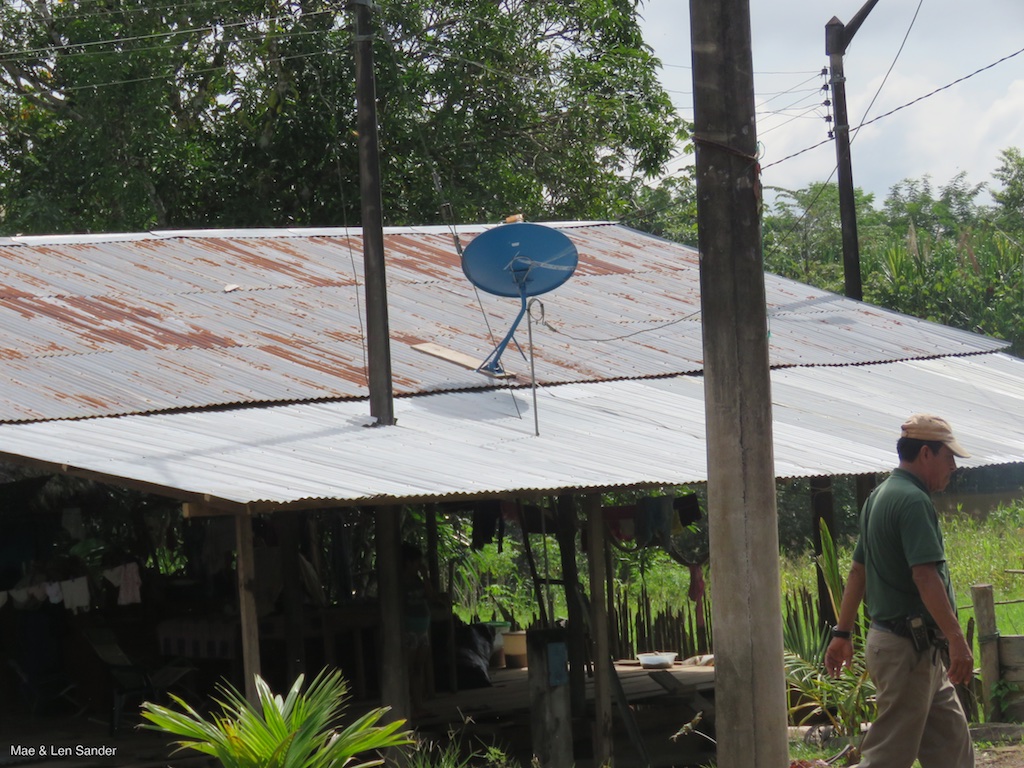
The village is wired for electricity, but doesn't have enough money to fuel their generators all the time. They mainly live by farming and fishing, but many of the former residents now live in the larger cities nearby and work in the oil extraction industry in the region. Their homes appear to mostly have thatched roofs and dirt floors, though I noticed several items of modern furniture and cookware. The children, who all wear modern kids' clothing, attend a modern cinder-block construction school equipped by the government, with a teacher who commutes from the nearby city, Nauta, population around 25,000.

I do not sense any contradictions in all this.

A larger village with a satellite tower.
Village with a water tower.
A child's feet, dangling above her flip-flops.


At the village school -- not in session, but the children came to look over the
visitors from the cruise ship.


A kitchen at a camp farther back in the forest.
Much more primitive tribal villages exist in other parts of the Amazon, in locations that are many more days of river travel from where we visited. I read a couple of books about travel to these areas, which are much more inaccessible than the area where we enjoyed our cruise. These books tell the very painful history of the exploitation and near-genocide of many of the tribal natives, especially during the rubber boom at the beginning of the twentieth century. It's notable, I think, that the acts of the rubber barons against the natives inspired the coining of the phrase "a crime against humanity."

"Shotguns were rapidly replacing the bow and arrow as the weapon of choice among tribal hunters," wrote Scott Wallace in The Unconquered: In Search of the Amazon's Last Uncontacted Tribes. "Entire villages were relocating from the highlands to riparian mission posts in order to gain access to trade goods and remedies for deadly malaria outbreaks their own shaporis could not cure. The younger men knew some Spanish, and they’d acquired a taste for Nike shoes, Ray-Ban sunglasses, and the red-and-black caps of the Chicago Bulls." (p. 252)

Wallace's book is the story of his trip on the Brazilian Amazon in search of a fleeting glance at the members of a tribe that had had little if any direct contact with Europeans and modernized tribal groups. This was a very complex story of Brazilian politics and philosophies of how these deeply buried groups might be fairly treated. He and the expedition leaders had no doubt that modern metal tools and weapons and many other goods would be immediately useful to them, and many questions about how to give or trade these goods. There's much controversy about what would help them and what would harm them.
The Delfin 2 on which we traveled in luxury, quite isolated from actual river-village life.

Our fellow passengers on the small skiffs that took us
on short trips into the small streams and lagoons where we looked for wildlife.
A skiff in the farthest-back lagoon that we visited.