|
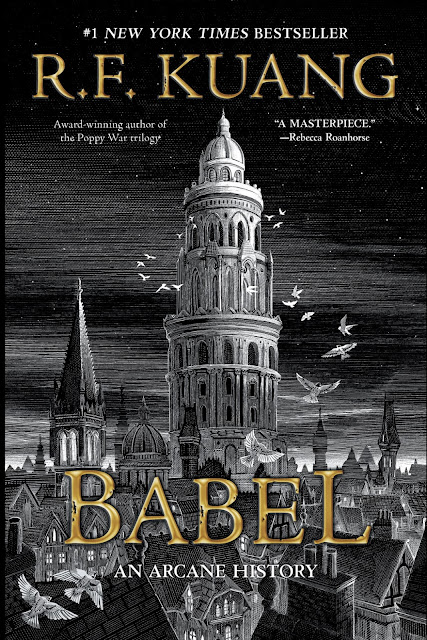
| Babel, Or the Necessity of Violence: An Arcane History of the Oxford Translators’ Revolution |
“A 'novel of ideas' is different from a novel with ideas. It is a novel
whose story expounds and explores a particular philosophical perspective
on the world.” (
Goodreads)
Babel by R.F.Kuang fits this definition. This very long and complex novel expounds several ideas. These ideas include applied linguistics (or maybe the less-respectable discipline of semantics), colonialism, the effects of slavery, British conquests in the 19th century, the uses and dangers of technology, the opium wars and why opium was bad for China, and the corrosive nature of racism.
Besides being a novel of ideas, Babel is a fantasy novel set in the 1830s. Historic fantasy novels where magic takes over from history are in a way a genre all their own. Here, an Oxford college of “translation” uses mystic connections among languages to create a web of technology that empowers the British empire.
The magic substance that enables these miracles is silver, and the magic connections are created by expert native speakers or masters of many languages, especially Chinese, French, and ancient classical languages. Marvels of this technology include much beyond the actual 19th century achievements, such as water and sewage treatment plants, railroad and carriage speed and comfort, very fast ship travel, serving platters that keep food warm on the table, and many other inventions that allow British upper-class people and intellectuals to enjoy a comfortable, happy, and powerful existence
The center of the novel is four young people with different backgrounds adapting to life in the college system of Oxford in the 1830s. There are many parallels to earlier novels, or maybe evidence of too much influence. For example, I constantly thought of several popular novels with similar themes, such as J.K. Rowling’s Harry Potter novels, the Oxford setting and mysticism of Pullman’s Dark Materials or of C.S.Lewis’s fantasy novels, the threatening magical-historic settings of Susanna Clarke’s Jonathan Strange and Mr. Norrell, and more.
Underlying these parallels is one more: the central character, leader of the four friends, is Robin Swift, who chose his last name because he loved the book Gulliver’s Travels by Jonathan Swift — and I think we are meant to consider how Robin’s developing view of the British Empire echoes some of the dark pessimism of Jonathan Swift’s portrayal of the foibles of humanity. At one point, feeling very bad about his role in the creation of enabling technology for empire, Robin says:
“Did you ever read Gulliver’s Travels? I read it all the time, when I lived here – I read it so often I nearly memorized it. And there’s this chapter where Gulliver winds up on a land ruled by horses, who call themselves the Houyhnhnms, and where the humans are savage, idiot slaves called Yahoos. They’re swapped. And Gulliver gets so used to living with his Houyhnhnm master, gets so convinced of Houyhnhnm superiority, that when he gets home, he’s horrified by his fellow humans. He thinks they’re imbeciles. He can’t stand to be around them.” (p. 306)
The novel is long in part because the magic, politics, ideas, and adventures are always described in great detail, including lots of domestic observations like how the students do their laundry, where they sleep if they are in an academic building without beds, relationships with servants, and similar things. More importantly, character development and expanding self-awareness, especially of Robin Swift, is a key feature of the novel, and I would say is its greatest accomplishment. The plot is exciting and suspenseful as well, with excellent reflections of the ideas that I mentioned earlier. However, I don't want to expand on these features — nor reveal any spoilers.
What did they eat?
Obviously, among all the details of life in the novel, it includes food (which I never miss). In the household where Robin lives before going to Oxford, there’s Mrs. Piper, a cozy and loving Scottish housekeeper who introduces British treats and meals to Robin, originally a native of Canton, China.
"Mrs Piper and her kitchen had enjoyed a glorious reunion. The dining room table, which seemed ridiculously large for just the two of them, was piled with pitchers of milk, white rolls of bread, roast carrots and potatoes, gravy, something still simmering in a silver-gilded tureen, and what looked like an entire glazed chicken." (p. 23).
"From Mrs Piper, he learned more than he’d imagined possible about English food and England. Adjusting to this new palate took some time. He had never thought much about food when he lived in Canton – the porridge, steamed buns, dumplings, and vegetable dishes that comprised his daily meals had seemed unremarkable to him. They were the staples of a poor family’s diet, a far cry from high Chinese cuisine. Now he was astonished by how much he missed them. The English made regular use of only two flavours – salty and not salty – and did not seem to recognize any of the others. For a country that profited so well from trading in spices, its citizens were violently averse to actually using them; in all his time in Hampstead, he never tasted a dish that could be properly described as ‘seasoned’, let alone ‘spicy.’" (p. 34).
"One night Mrs Piper brought out a round, flat circle: some kind of baked dough that had been cut into triangular wedges. Robin took one and tentatively bit at the corner. It was very thick and floury, much denser than the fluffy white rolls his mother used to steam every week. It was not unpleasant, just surprisingly heavy. He took a large gulp of water to guide the bolus down, then asked, ‘What’s this?’ ‘That’s a bannock, dear,’ said Mrs Piper. ‘Scone,’ corrected Professor Lovell." (p. 35).
The food they are served in the college dining hall is terrible -- virtually inedible, dry, and flavorless compared to Mrs. Piper's many-flavored scones or to the cuisines of the multi-cultural members of the translation institute such as Ramy, a student from India, who told Robin and his two other friends that "they were all cowards – in Calcutta, he claimed, infants could eat ghost peppers without batting an eye." (p. 130).
The only good food at the college was afternoon tea:
"All the hot food was gone, but afternoon tea and its trappings were on offer until supper. They loaded trays with teacups, teapots, sugar bowls, milk jugs, and scones, then navigated the long wooden tables in hall until they found an unoccupied one in the corner." (p. 84).
From The Guardian
“This is a grim and harrowing novel; many of the characters have poisonous opinions about race, and Swift becomes increasingly embittered. The antagonists are closer to demons than humans, with no nuance, and they do sickening things. Often the allure of fantasy is escape from the real world, but there’s no escape here; Kuang’s use of the genre does not soften real history but sharpens it. Babel asks what people from colonised countries are supposed to do when they reach positions of power – while being set in a time and place where reaching those positions would, in the real world, have been impossible. It is a fantastically made work, moving and enraging by turns, with an ending to blow down walls “ (source)
Blog post © 2022 mae sander


