Showing posts with label American life. Show all posts

Thursday, December 04, 2025

Injustice

“There are lots of things we consider public goods and fund accordingly: K-12 education, Social Security, clean water, parks, libraries, roads and highways, and other infrastructure. How have we allowed something as fundamental as shelter to be excluded from this list?” (p. 434)


There is No Place for Us by Brian Goldstone takes very sad look at the life of a forgotten stratum of American life, that is people who are homeless but who have makeshift arrangements for living that result in their exclusion from the homeless statistics. He looks at several families, while providing more general insights about policies and misfortunes that determine their situations.

Here is the author’s description of a street in Atlanta typical of the environment where the muliple histories of homeless workers takes place — “block after block of dialysis clinics, liquor stores, pawnshops, payday lenders, hair-braiding salons, plasma donation centers, twenty-four-hour daycares, storefront churches, and ramshackle motels.” (p 64)

The book takes a close look at the lives of several families in Atlanta, Georgia, over a period of around a decade, and it’s full of really interesting (and very depressing) examples of how they cope with working, taking care of their children, trying to find various types of government or charitable assistance, and many other ways they manage their lives. The bigger picture:

“A more recent analysis by the Southern Poverty Law Center estimates that between thirty thousand and forty-seven thousand people are now living in metro Atlanta’s budget extended-stay hotels, charged rates that are often double what an apartment downthe street would cost. ‘It’s a reinforcing cycle,’ argues Michelle Dempsky, a Legal Aid attorney who litigates on behalf of extended-stay residents. ‘If you’re in emergency need, you’re paying a premium for necessity, which puts you in more financial distress, which makes you less able to secure housing, which means you’re stuck there.’” (p. 300)
 
The New York Times review described this book when it was published last spring:

“‘There Is No Place for Us’ is a moving book. It is also appropriately enraging. Incremental remedies, Goldstone argues, have only worsened a problem that stems from the assumption that housing is ultimately a commodity, ‘and that the few who own it will invariably profit at the expense of the many who need it.’”

In The Guardian This Week

A very closely related article about the practices at Dollar General and Family Dollar stores describes another way that similar families (with or without housing) are being taken advantage of. These supposedly lower-priced stores are often the only option for poor families very much llike those I’ve just been reading about. A quote that resonates with the sad histories of the people in the book:

Review © 2025 mae sander


Saturday, September 21, 2024

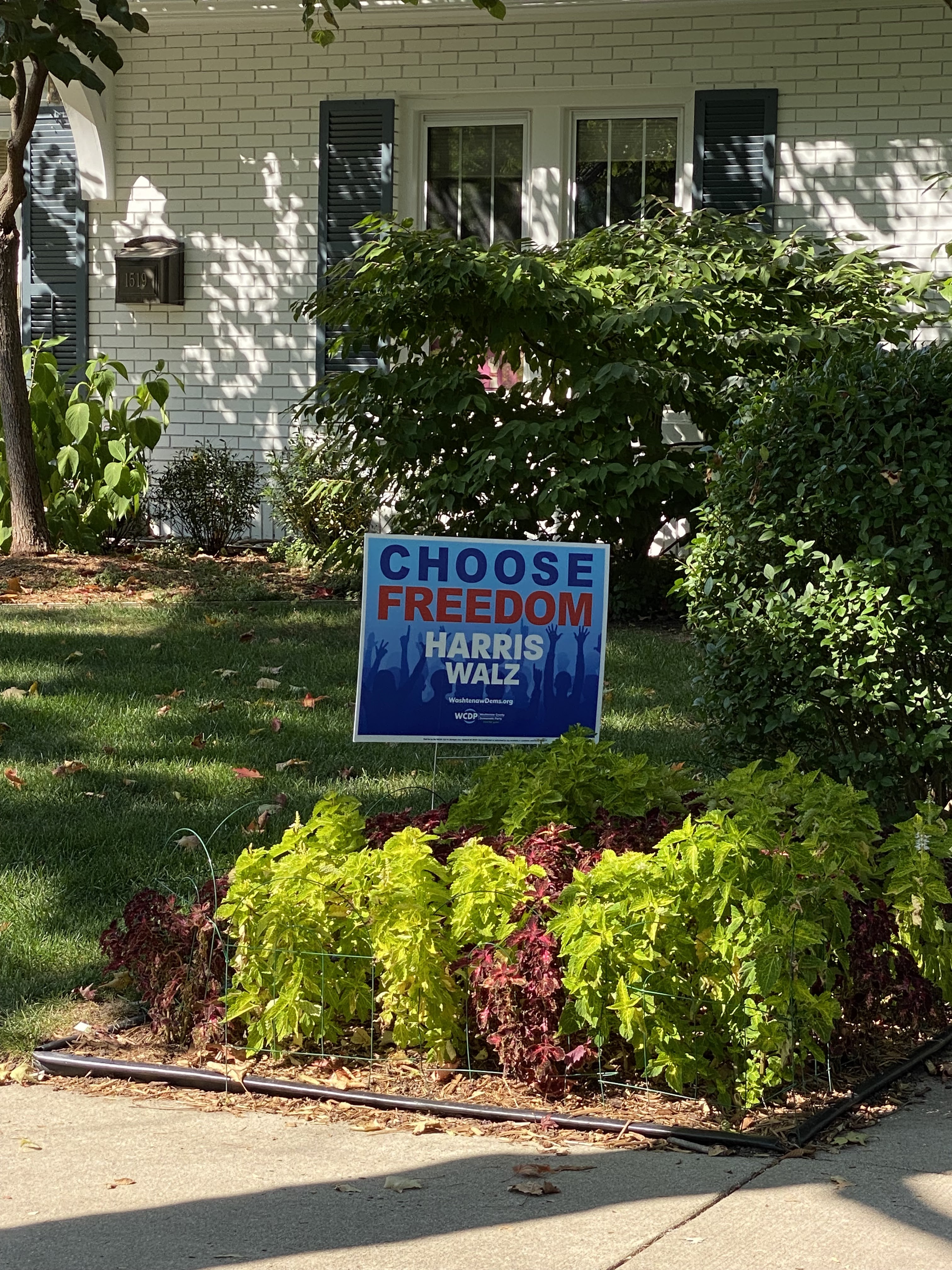
In My Neighborhood: Campaign Signs


After walking for a while, we stopped for a cappuccino.
In case you are wondering, I haven’t seen a single sign for the other candidate.
I wish our neighborhood would be predictive of the election result. 


Photos © 2024 mae sander

Saturday, July 27, 2024

This Week

New pot of succulents joins my cactus.
I’m sharing this and other things in my life with the Sunday Salon at Readerbuzz.

Watched the Olympics Opening Ceremony

Olympics in our living room…yes to Paris in July! A favorite moment: when they tolled the bells of Notre Dame for the first time since the catastrophic fire.

The bridge was decorated with new murals to celebrate the Olympics.
80 boats carried the Olympic Athletes for a 4-mile trip down the Seine River to the Eiffel Tower
for the final march with the flags of all nations. Best ever opening ceremony!

The torch is lit.

We watched the entire 4-hour ceremony.

Family Visit July 18-23

Miriam finds interesting critters on her run. Time for Eileen’s critters.

We made our traditional pilgrimage to DQ for blizzards.

A fabulous seafood dinner.

One last breakfast before their 9-hour drive.


Time to say goodbye!

What I’m Reading This Week


The Heaven & Earth Grocery Store is a satisfying book. It’s funny and serious at the same time. The main characters are wonderful and memorable (but I'm not going to describe them). Just one example: this description of a very minor character:

“Bernice was also the proud mother of, at last count, eight children, all of whom looked more or less like Bernice in varying degrees of skin color from light-skinned to dark. That was not a bad thing. Nor was it a good thing. Everybody knew Bernice had the kind of face that would make a man wire home for money. The question was, who was the man and where was the money?” (p. 94)

In this novel, good people mostly end up with good things happening to them. Quite a few bad people end up not so happy, maybe even satisfyingly dead. Good individuals from several mistreated or unlucky groups are often rewarded — Jews, blacks, Italians, other immigrants, disabled people, poor people, people who can’t read, people with a secret past, and more. But nobody is a stereotype. 

What saves this book from being a cloying mess of well-meaning fake optimism? It’s hard to say how the author manages, but somehow the evil doers get their just deserts, the survivors don’t gloat, and there is exactly enough revenge on the bad ones and rewards for the good ones.

Vivid writing also is absolutely a key to why this is such a lovable book. Like this description of the sounds heard in a hideously cruel home for mentally and physically disabled people: “moanings, groanings, coos, burps, sighs, growls, yells, chirps, yelps, chortles, cacklings, farts, chatterings, and howlings …” (p. 266)

The NPR reviewer described the writing thus: “McBride's roving narrator is, by turns, astute, withering, giddy, damning and jubilant. He has a fine appreciation for the human comedy: in particular, the surreal situation of African Americans and immigrant Jews in a early-to-mid-20th-century America that celebrates itself as a color-blind, welcoming Land of Liberty.” (source)

The New York Times reviewer describes The Heaven and Earth Grocery Store as:  “a murder mystery locked inside a Great American Novel.” (source) From The Atlantic: “In McBride’s work, digging deep into the tangled roots of complicated communities is the antidote to misplaced blame and false history.” (source)

I enjoyed reading this Great American Novel. Totally. I’m grateful to my sister who gave it to me as a gift.

Blog post © 2024 mae sander

Sunday, May 12, 2024

Driving Cross Country

The Mississippi River as we drove into St.Louis last week.


This bridge, which carries Interstate 270 between Missouri and Illinois,
is the site of quite a big construction project. This view is looking north.

Just past the bridge.

On the way home, we again crossed the Mississippi River,
driving from Missouri into Illinois. This view is looking south.

We drove across Michigan, Indiana, Illinois, and Ohio on the way to and from St.Louis last week. Our habit is to look for state-maintained rest stops along the road, which are convenient, clean, and quick -- and sometimes even offer a free paper map! Unfortunately, on our way back to Michigan the logical rest stops in Illinois and Indiana were all closed. So we did the next-best thing: we stopped at two McDonalds along the way. Maybe surprisingly, another very good place to stop if there's one at the freeway exit is a Walgreens! They always have a clean restroom, and sell snack food if we need it. And there seems to be no pressure to make a purchase if you don't want to. A Walgreen's was our third stop.

The two McD's where we stopped were interestingly decorated.

The entryway at the McDonald's in Casey, Illinois,
had birds painted on the wall.


This looks like a brick wall with a leaning bicycle, but it's a mural.


More birds on the wall.


Another stop, in Indiana -- the McDonald's decor was quite different.
The hamburger and fries, by the way, were exactly as expected. 

Eating at McDonalds or another burger chain for us is limited to the times when we are driving long distances — we virtually never eat there otherwise. An article in the New York Times just this morning points out how we are quite unusual: most Americans eat fast food much more often than we do. The article is inspired by the 20th anniversary of the film “Supersize Me” by Morgan Spurlock, who ate nothing but McDonald’s for one month, and ate every item on the menu at least once. It wasn’t good for his health!

“Supersize Me” was wildly popular but had no effect on fast food sales at all. The article explains:

“… two decades later, not only is McDonald’s bigger than ever, with nearly 42,000 global locations, but fast food in general has boomed. There are now some 40 chains with more than 500 locations in the United States. Fast food is the second-largest private employment sector in the country, after hospitals, and 36 percent of Americans — about 84 million people — eat fast food on any given day. The three major appeals of fast food remain intact: It’s cheap, it’s convenient and people like the way it tastes.”
 

Other than McDonalds… 


Because today is the day to share murals with Sami at the blog ColorfulWorld -- here's one more.
We found this mural in St.Louis while driving towards the Missouri Botanical Gardens.

On almost every trip to St.Louis we drive by the house where I grew up.
It was built in 1912 by an architect who lived there, and I think of it as a work of art.
I took this photo last week, but it looks exactly the way I remember it.


Blog post and all photos © 2024 mae sander

Saturday, May 04, 2024

Books and Flowers

I’ve reread two Icelandic mystery stories by Eva Björg Ægisdóttir. Good ones! 
The series now has four books, and the author will soon publish another one.

What is a monster? Claire Dederer devotes this entire book, Monsters: A Fan’s Dilemma, to an effort define this term insofar as it relates to gifted men — geniuses — creators — who are abusers, sexual predators, racists, antisemites, or worse. Men whose brilliant creations are stained in the eyes of the audience member who loves their work but becomes aware of the reality of the artist. One way she says it:

“I realized that for me, over the past few years of thinking about Polanski, thinking about Woody Allen, thinking about all these complicated men I loved, the word had come to take on a new meaning. It meant something more nuanced, and something more elemental. It meant: someone whose behavior disrupts our ability to apprehend the work on its own terms.” (p 46)

This is a terrific book, full of interesting insights into the consumers of great literature, art, film, and music who struggle with the sins of the artists. As a combination of memoir, literary criticism, and general observations about works of art, it's wide-ranging and readable. One very interesting theme is the contrast between men who create with women who create. Though  creative women and men can both be monsters, it’s never for the same reasons, and there are many examples to show the differences.

Another theme is how critics writing about the arts deal with the impact of a creative person's immorality or evil-doing on the audience for their work. The author tries to get to the heart of the claim that a critic can be objective and judge the art independent of its maker: “Authoritative criticism believes in the myth of the objective response, a response entirely unshaped by feeling, emotion, subjectivity.” (p. 73) Basically the author concludes that objectivity about art is a myth: a male myth. 

I enjoyed a lot of the varied accounts of authors/creators and their history:
  • I enjoyed Claire Dederer’s insights about a number of creators that I haven’t thought about recently, such as Gertrude Stein, Doris Lessing, Jenny Disky, Sylvia Plath, Woody Allen, Richard Wagner, Picasso, and many more, and the varied ways their biographies might affect their audiences.
  • I enjoyed it when she reminded me of the strange 1960s life of Valerie Solanis (1936-1988), author of the SCUM Manifesto, but better known for shooting Andy Warhol: in case you don’t know about Valerie Solanis, SCUM stands for “Society for Cutting Up Men.”
  • I enjoyed her examination of the challenges to women who want to be both creators and mothers, and maybe do terrible things to their children (or maybe just abandon them, terrible enough). Or maybe abandon their art.
  • I enjoyed her short biography of the little-known artist Ana Mendieta, whose death “makes a kind of parable about artistic silence.” A few weeks ago, I read Anita de Monte Laughs Last by Xochitl Gonzalez, thinking it was purely a work of fiction, but I checked up and discovered that it wasn’t simply fiction, but a fictionalized life of Ana, who was actually killed by her husband — also an artist. He was tried but let off, which is a scandal and clearly an example of an artist monster. I appreciated Claire Dederer’s insights about this particular example of the artist/husband who gets away with murder — and of a victim who was spectacularly diminished by her abuser.
The author presents the reader with many questions about those who love the works of genius/monsters, and those who justify the monstrousness. One possible explanation: “We want the asshole to cross the line, to break the rules. We reward that rule-breaking, and then we go a step further, and see it as endemic to art-making itself. We reward and reward this bad behavior until it becomes synonymous with greatness.” (p. 111) 

If you would like to read about fairness, this is not the book for you. The number of ways that society is unfair to women are unbearably numerous, from the unfairness to the victims of artists’ self-justified cruelty and violence to the unfairness to women artists. Even “cancelling” an artist for his vices isn’t very satisfactory. Quotes:
  • “The very term ‘cancel culture’ is hopelessly non-useful, with its suggestion that the loss of status for the accused is somehow on a par with the suffering endured by the victim.” (p.133)
  • “The violence of male artists is tied to their greatness. It’s an impulse. It’s freedom. The violence or self-harm of female artists can be a sign of sensitivity, a sign of lunacy, but it is rarely turned inside out to become a sign of creative and moral strength.” (p. 222)
In this review, I have hardly begun to explore the many-faceted content of this book. (It goes without saying that the author presents her own view of Lolita.) I’ll just leave you with this:

“It is easier to imagine the end of the world than the end of patriarchy.” (p. 221)


Next book:  Sojourner Truth by Nell Irvin Painter.

Gardens Around Me


Allium, about to bloom.


On the Road Again

It’s Saturday, and we left home at 8 AM.
Our destination is St.Louis. We are half-way there, in Indiana, at my sister’s house.

We arrived in time for a fabulous lunch.

Blog post and photos © mae sander 2024

Saturday, March 16, 2024

Weekend Update

 Recent Reading

Help Wanted, published March 5, 2024.

Help Wanted by Adelle Waldman has the clarity of a fable. I enjoyed reading it both as social commentary and as a good story of individuals struggling to make it in a society that hasn’t given them many opportunities. Virtually the entire novel takes place in the present time (mid-2020s) in a big-box store, part of a chain called Town Square that resembles a Target. It’s located in a middle-sized town that was once much more prosperous, and neither the town nor the store is as nice as it used to be. The novel is written with a good sense of humor and plenty of irony, though my summary doesn’t especially show this.

The employees at Town Square represent a slice of American life. The novel focuses on one group, which is responsible for unloading the trucks that bring the merchandise every day. As they appeared to their boss in their morning meeting:  “The diversity of race, gender, and ethnicity in the faces before him would have filled the headmaster of an elite private school with envy.” (p. 28) The characters, though each is fully portrayed, also seem to me to represent a set of types in our society. They realize this, and show it — for example, “Val threw her head back and laughed breezily, the way she imagined people do at fancy cocktail parties.” (p. 237)

The characters have a variety of reasons for being employed by a corporation that underpays them, makes sure that they don’t work enough hours to qualify for benefits or overtime pay, and gives raises that barely cover inflation. They are highly aware that there are not enough of them to restock shelves or assist customers effectively, particularly not to the standards they would set for themselves. This mistreatment of employees was intentional; further, the corporate policy of understaffing the store was purposely unacknowledged: “To keep customers from recognizing that the lack of employees on the sales floor was a deliberate choice, corporate constantly posted large banners reading help wanted—the implication being that any lack of staff on hand was a function of the tight labor market and/or a lazy populace’s unwillingness to work service jobs.” (p. 150)

Most of the characters have varying degrees of self-awareness and they are highly conscious of the way society has limited their options. They also see their own shortcomings. For example, Diego, an immigrant from Central America, considers why the white people seem to him to be better off, to live in houses that their parents or grandparents have owned, and to be better able to cope with their poor wages and lacking benefits. “Diego thought of a conversation he’d had with a guy named Isaac who used to work with them. Isaac had said that even at a store like Town Square, where they’re all paid shit, white people were still better off than black people. It was part of a bigger, historical picture, Isaac said. … When the jobs started to go away and wages started to fall, it was like a game of musical chairs. The people who already had stuff—white people—got a chair. Black people were left standing, with nothing but our civil rights.” (p. 175-176)

Each character has his or her own problems: some drink, some take drugs, some lose their tempers too readily, most have problems with spouses or partners, they never get enough sleep, and one has trouble reading because she suffered from lead poisoning from substandard housing during her childhood. All of them are struggling to provide themselves and their families with food and shelter, and often work a second job besides the one at Town Square. Mostly, they wish they could provide their children and partners with more extras such as a birthday party at Chuckie Cheese or good toys, or more healthful food. 

Most of the workers had higher aspirations when they were younger, and are slowly sinking into hopelessness. They all worry that they will never advance, even at Town Square. They feel held back because they haven’t finished college or never went to college at all or in fact didn’t even have a high school diploma or GED. For example, “What did Nicole know about college? Nicole’s own line on the subject had long been: Of course she wasn’t going—she’d barely gone to high school, and that had been free. Why would she pay to go to more school?” (p. 164)

The plot of Help Wanted centers on an announcement that the store manager is about to be transferred to a much-preferable location, and thus there will be an internal promotion of one of the lower-level managers. The employees at the center of the story decide that they would like their own manager to be promoted, not because she’s competent or likable (she’s neither one), but because they want to get rid of her. They know they will be interviewed by visitors from the corporate headquarters, to ask them what kind of leadership and initiative she has. Obviously, I’m not going to tell how this comes out, but I do recommend reading this very well-done fable for our time.

The Guardian reviewer says:
 
“Help Wanted is an acidic comedy about contemporary American serfs. It’s a kind of communal novel about the people clinging to the bottom of the social cliff: the two-jobbers, the drop-outs, the working poor. … A superb, empathic comedy of manners …. Perhaps the most impressive thing about Help Wanted is that Waldman manages, in telling her small story, to describe not just the American economic prison but the global one. So: both a novel of manners and a systems novel, a book that shows us, perhaps, how intimately linked these apparently disparate genres were all along.” (source)


Other books reviewed this week


On TV this week


Agatha Christie’s novel Murder is Easy was published in 1939, and it follows the conventions of a mystery where the detective thought he was an innocent bystander to events (specifically, murders) that he did not cause, and in which he has no stake. Christie was remarkably inventive, and was a master of many plot types in her mysteries. This is definitely a good one, with a whole series of murders that are more and more apparently done by one truly evil criminal. It’s been remade into any number of TV and movie adaptations, and we recently watched the latest one, which was released in 2023.

This newest version of Murder is Easy introduces a radical change in Christie’s plot: the person who is dragged into investigating and solving the murder is not a professional detective, but is a newly arrived Nigerian man, Luke Fitzwilliam, who is about to take a job in the British foreign office. He meets an elderly woman on a train, and she enlists his help because she says she must get to Scotland Yard and get help putting a stop to a series of murders that are happening in her village. The next thing that happens is that right in front of Luke she is knocked down and killed by a hit-and-run driver. But he — and we, the audience — know that it couldn’t have been an accident. As another famous detective (quoting Shakespeare) said: “The Game’s Afoot!”

The date for this new dramatization of Murder is Easy has been moved to 1954, which was a time when Nigeria was working towards independence from British rule; it achieved independence in 1960. This revision enables the script writers to introduce a fascinating characterization of Luke Fitzwilliam, who becomes the central character in the drama. It’s not too much of a spoiler to say that he penetrates the relationships and motives of the village people and figures out the identity of the evil mastermind.

The reaction to the arrival of a black African in the English village shows the varying views of the local people — some more bigoted than others.The introduction of racism to the Agatha-Christie-typical environment is an interesting twist added to their reaction to the uninvited investigator. For a Christie fan, it’s also a delicious interpolation into her oeuvre, as her books and her attitudes often embodied a good deal of racism, both explicit and implicit. (See this article for a recent attempt to clean up this issue in her books for new edition: “Agatha Christie Novels Reworked…”) 

Springtime in the woods


Reviews © 2024 mae sander
Shared with the Sunday Salon at Readerbuzz.