Showing posts with label aromas and odors. Show all posts

Saturday, November 02, 2024

Magic


Jonathan Strange and Mr Norrell, by Susanna Clarke,
illustrated by Portia Rosenberg.

I could not tell you why I decided to reread Jonathan Strange and Mr Norrell, except that its uncanny magical universe has something to do with a short new book by the same author. It’s a very long book: 850 pages, and it took me around a week of reading and being rather engaged with the history of the Napoleonic wars as experienced — and altered — by two English magicians and their circles of friends, relatives, acquaintances, and enemies. The magicians’ main enemy is a Fairy, a malevolent and self-centered creature. The fairy appears to many characters in the novel, and never means any good to them.

 
The fairy was described at his first appearance in the novel:

“a tall, handsome person with pale, perfect skin and an immense amount of hair, as pale and shining as thistle-down. His cold, blue eyes glittered and he had long dark eye-brows, which terminated in an upward flourish. He was dressed exactly like any other gentleman, except that his coat was of the brightest green imaginable – the colour of leaves in early summer.” (p. 90)

In the illustration, you can see the fairy who is obviously up to no good. Specifically, the magician Mr. Norrell has summoned him from a fairy realm beyond England to bring a beautiful young girl back from the dead. The bargain that’s made between magician and fairy is at the heart of many of the events in the novel. If you’ve ever read a fairy tale you wouldn’t be surprised at the consequences of such a bargain.


Another of Portia Rosenberg’s illustrations.

Mr Strange and Mr Norrell Take Tea

There are many plots and subplots about the two magicians Strange and Norrell and the magic that they do for the government of England, for individual noblemen, for their own interests, and in the case of Strange, for his wife. A number of other Englishmen want to be magicians as well, and they also play a role in the elaborate plot of the novel. All is tied together by the personalities of the magicians.

Both magicians are fond of taking a cup of tea, which is viewed as part of their deeply rooted Englishness. Being both typical and loyal is important to them and to the atmosphere of the novel.  When Mr. Norrell tries to offer his services to a Captain Harcourt-Bruce, the captain expects magical drama, troops of enchanted soldiers and swashbuckling magical victories. Instead, Norrell is rather an ordinary Englishman, not the leader of ideal fairy knights imagined by the military man: “That was Captain Harcourt-Bruce’s idea of a magician. That was the sort of thing which he now expected to see reproduced on every battlefield on the Continent. So when he saw Mr Norrell in his drawing-room in Hanover-square, and after he had sat and watched Mr Norrell peevishly complain to his footman, first that the cream in his tea was too creamy, and next that it was too watery – well, I shall not surprize you when I say he was somewhat disappointed.” (p. 107)

There’s even a reference to the supposed civilizing virtues of tea, concerning a captain who was  “entertaining the American savages and teaching them to drink tea (presumably with the idea that once a man had learnt to drink tea, the other habits and qualities that make up a Briton would naturally follow).” (p. 477) 

Mr. Norrell loved the comforts of his well-appointed home, and didn’t go out if he could help it. He preferred to stay in and read one of the thousands of books of magic in his collection; for example: “On a day in late December when storm clouds made Alpine landscapes in the sky above London, when the wind played such havoc in the heavens that the city was one moment plunged in gloom and the next illuminated by sunlight, when rain rattled upon the windowpane, Mr Norrell was seated comfortably in his library before a cheerful fire. The tea table spread with a quantity of good things stood before him and in his hand was Thomas Lanchester’s The Language of Birds.” p. 127.

Strange also finds comfort in his tea when he has some difficult issues that he calls “a wretched business from start to finish.” As he considered them, “he sipped his tea and ate a piece of toast.” (p. 441) Later when Strange is on the battlefield in Spain, he finds some Scots military men, and gives them some hard-boiled eggs he was carrying: “The Highlanders gave him some sweet, milky tea in return and soon they were chatting very companionably together.” (p. 473)

All this is in deep contrast to the foods that the fairy with thistledown hair has to offer his captives: “Here is a haunch of roasted wyvern and a pie of honeyed hummingbirds. Here is roasted salamander with a relish of pomegranates; here a delicate fricassee of the combs of cockatrices spiced with saffron and powdered rainbows and ornamented with gold stars! Now sit you down and eat!” (p. 500)

The famous military leader Wellington interacts with both magicians, especially with Jonathan Strange. He too enjoys English comforts even in the battlefield areas of Spain where the war is going on. His servants make sure to feed him properly: “As Wellington and his companions rode up to the castle they had just begun to lay it with plates of bread rolls, slices of Spanish ham, bowls of apricots and dishes of fresh butter. Wellington’s cook went off to fry fish, devil kidneys and make coffee.” (p. 347)

The appreciation of a typical English meal is shared by other English magicians, for example a man called Secundus, whose landlady brings him “a breakfast of two freshly grilled herrings, tea and fresh milk, and white bread and butter on a blue-and-white china plate.” (p. 26)

A woman in a weakened state begins to recover: “It was soon learnt that Miss Wintertowne had left her bed and, leaning upon Mr Norrell’s arm, had gone to her own sitting-room where she was now established in a chair by her fire and that she had asked for a cup of tea.” (p. 96)

Aromas and Odors

Now I’ve indulged myself by describing the way the author uses food and tea to create an atmosphere around the characters and their unusual lives. I should get down to business and actually review the book, but that’s been done by lots of other people. So I’ll just keep telling you a few things I found amusing.

I also appreciated the use of aromas and odors in the novel, especially the unpleasant aroma associated with an elderly woman whose cats create a rather potent situation (but I can’t say too much because this is quite a big part of the plot). Or the aroma of land and sea: “Instantly the sea became more ethereal and dreamlike, and the wood became more solid. Soon the sea was scarcely more than a faint silver shimmer among the dark trees and a salty tang mingling with the usual scents of a night-time wood.” (p. 667)

Here is a passage that describes the relief felt when a very dark magic spell is lifted from a city:
“There was a sudden rush of scents upon the air – scents of frost, winter earth and the nearby river. The colours and shapes of the park seemed simplified, as if England had been made afresh during the night. To the poor servants, who had been in some doubt whether they would ever see any thing but Dark and stars again, the sight was an exceedingly welcome one.” (p. 782)

More Magic

1871 Edition of The Princess
and the Goblin
Evidently, I enjoy books about magic. I didn’t give this much thought, but my fellow blogger Deb at Readerbuzz listed some magical fiction she was reading and I realized how much I have always liked certain types of magic in books, such as the magic of Ursula LeGuin’s Earthsea. Erin Morgenstern’s Night Circus entertained me, as did Harry Potter. (Lev Grossman: not so much.)

In childhood, I enjoyed the Oz books (which Deb is reading this year). I was very fond of The Princess and the Goblin by George MacDonald. I also loved fairy tales such as those by Hans Christian Andersen. And who doesn’t love the fairies in A Midsummernight’s Dream?

Here are a few books from Deb’s list that I have enjoyed reading in the past.

  • Emily Wilde's Encyclopaedia of Faeries by Heather Fawcett 
  • Babel by R. F. Kuang
  • A Tale for the Time Being by Ruth Ozeki

For more of Deb’s choices, see her blog post: Magical Books I Loved that You Might Like to Read.

Review © 2024 mae sander
Shared with Deb’s Sunday Salon


Thursday, December 14, 2023

Aromas of the Paris Metro and Other Metro Facts

Metropolitan: An Ode to the Paris Metro, published July, 2023

Andrew Martin’s ode to the Paris metro ranges over a huge variety of topics, many of which I found quite interesting, though not all of them. Martin is somewhat obsessed with comparing the history, purpose, architecture, engineering feats, sociology, and much else about the metro to the same features of the London underground, which I found a little tedious as I tend to value the Paris metro for itself alone.

I remember the metro for the many experiences and observations I’ve made during many visits to Paris over a number of decades. It’s always been my main transportation other than walking in Paris. Like Martin, I love to think about the names of the stations, which seem sometimes so exotic. I love the conventions of the standard metro map and enjoy trying to connect the underground map with the above ground map. I appreciated Martin’s summaries of how the metro stations, ticket sellers, gate controllers (human and automated), and other mechanics of riding have changed over the years. 

One topic that Martin covered only slightly is the buskers whose music can sometimes be heard echoing through the long connecting corridors, and how they have to audition to play legally. He mentioned only slightly (if at all the stations) where there's art in the metro, like the Louvre station, or murals of relevance to the station, like Bastille. He didn't mention the occasional vendors with permitted stalls selling mainly flowers and foods, and the many vending machines. 

Some of his material recalled things I’d long forgotten. For example, he described the mechanical route maps where you pushed a button for your destination and the map lit up a series of tiny incandescent light bulbs to show you which train lines to take and where to change lines. I can't find a single photo of such a map.

One feature of the metro that stays with me is the smell, which always strikes me as I descend the stairs into the underground tunnels. I am often amused to sniff the metro aroma that wafts up from grates in the sidewalk, a combination of odors which announce that you are above the ventilation system. I’ve never really figured out what components create this recognizable smell, but I’ve never encountered it anywhere else.

Martin has a few things to say about the metro smell — he’s much more analytical than my observations.

“‘It’s the smell of Paris,’ says my Parisian friend Julian Pepinster: ‘all the packed-in people and all the good and all the bad.’ When the first generation of all-steel Metro trains were stood down in the early 1980s, one ingredient of the Metro’s mysterious smell was lost: that of the hot oil on their wooden brake blocks. In Footprints in Paris: A Few Streets, a Few Lives, Gillian Tindall describes the smell as ‘garlic, dust and tobacco’. Cigarettes were an ingredient until 1991, when smoking on Metro platforms and corridors was banned. … I once described the odour as ‘lemongrass’; it’s possible I was detecting a perfume called Eau de Madeleine, which since 1998 has been added to the wax applied to the bitumen on Metro platforms during nightly cleaning. (The wax is to make the platforms shine, and you can see your blurry reflection in them, as in turbid water.) On 20 April 2001, ABC News described this scent as ‘a floral bouquet of rose and jasmine combined with citrus top notes, giving way to strong woody accents and a hint of sweetness in the base’. It might be that people are interested in the Metro aroma because Paris in general is such an odoriferous place, with all its concentrated perfumery, traffic, and outdoor dining.” (Metropolitan p. 112-113)

“From ‘Death of a Nobody’, a short story collected in Maigret’s Christmas: ‘the Metro, which smelled of bleach and where Maigret had to put out his pipe’.” (p. 10) 

On one long stay in Paris, we lived opposite the elevated metro line on Boulevard de Grenelle in the 15th arrondissement. So I enjoyed what he said about living next to these tracks (which could be very noisy, but we got used to it). He writes;

“I once discussed this part of town with a woman in her sixties whose mother lived in a third-floor flat on boulevard de Grenelle, directly overlooking the Line 6 viaduct. She insisted that such flats are no cheaper than any others in the desirable 15th Arrondissement, and that her mother enjoyed being near the trains, but did admit that her mother might have been prejudiced, since her (the mother’s) father had been one of the first drivers on the Metro. The boulevards and Line 6 do seem to have reached an accommodation, like two grand, venerable families; once, perhaps, wary of one another, but with more and more in common as time goes by.” (p. 153)

In his “ode to the Paris Metro” Martin refers to many other documentary books about the metro, as well as songs, films, novels, and popular culture from Parisians and tourists. For example, I remember seeing the film “Last Tango In Paris” where Marlon Brando’s apartment faces the Metro line that crosses the Seine near the Eiffel Tower — the elevated line near where we lived was only one Metro stop from this location, so we knew it well. In fact, I saw this film in a theater in Paris with French subtitles for the English and no subtitles for the occasional dialog in French.

Of course I know well the novel and film “Zazie dans le Metro” (Zazie in the Metro) by author Raymond Queneau; it’s about a foul-mouth little girl who visits Paris with the goal of riding the metro, but never has a chance because it’s on strike the entire time. Obviously another favorite of Martin! 

Here’s another cultural fact that I learned:

“Serge Gainsbourg had his first hit, in 1958, with a song called ‘Le Poinçonneur des Lilas’, whose bustling chorus – suggestive of a fast Metro train – repeatedly mentions the word trou, meaning a hole.” (p. 107)

Added note: in this video, available on Youtube, there's one extremely brief and a bit blurry view of one of the lit-up maps, with the words "connection lights."  

More Metro Books

Being a fan of the metro and loving to learn about it, I’ve read several other books on the topic — 


I’ve also read Martin’s book titled Sleeper Trains, reviewed it in 2018 (link). I haven’t read any of the dozens of other fiction and nonfiction books he has written!

The Famous Metro Entrances: Photos from the Web

As I read I couldn't help wishing for images of the topics in Martin's book because the Kindle edition has no illustrations. Searching the web produces a vast selection of images covering the last 120 years since the first metro lines came into service. I’ve just selected a few of them that I particularly like, particularly the Art Nouveau designs created in the very early days by Hector Guimard. 


Metro Platforms

Martin also referred to a work by the conceptual artist Daniel Buren, a collection of 100 images of the interior of a number of metro stations photographed in 1970. If you love the metro, as I do, check this out:

Cent Stations du métro parisien


Metro Decor

A few metro stations are decorated with murals such as this one at Bastille, installed in 1989. (source)

If I don't publish this RIGHT NOW I will probably spend the day finding more images and metro stories connecting to my metro memories!

Added Note: An earlier post with my own photos: "The Paris Metro"

Review © 2023 mae sander; images as credited.


Thursday, September 21, 2023

Very Very Noir: "Total Chaos"

Total Chaos by Jean-Claude Izzo (1945-2000)

You couldn't imagine a less cozy mystery than this graphically violent police story about Marseilles around 30 years ago. Jean-Claude Izzo's Total Chaos (written in 1995) is dark and often ugly with lots of underworld characters from all the ethnic and social strata of the Marseilles underground and police force. It's narrated by a policeman named Fabio Montale, a native of the city. Unlike him, his friends, both alive and dead, are mainly petty criminals and hookers. His enemies are gangsters and maybe some of his fellow policemen. The plot centers on the deaths of his two best friends and a young woman, and his efforts to discover who killed them, and maybe get some revenge. 

I didn't like the book at all: just not my kind of literature. However, one feature of this novel did appeal to me very much: between the scenes of unpleasant violence and the depiction of unsavory characters, Fabio's narrative is full of very savory food descriptions. Food here is totally central to the essence of the main character/narrator and his milieu. You could almost cook following his descriptions: in fact, if you were familiar with the local cuisine, you probably could use them as recipes.

Since I'm not fond of novels with this much graphic violence, I'll just quote a few of the amazing food descriptions. 

First, here is Fabio's childhood memory of his family dining table:

"The whole family used to come here on Saturdays. There’d be big plates of pasta in sauce, with headless larks and meatballs cooked in the same sauce. The smells of tomatoes, basil, thyme, and bay filled the rooms. Bottles of rosé wine did the rounds amid much laughter." (p. 38). 

Next, his friend Honorine makes Fabio some food to take on his boat:

"I made you some foccaccia, Honorine had written on a little piece of paper. Foccaccia is made with pizza dough, filled with whatever you like, and served hot. Tonight, the filling was cured ham and mozzarella." (p. 44).

And Honorine cooks another dish:

"Honorine made stuffed peppers like no one else could. Romanian style, she called it. She’d fill the peppers with a stuffing of rice, sausage meat and a little beef, well salted and peppered, then place them in an earthenware casserole and cover them with water, add tomato coulis, thyme, bay and saw-wort, and let them cook on a very low flame, without covering. They tasted wonderful, especially if you poured a spoonful of crème fraîche over them at the last moment." (p. 161).  

Another Marseilles specialty, by Céleste, another friend:

"Céleste made better aïoli than anyone I knew, except Honorine. The cod was desalted just right, which is rare. Most people leave it to soak for too long, and give it only two soakings. It was best to soak it several times. Eight hours the first time, then three times two hours. It was also a good idea to poach it in simmering water, with fennel and pepper grains. Céleste also used a particular olive oil to give the aïoli a ‘lift.’ .... Her salads always tasted different." (p. 194).  

Fabio's colleague Pérol supplies some provisions:

"Pérol had brought beer and sandwiches. Tomatoes, anchovies and tuna. Not so easy to eat, but better than the usual revolting ham sandwiches." (p. 139).  

Simple foods reflect the Marseilles atmosphere throughout the novel.A meal with a friend at a place called Chez Mario:. 

"Mozzarella and tomatoes, with capers, anchovies and black olives, for starters. Spaghetti with clams as a main dish. Tiramisu for dessert. To drink, a Bandol, from the Pibarnon vineyards." (p. 75).

Besides the tastes and preparations, there is also frequently a memory of aromas:

"On Rue Longue-des-Capucins, the market was in full swing. Smells of coriander, cumin, curry, mint. The East. I turned right, through the Halle Delacroix, went into a bistro and ordered a double espresso and a few slices of bread and butter." (p. 79). 

Sometimes Fabio himself prepares the meal:

"I’d started cooking early in the morning, listening to old blues songs by Lightnin’ Hopkins. After washing the bass, I’d filled it with fennel, then drizzled olive oil over it. Then I made the lasagne sauce. The rest of the fennel had simmered gently in salt water, with a touch of butter. In a well-oiled pan, I gently fried slivers of onion, garlic and finely chopped pepper. A spoonful of vinegar soup, then I added tomatoes that I’d cut into little cubes and plunged in boiling water. When the water evaporated, I added the fennel." (p. 100).  

To wrap up...

In contrast to Izzo's very hard-boiled crime stories is the genre of cozy mysteries. These were just becoming popular in the 1990s when Izzo's Marseilles novels were written. The cozy mystery genre in fact was initially developed as a reaction against noir tales like this. The main focus of cozy  novels is the food (cute little lady detectives in cozy mysteries are often owners of food establishments), but I think Izzo's food is much more fascinating and appealing. The meals served in a lot of cozy mysteries probably wouldn't be as delicious as Fabio's dishes. 

If you like your police tales noir and graphic, you should read this book. I prefer my crime fiction to be somewhere in the middle, not cutesy-cozy and not ultra-violent. I like quite a few authors of this in-between style. such as Donna Leon, Martin Walker, Tony or Anne Hillerman, Elly Griffiths, Sujata Massey, Robert Parker, and quite a few others. Total Chaos is the first volume of a trilogy, but I don't think I'll be reading the other two volumes.


Blog post © 2023 mae sander

Saturday, July 02, 2022

"Paris Metro Tales"

My Favorite Metro Photo: Faded but not Forgotten

It’s Paris in July in the world of bloggers, and I’m writing about books set in Paris! My favorite photo, showing me in front of one of the most famous metro entrances, has appeared in my blog posts before. I've included it again today. 

The Metro is one of my favorite Paris institutions. In July 2020, I wrote about it here:

The Paris Metro


Pursuing my reading theme of Paris-based fiction, I have chosen a collection titled Paris Metro Tales. Many of the stories take place near or in a particular Metro station; a few even take place on the train between stations. Because each Metro stop is named for a street or square near to the entrance, a habitual rider gets to know these place names even if one never gets out and looks around the neighborhood. The above-ground places that are never seen sometimes seem to be a mystery. 

I thought the stories in the collection would provide some insight about these unseen places, but most in fact do not. Only a few really focus on the Metro and its stations. In fact, they are more about the area or its history. Several of the stories were actually written prior to the design of the Metro system and construction of the tunnels and the famous entrances. Quite a few of these stories describe Paris streets and street life, or other features of life in the city, but aren’t really strictly about the Metro.

A Few Stories Are Really about the Metro

A few stories really have a focus on the Metro, with very specific details about characters riding on the trains or events within the stations. The most interesting to me was a story titled "Rue des Larmes" by Frédéric Fajardie (1947-2008). The central character of this story is very disoriented from the start, and it’s quickly clear that he has sustained a beating of some kind, with severe head wounds. He’s evidently been participating in some sort of violent street demonstrations. 

The story, told as a stream of consciousness, is fiction, though based in real events; in particular, one of the character’s fleeting memories is about a police massacre in 1962, which took place in a Metro Station — a horrifying event!  The disjointed memory as he struggles in the street: 

“On his right he saw the Philippe Auguste passage, at the far end of which he thought he could make out a small factory. Unless it was a large shed. Militant! Of course! How could he have forgotten such an important thing! He had just taken part in a demonstration. A demonstration intended to honour the memory of the eight people murdered at the Charonne metro on 8 February 1962: small chance of him forgetting the date because he was at that demonstration as well, when he was only a little boy, holding his father’s hand. He wondered at being able to recall all that in such detail.” (p. 106)

And the editor’s note on the  Charonne Metro Station: 

“On 8 February 1962, at the end of the war of Algerian Independence, eight people suffocated at this metro station while taking refuge from the police who, led by their chief, Maurice Papon [convicted, in 1998 for ‘crimes against humanity’ during World War II], were putting down a left-wing demonstration against the far-right nationalist OAS (Organisation de l’Armée Secrète). Fajardie recalls the violence at the metro in his story ‘Rue des Larmes’ (‘Street of Tears’).” (p. 297)

For a very interesting and detailed description of the 1962 massacre see: “A Massacre in the Metro.

***

“Confronting the Present" by Andrée Chedid (1920-2011)  is a story that's really about the Metro. It describes a man who loses his sense of time when he is riding the train -- 

"It was the rush hour. It was extremely crowded in the metro. The seats were folded up to allow the stream of passengers to invade the whole compartment. For a moment Wallace doubted their existence—and then doubted his own."

And then: "At the exit, a young man with a lot of hair and a leather jacket held the door open for him. He hurried through, thanked him; at the same time sorry to leave behind that very special smell of the Paris metro. A sharp-sweet odour which he sometimes caught a whiff of back home in his house in the woods." (p. 199 & 201). 

Oh, yes! I know the smell of the Metro. Sometimes when you walk over a street grid in certain neighborhoods, where the trains are not far beneath the street, you can smell that odor wafting upwards. 

***

Another story really about the Metro:  “Romance in the Metro” by Claude Dufresne (1920-2005). The central character is a punctilious man with no imagination. The story begins:

“Leaving home at 8.03, Hilaire Robichon reached the Porte de Vincennes metro at 8.12 precisely. Every morning for the last twenty-three years, Saturdays and Sundays excepted, he arrived there at the same time, at the same metro station. Time to buy his paper, get his weekly pass punched and reach the platform, and catch the 8.14 every morning, which set him down at Concorde exactly thirty-one minutes later.” (p. 252)

The remainder of the story seems like an imagined fantasy, but there’s a surprise ending! 

Paris Metro Tales: My Impressions

In my opinion, this story collection as a whole is not successful. The stories just don't have enough in common with one another. The fact that they take place in Paris doesn't give them enough connection. I expected to read tightly related tales centered on the Paris Metro. That was not the case, and it took me a while to adapt as I read. First, as I said, the link of many of the stories to the metro is tenuous -- sometimes there's just a mention or it's in the neighborhood. 

Another weakness of the collection is the editor's failure to give enough background information. Because these stories are set in many different eras, in fact different centuries, it would be nice if the date of composition had been given. You have to figure it out as you read, based on the biographical dates for the authors given in a list at the end of the book. Eventually I got used to this as well.

Reading stories with so many different themes and approaches made it hard for me to concentrate. I found myself forgetting what had happened in some of the stories, as I continued with something completely different. Or maybe some of the stories were just plain forgettable. All in all, I was disappointed in this book.

For more bloggers’ Paris posts,
see Thyme For Tea!

Blog post © 2022 mae sander.

Wednesday, June 08, 2022

“Kalmann,” an Icelandic Mystery


Iceland is a wonderful place. We toured there last summer, and hope to return when such travel is possible. So I was excited to hear about a new mystery novel named Kalmann by Joachim Schmidt. It’s set in a very small town called Raufarhöfn in the remote northeast of Iceland. The town is in “the snowy hinterland of the Melrakkaslétta.” (p. 5) It's a real town, though the events and characters are fiction.  We visited some places not extremely far from there, but not that town in particular. 

Kalmann, a thirty-four-year-old man, is the narrator. He lives alone and loves to watch many American TV shows. When he goes out, he pins an American sheriff star on his coat, and he wears a cowboy hat and a holster in which there's a real gun (but most people think it's a toy). He quickly reveals that he has mental disabilities, but as he describes his life and in particular, his adventure with the police and a murder, he seems to have his own sort of intelligence and self-awareness.  For example he says: 

"I have a superpower. I notice when people glance at one another, and I can read those glances. When I meet someone I’ve never met before, these kinds of glances always get exchanged. But I’ve learned to ignore them. Sometimes people look at me, stare at me in this completely backward way, and then I can’t help but grin, even though I don’t want to grin, but I do, and sometimes someone or other says: 'Why is he grinning like that?'” (p. 67). 

By trade, Kalmann is a fisherman: he sets out baited lines and brings in Greenland sharks from very deep water. He's also a hunter, and closely observes the birds and animals in the rugged environment: "A hunter has an eye for these things. On the Melrakkaslétta, there were Arctic foxes and wild geese, falcons and snow grouse. Once, and only once, I saw a snowy owl." (p. 102).  I loved hearing about the birds he saw, some of which I've seen when in the far north. He writes about the snow grouse and the falcon:

"I would see snow grouse for sure, because at this time of year the cocks were still in their white winter plumage and easy to spot against the brown terrain. The females already had brown flecks in their feathering, camouflaging them against the falcons. The men sacrificed themselves for the women, so that at least their offspring would be protected. That’s the balance of nature. You can’t change it. That’s just how it is. Women and children first. The falcons’ favourite dish was snow grouse, and when there are only a few, there are fewer falcons, because then they have nothing to feed on. And if there are fewer falcons, there are more snow grouse. And when there are more snow grouse, there are more falcons. This example can most likely be applied to humans too, but at this moment I can’t think how." (p. 198). 

After each successful catch of a shark, which doesn't happen often, Kalmann ages and treats the shark meat, which is inedible without processing. His secret cure for the shark meat makes it into an Icelandic delicacy called hákarl. The odor of this delicacy is very strong and even many of his fellow townspeople find it offensive, but he and a few others are quite fond of eating it. He claims to make the second-best hákarl in all of Iceland -- the best having been made by his grandfather. 

Foods, including both Icelandic foods and imported foods and drinks, are of great interest to Kalmann; for example, his favorite drink is cola. And he likes "a hamburger with fries and Thousand Island dressing." (p. 108).  At a reception, he attended, he mentioned "the dried fish, the rye bread, the smoked lamb, the cake and the coffee," that were served to the guests. (p. 274).

When Kalmann describes the little he knows about his grandmother, who died before he was born, he says that she cooked only a few things: "broiled fish with potatoes, fish balls with potatoes, or lamb soup with carrots, turnips and potatoes." (p, 57) His grandfather is very much alive though he's lost his memory, and is now a patient in a nursing home in a neighboring town, and unable to do anything much at all. On a visit, Kalmann joins the residents for a meal:

"Then the lunch gong rang, and we went to eat, but Grandfather wasn’t hungry and silently pushed his plate away. I ate only the mashed potatoes, the sauce and the pork, but when it came to the vegetables my stomach was full to bursting. ... For dessert there was carrot cake. It was delicious. I ate Grandfather’s piece too."

Grandfather perks up when Kalmann brings out a treat: 

"Once we were back in the room, I pulled out my little plastic container of hákarl. I always had a little folding knife with me. It had a good edge to it. I cut the hákarl into little pieces, and Grandfather watched me impatiently. Once I was done, he helped himself and hummed contentedly. 'It’s enough to bring tears to your eyes,' he sighed. I was so proud. ...

The taste and aroma of this favorite food trigger a moment of clarity in Grandfather’s mind. He asks about the fishing boat and Kalmann’s activities. And:

"Grandfather studied me. 'You’re really good at it,' he said. 'I always knew you would be.' I nodded and tried to suppress a grin. Grandfather grabbed my hand and squeezed it tightly, so much so that it almost hurt. 'Your shark is really delicious. The best shark in the whole of Iceland!'” (p. 118-120)

Later on, during an exciting moment in the police investigation into the mystery of the novel, Kalmann participates in an impromptu meeting of a few of the residents of Raufarhöfn (population less than 200). They have another Icelandic treat, which amused me because we sampled some when we were there.

Icelandic Donuts and Coffee, served by our local
guides on a long hike not very far from Raufarhöfn.

Kalmann's words:

"We waited impatiently until Siggi had finally arrived in the harbour. Sæmundur fetched a pitcher of coffee and fried kleinur doughnuts, so the atmosphere was great. A few more people came and joined us, for example the poet Bragi."

This paragraph also suggests how the author creates brief and amusing portraits of many townspeople in Raufarhöfn, as well as vivid depictions of the land, the sea, and the wildlife. I can't tell you very much about the wonderfully crafted murder mystery that is the center of this book, because I don't want to spoil the story in case you decide to read it. It's very much worth reading!

I'm sure many readers will be tempted to compare Kalmann to The Curious Incident of the Dog in the Night-Time by Mark Haddon, because the central characters of the two books have some disabilities in common. I suggest that Haddon's statement about his novel applies to both books. He says his work is "a novel about difference, about being an outsider, about seeing the world in a surprising and revealing way." But that it's not about a specific disorder. True also of Kalmann.

Blog post © 2022 mae sander.

Monday, April 11, 2022

What makes eating so satisfying? (Repost from 2013)

Looking forward to wine and crunchy snacks on the patio,
while the weather is still keeping us waiting for spring!
This post is linked to the weekly celebration of drinks at Elizabeth's blog

"With wine, there are actually two layers of flavour in the initial nosing. The first aromas to hit are those such as bubble gum, banana or butterscotch from the most volatile elements that, says Smith, 'have probably arisen from fermentation.' Then, after the glass is agitated to break the surface tension, a second set of volatiles is released. 'That's when you get the fruit aroma – raspberry, pear, melon,' Smith adds." (The Guardian

Several years ago, in 2013, I did a reading project about the sense of smell. I continue to find the study of "neurogastronomy," or how the brain processes aromas and tastes, a compelling one (documented here). I often look for new articles about ongoing research on the subject. However, today, I'd like to repeat a post that I wrote back then, beginning with a link to an article in the Guardian -- "What makes eating so satisfying?" This article summarized some of the research on how the brain and sensory organs work together to create flavor and enjoyment in eating and drinking. This fit very well with my reading project of that time. It also fits well with several books and articles I have read this year, in 2022.

The author had several things to say about the complex pleasure of smelling and tasting wine.When you sniff a wine, the article points out, you perceive the most volatile aromas first, followed by those that are stirred up when you swirl the contents of your glass.

From the article: With wine, it is easy to confuse the two separate
entities of taste and smell. Photograph: David Levene

The complexity of the taste receptors on the tongue isn't quite what one learned in the past: the old "map" of taste buds has been superseded by recent research, says the Guardian. "The current consensus is that tastebuds all over the mouth carry receptors for all the basic tastes, it's just that there are higher concentrations of those four tastes in their designated areas."

The following example illustrates the article's point that perceptions of flavors in fact reside in the brain and on memories and learned reactions, citing Professor Barry Smith of London University's Centre for the Study of the Senses:
It is easy to confuse the two separate entities of taste and smell, and the latter holds great sway over how something will taste when it reaches your mouth. For example, westerners associate the aroma vanilla with sweetness (which is a taste – we can't actually smell sweet) so strongly that if vanilla is added to food, we'll think it tastes sweeter than it really is. But connections such as this are, adds Smith, "learned by the brain, not by you". If you are given a drink that has traces of sugar and vanilla that you wouldn't detect if they were on their own, the two together will taste sweet to you. Unless you're from Asia, where vanilla tends to be associated with salty food. 
The role of the brain in creating flavor is the subject of an entire book that I have read more than once: Neurogastronomy: How the Brain Creates Flavor and Why It Matters by Gordon Shepherd. The connection made me find this example especially interesting.

Enjoyment of food also depends on visual cues, especially color, and on the sounds one hears while eating, says the Guardian:
In 2008, the Oxford professor Charles Spence won the Ig Nobel prize for proving the importance of noise when eating crunchy snacks. The study showed that people think Pringles "taste" stale when they're less crunchy, even though the taste and smell remain normal. He then put headphones on his munching participants, amplifying the sounds of their own crunching. The louder the crunch, the fresher and crisper the Pringles were reported to be. This is why, says Smith, "they make bags of crisps so noisy, to get the brain to think: fresh fresh fresh." 
Quite a fascinating article!

Blog post © 2013, 2022 by mae sander for maefood dot blogspot dot com. 

Thursday, March 10, 2022

Recent Reading

All the time, I’m thinking about the war. I’m looking at news sites to see if there’s anything new (there isn’t). I’m feeling terrible for the suffering of the victims of Putin and his willing executioners. But I have to do something else, and that’s reading. As it stands here, I don’t really have the energy to review the last few books, so here’s a simple summary of what I’ve read. Every book is by an author that I already know and have read several of their books.

Julie Otsuka, The Swimmers.

The Swimmers is a hard book to read, because it's a remarkably penetrating portrayal of dementia, which I don't want to think about. There are some good memory parts, though, like memories of odors -- "She remembers the smell of incense and pickled cabbage in the kitchen." (p. 63).  Julie Otsuka is a wonderful writer, so her masterful prose makes up for her depressing subject matter, but if you want to read one of her books, I suggest that you start with The Buddha in the Attic or When the Emperor was Divine.

Louise Erdrich, The Night Watchman.

Louise Erdrich's characters, mainly native Americans, are really a pleasure to read about. I loved every individual in The Night Watchman, which takes place in the early 1950s. The locale is mainly on the reservation where the tribe's treaty rights are about to be revoked. The main plot line is how the members of the tribe, led by the main character named Thomas, peacefully challenge the government threat against them. The sub-plots are equally fascinating, about the struggles of very poor but proud and imaginative people against a variety of challenges. As I have with every one of Erdrich's books that I've read, I also loved the descriptions of the food the people cook and eat, and I love the occasional humor.

Arnaldur Indridason, Voices.

Although I enjoyed the local color of the Icelandic hotel in mid-winter where most of this novel takes place, the characters and events -- especially the murder at the center -- are all a bit too sordid and ugly for me to really like it. The previous two books in the series are also similarly extreme.

Elly Griffiths, The Woman in Blue.

Slowly, I'm working my way through the many books in the Ruth Galloway series by Elly Griffiths, watching the lives of the characters as they solve one murder mystery after another. I think I was more enthusiastic about the earlier ones, but they are a tempting distraction from reality, so I'll probably read more (and more).

Reviews © 2022 mae sander.
 

Monday, February 07, 2022

Where some interesting food names come from

Why it's called a Bing Cherry 

Cherries at the Ann Arbor Farmers Market.
I had never thought much about where the Bing Cherry got its name, though I've definitely eaten them with pleasure for much of my life. It's the kind of thing you don't think about until someone tells you, and then you wonder why you never wondered about it. 

In the current issue of the New Yorker, the author John McPhee, who has been writing for this magazine since 1963, published a brief memoir titled  “Tabula Rasa” in which he mentioned the history of this very popular variety of cherries:
"This cherry had been bred in 1875 at an orchard in Oregon, on the Willamette River, just south of Portland. In an open-pollination cross, its mother was a Black Republican and its father a Royal Ann (sic). The orchard foreman was Ah Bing. A Manchurian well over six feet tall, he spent several decades in the United States, sending home to his wife and children money from his long employment at what had been one of Oregon’s pioneer nurseries. Its founder, Henderson Lewelling, brought his fruit trees and his family overland by oxcart from Iowa.

"In a memoir written many years after the fact, a member of the Lewelling family recalled that Ah Bing had under his personal supervision the row of test trees in which the successful cultivar appeared. In any case, he was the foreman and the cherry was named for him. Taxonomy went elsewhere. The Bing cherry, of the species Prunus avium, has the medicinal implications of a prune. Ripening, it tends to split if too much rain falls on it. Hence this red cherry, by far the most popular in America, is mainly grown in the dry-summer valleys of Washington, Oregon, and California." (source

Why it's called a McIntosh Apple

After reading about the Bing Cherry, I wondered where popular varieties of apples get their names. New types of apples are constantly being developed, especially at three agricultural establishments: the University of Minnesota Agricultural Experiment Station, Washington State University, and Cornell University. The Minnesota scientists developed the Honeycrisp apple in the 1980s, and named it for its main characteristics: sweetness and crispness. Honeycrisps are now among the most popular of apples (source). The Idared apple, similarly, was developed at the University of Idaho in the 1930s. I hate "delicious" apples, so I don't care how they got their undeserved name.

Many older varieties of apple got their names from the farmer in whose orchard the particular apple first appeared, or from someone the farmer knew. (Apples are grown by grafting the fruit-bearing twigs onto a different root stock, so all apples of a named variety are a single clone.)  Traditional varieties often date to the 19th century, for example, the McIntosh apple, which is still widely grown and very well-liked. From The Canadian Encyclopedia:
"The McIntosh apple (Malus domestica 'McIntosh') is often called the national apple of Canada. Discovered in 1811 by John McIntosh on his Ontario farm, the McIntosh apple has been commercially available since the 1880s. It is grown mostly in eastern Ontario, British Columbia’s Okanagan Valley, and the northeastern United States. The skin of this medium-sized apple is mostly bright red, but often includes green and white areas. The flesh is white, crisp and tart tasting. The McIntosh is one of the top 10 apples sold in North America." (source)

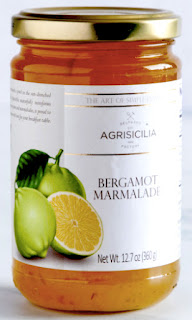
The origin of bergamot flavor and its name

Earl Grey tea is characterized by a flavor called “bergamot,” which comes from a citrus fruit called the bergamot. In Nose Dive: A Field Guide to the World's Smells, author Harold McGee describes this fruit as "a cross between lemon and sour orange." McGee cites several uses for the flavor derived from the bergamot in perfume and in food flavorings.

There’s a commonly held belief that this exotic member of the citrus family was named for the town of Bergamo in Italy. (I was in Bergamo once, after a red-eye flight from the US to the Milan airport, which is not far from Bergamo, so I've always been a bit curious about the fruit and its name.)

McGee explains the real origin of the name Bergamot, which is even more exotic than the incorrect attribution to the little town of Bergamo:
"The fruit's unusual name apparently comes not from the Italian city Bergamo, but from the resemblance of its slightly elongated shape to that of another highly regarded fruit, the bergamot pear, whose name came from the Turkish beg-ármûdi "the prince's pear." It may have arisen somewhere in the Mediterranean and is now produced mainly in the southern Italian region of Calabria. The whole fruit is sometimes made into a fragrant marmalade." (p. 326)

I am finding McGee's book very interesting, though challenging to read. I have read about half of it, and will no doubt find a few more obscure things to mention in my blog as I continue. I may never feel confident enough to write a review of the entire book! 

 Blog post © 2022 mae sander.

Wednesday, April 21, 2021

“The Strange Journey of Alice Pendelbury”

Marc Levy is a best-selling French novelist. This is the first of his books that I have read. I was disappointed for the same reason that very popular historical fiction often disappoints me: it does too good a job of meeting my expectations. As a result, books like this don't seem to offer any new insights about its historic time and place, and often portray their characters with 21st century social and cultural attitudes.  

The Strange Journey of Alice Pendelbury begins in London  in 1950, just after the war. Most readers would have some expectations about this setting: the neighborhoods that are not yet restored after the severe bombings, the lives that are affected by loss of loved-ones, the shortages and rationing of food and clothing that are still in effect, and the feeling among Londoners that the rest of the world is healing more quickly. These are cliches. And the author relies far too much on these cliches: it’s too predictable. Amidst these conditions, Alice Pendelbury, the main character, lives in a studio apartment all alone. She has a few friends and no family: they died in the bombing. 

On page 15, a fortune-teller discerns a very unexpected future for Alice. Because of her visceral reaction to the fortune-teller’s prediction, Alice soon afterwards travels to Istanbul with her next-door neighbor. The rest of the novel is a quest to discover the truth of the prediction. It’s a long quest, which many readers probably find quite suspenseful and enjoyable, but again, I found it a bit too full of cliches. (I’ll forgo presenting plot details since you might want to read it and find out for yourself.)

All in all, I found Alice’s story to be a kind of over-the-top melodrama. The descriptions of Istanbul seemed mostly the sort of thing that you could find in a 1950s guidebook. Alice’s air travel from London to Istanbul was presented with all the expected details from the early days of commercial plane travel. On arrival, Alice and her travel companion checked into the Pera Palace Hotel — which was the major high-end place for famous European visitors from early in the twentieth century until the end of World War II. By 1950 when the novel takes place it was actually a bit run down because of political choices made by the Turkish government (its Greek owners were expelled and it was given to a native/Moslem Turk), but the decline doesn’t seem have happened in the book. And on and on.

There were also some questionable details — small ones but they bothered me. For example, Alice’s traveling companion brings her a beautiful evening gown to wear to an event at the British Embassy. She says it’s lovely and he says:  

“It’s a French model called the ‘New Look.’ They might not be much at the art of war, but I have to admit that the French have an undeniable genius for dressing women ... .”  

Remember, the novel is set in the year 1950. Dior’s “New Look” debuted in Paris in 1947 and was a sensation, noted throughout the world. To show you how famous this was: the term “New Look” was coined by Life magazine. So the characters’ unfamiliarity with the style by 1950 is a bit off. This is a detail, but the kind of detail that disrupts my trust in a a historical novel.

Alice Pendelbury’s distinguishing feature was her acute sense of smell:

“Alice had a rare gift: she was a ‘nose.’ Her sense of smell was so acute that she could distinguish and memorize the slightest odor. She spent her days alone, bent over the long wooden table in her flat, blending different essences to obtain combinations that might one day become a perfume. Every month she made the rounds of the London perfume shops, offering them her new creations.” (p. 6)

Throughout the book Alice is highly aware of aromas and the way they trigger her memories. She seeks out unusual combinations of fragrance that create a characteristic ambience, and she designs perfumes and other aromatic products. Normally, I would find this a very compelling theme in a novel. Unfortunately, I thought that like many things here, the depiction of smells and the memories they elicited was presented in a formulaic and mechanical way. Again, I found this a source of disappointment.

Similarly, the descriptions of food in this novel seem done by rote. The scarce groceries in London, the cups of coffee, the Turkish breakfasts, and the fine restaurants were all described in a way that I found too predictable, too superficial, and  too close to what I’ve read in many other accounts of travel. I was also a little skeptical about the accuracy: for example, eggs, meat, and bacon were rationed until 1954, but the characters seem to find at least some of them in the shops. Maybe they had ration cards or something for the small quantities they bought; this wasn’t mentioned and again is only a detail.

I’m sure my reactions to this novel are eccentric: many readers obviously find this author very compelling. Sorry to be a malcontent. This book was one of 10 free books offered on Kindle this month. The author was on my “maybe read” list so I went for it. I hope I more throughly enjoy the others I chose.

Blog post © 2021 mae sander.

Tuesday, September 08, 2020

A Fantasy of an Alternate Life

A Man by Keiichiro Hirano
English edition published June, 2020.
"In all honesty, I don’t like when other Zainichi  [that is, people whose families immigrated to Japan from Korea] try to claim me, as though we were somehow separate and special. ... Whether it’s being a lawyer or being Japanese, the same applies. It’s unbearable to have your identity summed up by one thing and one thing only and for other people to have control over what that is.” (p. 119). 
"Basically, Kido hated the very idea of collecting human beings into categories. That was the sole reason he found his Zainichi background bothersome. It should have gone without saying that some Zainichi would be good people and some bad, and there would be things about the good Zainichi that he disliked as well as things about the bad Zainichi that were good even if he didn’t know it." (p. 217). 
A Man by Keiichiro Hirano is a mystery novel with a number of very interesting themes. It takes place in several locations in big cities and very small villages in Japan in the few years after the disastrous earthquake and nuclear power plant meltdown of 2011. I enjoyed reading it for a number of reasons, not the least of which that the characters live in a very 21st century way, depending on Facebook, the internet, popular culture and technology, and current literature. I loved Hirano's many references to modern writers, both Japanese and Western.

One phrase from the book, "a fantasy of an alternate life" (p. 155) summarizes the principal theme, expressed in the lives of several characters. They either ponder alternate life as a fantasy, or actually act out the fantasy by trading family register papers and then living as someone other than their natural born selves.

The mystery plot primarily centers on a lawyer, Kido, who investigates several such cases while harboring fantasies about his own identity and how it might have been other. He thinks a lot about his birth as a Zainichi -- that is, his grandparents came from Korea so he is socially inferior to native Japanese people. His wife's family had been reluctant to accept him, as they were not Zainichi, and he also worries deeply about ingrained racism against Koreans that's embedded, seemingly permanently, in Japanese attitudes. I have never read much about this group and how the Japanese treat them, so I found the exploration of bigotry and discrimination of this group in Japan very interesting.

Less profound details in the book are very enjoyable. Hirano has an amazing powers of discriminating between individual Japanese faces, and of delineating the nuances of facial expressions. If you think Japanese people look very similar to one another, you should read what he says about their appearance!

In A Man, the characters often meet and interact in bars and restaurants, and as always I enjoyed the recounting of what they ate, drank, and the aromas they perceived. Here are a couple of interesting descriptions of drinking alcoholic beverages, that show the type of detail that the author is master of:
"Kido poured himself a glass. The vodka was so deliciously cold the consistency was thick, and it had a kick to it like a sweet blaze in his mouth. The scent went up into his nose, recalling faint flashes of the doctor swabbing his arm before a shot in childhood, when he had for the first time discovered the existence of something called 'alcohol.' ... When she was done, the vodka gimlet was so thoroughly shaken it fizzed as she poured it into the frosty glass. Kido found it well chilled and smooth and detected a mellow sparkle to the flavor. " (pp. 38 & 52-53).
"For his first drink, Kido ordered a vodka gimlet, remembering Misuzu. His drink of choice for a long time had been a balalaika, but he’d ordered a gimlet on impulse that night in Arakicho and found himself unable to go back to the sweetness of Cointreau ever since, even though he’d sworn by it since he was a young man." (p. 94). 
A typical description highlighted Kido's perception of the interior a train car coming back from the memorial service for a friend. This trip, like many of his experiences, combined two elements: train travel, an element of modern life, and traditional family and social life in Japan:
"The interior of the bullet train had looked somehow grotesque under the weight of his exhaustion and the sharp fluorescent lights. While many passengers dozed, several drunken groups chattered incessantly. The air in the car was stagnant and heavy, laced with the stench of workday sweat, beer, and some pungent junk food, perhaps dried squid. Kido’s suit was tinged with the added scent of the incense he had burned for his friend." (p. 98).
I'm quoting just one example of a food description. Rather than one of the many images of Japanese specialties, I've chosen the Kido's enjoyment of a special French style of omelet.
"For lunch, they went to a well-known restaurant attached to the station that served Mont-Saint-Michel cuisine. Over souffléed omelets so fluffy the eggs had been whipped into a froth, they shared their impressions ... [Kido] cut into the hearty, well-fluffed omelet on his plate. Cooked to the ideal golden hue, it was folded in half, and frothy egg overflowed from the seam with such impudence that Kido almost felt thwarted. It made him think of molten lava rushing toward the sea. (p. 115 & 118). 
Author Keiichiro Hirano apparently has been very popular in Japan for quite a while, but this is one of the first of his works to be translated into English. As a follow-up, I read one of his short stories, "The Bees that Disappeared," published in Granta a few years ago. (link) In it, he portrayed another very quirky and entertaining character living in a Japanese village.

This review © 2020 mae sander posted in mae food dot blog spot dot com.