Showing posts with label Japanese Literature. Show all posts

Sunday, August 09, 2026

Sunday Thought


The Frog Pond Haiku by Matsuo Bashō
Old pond — frogs jumped in — sound of water. — Translated by Lafcadio Hearn

I’m wearing my Bashō-frog shirt today.


Blog post © 2026 mae sander

Thursday, February 26, 2026

A Food-Obsessed Book

Butter: A Novel of Food and Murder by Asako Yuzuki
Published in Japan in 2017 and in the US in 2024.
 
The characters in this book can’t stop thinking about food — including a woman who is in jail because she was a serial killer, and another character who is a journalist doing a story about the murders. As you can imagine, the plot is a bit over-the-top! Everything centers on food descriptions, which  are incredibly detailed but eventually get out of hand. Especially about butter. For example:

“As it melted under the heat of her tongue, the sweet butter expanded lusciously, rousing all the cells across her body capable of apprehending its rich goodness.” (p. 69)

Unfortunately, around half-way through the author seems to have lost her way, and the narrative becomes nearly unreadable. Earlier the book was a bit repetitive but this flaw gets worse and worse: really annoying. But I continued reading and finished the book despite being bored and bothered. 

I was surprised to learn that the plot is based on the history of an actual serial killer! Wikipedia says: “Kanae Kijima (木嶋 佳苗, Kijima Kanae; born November 27, 1974), known as The Konkatsu Killer, is a Japanese fraudster and serial killer, convicted for poisoning three would-be husbands and suspected of four more, spanning from 2007 to 2009.”

A few quotes:

“Reiko set down on the table a selection of large plates, each of a different design and glaze, and the meal began. Bagna càuda with a plentiful variety of steamed winter vegetables and a rich anchovy sauce, thinly cut slices of warmed salt pork, a tofu and leek gratin, rice cooked in an earthenware pot with vegetables and chopped oysters, and miso soup,” (p. 7)

“Eating was ultimately an individual and egoistic compulsion, Rika was starting to realise. A gourmand was ultimately a seeker of the truth. You could wrap up their mission in all kinds of fancy language, but they were simply confronting their desires day in and day out. As you learned to cook, you became increasingly able to shut out the outside world and create a fortress within your own spirit.” (p. 179)

“When I made them boeuf bourguignon, all they saw was beef stew.’ (p. 336) 

Note: I do not recommend this book! It’s tedious and I suspect the translation is bad, or at least in English the author often seems to use the wrong word for common things. (Example: for the entryway of an ordinary house, the book uses the word “lobby.” The book uses the phrase “a pat of butter” to refer to an entire 200 gram stick of butter. And so on.) If you want to read Japanese literature with food scenes, I recommend Haruki Murakami. 

Friday, December 12, 2025

Mysteries and Celebrations

Say this author’s name (pseudonym) fast and you hear “Edgar Allen Poe.”
He’s actually a Japanese imitator of early European mysteries, and lived from 1894-1965.

The tales are truly creepy!

The author Edogawa Rampo

There’s a new book in the “Dark Materials” series by Philip Pullman.
I read this short story about the characters in the series, but I’m not sure what I’ll read next.

Happy Food

Alice’s Tomato

Miso Soup at Slurping Turtle


Slurping Turtle Sushi Roll

A Year Ago Today

On December 12, 2024, we were birding in Tobago.
We enjoyed seeing the Trinidad Motmot, found only in Trinidad and Tobago.

The day ended with an exotic drink on the beautiful veranda of our seaside hotel.

Coming Soon: Latkes for Chanuka (photos from previous years)


Photos © 2014-2025 mae sander

Tuesday, July 08, 2025

Detective Kosuke Kindaichi: Another Japanese Mystery Story

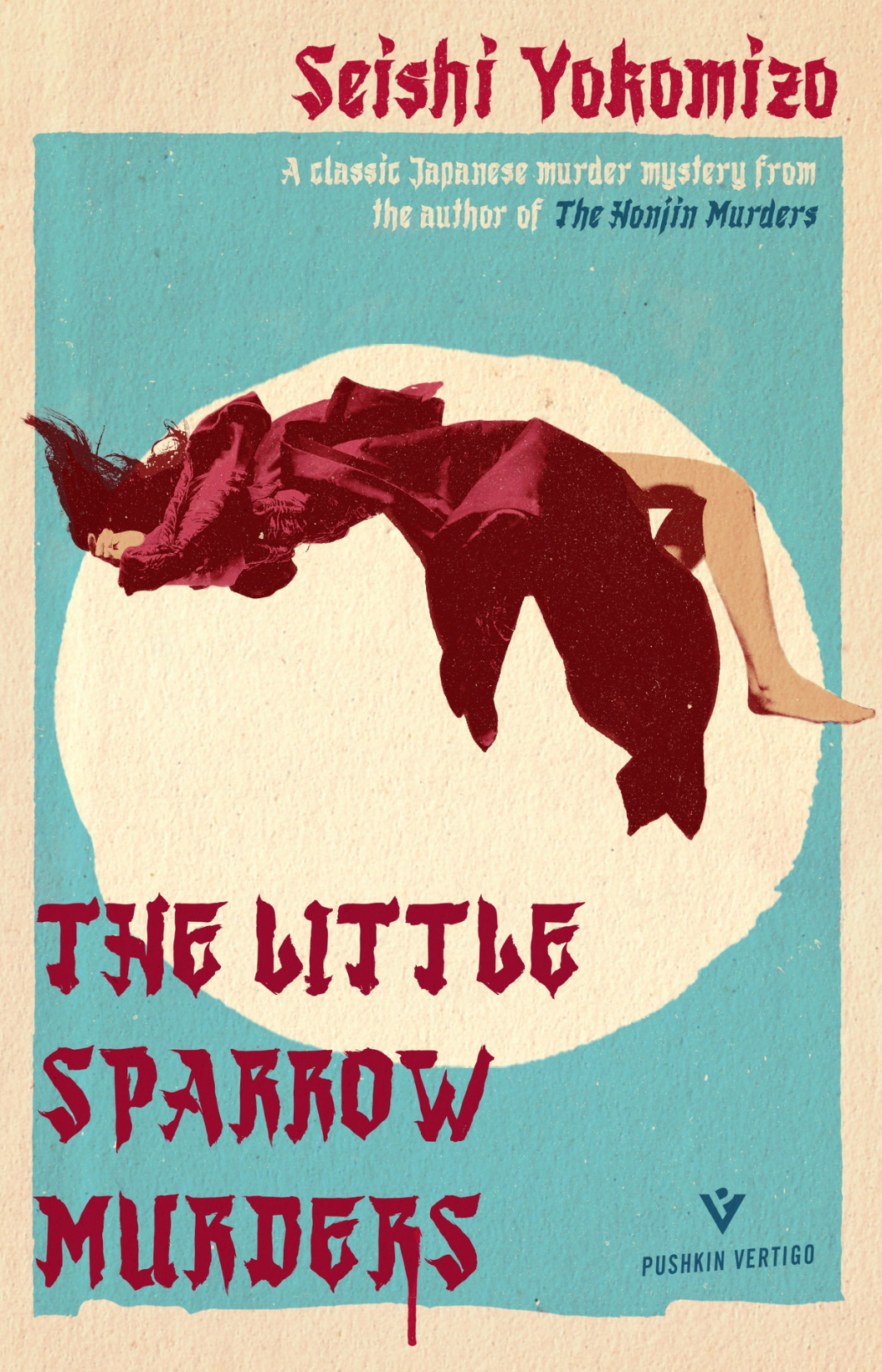
Good reading: The Little Sparrow Murders by Seishi Yokomizo (1902-1981). His detective in this novel, Kosuke Kindaichi, is eccentric, as I have found him in several other novels from a very long and permanently popular series. The action takes place in a village somewhere in rural Japan in 1955. The suspense builds as a series of murders baffle the local people and all of the professional detectives involved in trying to solve them. 

Kindaichi’s appearance conceals his brilliance, as witnessed by his colleague: “Inspector Isokawa looked at his friend, who, as usual, appeared dishevelled in his tired white-and-indigo kimono, which he wore with a pair of threadbare summer hakama.” This description also hints at the preponderance of details from Japanese life that may seem challenging to the modern American reader — but these details create a wonderful traditional atmosphere in post-war Japan. In my opinion, it requires patience and determination to read these novels — but it’s worth doing.


At the beginning of the novel, as is usual with many Japanese translations, the editors supply a list of characters in the village where the action takes place. In this novel, the list has 30 of them, grouped by families; most of the families have more than one identifying name. Also included: the names of several policemen and the detectives, including Kosuke Kindaichi, who is the principal character in the numerous novels in this series.

The breadth of descriptions and variety of personalities in the story create a vivid picture of village life — as experienced by the non-local detectives. I find this fascinating (as always in this series of books). I especially liked some of the food scenes, for example:

“It had already gone eleven o’clock by the time Kosuke Kindaichi and Inspector Isokawa stepped out of the bath and sat down to a hearty breakfast. The meal was comprised of miso soup with nameko mushrooms, salt-grilled salmon, stewed vegetables, and an egg each—and although it was an altogether simple affair, the delicious miso soup filled their empty stomachs.”

Other details involve the geography of this small place: in fact, the solution to the mystery, as of course reasoned out by Kindaichi, involves much trekking around on foot and on bicycles. The reader is offered a great amount of information about how the various houses and farm buildings (especially a winery where a terrible sour wine is made) are placed. 

The map is essential: 

A map of the village where the action occurs. 


The novel includes many examples of Japanese culture, such as a scene near a statue of the folk god Jizo.
I was quite intrigued and googled for images of this child-like god, who wears little clothes that people make for him.

Seishi Yokomizo (1902–81) was a famous and much-loved Japanese mystery writer, and Detective Kosuke Kindaichi -- who appears in many of the author's other novels -- has been in a variety of TV shows in Japan, and even in video games. The novels are currently being republished: this is a recent edition, published last fall. All those I have read are great for suspense, clever plotting, character development, and depictions of a now-lost culture from the mid-20th century.

Blog post© 2025 mae sander

Thursday, June 26, 2025

Murakami Forever

The first two stories ever published by Haruki Murakami:

These two short novels, Wind and Pinball, are very enjoyable reading. I’ve long been a Murakami fan, but never read these early works, the beginning of his fascinating literary accomplishments. Murakami novels are usually very long and involved, with sometimes hard-to-follow plots and magical realism. These stories are very simple, short, and have pretty much straight-line plots. There’s no magic — only somewhat eccentric characters such as a pair of identical twins who show up and move into the narrator’s small apartment, and then just as abruptly pack up their clothes, get on a bus, and leave.

I did find that these works illustrate the author’s love of detail and his wonderful turn of descriptive phrases, especially for evoking very ordinary things like food and music. Murakami loves American jazz and popular music, which appear here as in almost all his later works. Almost every one of his works of fiction has some passages about cooking, including these early ones — as his works became more surrealistic, food was often a way that he grounded his narrative in every-day life.

Some quotes that embody what I see as pure Murakami:

“When I stuck my head out the window I thought I sniffed rain. A few autumn birds cut across the sky. The drone of the city was everywhere, a mix of countless sounds: subway trains, sizzling hamburgers, cars on elevated highways, automatic doors opening and closing.”

“My cassette tape of an old Stan Getz album was the musical background for my efforts that morning. It was a dynamite band featuring Getz, Al Haig, Jimmy Raney, Teddy Kotick, and Tiny Kahn. Whistling Getz’s solo to ‘Jumpin’ with Symphony Sid’ from start to finish along with the tape really picked me up.”

“The foghorns on the ships anchored at sea were emitting sharp, plaintive wails, like calves that had strayed from the herd. Some of the wails were brief, others long, but each had its own distinct pitch as it cut through the darkness on its way toward the mountains.”


"We pulled up next to the water and sat there in the car, drinking coffee from the thermos and munching the cookies the twins had bought. There were three kinds—buttercream, coffee cream, and maple— that we divided up into equal groups to give everyone a fair share.” (Photo: coffee cream cookies from the web).
  
“I had finished my bath and downed the last of my beer when they finished grilling the trout. There was one for each of us, with canned asparagus and a huge bunch of watercress on the side. The trout tasted like something from the good old days—a mountain path in summer. We took our time picking every last morsel from the fish with our chopsticks. All that was left on the plate was white bones and a pencil-sized watercress stalk. The twins washed the dishes right away and made coffee.”

I’ve been reading Murakami’s novels since 1989, mostly picking them up at the time they were published. He’s quirky! I appreciate his very strange sense of reality, which I think is grounded in an amazing ability to observe the details of life, as in these early novels. 

Blog post © 2025 mae sander

Thursday, June 19, 2025

So Much to Learn!

 Books!

My longtime favorite little library. Around a mile from our house.
(Yes, they still keep going.)
I seem to read everything on ebooks.

Our Garden


Serious Book


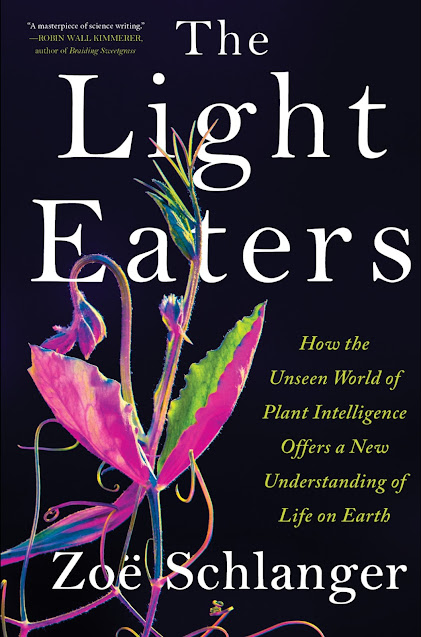
Quotes from The Light Eaters by Zoë Schlanger

“Electricity is a wily force. It itself is not alive, but it is very often the best sign of life. It’s a proxy for aliveness.”

“Already, scientists have found compelling evidence that language is not entirely confined to the human realm; prairie dogs appear to use adjectives, specific repeated sounds they use to describe the size, shape, color, and speed of predators. Japanese great tits have syntax; they use distinct strings of chirps to instruct their comrades to scan for danger, or tell them to move closer. We’ve heard about songbirds using backchannels for alarm calls, and risk-averse chipmunks screaming at the slightest spook. Perhaps it would be small-minded of us to foreclose on the possibility of a sound-based plant language emerging too.”

“If plants can’t do something for themselves, they find other things that can do it for them. But when those other things are living creatures with their own agendas, that might take a little bribing—or manipulation. Legumes, for example, form associations with bacteria in their roots to lock in a steady supply of nitrogen fertilizer.”

“Agency is an organism’s capacity to assess the conditions it finds itself in, and change itself to suit them. Yes, we do this all the time. So do plants.”

“Intelligence is a loaded word, perhaps overly connected to our ideas of academic achievement. It’s been weaponized against fellow humans for millennia, used to divide people into hierarchies of worth and power. I wouldn’t want to apply that schema to a whole additional category of life. Yet it is, by its very definition, still a word that contains the germ of what we mean by alert, awake to the world, spontaneous, responsive, decision-making. From the Latin interlegere: to discern, to choose between. So science may or may not ever deign to use it for plants, for exactly the reasons of the social implications; humans have contaminated the word with their humanness. But words are merely symbols. They draw a perimeter around a feeling for which there is no language. In that sense, intelligent might be the tightest word-perimeter we’ve got to describe what we are seeing plants do.”

Not-so-Serious Book


The Kamogawa Food Detectives is a light-hearted book, but unfortunately it’s quite repetitive. Each chapter begins in the secretive restaurant of the Kamogawa family, the father, Nagare, and the daughter, Koishi. In each case, a person comes into the restaurant with a request to the “detectives” to identify a blurry food memory, usually from their early childhood. 

Before hearing about this request, Koishi and Nagare serve him or her a remarkable, delicious, and ultra-traditional Japanese meal. The descriptions of these over-the-top Japanese meals really seem to be the main motivation for the novel. Here’s an example:

“‘From top left,’ began Nagare, tucking the tray under his arm, ‘Miyajima oysters, simmered Kurama-style, miso-glazed baked butterburs with millet cake, bracken and bamboo shoot stew, chargrilled moroko, breast of Kyoto-reared chicken with a wasabi dressing, and vinegared Wakasa mackerel wrapped in pickled Shogoin turnip. In the bottom right you have a hamaguri clam broth thickened with kudzu starch. Tonight’s customer asked me to create something that evoked both the lingering winter and the onset of spring, which led to the dishes you see here.’”

After the client eats and describes the food memory they wish to recapture, Nagare travels to somewhere in Japan where the seeker lived as a child. This consistently requires two weeks, after which he will prepare the dish that haunted their client. In contrast to the lavish meal served two weeks before, these nostalgic dishes are usually very simple — in one case, it’s a simple dish of spaghetti with hot dogs, served in a special way; usually it’s a simple food typical of Japanese childhood, but also slightly unusual in some way. 

Each chapter is so much like the others that I quickly got tired of reading. There’s even a cat that makes an appearance at the same point in each story. Note, however, that I did finish all 201 pages of the book.

UPDATE: A recent New York Times cooking article described the Japanese “Spaghetti Napolitan” that featured in the story I mentioned. It’s spaghetti fried with seasoned ketchup — based on Italian cuisine, but invented in Japan, and a definite favorite of kids there. (NYT Article Here)

Alice in Amsterdam

Alice sent me some photos of her visit. I love this street art!

At the Reijksmuseum


Wonderful dollhouses. I try to see them whenever I am there.

“The Nightwatch” is being cleaned. A previous time it was cleaned was in 1976, and we
(Len, Evelyn, and I) saw it then, in a workshop. So it’s funny that Alice is seeing the same thing.

I’m sharing this weekend post with Eileen’s critters, Sami’s murals (The Nightwatch is DEFINITELY a mural!) and with Deb’s Sunday Salon. © 2025 mae sander.

Friday, June 13, 2025

A Week in Ann Arbor

A pleasant place to sit in the park for an hour.

A mural from Alice.

Indescribable Garden Art


In a neighbor’s garden

Trying Recipes from the New York Times


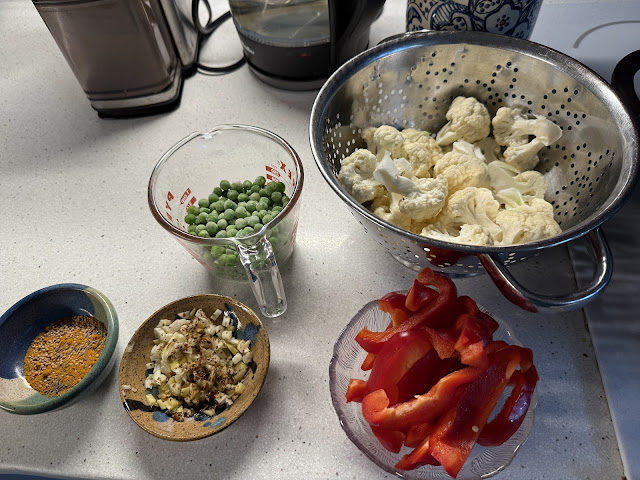
Ingredients for cauliflower recipe — I added red bell pepper to the dish.


Not Reading Much

I read one story from this collection.

The locale of the story I read, which took place in the mid-19th century.

My next reading project, starting slowly: The Light Eaters.

Home Improvement


Our old shower door was not sliding any more. We had a new one installed.

A Great Evening With Carol and Nat


Each dish featured different herbs from Carol’s garden.

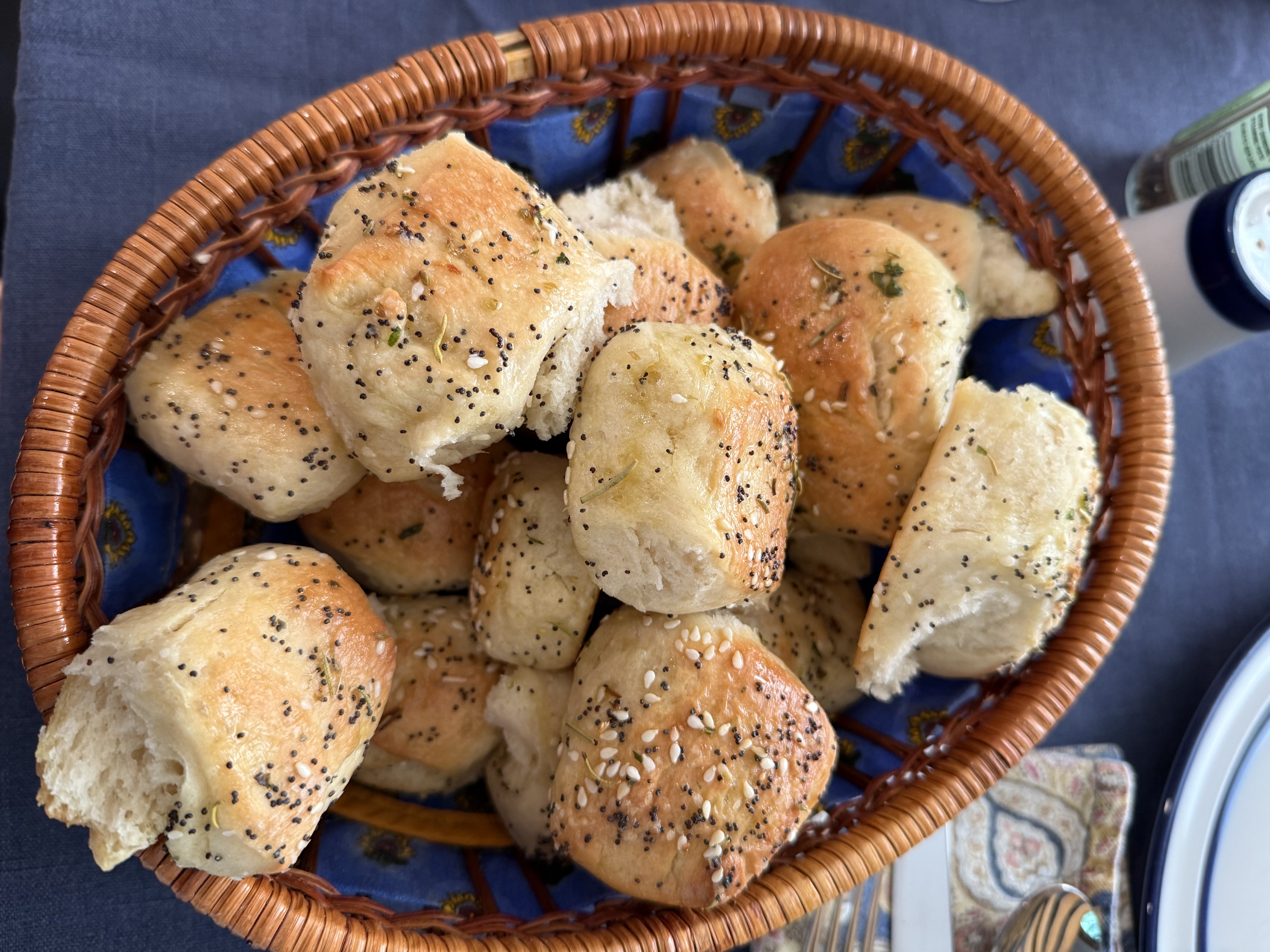
Delicious dinner rolls using a recipe from a popular local restaurant— plus herbs.

Salmon with sorrel, a wonderful and unusual herb.

Magnificent roasted peppers.

Blog post © 2025 mae sander

Friday, February 07, 2025

At My House

 Cooking 

Dinner for Guests

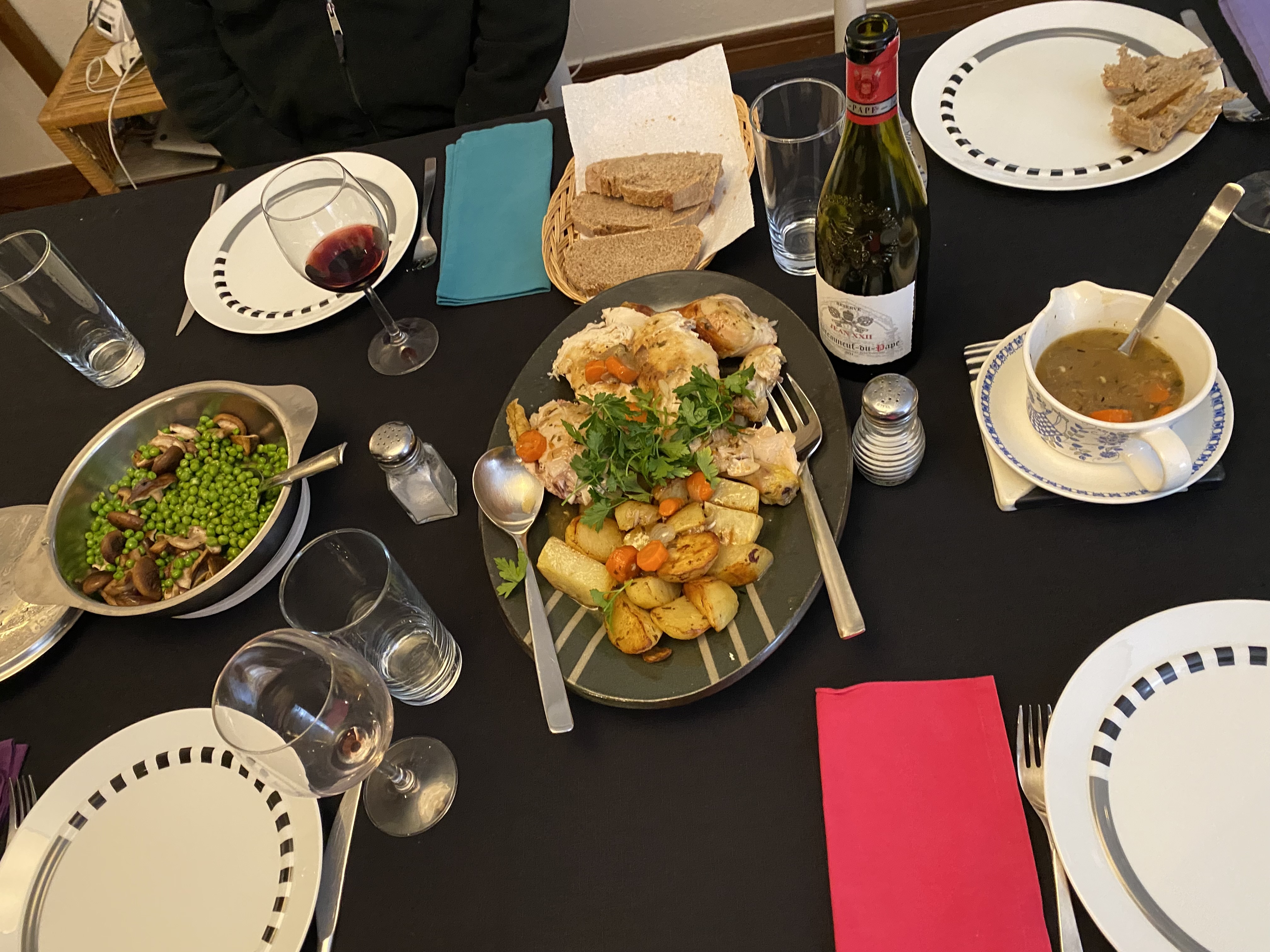
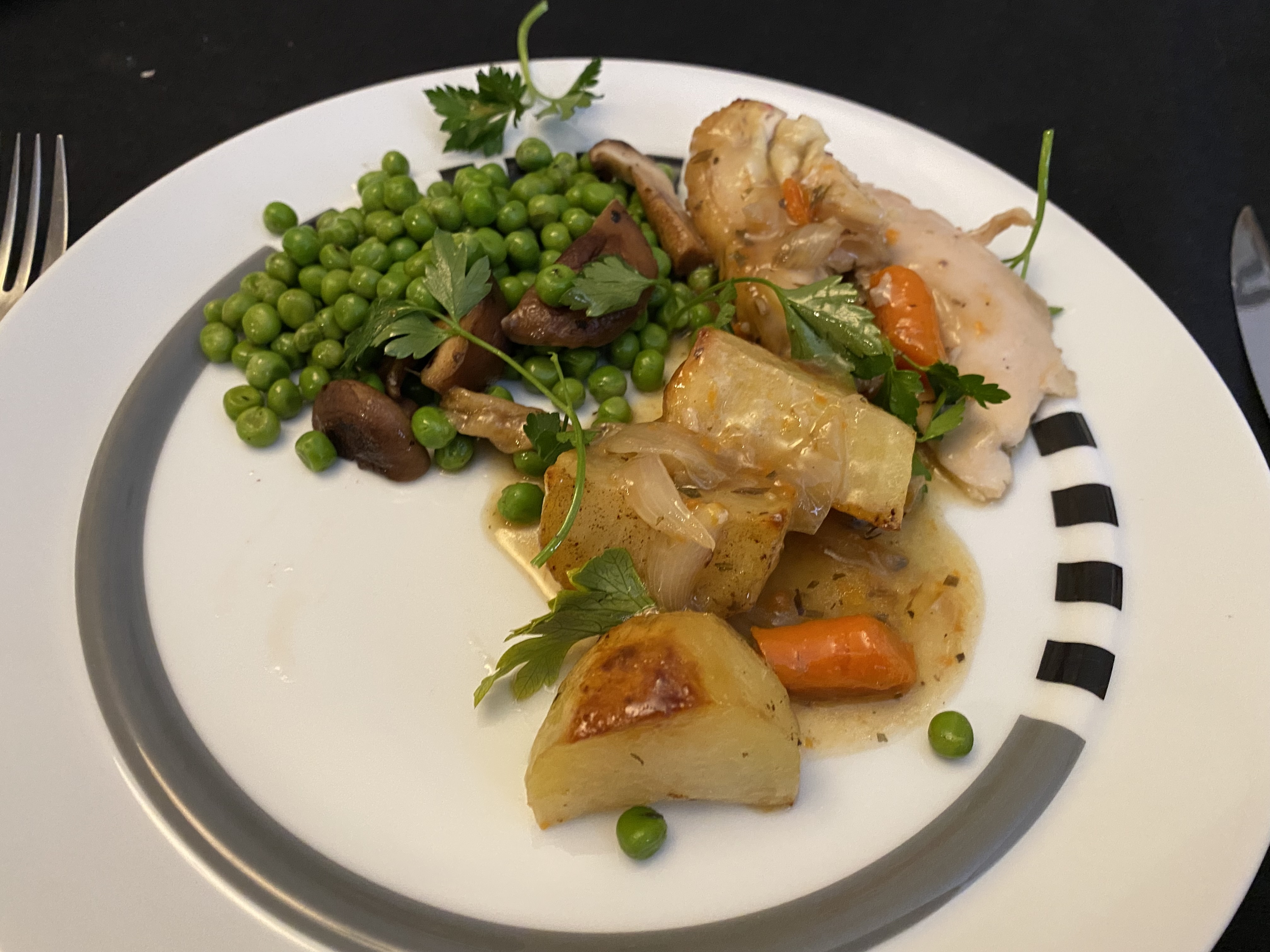
We hadn’t cooked any recipes from Mastering the Art of French Cooking lately, so when we started planning a meal for friends, we thought about an old favorite: casserole-roasted chicken with tarragon. If you want to get amazing results you have to do every step the way that Julia Child says to do it. So in addition to the recipe in the old favorite book, we watched the 60-year-old TV episode where Julia Child showed American cooks how to make this dish. Back then, it was revolutionary!

These original episodes of The French Chef are of course in black-and-white.
As you may know, Julia Child’s cooking show pretty much invented Food TV.

Julia Child’s recipe  recommends roasted potatoes and peas with mushrooms as side dishes. OK.

Unbelievably delicious!


Our guests.

Best Breakfast

 Another great bake by Len.


Reading

A bit of reading about Tokyo for a change of scene. Tokyo on Foot is a delightful collection of images.
Thanks to Emma at Words and Peace for recommending these books.

Reading next: classic haiku.

This is not one of the best novels by Patricia Highsmith.
I didn’t like any of the tediously portrayed characters and they weren’t
quirky enough to be interesting. 

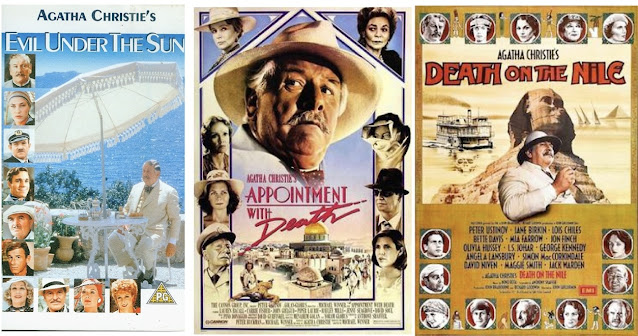
Watching Peter Ustinov’s Poirot

We wondered why we hadn’t seen these Agatha Christie films before. Each one has an all-star cast.
They have a delightful light touch. We also watched Kenneth Branagh’s Orient Express: very heavy-handed.

The Weather is Grim

Woody, the Michigan Groundhog saw no shadow and (as superstition has it) said no to more winter.
I agree that winter should end, but unfortunately, Woody is only right 35% of the time. (Photo Credit)
The “weather” in our nation isn’t so great either.

What I was doing two years ago

Whale watching in Baja California, February, 2023.

Photos © 2023, 2025 mae sander
Shared with Sunday Salon at Readerbuzz and Eileen’s Critters.