Showing posts with label Agatha Christie. Show all posts

Sunday, January 18, 2026

Murderers, Poets and Barbecue


Creepy country house in 1925. Helena Bonham Carter. Agatha Christie. New Netflick…Just wow!

E.C.R. Lorac’s novel offers us another aristocratic family down on their luck,
living in the ruins of their family manor. Suspense! Murder! More Wow!

The Poet X — a poor high-school girl trying to become a poet.
Couldn’t be more different from stories of the English aristocracy!

Barbecue Take-Out for Dinner


Barbecue from Satchel’s: chicken, beef, coleslaw, salads, cornbread.

Blog post © 2026 mae sander

Monday, December 01, 2025

TV and Books

Fun movie to watch — I love all the cameos by famous actors from that era.
 

Five Found Dead takes place on the Orient Express, and all the passengers are aware of the 
Agatha Christie plot. It starts well, but there are too many murders and not enough Christie-type characters.

Other Reading Last Month

I’ve been reading (or at times just sampling) several books about people and places well beyond my usual habits in reading or in socializing. I’ve enjoyed some, and I’ve been put off by others. I haven’t finished all of them, but I’m not sure I’ll be going back to them, especially as these are mainly collections of essays  that can be read separately.


NOTE: This book is not related to the TV series of the same name.


Blog post by mae sander 2025.

Wednesday, March 19, 2025

A Cute but Unnecessary Book


Sylvia Plath’s Tomato Soup Cake: A Compendium of Classic Authors’ Favourite Recipes.
Arbitrarily photographed with some eggs in my kitchen that were going into an omelet that was probably better than anything in the book.

Collections of recipes by famous people appeal to many readers. Many such collections have been published, sometimes by asking the famous people to contribute recipes, and sometimes by finding their recipes already published somewhere else — maybe in a journal or in letters, maybe in a novel. Sylvia Plath’s Tomato Soup Cake is such a collection with recipes already published in similar anthologies. When I heard about it, I ordered it because it sounded really good and I thought that in some way, it would be original. It isn’t. I am somewhat disappointed.

The sources of the recipes in this new book are mainly recipes from earlier collections — sometimes it seems to be kind of a cannibalized work. Here are the covers of some of the sources cited in the afterward to the work:

Where to find writers’ favorite recipes? Look in earlier collections of writers’ recipes.
Most of the books depicted above are now out of print and costly. I found the images by searching the web. I own only one of these books (though I also own some similar collections).

Big Question: do these sound like good recipes? Would you want to use them to make dinner or a special treat for guests? Well, not really. After all, most of the authors whose work is included were not at all cooks. Some of them even say they weren’t very good in the kitchen, though some of the recipes are quite plausible, if ordinary. For example, Allen Ginsberg’s Cold Summer Beet Borscht is almost exactly like the borscht my mother made. Christopher Isherwood’s “Brownies Wendy” are simply the most standard classic brownies (the ones my seventh-grade cooking class was assigned to make). Tennessee Williams’s Grits are pretty undistinguished from the usual southern favorite. Barbara Pym’s Marmalade is ordinary as well. Not much to see here —  though at least these are interesting authors, so maybe it’s nice to know what they might have cooked.

A few recipes are distinguished by their unappealing nature: these are recipes that I would never try and in fact they are by authors that I would probably never read:
  • Noel Streatfield’s Filets de Boeuf aux Bananas contains beef, bananas, horseradish, parsley… no thanks. Also, I had never heard of Noel Streatfield (1895-1986), author of children’s books, but now I have. 
  • Elizabeth Jane Howard’s Devils on Horseback are made from bacon wrapped around prunes that are stuffed with olives stuffed with pimentos. I guess these were popular back in the day — this author was born in 1923. I have a feeling that her books are also forgotten, along with her style of cooking.
  • Spike Milligan’s Spaghetti Dolce is spaghetti with cream, sugar, and brandy. Another unappealing recipe by another forgotten writer.

Fun fact: Sylvia Plath’s Tomato Soup Cake has no listed author: it was put together by the staff of the publisher, Faber. The more I think about it, the more it seems to be a rather cynical hack job. While some of the authors may be interesting, many are deservedly obscure, and they have no actual connection to one another, aside from the fact that at some point they published recipes. I think the book’s reason for existing is just to make a bit more money off the same old material, and, like the title itself, is meant to attract attention in a shallow kind of way. If you already have any collections of recipes by writers and artists, you probably don’t need this one.

Better Celebrity Cookbooks


 I have quite a few celebrity recipe collections on my shelves. I also have several recipe books by famous authors, where they shared their recipes along with maybe a few anecdotes about dinner parties or meals shared with other famous people. The Alice B. Toklas Cookbook by Gertrude Stein’s companion, written after Stein’s death, is probably the most famous (and to me wonderful) of such celebrity cookbook. 

Memorably, Peter Sellers’  1968 film “I love you Alice B. Toklas” made reference to the Hash Brownies recipe included in this book. The film is surely forgotten by now, but this cookbook was consequently even more famous at that time.


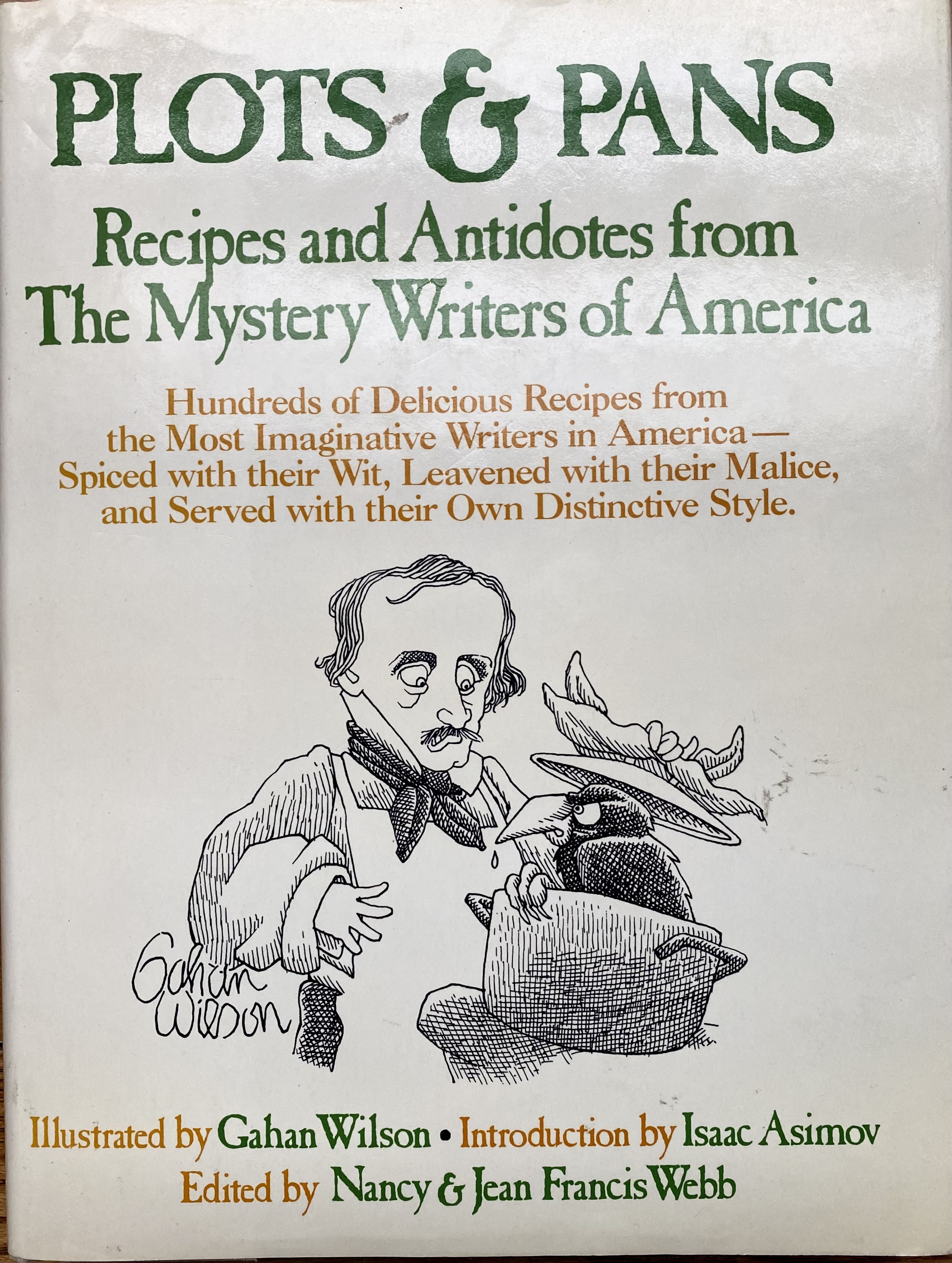
Plots & Pans: Recipes and Antidotes from The Mystery Writers of America promises “Hundreds of Delicious Recipes from the Most Imaginative Writers in America — Spiced with their Wit, Leavened with their Malice, and Served with their Own Distinctive Style.” Published in 1989, this book is still in print and available. The illustrations are amusing.

I have around a dozen other recipe books featuring work by various authors. Some were compiled later, and the recipes are reconstructed from brief mentions in an author’s works; for example: a Jane Austen cookbook or an Agatha Christie cookbook, by authors who didn’t participate in making the book. I also have several by authors who were interested in food as well as detective fiction or other fiction. 

Bottom line: you can do better than the recently published book!

Sunday, April 21, 2024

Reading and Enjoying Spring Weather

 Julia Alvarez: The Cemetery of Untold Stories


Julia Alvarez is a wonderful story teller! In this novel, a successful New York writer decides to return to her childhood land: the Caribbean country of Dominica — which is also the birthplace of Alvarez. The character brings with her many boxes of notes and materials from novels that she hasn’t written, and creates a “cemetery” for these unrealized projects and the characters they were going to develop. She commissions a talented sculptor make a monument to each persona whose story she didn’t finish. 

The characters who now inhabit these monuments come to life and tell their stories to a local woman who has never read fiction (in fact, she can’t read at all). I loved reading these intertwined tales, along with the story of the illiterate woman herself, and of her family, which also has some members who have become successful American immigrants.

There’s so much in this novel — themes of identity; themes of chances and of opportunities both taken and missed; themes of good and bad family relationships; and themes of the history of the island, which is divided into two countries: Dominica and Haiti. Really good reading!

Claude Izner: Murder on the Eiffel Tower


This is a historical novel that takes place in Paris in 1889 during the great exposition for which the Eiffel Tower had just been built. The painstaking historical detail in the novel is fascinating — I assume it’s accurate, but I didn’t check. For example: 

“I was lucky enough to see the exhibition of Japanese prints organised by the Van Gogh brothers. The Great Wave by Hokusai made a real impression on me.” (p. 17)

“The Colonial Exhibition was made up of numerous buildings, either standing alone or grouped into indigenous villages. Victor did not wait to look at the seven pediments of the temple of Angkor but hurried towards the red structure of the Colonial Palace, an architectural mish-mash of Norwegian, Chinese and French Renaissance styles topped by green roofing.” (p. 60)

The food details are especially fun:

“Fried-fish vendors and left-over food sellers were setting up their stalls in the wind. Dishes of beetroot sat alongside rounds of cold black pudding.” (p 161) 
 
“In the kitchen, Germaine, with tousled hair and apron askew, was stirring the contents of a saucepan with a wooden spoon. Victor sniffed, recognising the aroma of partridge and cabbage in a cognac sauce.” (p. 207) 

Unfortunately, as a detective story this novel is too complicated. One murder after another piles up, and one man becomes obsessed with the murders and tries to figure out how they are linked and who is the perpetrator. At a frantic pace, he follows one suspect after another, becoming exhausted and confused. He also falls in love with a woman who is also enmeshed in the goings-on. He keeps having migraine headaches, or being hit over the head, or being baffled and overtired, or pursuing the love interest instead of the mystery. He’s always trying to think of some elusive insight that he can’t quite bring to the surface. There’s too much of this type of description:

“An idea was taking hold, but just out of his reach. He put on his frock coat as his mind worked on. … His memory was still teasing him: it was something to do with a name he had glimpsed recently, a name … But what name?” (p. 203)

I found the author’s mystery skills somewhat clumsy, and the piling-on of details and events somewhat unbelievable. Compared to Agatha Christie or other classic writers of the twentieth century, Izner just isn’t quite as good at creating a plot, embedding clues, or building suspense. I’m thinking of the well-formed detectives, victims, by-standers and witnesses in the novels of Martin Walker or Elly Griffiths or Donna Leon, and I just don’t find Izner’s focus and clarity to measure up.

Spring Pictures from This Week


Sunrise outside my bedroom window.

Just before the rain.


The beaver lodge at Matthaei Botanical Gardens.
Last year, the beaver built a dam across the stream, but a winter storm washed it away.


Michigan students painting “The Rock” — maybe in anticipation of finals during the next two weeks.

The magic spoon turns purple when the frozen ice cream touches it.
After a spring walk in the woods, we stopped for ice cream.

I enjoyed a scoop of each of these flavors.


Blog post and all photos © 2024 mae sander
Shared with Sunday Salon at Readerbuzz.

Saturday, March 23, 2024

Miss Marple Carries Her Purse (I mean Handbag)

Agatha Christie’s Miss Marple in the BBC series from 1987.
I love the way she carries her handbag! 
Corrected because it’s been pointed out to me that in England it’s a handbag, not a purse.

Joan Hickson (1906-1998) is my favorite portrayer of Miss Marple, the seemingly invisible old lady in Agatha Christie’s detective novels who always figures out who committed the crime, how they did it, and why. Joan Hickson’s acting suggests that Miss Marple was dotty and did not know what was going on — but meanwhile she was observing everyone and figuring out their motives and methods. The character’s sharp grasp of human nature was developed by watching the people in her little town, Saint Mary Mead, where she classified her fellow inhabitants by their type, and applied these observations in her successful career as a clandestine detective.


“At Bertram’s Hotel,” based on the 1965 novel.

“At Bertram’s Hotel” takes place at a hotel in London, beginning as Miss Marple and several other people are checking in at the counter in the beautifully retro hotel lobby, full of comfortable leather arm chairs, a fire burning in a fireplace, and lots of uniformed servants. Guests are constantly having tea with wonderful traditional sweets like “seed cake” — a dryish caraway-flavored cake whose popularity dates to the 18th century (source).

Miss Marple mentions that as a child she had once stayed at Bertram’s with her aunt — and that nothing has changed there since that moment. Watching this drama, you are thus aware of at least three eras in the past: the 1980s when the series was filmed, the 1960s when the action takes place, and perhaps the pre-World-War-I era when Miss Marple remembers her first visit there. Very amusing!

Ultimately, Miss Marple realizes that the retro atmosphere is faked, like a magician’s misdirection, concealing a deep criminal plot, and also becoming the scene of a crime of passion. She helps two police detectives to bring the criminal gang to justice, and solves the other mystery as well, ending with the statement:

“I learned what I suppose I really knew already — that one can never go back, that one should not ever try to go back—that the essence of life is going forward. Life is really a one way street, isn’t it?”


This week we also watched two other dramatizations of Miss Marple novels, both with Joan Hickson.

I also read one volume of an Elly Griffiths series,
The Vanishing Box It’s not as good as her Ruth Galloway books.

It’s definitely been a week of mysteries!

Winter is back. Poor daffodils!


Blog post © 2024 mae sander


Saturday, March 16, 2024

Weekend Update

 Recent Reading

Help Wanted, published March 5, 2024.

Help Wanted by Adelle Waldman has the clarity of a fable. I enjoyed reading it both as social commentary and as a good story of individuals struggling to make it in a society that hasn’t given them many opportunities. Virtually the entire novel takes place in the present time (mid-2020s) in a big-box store, part of a chain called Town Square that resembles a Target. It’s located in a middle-sized town that was once much more prosperous, and neither the town nor the store is as nice as it used to be. The novel is written with a good sense of humor and plenty of irony, though my summary doesn’t especially show this.

The employees at Town Square represent a slice of American life. The novel focuses on one group, which is responsible for unloading the trucks that bring the merchandise every day. As they appeared to their boss in their morning meeting:  “The diversity of race, gender, and ethnicity in the faces before him would have filled the headmaster of an elite private school with envy.” (p. 28) The characters, though each is fully portrayed, also seem to me to represent a set of types in our society. They realize this, and show it — for example, “Val threw her head back and laughed breezily, the way she imagined people do at fancy cocktail parties.” (p. 237)

The characters have a variety of reasons for being employed by a corporation that underpays them, makes sure that they don’t work enough hours to qualify for benefits or overtime pay, and gives raises that barely cover inflation. They are highly aware that there are not enough of them to restock shelves or assist customers effectively, particularly not to the standards they would set for themselves. This mistreatment of employees was intentional; further, the corporate policy of understaffing the store was purposely unacknowledged: “To keep customers from recognizing that the lack of employees on the sales floor was a deliberate choice, corporate constantly posted large banners reading help wanted—the implication being that any lack of staff on hand was a function of the tight labor market and/or a lazy populace’s unwillingness to work service jobs.” (p. 150)

Most of the characters have varying degrees of self-awareness and they are highly conscious of the way society has limited their options. They also see their own shortcomings. For example, Diego, an immigrant from Central America, considers why the white people seem to him to be better off, to live in houses that their parents or grandparents have owned, and to be better able to cope with their poor wages and lacking benefits. “Diego thought of a conversation he’d had with a guy named Isaac who used to work with them. Isaac had said that even at a store like Town Square, where they’re all paid shit, white people were still better off than black people. It was part of a bigger, historical picture, Isaac said. … When the jobs started to go away and wages started to fall, it was like a game of musical chairs. The people who already had stuff—white people—got a chair. Black people were left standing, with nothing but our civil rights.” (p. 175-176)

Each character has his or her own problems: some drink, some take drugs, some lose their tempers too readily, most have problems with spouses or partners, they never get enough sleep, and one has trouble reading because she suffered from lead poisoning from substandard housing during her childhood. All of them are struggling to provide themselves and their families with food and shelter, and often work a second job besides the one at Town Square. Mostly, they wish they could provide their children and partners with more extras such as a birthday party at Chuckie Cheese or good toys, or more healthful food. 

Most of the workers had higher aspirations when they were younger, and are slowly sinking into hopelessness. They all worry that they will never advance, even at Town Square. They feel held back because they haven’t finished college or never went to college at all or in fact didn’t even have a high school diploma or GED. For example, “What did Nicole know about college? Nicole’s own line on the subject had long been: Of course she wasn’t going—she’d barely gone to high school, and that had been free. Why would she pay to go to more school?” (p. 164)

The plot of Help Wanted centers on an announcement that the store manager is about to be transferred to a much-preferable location, and thus there will be an internal promotion of one of the lower-level managers. The employees at the center of the story decide that they would like their own manager to be promoted, not because she’s competent or likable (she’s neither one), but because they want to get rid of her. They know they will be interviewed by visitors from the corporate headquarters, to ask them what kind of leadership and initiative she has. Obviously, I’m not going to tell how this comes out, but I do recommend reading this very well-done fable for our time.

The Guardian reviewer says:
 
“Help Wanted is an acidic comedy about contemporary American serfs. It’s a kind of communal novel about the people clinging to the bottom of the social cliff: the two-jobbers, the drop-outs, the working poor. … A superb, empathic comedy of manners …. Perhaps the most impressive thing about Help Wanted is that Waldman manages, in telling her small story, to describe not just the American economic prison but the global one. So: both a novel of manners and a systems novel, a book that shows us, perhaps, how intimately linked these apparently disparate genres were all along.” (source)


Other books reviewed this week


On TV this week


Agatha Christie’s novel Murder is Easy was published in 1939, and it follows the conventions of a mystery where the detective thought he was an innocent bystander to events (specifically, murders) that he did not cause, and in which he has no stake. Christie was remarkably inventive, and was a master of many plot types in her mysteries. This is definitely a good one, with a whole series of murders that are more and more apparently done by one truly evil criminal. It’s been remade into any number of TV and movie adaptations, and we recently watched the latest one, which was released in 2023.

This newest version of Murder is Easy introduces a radical change in Christie’s plot: the person who is dragged into investigating and solving the murder is not a professional detective, but is a newly arrived Nigerian man, Luke Fitzwilliam, who is about to take a job in the British foreign office. He meets an elderly woman on a train, and she enlists his help because she says she must get to Scotland Yard and get help putting a stop to a series of murders that are happening in her village. The next thing that happens is that right in front of Luke she is knocked down and killed by a hit-and-run driver. But he — and we, the audience — know that it couldn’t have been an accident. As another famous detective (quoting Shakespeare) said: “The Game’s Afoot!”

The date for this new dramatization of Murder is Easy has been moved to 1954, which was a time when Nigeria was working towards independence from British rule; it achieved independence in 1960. This revision enables the script writers to introduce a fascinating characterization of Luke Fitzwilliam, who becomes the central character in the drama. It’s not too much of a spoiler to say that he penetrates the relationships and motives of the village people and figures out the identity of the evil mastermind.

The reaction to the arrival of a black African in the English village shows the varying views of the local people — some more bigoted than others.The introduction of racism to the Agatha-Christie-typical environment is an interesting twist added to their reaction to the uninvited investigator. For a Christie fan, it’s also a delicious interpolation into her oeuvre, as her books and her attitudes often embodied a good deal of racism, both explicit and implicit. (See this article for a recent attempt to clean up this issue in her books for new edition: “Agatha Christie Novels Reworked…”) 

Springtime in the woods


Reviews © 2024 mae sander
Shared with the Sunday Salon at Readerbuzz.

Monday, August 21, 2023

The Puzzle of Blackstone Lodge


Mystery reading this week: The puzzle of Blackstone Lodge  by Martin Edwards, first published 2022. Set in the 1930s, this book is crammed with culture and drama — food, wine, fashionable and not fashionable clothing, motor cars, household situations, complicated relationships, unexplained disappearances, and murders of course. It’s a good mystery, more or less in the style of the well-known writers of that era: I’m thinking Dorothy Sayers or Agatha Christie. Like the locked room mysteries of early mystery writers, it’s very complex, with many characters, constantly shifting motives, and vast numbers of clues. The most amazing portrayal is that of a spiritual medium who possesses highly effective methods of seemingly offering contact with the dead to bereaved customers  — and charging them very high prices. The gradual revelation of the reality of this character and the discovery of how she is able to be such an effective medium is masterful.

Finally after several murders and much effort to find the murderers and their motives, there’s a very long denouement in a very unusual setting. Finally, in this scene and one more conversation, the author reveals the perpetrators — both suspected and unsuspected. The young woman amateur detective, Rachel Savernake, masterminds the entire final revelation. Although the novel is complex — even over-complex and maybe a bit too long — it’s a readable tale, and it amuses me that the author, writing in the present time, the 2020s, returned to so many classic mystery novel conventions.

A Bottle of Wine

“Jacob reclined on the settee in the sitting room of Gaunt House. Nell Fagan’s death had ruined his day, but a glass of Château Pavie 1921 provided a touch of solace. He was no wine buff, but it was the most stunning Bordeaux he’d ever tasted. … Jacob washed down Hetty’s shepherd’s pie with more than his fair share of the Château Pavie.” (p. 186-189)

Ah, yes, the pleasure of visiting a grand household that hasn’t lost its money in the Depression. I don’t know what the wine was worth then, but I’m sure it was expensive. (The bottle depicted here is available, believe it or not, for around $3500, though it may have lost some of its flavor in the past century or so.) 

UPDATE: in response to comments — to repeat, the price of a surviving bottle of the 1921 vintage TODAY is very high, but that wouldn’t have been the price in the 1930s when the book is set. Today a recent vintage is around $400.

Quite a few scenes of food and drink contribute to the atmosphere of this novel, and I always love to see how the author employs food details as a way to enhance atmosphere and character development. 

In sum: I found this to be a good read, even if very complicated and drawn-out. Above all, I am highly impressed at the vast number of loose ends that are explained in the final chapters.

Review © 2023 mae sander


Thursday, August 10, 2023

Books and Films

Another Japanese Classic


I read another book by Osamu Dazai titled Otogizōshi: The Fairy Tale Book of Dazai Osamu. Totally fascinating! I must admit that the cover design was partly responsible for my decision of which of this author's books to read next. Isn't it neat? It shows a famous fairy-tale character riding on the back of a sea turtle. Here is the original print.

Urashima Taro Returning Home from the Palace of the Dragon King, 1886.
Yoshitoshi Tsukioka (source: Art Institute of Chicago)

In this collection of stories, Dazai retells several fairy tales that would have been familiar to any Japanese child or anyone who grew up in Japan before or during World War II. While I am completely unfamiliar with these classics, his presentation is complete, so I felt as if I understood him. (Maybe I did, and maybe I didn't.) 

Each of the tales is retold with a great deal of elaboration, explaining the moral of the story, in a way, but actually turning these fairy tale types into psychological and social histories of individualized human beings. As the author interprets each tale, he describes his own thoughts and experiences, living through World War II bombings, as he writes. At the beginning of the last fairy tale in the collection, he explains:

"I’ve been writing these fairy tales little by little in what spare time I’ve had, what with being mobilized for civilian duty and dealing with the post-bombing remains of my house and what have you, and despite a persistent fever, hoping only that they might prove a mild diversion suitable for any moments of leisure afforded those fighting courageously to help Nippon through her national crisis."  (p. 97). 

The foreword of this translation points out that Dazai wrote in a style of "autobiographical or self-referential semi-fiction, known as shishōsetsu, which exerted a powerful hold on many Japanese authors and readers for much of the twentieth century." As I learned a few days ago, his daughter also wrote in this style, as do many more recent Western writers. Very intriguing. 

A Popular French Novel


After participating in the blog event Paris in July, I have mainly switched my focus from France to Japan for the month of August. However, as a Paris in July followup,  Emma, of the blog Words and Peace, who organized Paris in July, sent me her copy of An Astronomer in Love by the very popular French writer Antoine Laurain. I very much enjoyed reading it. 

An Astronomer in Love contains two wonderful and vivid stories, told alternately in brief, beautifully written short chapters. One physical object unites the stories: a beautifully crafted telescope. And one astronomical phenomenon motivates the central characters in the two stories: the Transit of Venus, which is the passage of the planet Venus in front of the sun from the perspective of an observer on earth. The brilliant feature of this novel, in my opinion, is that the two stories are not in the least parallel -- there's no forced connection other than the telescope, the planet Venus, the sun, and in a sense, love. That's all. 

One of the alternating stories is about the efforts of a French astronomer named Guillaume to make accurate observations of the successive transits of Venus in 1761 and 1769; he travels around the world on the very slow ships of his day, and spends almost 12 years on his long and fascinating voyage. In the 18th century, accurate observation of the transit would have contributed to a more exact estimate of the size of the solar system, so the French astronomer was sent with a clear mission. 

Laurain based this story on the actual diaries of the historic person, Guillaume le Gentil, who was the appointed astronomer to King Louis XV of France. A wonderfully told story, it vividly describes many exotic locations in that long-ago era. For example, Laurain describes how Guillaume experiences many remarkable things; among others, he has the opportunity to taste "thousands of fish caught, from Isle de France to the China Sea, fish he had prepared, boiled, eaten, and shellfish too, species that no one in France had cracked open, even in their dreams." (p. 149)

The other story is about a modern Frenchman named Xavier, who somehow comes into possession of Guillaume's original telescope, and then witnesses the transit in 2012. Xavier is a rather ordinary man who lives alone, and often for a meal just eats some cheese, toast, and a tomato -- but in a small parallel, he once is offered a luxury meal, in which a butler offers him "skewers of grilled lobster" as well as the finest of wines.A little parallel tease, maybe?

In the course of the story, Xavier meets the love of his life, a woman named Alice, and they manage to watch the 2012 transit together. And at the end, Guillaume also finds the love of his life, who had been waiting for him for 12 years. Laurain describes the transit as both the 18th and 21st century characters see it. Here's what they saw:

The Transit of Venus, 2012.
(NPR: this source also explains the science involved in the observations.)

The next Transit of Venus will take place in 2117 -- it is a strange and rare event with a rather bizarre 243 year repeating schedule: two transits occur 8 years apart, then there is a more-than-100 year pause, another two close together, and an even longer pause. I remember hearing about the transits that took place in 2004 and 2012. Historic discussions then were focused on another historic figure that made an extraordinary voyage to witness the 18th century transit; that is, the famous Captain James Cook. On his ship the Endeavor, he went to Tahiti for the 1769 event. Unlike the unfortunate French astronomer Guillaume, who missed both of the 18th century transits, Captain Cook did manage to observe the celestial event in 1769.

More Agatha Christie


This is one of Agatha Christie’s paranoid spy stories, which I watched in the 1981 Netflix version that is now available on streaming.. Her spy stories have many of the same features as her murder mysteries, but also a kind of existential fear that Britain is full of sinister plots and evil people. I probably read this years ago but forgot it, or maybe the script writers rejiggered it in some way. But fun to watch, and also full of great period clothing and antique cars.

Reviews © 2023 mae sander.
Shared with bloggers on my favorite weekend blog parties.
 

Wednesday, July 26, 2023

Agatha Christie

 An amusing Agatha Christie film: Why didn’t they ask Evans?

A 2022 re-creation of the Agatha Christie novel.

Lots of great old cars in this BritBox series! 


We liked it so much that we watched the 1980 version:


Vintage cars were also a big attraction in this version.

John Gielgud played the role of the vicar. Many scenes involved taking tea!

We enjoyed both of these versions of the classic Agatha Christie thriller! The plot was very much the same in both of them, but the endings were different, and the dialog was different. The sets, costumes, and old cars all seemed quite carefully chosen to emphasize the time frame, around 1930, though I don’t know enough to catch any anachronisms or inconsistencies. Altogether,  it was fun to watch them one after the other even though each one is around 3 hours long. It is amazing that Agatha Christie’s novels appeal to one generation after another, and new dramatizations keep being made.

Review © 2023 mae sander

Tuesday, January 17, 2023

A Famous Locked Room Mystery

In the first chapter of The Honjin Murders by Japanese author Seishi Yokomizo, published 1946, the fictitious narrator says:

"The locked room murder mystery—a genre that any self-respecting detective novelist will attempt at some point in his or her career. The murder takes place in a room with no apparent way for the killer to enter or exit. ... As a writer of detective novels myself, I intended one day to try my hand at one of these, and now I’ve been unexpectedly blessed—one has fallen right into my lap. I know it’s shocking but I feel I owe a debt of gratitude to the killer for devising such a fiendish method to stab this man and woman. When I first heard the story, I immediately racked my brain to think of any similar cases among all the novels I’ve read. The first that came to mind were Gaston Leroux’s The Mystery of the Yellow Room and Maurice Leblanc’s The Teeth of the Tiger; then there’s The Canary Murder Case and The Kennel Murder Case, both by S.S. Van Dine; and finally, Dickson Carr’s The Plague Court Murders." (p. 10).

The Mystery of the Yellow Room
Serialized in French in 1907.
Published in book form, 1908.
I read it this week.


Gaston Leroux (1868-1927) was a highly influential and popular French novelist. While the author is better-known for his 1909 novel The Phantom of the Opera, on which the famous musical is based, his Mystery of the Yellow Room is also highly admired. It has been reissued frequently since its first publication, and has been made into a number of films in French and in English. 

As illustrated in the quote above, Leroux's novel is often cited as a model of the locked room detective story, including mentions in works by Agatha Christie, John Dickinson Carr, and especially Seishi Yokomizo (whose work I'm in the process of reading). Because of its fame, this novel probably also influenced many other mystery writers. I decided to read it because Yokomizo praised it so highly, and because so many mid-20th-century classic authors loved to create locked room mysteries. I suspect that the first locked-room tale I ever read was the Nancy Drew mystery The Hidden Staircase, the second in this series about the girl detective that introduced me to detective fiction when I was a girl!

My Reaction to The Mystery of the Yellow Room

I'm sorry to report that despite being a big fan of mystery stories from the past and the present, and from a variety of countries and different authors -- I didn't like this one at all! So disappointing. I was particularly unhappy with the final explanation of the sequence of events. At the very end, the author revealed a number of details that were never hinted at whatsoever during the narrative. I didn't feel as if I was reading the same story at the end as the one I’d been following all along. Further, many unneeded and superfluous details about the numerous people trying to solve the crime caused the story to be somewhat tedious.

The central character, Rouletabille, a young reporter whose success was hinted from the beginning, and who eventually solved the mystery, was very secretive, and often refused to answer the narrator when asked what he was thinking and discovering. When this happens in mystery novels, it reduces my respect for the author, because it makes it too easy to produce a final explanation that wasn't dependent on the clues dispersed in the actual novel. I don't mind one or two unstated clues, but I think that a good mystery author ought to present a kind of puzzle that the reader could at least partially solve. At the very least, the explanation at the end should be an AH-HA moment for an attentive reader! Not here.

There was already a tradition of locked room mystery stories by the early twentieth century. In fact, Leroux's narrator acknowledges this when surveying the situation:

"Yes," said the young reporter …, "The Yellow Room was as tightly shut as an iron safe." 
 
"That," I said, "is why this mystery is the most surprising I know. Edgar Allan Poe, in 'The Murders in the Rue Morgue,' invented nothing like it. The place of that crime was sufficiently closed to prevent the escape of a man; but there was that window through which the monkey, the perpetrator of the murder, could slip away! But here, there can be no question of an opening of any sort.” (The Mystery of the Yellow Room, p. 42)

Although I didn't enjoy it, I'm glad to finally have read this highly admired classic! And I now have a rather intriguing reading list of more locked room mysteries to read.

Review © 2023 mae sander. 


Friday, November 11, 2022

Time Travel

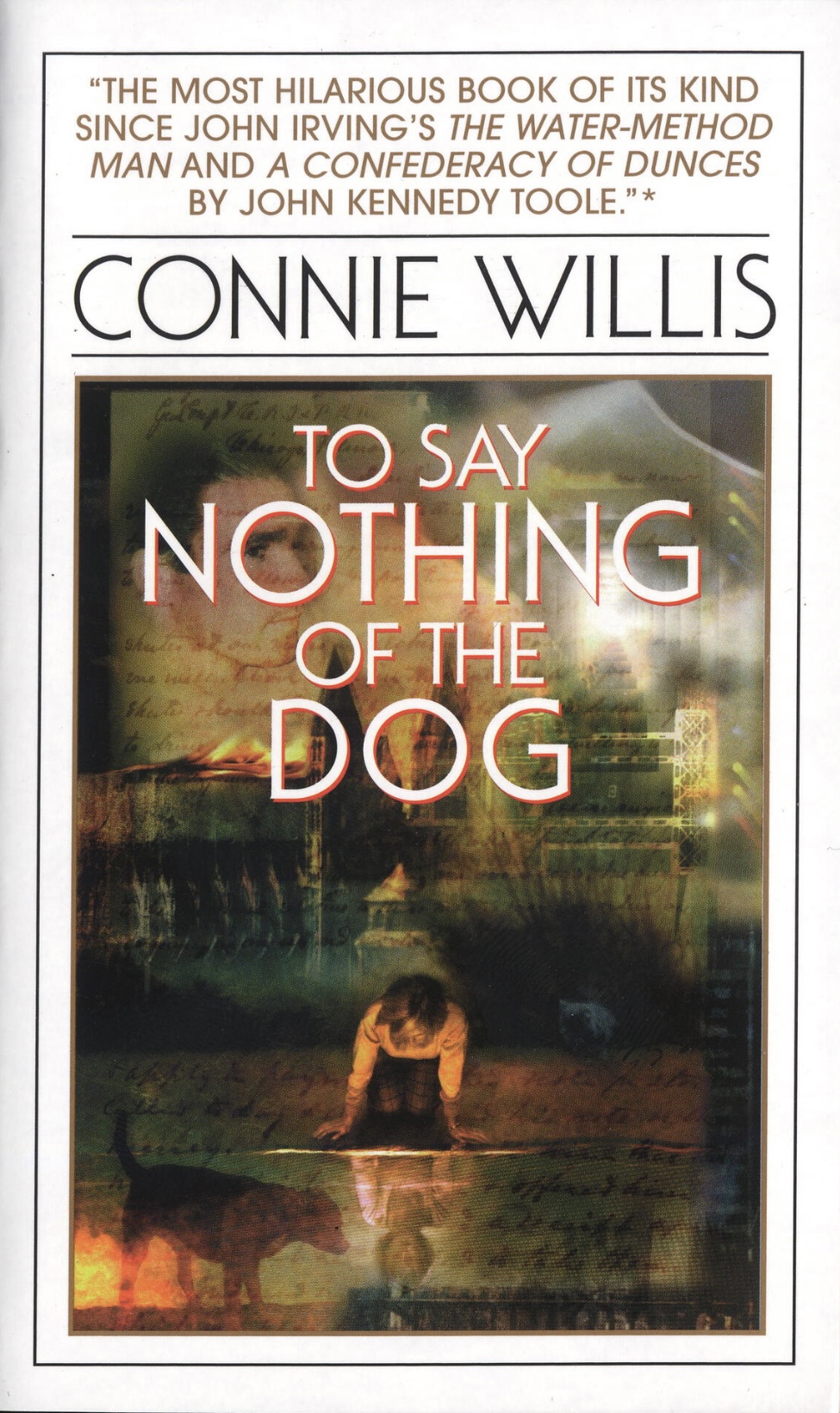
“Darwin, Disraeli, the Indian question, Alice in Wonderland, Little Nell, Turner, Tennyson, Three Men in a Boat, crinolines, croquet, … penwipers, crocheted antimacassars, hair wreaths, Prince Albert, Flush, frock coats, sexual repression, Ruskin, Fagin, Elizabeth Barrett Browning, Dante Gabriel Rossetti, George Bernard Shaw, Gladstone, Galsworthy, Gothic Revival, Gilbert and Sullivan, lawn tennis, and parasols.” — To Say Nothing of the Dog,  p. 38.

Time travel to the nineteenth century requires some preparation, and Ned, the narrator of Connie Willis’s novel  To Say Nothing of the Dog, only receives the quoted summary of Victorian life before being transported to a long adventure in 1888. His adventures are controlled by somewhat bumbling time-travel monitors in the late twenty-first century Oxford, his native time and place. 

The book does have a plot, sort-of — centered on the bombing of Coventry Cathedral in a Nazi raid in 1940. But the narrative is mostly humor about Ned’s efforts to keep his secret: that he’s in the wrong place at the wrong time, with a mission that he doesn’t quite understand, which involves finding a hideous Victorian flower holder called a bird stump. He collaborates with other time travelers from his own era, all avoiding the paradoxes that occur when you mess with the continuum. Or something. 

It’s fun to read Ned’s story, and to finally find out what his mission probably was, and how he and his co-travelers used bits and pieces of popular twentieth-century literature to figure out how to act and what to expect. The book was written at the end of the twentieth century, so the characters really don’t know about the twenty-first century except that there was a pandemic around 2020 — really! I wonder how the author knew that. Also, cats had gone extinct, seemingly from some disease. I guess the cat pandemic will happen in a few years from now, as the author predicts.

I especially enjoyed Ned’s bafflement at the manners of 19th century people. For example, he almost gets into TERRIBLE trouble when he notices that a Victorian cat (which he loves seeing in the flesh) is soon going to have kittens — an UNMENTIONABLE condition in front of the ladies. 

Ned is also challenged by the typical country house breakfast at the stately home where he somehow manages to be invited as a guest, as the characters who are there are part of his mission. I think the author probably read the same English Breakfast documentation that I reviewed a few years ago (blog post here). 

Ned begins by describing covered dish “which had a statuette of a flopping fish for a handle.” His colleague, Verity, also suitable disguised from her 21st century self, takes off the lid:

“Good Lord, what’s that?” I was staring at a bed of blindingly yellow rice with strips of flaked white in it. “It’s kedgeree,” she said, putting a small spoonful on her plate. “Curried rice and smoked fish.” “For breakfast?” “It’s an Indian dish. The Colonel’s fond of it.” She put the lid back on. (p. 214)

As they check out the breakfast buffet, they discuss their mission, and she helps him cope with the food: 

She moved down to the next covered dish. This lid had a large antlered deer. I wondered briefly if they represented some sort of code, but the next one down was a snarling wolf, so I doubted it. … Inside was a mass of pungent-smelling brown objects. “What’s that?” “Devilled kidneys,” she said, “braised in chutney and mustard. In Hercule Poirot mysteries, there’s always one little fact that doesn’t fit, and that’s the key to the mystery.” She picked up a charging bull by the horns. “This is cold ptarmigan.” “Aren’t there any eggs and bacon?” She shook her head. “Strictly for the lower classes.” She held out a shellacked fish on a fork. “Kipper?” I settled for porridge. (p. 215)

The Hercule Poirot mysteries, the Jeeves stories by P.G. Wodehouse, Three Men and a Boat (which was published a year after the events at the breakfast table), and many others are constantly in the thoughts of Ned and Verity as they jump back as far as the fourteenth century, to 1940, or to 2022. In a way, reading this novel could make you a little dizzy.

Review © 2022 mae sander. 
With thanks to Elaine & Larry for the recommendation,


Monday, October 24, 2022

What's On Streaming?

Iceland in the Age of Magic

After two visits to Iceland, we are very intrigued by TV shows that are set there. Some of the naturalists on our trip there last summer were enthusiastic about the very recent film, "The Northman." We watched it last week.

A drama full of violence and pathos. The similarity to Shakespeare’s Hamlet
becomes less and less important as the film goes on. Plot summary:
Prince Amleth is the son of the king. His mother and uncle conspire to kill
the king, marry each other, and take over. Rest of story: REVENGE.

Much of the action is set in 9th century Iceland. There’s lots of black magic, witches, and the like.

I think the costumes, sod houses, boats, and armor are pretty accurate.

Iceland is a ravishingly beautiful location, and the film captured lots of great vistas.

“Trapped”

We found ourselves literally trapped by the Icelandic police procedural titled "Trapped." The first season dates from a few years ago. We binged all 10 of the episodes in around two days. Insane!

Andri, Chief of Police in an Icelandic fishing village, is challenged by numerous murders. 
He has lots of quirks — the best-known being that he drinks milk.

The burly and brooding Andri is played by actor Ólafur Darri Ólafsson.

Hinrika, Andri's brave & competent partner in the
investigation, is played by Ilmur Kristjánsdóttir. 


The fishing village where Andri is Chief of Police. Who would  think it would be a hotbed of crime!

Map showing the location of the real village where the filming was done.

Most of all in “Trapped” I loved the Icelandic scenery and the long shots of the fishing village. The series was filmed mainly in the fishing village of Siglufjörður, North Iceland, which is very picturesque. Since it takes place in mid-February, the characters experience the worst of winter: specifically, a blizzard is blocking all the roads during the first several episodes. Numerous murders and other crimes create an absorbing plot, though there's sometimes an overdose of cruelty, including several violent deaths (I sort of lost count).

Classified as “Icelandic Noir” this crime drama is both very Icelandic and very very Noir. In fact, the shortness of days in the far north mean that there are a lot of night scenes, and if it wasn’t already dark enough, an avalanche takes out the village's power plant, so there are a number of interior scenes lit only by candles and flashlights. Now that’s noir!

The Great British Baking Show: Wrong Again

Ridiculously unAmerican s'mores from the Great British Baking Show.

As you see: we've been watching a lot of TV. Every Friday morning for 10 weeks we are watching a newly-released episode of the Great British Baking Show. This series isn't as good as it used to be, but still is nice mindless fun. The latest episode included an American "pastry" — s'mores. I would never have considered this childhood campfire treat as "pastry," but the judges made the contestants bake their own graham crackers: in Britspeak that would be "Digestive Biscuits." I've never heard of a normal American who has baked graham crackers from scratch for other than religious reasons. Nabisco Honey Grahams are the prescribed choice for s'mores.

Still more ridiculous: the bakers had to make their own marshmallows and some kind of fancy chocolate confection to substitute for the customary Hershey Bar. And the judges’ method won’t work. They required the bakers to make marshmallows that were equal in size to around 4 commercial American marshmallows, which meant that the contestants couldn't possible toast them correctly so they were gooey, as you should for s'mores. Of course they also required using a kitchen torch, not a campfire, but that’s a detail.

In case you don’t know it: this is a real s'more with a gooey toasted marshmallow melting the chocolate. (source)

One contestant did torch his marshmallows long enough to make them gooey, and Prue’s reaction was to make one of her dismissive sniffy noises and say that his marshmallows shouldn’t be so soft, and the chocolate isn't supposed to drip down.

Dear Prue and Paul: Drippy chocolate and very soft hot toasted marshmallows are authentic features of s'mores. The word “gooey” even appears in the first published s’mores recipe in the1927 Girl Scout Handbook (see it here). If America were a third-world country, you'd be guilty of cultural appropriation and ethnic insensitivity like what you did on Mexican Week recently. I'm sorry you have run out of variations on Victoria Sponge and are resorting to all kinds of foods that you don’t know much about.


Miss Marple.

Marple

More British than the Great British Baking show is “Marple” one of many interpretations of the work of Agatha Christie over the 100+ years since she began writing mysteries. "Marple" originally ran from 2004-2014, and is currently available for streaming. We are watching this slowly. I especially like Geraldine McEwan, one of the two actresses who plays Miss Marple in this series. Of course there are many cups of tea!

Blog post © 2022 mae sander. 
Shared with Elizabeth’s blog party celebrating drinks like Andri’s milk.