![]() |
| Competing. (These and all images in this post are screen shots I made during the show.) |
![]() |
| One of many very richly decorated and filled cakes. |
![]() |
| Judging |
![]() |
| With all the friends, family, and other contestants — about to announce the winner. |
![]() |
| Competing. (These and all images in this post are screen shots I made during the show.) |
![]() |
| One of many very richly decorated and filled cakes. |
![]() |
| Judging |
![]() |
| With all the friends, family, and other contestants — about to announce the winner. |
| Yes it is a yellowjacket on my donut. |
| We like to go to the cider mill every autumn and have cider and donuts. |
![]() |
| The Japanese title is taken from a classic book written in 1937 and loved by Japanese youth. |
![]() |
| Quite a few scenes include someone making tea served with bread & butter. |
![]() |
| Miyazaki’s films often feature a “Granny” — in this one there are quite a few grannies who crave food and cigarettes (since it’s set during the war when shortages were severe). |
![]() |
| Agatha Christie’s Miss Marple in the BBC series from 1987. I love the way she carries her handbag! Corrected because it’s been pointed out to me that in England it’s a handbag, not a purse. |
Joan Hickson (1906-1998) is my favorite portrayer of Miss Marple, the seemingly invisible old lady in Agatha Christie’s detective novels who always figures out who committed the crime, how they did it, and why. Joan Hickson’s acting suggests that Miss Marple was dotty and did not know what was going on — but meanwhile she was observing everyone and figuring out their motives and methods. The character’s sharp grasp of human nature was developed by watching the people in her little town, Saint Mary Mead, where she classified her fellow inhabitants by their type, and applied these observations in her successful career as a clandestine detective.
![]() |
| “At Bertram’s Hotel,” based on the 1965 novel. |
“I learned what I suppose I really knew already — that one can never go back, that one should not ever try to go back—that the essence of life is going forward. Life is really a one way street, isn’t it?”
![]() |
| This week we also watched two other dramatizations of Miss Marple novels, both with Joan Hickson. |
![]() |
| I also read one volume of an Elly Griffiths series, The Vanishing Box It’s not as good as her Ruth Galloway books. |
It’s definitely been a week of mysteries!
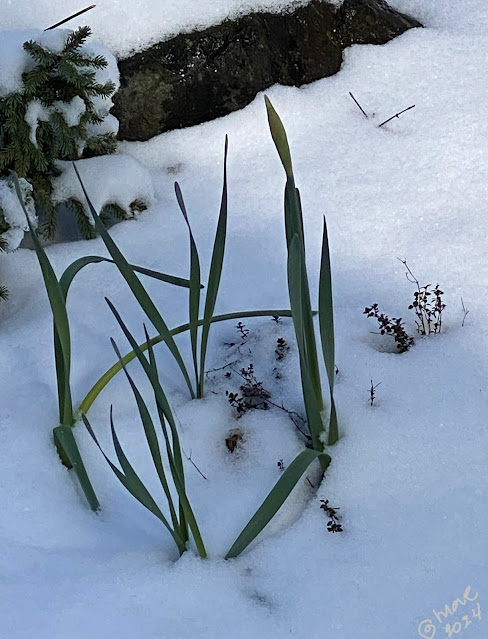
| Winter is back. Poor daffodils! |
![]() |
| Environmentally and socially responsible collection. |
"It could have happened sooner, but for decades food writers were actively discouraged from thinking about food as anything other than pleasurable. Those late-twentieth-century food writers could produce all they wanted about continental luxury hotels and their restaurants, about authenticity in Mongolia, about potatoes in Peru, about the mysterious ways of Japan, about the availability of sea urchin by mail, or how a home cook could produce deer—or tofu!—jerky, and so on, but they were for the most part forbidden from treading on the fields of sustainability, environmental pollution (food writers decidedly did not cover Rachel Carson), the decline of nutrition, the horrors of processing or labor: Leave those more serious and less-enchanting and -delightful subjects to your colleagues in Business or Health or Agriculture." (The Best American Food Writing 2023, p. xxi).
From "What Counts as Fresh Food?" by Bee Wilson:
"The great miracle of our modern food system has been to supply us with the freshness of spring all year round—or at least with an approximation of it. ... Our entire food supply is based on the idea of 'fresh' and 'keeping things fresh.' But to keep things fresh is a kind of contradiction or deception, because something can only be truly fresh when it is right out of the ground or just cooked. (p. 19-20)
From "What We Write About When We Write About Food" by Ligaya Mishan:
"Still, when contemporary food writers (and, I suppose, I am one) stray from celebrating flavors to probe the larger issues surrounding the parade of dishes to our tables—exploitation of labor, abuse of animals, climate change, the homogenizing of cuisines and cultures under globalization, systemic injustices that allow millions of people to go hungry each year—some readers complain. Food should not be political, they insist. Food is universal; food unites us. Let us have our cake in peace." (p. 132).
![]() |
| Pedro Páramo by Juan Rulfo: new translation. |
"Jorge Luis Borges said it was one of the greatest works of literature ever written. Susan Sontag called it one of the masterpieces of the 20th century. Enrique Vila-Matas has said that it is the 'perfect novel.' Roberto Bolaño’s '2666' would probably not exist without it. The book shows its readers how to read all over again, the same way 'The Waste Land' or 'Ulysses' does, by bending the rules of literature so skillfully, so freely, that the rules must change thereafter."
Just one thing: as I read, I appreciated the numerous brief mentions of birds. These lighten the very dark mood of a town of the dead. Examples —"A roadrunner, señor. That’s what they call those birds." (p. 16) ... "I’d seen the still air shattered by doves flapping their wings as if they were breaking free of the day." (p. 17) ... "I wish I were a vulture so I could fly to where my sister lives." (p. 28)... "Through the hole in the roof, I watched flocks of thrushes pass overhead, those birds that flutter about in the late afternoon just before darkness closes the roads." (p. 62) ... "Returning from its flight around the fields, the mockingbird crossed in front of him and let out an anguished howl." (p. 71) ... "There weren’t any seagulls, only those birds they call 'ugly beaks,' the ones that growl as if they were snoring and then disappear when the sun comes out." (p. 105).
Count me as clueless. But I did finish reading it.
![]() |
| "Lessons in Chemistry" on Apple TV. Very good series! |
![]() |
| Final episode of Great British Baking Show (no photo of finalists -- no spoilers). Some review I read said this season was like watching bread rise. Yes, but it's so soothing! |
![]() |
| From the Washington Post |
![]() |
| Morning sky as we occasionally see it in winter. Mostly we see only grey clouds. No auroras yet. |
![]() |
| The TV series is full of wonderful scenes with fine horse-drawn carriages and Georgian elegance. |
![]() |
| At the beginning, Pemberley is buzzing with preparations for a ball, including incredible food scenes. Here, Elizabeth is reviewing the food in the kitchen. |
![]() |
| The servants are all ready and at attention as their work is reviewed. |
![]() |
| Not surprisingly, the costumes are also wonderful. |
"Despite its vast store of ingredients, my employer’s restaurant defaulted, like others in that age, to familiar symbols of prestige. French classics with lots of cream, lots of butter, expensive ingredients, just money glopped on the plate. Money." (p. 19).
"Autumn was a harvest of big-box stores and their back-to-school sales: fruit leather, instant mac ’n’ cheese, and bread that we unhusked, crinkling, from its plastic sleeve. My mouth watered for the sweetness of processed wheat sown thick through gas stations from California to New York. Honey Buns and Wonder Breads, in perfect squares and machined circles, and the ripe weight of a Danish, mass-produced, that attempts no fidelity to the country after which it is named—no country but this one ambered by waves of industrial grain." (p. 154).
After the set-up of the catastrophic end-of-the-world-as-we-know-it and the secret stash of real food, the demands on the narrator's culinary skills get kind of weird with a lot of demand for cooking exotic animals that have been reconstructed through some kind of DNA science. She even is forced to prepare a meal of wooly mammoth which is disgusting, and other meat that's even more disgusting.
A complex plot involving the employer and his young daughter seems to me to be kind of an afterthought to enable a wide variety of food descriptions. Maybe, I sometimes thought while reading, the author really just wanted to set up this imagined human fate. So I won't bother to describe it or the too-pat ending.
![]() |
| This is the Bao Space kitchen, which is visible from the window where orders are placed. |
![]() |
| Dough for the bao buns is freshly made with flour, yeast, and milk. |
![]() |
| Our order: bao buns, sesame-noodle-cucumber salad, and two cups of lemonade. The menu is simple: just bao, dumplings, a few soups & noodle bowls, and soft drinks. |
![]() |
| One bao filled with pork. Other fillings include chicken, beef, and several vegetarian options. |
![]() |
| Dr. Max Liebermann, a Freudian analyst and amateur detective in a wonderful series. |
![]() |
| The era is Vienna in the first decade of the 20th century, with fabulous costumes and sets. We have watched all six episodes, which were released recently. |
![]() |
| Max and his former fiancée Clara Weiss often have coffee at Viennese cafes. She has become a newspaper reporter, and wants to know about the cases he is solving. |
![]() |
| We have watched the first two episodes, and will watch the rest when available. Although I have read the book, I don’t remember how it came out so I’m really liking it. |
“While all the other children gummed their peanut butter and jelly sandwiches, Madeline opened her lunch box to find a thick slice of leftover lasagna, a side helping of buttery zucchini, an exotic kiwi cut into quarters, five pearly round cherry tomatoes, a tiny Morton salt shaker, two still-warm chocolate chip cookies, and a red plaid thermos full of ice-cold milk.” (p. 3)
This is the lunch that Madeline’s mother, Elizabeth Zott, packed for her. It was “back in 1961, when women wore shirtwaist dresses and joined garden clubs and drove legions of children around in seatbeltless cars without giving it a second thought.” So begins Lessons in Chemistry, a novel by Bonnie Garmus.
Wait a minute, I thought when I read about this lunch. Kiwis and cherry tomatoes weren’t readily available even at specialty food markets until some time much later than 1961. (I looked it up. Kiwis were exotic and rare, and the hybridization of marketable cherry tomatoes didn’t happen until the 70s and 80s.)
Is this another work of seemingly historic fiction where the author doesn’t think the reader cares about accurate details, especially about food? The more I read, the more I thought that this book is a kind of elaborate joke about the sixties, so it indulges in many anachronisms for effect. Maybe. Sometimes, it is conscious of changing times, including details like this: “… he always did his running outside in tennis shoes. This made him an early jogger, meaning that he jogged long before jogging was popular, long before it was even called jogging.” (p. 59)
The fundamental subject of Lessons in Chemistry is the abuse and exclusion of women, ordinary women, from the important features of modern life. Women were not allowed generally to participate in intellectual and professional activities in the post-World-War-II era — a point made over and over in the life and experience of Elizabeth Zott. Women acquired an identity and a living only through their husbands; an unmarried woman like Elizabeth was reviled or abused, especially if like Elizabeth she had dared to give birth to a child and raise her on her own. Including Elizabeth, women in the novel as in history, resented this: what they were after was “Being taken seriously.”
Similar analysis of women's fate has been around since the sixties at least, and you could take it back to Mary Wollstonecraft in the 1700s. The events of Lessons in Chemistry occurred just before the publication of the famous book The Feminine Mystique by Betty Friedan, which took the marginalization of women very seriously, along with other social problems of the era. Garmus, it seems to me, is serious about these same issues, but her book makes the point in a very humorous way, with a variety of exaggerations for effect. For example, the main character, Elizabeth, makes her daughter Madeline into a prodigy — a nearly unbelievable one, in order to highlight the deficits of education and the assumptions of how mothers (not fathers) would be involved.
“Elizabeth had not only taught Madeline to read but to read highly complex things: newspapers, novels, Popular Mechanics.” (p. 234) It’s mentioned that at age 5 this remarkable child was reading Zane Grey, Faulkner, Dickens, Darwin’s Origin of species, and more. Madeline constantly astounds — or annoys — the school librarian with her requests with her exceptionalism, caused by her mother’s refusal to be average.
Six-Thirty, Elizabeth’s dog, has some remarkable characteristics, which also highlight some of the novel’s points about human oddities. Six-Thirty can read the minds of humans. He has a great deal of self-awareness, and a vocabulary that keeps growing. At last count he somehow knew over 900 English words, though he did not speak and we don’t know just what his word knowledge means. There are lots of interesting things about the dog such as that he finds “fetch” to be boring but he indulges humans who want to play with him. All for humorous effect.
The core of the novel is the character Elizabeth Zott’s TV show, where she talks about her real profession, chemistry, and applies it to cooking. In giving kitchen advice to housewives, she encourages them to think, to strive, and to respect and cherish education. And above all, to take themselves seriously!
In fact, the author really plays with us. Here’s a sample when Elizabeth’s boss agrees for her show to have a canned soup manufacturer as a sponsor. What does she do?
“Hello, viewers,” Elizabeth said three hours later. “And welcome back. See this?” She held a soup can close to the camera. “It’s a real time-saver.” From his producer’s chair, Walter gasped in gratitude. She was using the soup! “That’s because it’s full of artificial ingredients,” she said, tossing it with a clunk into a nearby garbage can. “Feed enough of it to your loved ones and they’ll eventually die off, saving you tons of time since you won’t have to feed them anymore.” …
“Luckily, there are much faster ways to kill off your loved ones,” she continued, walking to her easel, where a selection of mushroom drawings was on display, “and mushrooms are an excellent place to start. If it were me, I’d opt for the Amanita phalloides,” she said, tapping one of the drawings, “also known as the death cap mushroom. Not only does its poison withstand high heat, making it a go-to ingredient for a benign-looking casserole, but it very much resembles its nontoxic cousin, the straw mushroom. So if someone dies and there’s an inquiry, you can easily play the dumb housewife and plead mistaken mushroom identity.” (p. 268)
Discrimination against women had an even uglier side in the novel as in real life. A scene that's central to the theme of the book involves a heated interchange between Elizabeth and Miss Frask, a former secretary who had been gleefully instrumental in depriving her of a research position.
Elizabeth says:
“I’m a chemist. Not a woman chemist. A chemist. A damn good one!”
“Well, I’m a personnel expert! An almost-psychologist,” Frask shouted.
“Almost-psychologist?”
“Shut up.”
“No really,” Zott said.
“Almost?”
“I didn’t have a chance to finish, okay? What about you? Why aren’t you a PhD, Zott?” Frask shot back.
Elizabeth hardened, and without meaning to, revealed a fact about herself that she’d never told anyone other than a police officer. "Because I was sexually violated by my thesis advisor, then kicked out of the doctoral program, she shouted. "You?'
Frask looked back, shocked.
"Same," she said limply. (p. 178).
Sometimes I think the reason for the anachronisms is to bring home the point that women haven't made much progress, and that they are still staying home maybe watching cooking shows that seem to take them seriously, maybe relying on husbands for their identity, maybe being shut out of professional goals. This book made me laugh and made me think. So maybe it doesn’t matter if the details or right. Or maybe it does. I can’t decide.
Blog post © 2020 mae sander
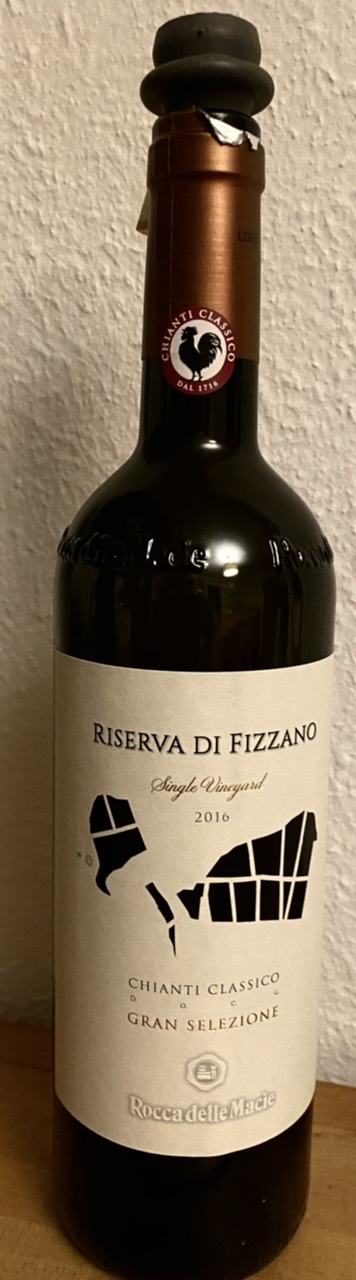
Fizzano! This Chianti was quite nice with our pizza dinner. What’s in a name? It’s not even a bit fizzy! In fact, it’s a nice little red from a boutique vineyard. Here’s what their website says about one of the wines in their repertoire:
“Arriving at the Tenuta Fizzano estate and finding yourself in front of 35 hectares of highly specialized vineyards with an enviable south-westerly exposure, featuring highly ordered rows that work their way across sinuous hillsides, it is easy to understand why ‘Chiantishire’ is renowned the world over. This is the evocative backdrop against which we harvest the grapes that will be used to produce our Chianti Classico Gran Selezione Tenuta Fizzano. Bright ruby-red in color, with ripe berry fruit overtones and a strong mineral note, it is an elegant wine that lasts and lasts on the palate. It has a verve and a character that allow it to mature over time without losing its fascination.” (source)
Fizzano! Wouldn’t Chico Marx be the perfect owner of a winery with a name like this?
As for the pizza: we defrosted a ball of dough that we froze the last time Len made pizza. He used a mixture of tomato paste, garlic, and olive oil brushed onto the crust and then just a few anchovies and some cheese. Very simple.
![]() |
| Pizza and Chianti! |
![]() |
| We enjoyed binging on Season 3 of "Entrapped." SHOWN ON NETFLIX. |
We watched the second Enola Holmes film on Netflix. It manages to be both very funny, full of almost unbelievable chase scenes, and also suspenseful. It has very good actors, starring Millie Bobby Brown and including Helena Bonham Carter. A major plot element — protest against abuse of the women who work in a toxic match factory — is based on actual history.