Showing posts with label Gertrude Stein. Show all posts

Wednesday, March 19, 2025

A Cute but Unnecessary Book


Sylvia Plath’s Tomato Soup Cake: A Compendium of Classic Authors’ Favourite Recipes.
Arbitrarily photographed with some eggs in my kitchen that were going into an omelet that was probably better than anything in the book.

Collections of recipes by famous people appeal to many readers. Many such collections have been published, sometimes by asking the famous people to contribute recipes, and sometimes by finding their recipes already published somewhere else — maybe in a journal or in letters, maybe in a novel. Sylvia Plath’s Tomato Soup Cake is such a collection with recipes already published in similar anthologies. When I heard about it, I ordered it because it sounded really good and I thought that in some way, it would be original. It isn’t. I am somewhat disappointed.

The sources of the recipes in this new book are mainly recipes from earlier collections — sometimes it seems to be kind of a cannibalized work. Here are the covers of some of the sources cited in the afterward to the work:

Where to find writers’ favorite recipes? Look in earlier collections of writers’ recipes.
Most of the books depicted above are now out of print and costly. I found the images by searching the web. I own only one of these books (though I also own some similar collections).

Big Question: do these sound like good recipes? Would you want to use them to make dinner or a special treat for guests? Well, not really. After all, most of the authors whose work is included were not at all cooks. Some of them even say they weren’t very good in the kitchen, though some of the recipes are quite plausible, if ordinary. For example, Allen Ginsberg’s Cold Summer Beet Borscht is almost exactly like the borscht my mother made. Christopher Isherwood’s “Brownies Wendy” are simply the most standard classic brownies (the ones my seventh-grade cooking class was assigned to make). Tennessee Williams’s Grits are pretty undistinguished from the usual southern favorite. Barbara Pym’s Marmalade is ordinary as well. Not much to see here —  though at least these are interesting authors, so maybe it’s nice to know what they might have cooked.

A few recipes are distinguished by their unappealing nature: these are recipes that I would never try and in fact they are by authors that I would probably never read:
  • Noel Streatfield’s Filets de Boeuf aux Bananas contains beef, bananas, horseradish, parsley… no thanks. Also, I had never heard of Noel Streatfield (1895-1986), author of children’s books, but now I have. 
  • Elizabeth Jane Howard’s Devils on Horseback are made from bacon wrapped around prunes that are stuffed with olives stuffed with pimentos. I guess these were popular back in the day — this author was born in 1923. I have a feeling that her books are also forgotten, along with her style of cooking.
  • Spike Milligan’s Spaghetti Dolce is spaghetti with cream, sugar, and brandy. Another unappealing recipe by another forgotten writer.

Fun fact: Sylvia Plath’s Tomato Soup Cake has no listed author: it was put together by the staff of the publisher, Faber. The more I think about it, the more it seems to be a rather cynical hack job. While some of the authors may be interesting, many are deservedly obscure, and they have no actual connection to one another, aside from the fact that at some point they published recipes. I think the book’s reason for existing is just to make a bit more money off the same old material, and, like the title itself, is meant to attract attention in a shallow kind of way. If you already have any collections of recipes by writers and artists, you probably don’t need this one.

Better Celebrity Cookbooks


 I have quite a few celebrity recipe collections on my shelves. I also have several recipe books by famous authors, where they shared their recipes along with maybe a few anecdotes about dinner parties or meals shared with other famous people. The Alice B. Toklas Cookbook by Gertrude Stein’s companion, written after Stein’s death, is probably the most famous (and to me wonderful) of such celebrity cookbook. 

Memorably, Peter Sellers’  1968 film “I love you Alice B. Toklas” made reference to the Hash Brownies recipe included in this book. The film is surely forgotten by now, but this cookbook was consequently even more famous at that time.


Plots & Pans: Recipes and Antidotes from The Mystery Writers of America promises “Hundreds of Delicious Recipes from the Most Imaginative Writers in America — Spiced with their Wit, Leavened with their Malice, and Served with their Own Distinctive Style.” Published in 1989, this book is still in print and available. The illustrations are amusing.

I have around a dozen other recipe books featuring work by various authors. Some were compiled later, and the recipes are reconstructed from brief mentions in an author’s works; for example: a Jane Austen cookbook or an Agatha Christie cookbook, by authors who didn’t participate in making the book. I also have several by authors who were interested in food as well as detective fiction or other fiction. 

Bottom line: you can do better than the recently published book!

Monday, October 02, 2023

At the Baltimore Museum of Art

The living room of Claribel and Etta Cone whose art collections now belong to the  Baltimore Museum of Art. The room has been reconstructed to accompany the display of their art collections. It seems that when the sisters needed more space for their possessions, they would rent another apartment in the building where they lived in Baltimore.

This painting of bathers by Cezanne was purchased by Leo and Gertrude Stein in 1904. At about this time,
the Cone sisters visited the Steins, who were family friends from Baltimore (where they all lived).
The Cone sisters, under the influence of the Steins, learned to love the modern art that was emerging then.
They bought the painting from Gertrude Stein in 1926.

Pierre Bonnard, “Luncheon Table,” 1908.

Henri Matisse: “Interior, Flowers and Parakeets”
This painting was one of Etta Cone’s favorites, acquired in 1925.

Detail of the Matisse painting, showing the drinking cup.
Detail of Matisse’s “Still Life, Bouquet of Dahlias and White Book”
Another drink image to share with Elizabeth’s blog party!

 From the Cone collection: Picasso, “Woman with Bangs,” 1902.
The Cone sisters visited Picasso’s studio with Gertrude Stein 
in 1903.

In the room with the Cone collection: a sculpture by Rodin.

At the Baltimore Museum of Art last Saturday, we enjoyed seeing the collections of the Cone sisters, Claribel (1864-1929) and Etta (1870-1949). Paintings and sculpture by Matisse, Picasso, Cezanne, and many others make up this remarkable trove of early 20th century art, which now belongs to the museum along with their enormous collections of furniture, jewelry, bric-a-brac, textiles, and more. I enjoyed this description of the two sisters from one of the many placards on the walls of the exhibit:

A PASSION FOR COLLECTING

The Cone sisters were ardent collectors. When drawn to a compelling painting, drawing, or sculpture, they found it difficult to resist its pull. The same was true of small items of lesser consequence that filled their drawers to overflowing. If the sisters found one piece of jewelry or lace delightful, three pieces delighted them even more. So they "bought passionately and by the dozens" and never threw anything away. The sisters stored their purchases in heavy chests and hundreds of beautiful boxes made of carved wood, leather, silver, lacquer, and brocade.

Dr. Claribel clearly understood her compulsion to collect. When tempted to purchase Indian silks she wrote, "I am beginning the buying all over again…how the Saris wind themselves about my very heart. Throat would be better, for they strangle out all other impulses.... Now that I stop to reason about it, it is silly foolishness, this collecting of things. But it must have some solid foundation — some foundation deep in the hearts of people.... It is the craving for beauty that is such a vital function of the human soul...."

A small part of Claribel Cone’s jewelry collection, as displayed in the museum.


Blog post © 2023 mae sander


Saturday, July 29, 2023

Dreaming of Paris

 What I dream of when I dream of Paris...


The Mona Lisa at the Louvre Museum, November, 2018.

In July of 2018, I wrote a blog post titled “What I dream of when I dream of Paris.” Now, after another month participating in the blog event titled Paris in July, I would like to revisit that topic, and add some further thoughts to that post. I’ve been back to Paris once since then in November of 2018 — like everyone in the world, I’ve had my travel dreams disrupted by the pandemic and its aftermath, so I haven’t had a chance to visit there recently.

The back of Notre Dame Cathedral. The photo was taken in 2014, but this must have been my first look
at Paris from the back of our motor scooter.


Paris has been my dream city for many years, since the first time that I saw it. I was on the back of the Lambretta motor scooter on which we were wandering around Europe in the 1960s. The scooter wasn't safe on big roads (I have no idea if the REALLY big autoroutes had even been constructed back that far in time). So we came in through a series of rather run-down neighborhoods full of not very interesting post-war buildings. Until suddenly we were scooting alongside the river and coming right up to the back of Notre Dame de Paris. I was breathless! (Breathless: a perfectly-named movie about Paris from a few years earlier, 1960.) We found a very cheap hotel on the Quai de la Tournelle which directly faced Notre Dame. 

I dream of the Cluny Museum as it was for many years, and of the new and expanded interior
and presentation as we saw it in 2018.


From our favorite Unicorn Tapestry at Cluny.
One of the first museums we went to was the Cluny Museum, to see the Unicorn Tapestries, which I'd been reading about for years. Breathless! We've gone back to Cluny on every Paris trip, except when it was under construction.

We mostly ate meals in student restaurants because Len had been enrolled in the  University of Grenoble, and we had special cards that entitled us to this privilege. But we had received a wedding gift of a 100 franc note, which we used for one real high-end meal at a serious restaurant. I wish I recalled what we ate, but all I remember was that it was amazingly delicious, and we were surprised that the waiters and so on treated us as honored guests, not as the poorly dressed student wanderers that we were.

In 1976, we spent most of a year in Paris, living in a very small apartment on Boulevard de Grenelle. Our balcony looked out at the elevated metro train -- noisy! especially when a terrible heat wave hit the city in late May.  The famous Poilâne bakery was across the street.

The sidewalk in front of the bakery could be seen from our balcony, though the facade was mostly hidden behind the metro. Sometimes we could see a long line of people waiting to buy the famous bread. And early in the morning, we could watch the deliveries of cords of wood to the cellar door that gaped in the middle of the sidewalk. Poilâne was famous for its wood-baked bread, and the ovens were in the cellars where the wood was being delivered. In the photo from inside the bakery, taken in 1976, you can see the elevated metro and dimly make out our building across the street.

We ate Poilâne's bread often, as well as the fantastic croissants, apple turnovers, rolls, and other Poilâne products that can be seen in the photo. Recently, we have been enjoying a new cookbook by the current owner of this famous bakery.

Under the elevated tracks facing our building, city workers constructed the temporary stalls for an open-air market on Sunday and another day, maybe Tuesday: a good place to buy produce to prepare in our tiny kitchen. Right around the corner from us was a wonderful shopping street: Rue de Lourmel. I remember specialists in fresh fish who would tell me how to cook what I bought, specialists in exotic fruit and vegetables, and especially an amazing cheese shop called Cantin. This original Cantin shop doesn't seem to be on Rue de Lourmel any more, though there's another Cantin owned by the daughter of the original owner.

The memorial at the Vélodrome d'Hiver (Wikipedia).
Sadly, there is another landmark on Boulevard de Grenelle in the other direction, beyond the huge concrete building where we lived that year. This is the site of the Vélodrome d'Hiver, or indoor bicycle racing arena, which was torn down in approximately 1959, and replaced by other huge middle-class apartment buildings in solid concrete. The Vel d'Hiv is mainly remembered in history as the site of a huge round-up of the Jews of Paris in July of 1942. Something like 13,000 people, including 4000 children, were herded into the arena without food, water, or sanitation, and held for days before being shipped off to Auschwitz. I often walked past the monument and thought about this collective horror. Depressingly, the signs commemorating the past were often defaced by right-wing fanatics, but at the time I thought they were special to France. Now I'm thinking again of those families torn apart forever in 1942, and putting it together with what's happening to many innocent immigrant families in our own country -- in 2023. This is not a dream of Paris, but a nightmare.

Place Dauphine in 1615. A very historic location! (Wikipedia).
We've also made many shorter visits to Paris. I recall a specific day when I was alone because Len had to fly back on a different plane. I had lunch alone at a restaurant near the historic center of Paris on the Ile de la Cité in Place Dauphine. This is quite near the office of Inspector Maigret, where he sometimes has his lunch. Yes, I know he was fictitious, but for me he's a real Parisian. I was seated at a table with another tourist, a German woman, and had a very interesting conversation in French, our mutual language, about what we liked about Paris. I don't know why it was memorable! But it was.

On both long trips and many short ones, I searched for hours in a quest to collect Mona Lisa parodies, which I've posted on this and other blogs many times. I looked in antique shops, bouquinistes (that is, those book stalls along the Seine), specialists in old paper, and modern card shops. Sometimes I found a few wonderful items, sometimes not. But it's always good to have an obscure goal that takes one out of the tourist routine!

In 1976, I also followed the guidance of a book that a friend gave me. Its title was Paris Inconnu, and it described the history of very old and deteriorating buildings throughout Paris. This book is now very obsolete because most of these buildings have since then been restored and serve as museums or high-end office space or apartments worth millions of euros. The Picasso museum and the Jewish museum of Paris are both in such restored buildings. I'm amused to recall how I peeked into slummy courtyards to look for Renaissance archways and stone carvings visible behind rows of garbage cans and parked bicycles.

Another friend that year introduced me to a book titled Paris pas Cher, which explained how to find bargains. She was especially fond of one recommended store that had mid-level designer clothing and other not-quite-high-end clothing in rejected lots from the manufacturers -- who still made clothing in Paris then. Dresses, blouses, and kids' clothing, particularly by design house Cacharel, were often sold with the center of the label cut out (or in French, dégriffé) so that a person who knew labels could recognize it, but so it was clearly designated second-quality. We found quite a few nice things shopping there. (The edition that I still have is from the next long stay in Paris, as shown.)

A favorite restaurant just around the corner from our 1989 apartment.

Paris, Len's campus workplace at Place Jussieu (Wikipedia).
I'll just mention that in 1989, we spent a full year living not far from the same place, in a relatively unpleasant apartment on the ground floor of an otherwise nice building next to a very nice little restaurant where we ate often. As in 1976, Len was visiting at the University of Paris in the ugliest complex of buildings we've ever seen. But it was a wonderful year with more visits to great restaurants and fabulous museums, discoveries of food, wine bars, art, books, and a growing familiarity with subway stations and obscure neighborhoods. Above all, during each stay in Paris we enjoyed the company of many Parisian friends and many visitors who also appreciated Paris.


Picasso’s portrait of Gertrude Stein
On our most recent trips to Paris, we have stayed in a hotel in the area around Montparnasse, near the huge skyscraper (which made the Parisians vow never to allow another towering building in the center). It’s an amusing neighborhood, and a wonderful walk towards the Latin Quarter and many of the museums and other attractions. Each time we walked that way, we stopped at the house where Gertrude Stein and Alice B. Toklas lived in the first half of the 20th century. Their influence on American ex-pats is renowned,. This had special resonance with me because in high school, I did. a term project on Gertrude Stein, and her work helped me create an early vision (or dream) of Paris.

Our hotel in Paris, the last night of our 2018 stay.

Well, that's my wrap-up of memories of Paris, particularly the small things rather than the ones that get on everyone's list. You know the list. You can find it in any guidebook: the Louvre and the Mona Lisa, the Eiffel Tower, Impressionist museums, a walk on the Champs Élysée, a dinner cruise on the Seine in one of the famous bâteaux-mouches. In fact, we've never done a dinner cruise on the Seine, just watched the brightly lit boats go by as darkness fell and the lights of Paris came on. In that first hotel when we stayed on the quai, spotlights from the passing boats would shine into our eyes when we were trying to sleep.

I'm sure I've written down some of these thoughts before, though not recently. Paris in July is a great idea! And I thank Emma at Words and Peace for organizing many bloggers for this year’s blog event.

Blog post © 2018, 2023 by mae sander


Sunday, July 03, 2022

Americans in Paris

Mural: "Ben Franklin, Colonial Postmaster," 1938, by George Harding at the Ariel Rios Federal Building
in Washington, D.C. Source: Library of Congress. 

My overall project for the current "Paris in July" blog event is writers who wrote in French about Paris. In contrast, as we are celebrating the founding of the US tomorrow, July 4, it's also interesting to think about American expats who lived in Paris, and what they mean to American history. I started this post with a mural about Benjamin Franklin, who went to France to represent the American Colonies at the start of the Revolution, so he can be considered the first ex-pat. Franklin is a man of so many accomplishments that it's hard to represent him with just one image! 

American ExPats

Just for fun, here's my list of Americans who lived for at least a while in Paris. Some wrote about Paris, some didn't.  Fans of these short-term or life-long Paris residents often like to visit the streets where they lived, the cafes where they hung out, or even their graves, if they are buried in a Paris cemetery. I have included a brief word on what they did, and the approximate dates of their stay.

Benjamin Franklin, Diplomat & Writer: 1776-1785

Thomas Jefferson, Diplomat & Statesman: 1784-1789 

Henry James, Novelist: 1875-1876

Edith Wharton, Novelist: 1907-1937

Gertrude Stein, Writer & Host of Famous Salon: 1903-1946

Alice B. Toklas, Partner of Gertrude Stein: 1910-1967 

Ernest Hemingway, Novelist: 1921-1928 

Janet Flanner, Journalist: 1922-1939 and 1944-1979

Josephine Baker, Dancer & Stage Personality: 1925-1975

A. J. Liebling, Journalist: 1926-1927

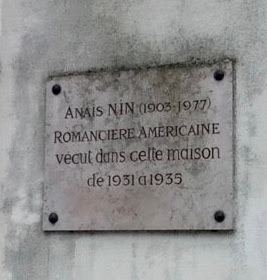
Anaïs Nin, Writer: 1924-1940 

Henry Miller, Writer: 1930-1939

Art Buchwald, Journalist: 1948-1961

James Baldwin, Writer: 1948-1970

Chester Heims, Writer: 1953-1984 

Julia and Paul Child, Cookbook Creators: 1948-1954

Nina Simone, Singer-Songwriter: 1981-1983

Jim Morrison, Singer-Songwriter: 1971. His grave in Pére Lachaise Cemetery is much more famous than his brief Paris stay at the end of his life.

Paris Homes of the American Ex-Patriates

If you walk around in Paris, you will see many information placards on the walls of buildings, frequently naming a famous person who lived in that house or an event that occurred nearby. Many of the people on the list above are commemorated this way at the Paris locations where they lived. However, not all of those on the list are so remembered. For example, James Baldwin when in Paris lived in cheap hotels. Or Henry Miller who lived in a variety of places. Here are a few images of such placards:

Benjamin Franklin’s street in the Passy district
is now named for him.


I have often seen this doorway and placard identifying Hemingway’s best-known Paris residence
because we have a friend who lives directly across the street.


Julia and Paul Child lived in this Paris building — but
there is no placard. She’s not that well-known in France.

After becoming rich & famous, dancer Josephine Baker lived in this chateau.
It was in the Dordogne, location corrected -- thanks, Kwarkito!
She adopted many children and made them a home here. Then she lost her money, and had to sell. (source)

Nina Simone’s exact Paris address isn’t known,
but this graffiti appeared in the Montmartre area in 2012. (source)

The grave of Jim Morrison in 2021, 50 years after his death (source).
Gertrude Stein is also buried in the very famous Pére Lachaise Cemetery.

Blog post © 2022 mae sander, photos Wikipedia or as credited.
Shared with Sami's mural project and with Paris in July.

Saturday, February 26, 2022

"The Book of Salt"

The Book of Salt by Monique Truong constructs the life story of a Vietnamese cook who worked for Gertrude Stein and Alice B. Toklas in the 1920s and 1930s at their home: 27, rue du Fleurus, Paris: a magic place in the history of American literature and literary Paris in the early twentieth century.

As a long-time student of the life and work of Stein and Toklas, I was curious to see what this author made of these unusual and gifted women and the mainly fictional servant. To be specific, I have been a fan of Gertrude Stein since I was in high school, when I did a project about her, and gave a presentation to a summer literature class that I was enrolled in. Ever since, I have returned from time to time to read works by and about Gertrude Stein.

When I read historical fiction, I always find myself questioning which parts of the characters' lives are made up and which parts are based on documents or memoirs from the characters. In this case, the cook, whose name is Bình, narrates the book, so there's a great deal that Truong has to invent about his childhood in Vietnam, his job from the age of six as a kitchen boy and then sous chef for in the the Governor-General’s kitchen in Saigon, and his journey to Paris where he worked for Stein and Toklas. He feels that he is looked down on or even hated for two things he can't change: his identity as a Vietnamese, and his identity as a gay man. He particularly narrates his views on cooking and what he cooked on various occasions for his employers, and his love for a particular American man that he called "Sweet Sunday-Man" because that was when they were together.

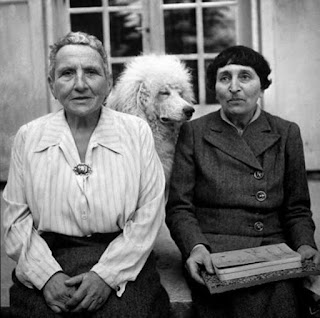
Gertrude Stein, Alice B. Toklas, and their dog Basket,
who plays a role in The Book of Salt.
Although clearly based on The Autobiography of Alice B. Toklas (by Gertrude Stein) and The Alice B. Toklas Cookbook (by Alice B. Toklas, written after the death of Gertrude Stein), as well as some of Stein's more obscure fiction, Truong's book creates a story of its own, not necessarily the exact narrative of a meticulous biographer. From a brief mention of Vietnamese cooks in Alice Toklas’s cookbook, she invents an entire life — and many food memories, as well as memories of the famous Saturday dinners at rue du Fleurus, and life in the countryside where the women spent their summers, accompanied by their cook. 

A few of the most luscious food descriptions — which all mention salt, so central to the imagery of the novel:

“She wants an omelet,” says Miss Toklas, who busies herself with the plates, silverware, and tray. Six eggs beaten with a generous pinch of salt until the mixture is thick with air, until the color lightens to the bare yellow of chamomile centers. Two large soupspoons of butter, the first melted in the pan until it sizzles, a harmonic of anticipation. The second is tucked under the puffy skin that has formed in less than a minute, if the heat is just right. A simple dish that reveals the master, exposes the novice. My omelets are well regarded and held in high esteem by all those who have partaken. Like children, gullible and full of wonder, they always ask, “What is your secret?” (p. 153)

“Pré-salé lambs are named for the salt marshes along the northern coast of France where they graze. Saltwater overflows onto flat stretches of land and leaves behind a sweet mix of herbs and flora. Elemental and tender, pré-salé lambs are salted and seasoned from the raw beginning. Now that, Miss Toklas thinks, is forethought. The first bite is a revelation of flavors, infused and deep. The second bite is a reminder of why we kill and eat the young. The third allows the brain back into the fray to ask, But how is it possible? Not a visible grind of pepper, a milky grain of salt, not even the faintest traces of rosemary, wild fennel, or thyme, and yet the lamb gives all this and more. Yes, intrigue is what my Madame aspires to in all of her creations.” (p. 178)

“The true taste of salt—the whole of the sea on the tip of the tongue, sorrow’s sting, labor’s smack—has been lost, according to my Madame, to centuries of culinary imprudence. It is a taste that Miss Toklas insists is sometimes unnecessary, as in the gazpacho of Malaga, and other times, as in the gazpacho of Segovia, it is the hinge that allows the flavors of the other ingredients to swing wide open. ‘In my kitchen, I will tell you when salt is necessary,’ my Madame said, concluding the real lesson for that day.” (p. 210)

While I didn’t like everything about the book, it’s pretty good, and I liked the effort to see Stein and Toklas as Americans with American sensibilities, American prejudices, and American judgements. Mainly, I feel that I should return to some of the books by Stein and Toklas and read them again. And I feel as if I should go back to some of my old French recipes and cook them again. And go back to Paris again, where I often walk past 27, rue du Fleurus and think of Gertrude Stein and Alice B. Toklas.

The door to Gertrude Stein's house at 27, Rue du Fleurus
(from my visit in 2013).

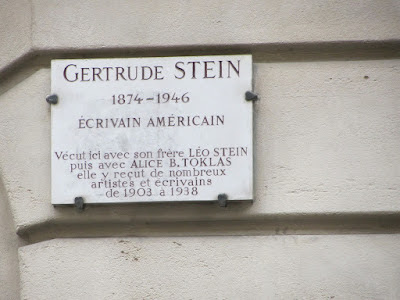
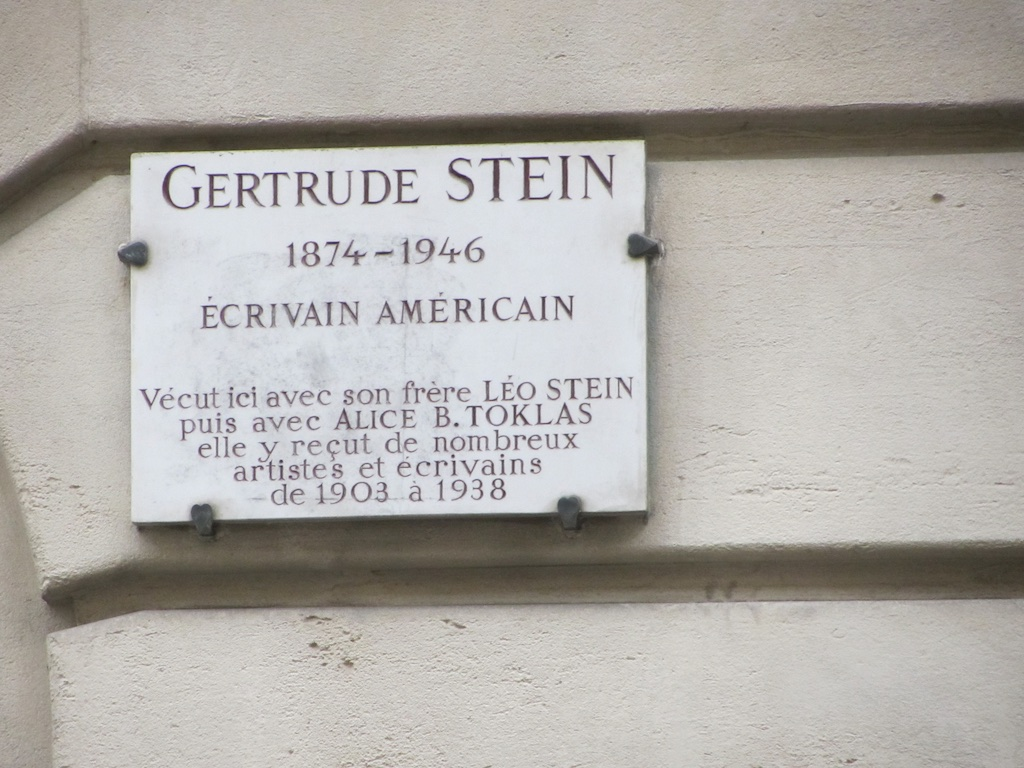
The plaque on the wall beside the door reads:
"Gertrude STEIN
1874-1946
AMERICAN WRITER
Lived here with her brother Leo STEIN
then with Alice B. TOKLAS
she received many artists and writers
from 1903 to 1938."

Blog post © 2022 mae sander.


Saturday, July 17, 2021

The Café du Dôme, Paris

 
André Kertesz, 1925, Le Café du Dôme, Paris. 
 
"Well, we'll meet again shan't we? Of course we shall. It would be a pity not to meet again, wouldn't it? Will I meet them at the Pékin tomorrow for lunch? I have an idea that I shan't be feeling much like Chinese food at half-past twelve tomorrow. We arrange to meet at the Dôme at four o'clock." (Jean Rhys, Good Morning, Midnight, p. 42)
What was the Dôme? Founded at the turn of the 20th century, this was the café most popular with the artists, writers, and intellectuals of the inter-war period -- Ernest Hemingway, Robert Capa, Pablo Picasso, Anaïs Nin, Man Ray, Henry Miller, Gertrude Stein, Walter Benjamin, and so on. Also there: hangers-on who wanted to see the famous people. 

In Jean Rhys's 1937 novel Good Morning, Midnight, the narrator is an English woman who is staying temporarily in Paris at a rather seedy hotel. (Very similar in many respects to the central characters of the two earlier Jean Rhys novels I wrote about last week.) As she wanders around Paris, she remembers her life there quite a bit earlier, in the mid-1920s, and also experiences the Paris of the mid-1930s.

Her rather pathetic Paris wanderings often end up at the Dôme:
"I'm not going to any beastly little bar tonight. No, tonight I'm going somewhere where there's music; somewhere where I can be with a lot of people; somewhere where there's dancing. But where? By myself, where can I go? I'll have one more drink first and then think it out. 
"Not the Dôme, I'll avoid the damn Dôme. And of course it's the Dôme I go to. 
"The terrace is crowded, but there are not many people inside." (p. 65)

And later, she begins to talk to a man sitting at a table opposite to hers at the Dôme. She points out to him: "You want somebody very rich and very chick." He says "Yes, that's what would just suit me. And beautiful." And she answers: "But my dear, you're not going to find that at the Dôme." (p. 72) 

Good Morning Midnight makes reference to many other cafés and small restaurants in Paris, both in the narrator's 1930's frame story and in her flashbacks to her life in the 1920s. She mentions the Ritz Hotel (but never goes there), the Deux Magots. the Closerie de Lilas, the Select... many more. But somehow, she always comes back to the Dôme. (For a list of famous cafés during this era see: "The Lost Generation: Cafés in Paris.)

Eugene Atget, Café du Dôme, 1925.


Len and I ate breakfast at the Dôme a few years ago, when staying nearby.
Although the location and the decor are kept the same, the Dôme is now a very
high-priced seafood restaurant, not at all a meeting place for intellectuals.


In some ways, as I read Good Morning, Midnight, I felt as if I was reading yet another version of Jean Rhys's first two books. However, the character in this one is somewhat more developed and self-aware, despite being just as pathetic and helpless. Her constant need to ask for money, and to get people to buy her food, as well as to sympathize with her, is sad, and illustrates her desperate state. Sometimes her depression makes her not want food, though she manages to drink alcohol constantly. Sometimes in the flashbacks to earlier times she spent long times without a real meal, or she had to smuggle food into her hotel room when she had no money for a restaurant. Her hunger is often vividly described.
"I start thinking about food. Choucroute, for instance -- you ought to be able to get choucroute garnie here. Lovely sausage, lovely potato, lovely, lovely cabbage.... My mouth starts watering violently. I drink half the glass of Pernod in order to swallow convenablement." (p. 81)
"We go next door to a place called La Napolitaine and eat ravioli. Warming me. Eat slowly, make it last a long time... I've never been so happy in my life. I'm alive, eating ravioli and drinking wine. I've escaped. A door has opened and let me out into the sun. What more do I want. Anything might happen." (p. 118)
It's hard to describe the desperation of this character. And hard to read her very depressing story. Very different from the happy dreams and memories of Paris that are being shared this month at the blog event Paris in July. I'm also sharing all these beverage photos with the bloggers at Elizabeth's weekly blog party.

Blog post © 2021 mae sander.

Monday, July 12, 2021

Jean Rhys in Paris

From my attic bookshelves…

Jean Rhys (1890-1979) wrote about life in 1920s Paris in a rather dismal way in two of her novels: Quartet and After Leaving Mr. MacKenzie. A long time ago, I read these books, and they've been sitting on my attic bookshelves for decades! I have also ordered a copy of Rhys's book Good Morning, Midnight because rereading these two books has made me want to read more. Her later book, Wide Sargasso Sea, is also on my shelf, but it's about another time and place.

The action in the books takes place at the same time and on the same streets and neighborhoods as the exciting and Bohemian life of the famous creative artists and writers of the early 20th century: Hemingway, Picasso, Gertrude Stein, and so on. Rhys mentions the streets and famous cafés around Montparnasse, the quays along the Seine near the Latin Quarter, and the bookstalls along the river. She describes several seedy and poorly-heated hotels and rooming houses -- even one where the landlady is too cheap to install electric light! Lace curtains on small windows in hot airless hotel rooms mentioned in the books all evoke my memories of long-ago Paris hotel stays.

The biographies and legends of the enduringly famous creators who lived there have made 1920s Paris familiar. However, no character in Rhys's books is at all creative or connected to the creative worlds of Paris, though they may be vaguely aware of it. At the center of each book is a sad and damaged woman, living a not-very-respectable life, with no artistic contacts or accomplishments. Both books develop a psychological portrait of an unmoored, undisciplined, often bored, not-very-introspective, and easily dependent person. Both novels portray the drift from one man to another, as the women become more and more unable to cope with life. Although intensely aware of the disapproval of other people, neither of these characters can manage to establish a better way to lead her life — or even to imagine such a life. Somehow, Rhys makes these lost women highly interesting to read about.

Marya, in Quartet, is an English woman who has lived in various countries throughout her adult life, always on the margins. At the beginning of the book her husband is sent to prison, leaving her adrift and without any money. She connects with a couple, the Heidlers, who take her in and more or less coerce her into an affair with the man, while Lois, the wife, more or less watches them. All three crave excitement:

Marie Laurencin: "Three Young Girls in Dance."
"Lois said in a high, excited voice that she was bored to death with Montparnasse. 
"'I'm bored, bored, bored! Look here. Let's go to a music-hall, .... Something canaille, what?' 

"Two naked girls were dancing before a background of blue and mauve which was like a picture by Marie Laurencin." (Quartet, p. 85-86)


Paris today still has much in common with the Paris of the two novels, though availability of very cheap places to live disappeared quite a long time ago. At the beginning of After Leaving Mr. MacKenzie, the main character, Julia Martin, another Englishwoman, lives in a very cheap hotel on the Quai des Grands Augustins. The hotel card listed the amenities of central heating, running water, and rooms rented by the day or by the month. Julia's room was surprisingly clean, and had wallpaper depicting a bird and a lizard. The bed was comfortable, and the chambermaid would bring coffee and a croissant each morning for breakfast. Julia spent much of her time in her room, but went out for meals around the corner on the Boulevard Saint Michel and other locations in the Latin Quarter. 

Many years ago on my first visit to Paris, I stayed in a very very cheap room in the same location on the quay -- a tiny, poorly-furnished hotel room with a shared toilet. The book definitely brings back memories! Paris changes slowly, but I suspect by now the hotels in that area have been upgraded quite a lot. At the website hotels.com today, I see a nearby hotel for $147 per night, which still seems pretty cheap. The web photos of the accomodations look beautiful; of course there is a full en-suite bathroom for each room. 

Another hotel, in Quartet, was described along with Paris weather:
"August was a hot, oppressive month, the sun beating down on sleepy streets, the cafés and restaurants nearly empty, the staircase and passages of the Hôtel du Bosphore and its fellows pervaded by an extraordinary mixture of smells. Drains, face powder, scent, garlic, drains. Above all, drains." (Quartet, p. 127)

Reading these books about Paris, I experienced a feeling of strange juxtaposition between things that have stayed the same and things that have changed. Songs the characters play for dancing include "Yes, We Have No Bananas" and "If You Knew Susie" -- that is, the songs of the twenties. In a country town, the characters get a ride from the train station to their hotel in a horse-drawn cab. But so much of the atmosphere is totally familiar, like images in a dream: even the disapproving hotel maids and supercilious waiters; even the smell of drains. Sometimes while reading I wondered momentarily if the details were anachronistic -- but that's impossible, because the books were written at the time, not recently. And because Jean Rhys's biography includes Paris experiences very much like the story of her characters.

Do you want to read about romantic Paris adventures in a beautiful, welcoming city? Do you want to read about unexpectedly great meals in amazing little bistros? Do you love to learn of likable and idealistic characters succeeding despite some not-too-terrible obstacles? If that's what you want, don't read these books!

Finally, I want to thank Nadia, the blogger at "A Bookish Way of Life," for reminding me about the work of Jean Rhys, and thank Tamara of "Thyme for Tea" for hosting the blog event Paris in July. 

Blog post © 2021 mae sander.