Thursday, January 23, 2025

Cruelty: A Story of Vietnam and Cambodia


Slow Noodles: A Cambodian Memoir of Love, Loss, and Family Recipes by Chantha Nguon (published 2024) is one of the most brutal stories I can remember reading. Born in Cambodia to a Vietnamese mother, she experienced the early days of the hideous events in Cambodia in the 1970s; she fled to Saigon where she suffered as the Vietnam War ended and dictatorship and poverty overtook the once-prosperous country. She lived perilously in Vietnam and then again in Cambodia and Thailand where she was in a wide variety of urban slums, refugee camps, and other places of suffering. As I read, I often had to stop and take a symbolic breath of air to clear my mind of the anguish, as well as to recollect the history of the Vietnam War and the Cambodian Genocide, which I haven’t thought about recently.

A quote that the author uses throughout the book: “Rice is what you eat when you have nothing and when you have everything.” (p. 16)  Remarkably, Nguon’s narrative of want and desperation is nevertheless filled with food descriptions. This may be the strangest embedding of food memories I’ve ever read! Each chapter has its own recipes, usually for the traditional foods of the countries where she lived, and usually of a fascinating exotic nature with many local and unfamilar-to-me ingredients. Some of the recipes, however, are written in irony with instructions like this: “Buy the least rotten fish you can find in the communal store or from your neighbor in the market.” (p. 109) or “Recipe: A Taste of Poverty: This dish is easy to prepare, but the regimen is very difficult to maintain—unless you must.” (this recipe is only rice, p. 226)

Life for Nguon until age nine was happy and prosperous; even after the early death of her father, her mother was able to provide a pretty good home and appealing food. Her mother’s many varieties of hand-made noodles are an especially vivid memory. She later contrasts these delicious creations to the packets of instant noodles that were available in some of the refugee camps where she was confined. The instant noodles that her mother disdained were a luxury in these later bad times.

The family escaped from Cambodia to Vietnam just before the situation in Cambodia became impossible: the Khmer Rouge dictators of Cambodia drove the educated urban population from their homes into the countryside where they had nothing and where one fourth of the people died of starvation or worse. (I have included a historic note about these events at the end of this blog post). 

Nguon describes this flight from the city: “You pack your things and walk out of the city with your family. You ask no questions. A sea of humanity is on the move: children, grandparents on cyclos, the sick and wounded in wheeled hospital beds.” (p. 71)

As the Vietnam war ended, Nguon experiences another era of losing everything, becoming a refugee in a camp. “We slept in two rows of thirty bamboo beds in a long, open-air bamboo hut with a thatched roof and earthen floor.” (p. 82) Still, she recalled dreaming of food at that time saying: “my fondest food memories are more of food-dreaming than of the actual meals we ate. It was the dreaming that sustained our minds, if not our bellies.” (p. 65)

Image of boat people fleeing Vietnam, 1975. (source)

After fleeing from Vietnam in a small dangerous boat (that is, becoming “boat people”) she and her husband spent a decade waiting in another refugee camp in Thailand, hoping to be accepted to go to Europe or the US. In the camp, they were given a few necessities:

“Again, a UNHCR official issued us two cookpots. This time we also got a small wood-burning cook stove, two blankets, a mosquito net, a spoon, and a plastic plate. Someone showed us to a long, narrow structure with concrete floors, tin roofs, and thin cement walls on three sides. ‘This is your house,’ the man said. The shelters were designed for forty people, so each person was allotted a rectangle of concrete about the size of a single bed.” (p. 190)

Eventually, they realized that they had no chance of escape from the refugee camp, and in desperation they returned to Cambodia, which was emerging from the genocide nightmare and becoming civilized again. After several years of various endeavors, they founded a women’s weaving studio where they helped to create a better life for other people, and where they raised their two children, though there’s only a fairly brief summary of this time of her life.

Refugee Camps Still Exist: Waiting at the US Border This Month

As I read the stories of the expulsions 50 years ago as people were forced from their homes and were walking long distances in search of a place of refuge, I thought with horror of the fact that the same thing is happening right now. Long lines of displaced people in Mexico are heading for the US border, and as of this week, their hopes of asylum have been destroyed. The camps where they wait are eerily like the ones the author experienced in Southeast Asia a generation ago.

Historic Note on Events in Nguon’s Memoir


In case the history is unfamiliar to you, here is a summary of the Cambodian Genocide: 

”Lasting for four years (between 1975 and 1979), the Cambodian Genocide was an explosion of mass violence that saw between 1.5 and 3 million people killed at the hands of the Khmer Rouge, a communist political group. The Khmer Rouge had taken power in the country following the Cambodian Civil War. During their brutal four-year rule, the Khmer Rouge was responsible for the deaths of nearly a quarter of Cambodians.

“The Cambodian Genocide was the result of a social engineering project by the Khmer Rouge, attempting to create a classless agrarian society. The regime would ultimately collapse when the neighboring Vietnam invaded, establishing an occupation that would last more than a decade.” (source)

Review © 2024 mae sander for maefood.blogspot.com

Wednesday, January 22, 2025

The Bells of Old Tokyo


The Bells of Old Tokyo: Meditations on Time and a City by Anna Sherman is a pretty good book, though I found that sometimes it seemed a bit unfocused. The author claims to be exploring the history of bells in the temples and other institutions of the city, but as she documents her visits many sites in Tokyo, she not only seeks the bells that are her specified topic, she also ranges over many other subjects and historic events. Her focus gets lost in many details that are interesting but very diffused. Above all, I felt that this book needed illustrations! Although the author’s descriptions are interesting, the scenes she describes just cry out for actual pictures. The kindle edition that I read had no illustrations whatsoever, which may also be the case for print copies of the book.

As I read I thought about our visits to Tokyo, always too short, and revisited some of my photos of our trip in 2011. Here are some quotes from the book with my photos.

The Sumida River as we saw it on a ferry ride in 2011

I enjoyed the many vignettes about the Sumida River and its long history because this river is one locale that we saw on our stay in the huge and varied city. Sherman’s summary:

“In its thousand years of written history, the Sumida has been moved and merged, its channels drained and diverted from one riverbed to another. Its waters were diverted so often – into canals, into gutters – that no one knows where the original channel once lay.” (p. 126)

“Today the Sumida has concrete banks and the buildings along its banks turn away from the river,
as if it weren’t even there.” (p. 127)

“Today the Sumida’s banks are scattered with new-fangled architecture from the 1980s Bubble
and the so-called Lost Decades afterward.” (p. 157)


“‘Of all Edo’s beauties, the river is paramount; its face changes from morning to evening.’ — Blossoms on the Sumida by Terakado Seiken” (Quoted as a chapter heading, p. 123)

The Black Gate, now at the museum in Ueno Park

“Ueno had seven gates. On 15 May 1868, the shōgitai massed near the main one, known as the Black Gate, where they faced off against the forces of Saigō Takamori, the era’s most gifted general and – even more ominous for the shōgitai – his five British-built Armstrong cannons.” (p. 84)

Now part of the museum in Ueno Park, which I visited in 2011, this gate had great historic significance
in the final defeat of the shogun and return of the emperor in 1868.

Throughout the book, the author returns to her discussions with the owner of a small old-fashioned coffee shop, which are interesting but not exactly on the topic of bells. She also has quite a lot of material about the 1923 earthquake and fire storm and the bombings of Tokyo in World War II. These were devastating to the monuments, including the bells, and to the entire city. In fact these chapters seem to defocus the book, especially the very long personal narrative about a Japanese woman’s experience in the war. I enjoy reading books about Japan, and I hope I’ll be finding some that I like better than this one!


Blog post © 2024, photos © 2011 mae sander 
for maefood.blogspot.com and maetravels,blogspot.com


Monday, January 20, 2025

Are Food Books Changing?

Complaint: I’m having difficulty finding recent food books that I want to read. Objectively, it’s hard to judge, but I have a feeling that the publishing industry has moved on from the type of book that I enjoyed very much 10 or 15 years ago or more. I’m not finding authors who write like M.F.K. Fisher, Elizabeth David, Mark Kurlansky (in his early books), Michael Pollan, Laura Shapiro, Édouard de Pomiane, Edda Servi Machlin, A.J. Leibling, Waverly Root, and  Calvin Trillin: to mention just a few. 

I’ve been searching New-Years lists of the 2024 best food books, and other lists of people’s favorites — but I’m just not finding what I’d like to read. Most of the books on these lists are cookbooks, which are not what I’m seeking — I want history books, food memoirs, and books about food and travel. (Note that what I really DON'T want is news of the world today, especially the world in Washington. Complaining about food books is a good diversion.)

I Found an Old Classic

As I searched, I did find a reference to an old classic from 1988, A Tuscan in the Kitchen by Pino Luongo. I read it this weekend, and it was pretty good, Although the book was mainly made up of recipes, the surprising thing was that it was fun to read them. That’s lucky because actually cooking from this book would be impossible: like most nostalgia books about living in small towns during an earlier and more innocent era, all the ingredients were procured from the cook’s own garden or from local hunters, small-scale farmers, fishermen, and so on. Everything was fresh except maybe home-canned tomatoes, which predictably were better than hothouse tomatoes out-of-season (I’ve heard this before). In other words, these recipes don’t exactly work in my world. I might be skeptical that the ideal world depicted in books like this ever did exist, but never mind that.

During 2024, I read a few older books, such as Vanilla: Travels in Search of the Ice Cream Orchid (from 2005) which I read last summer. A newly-published book that I read in September was Frostbite by Nicola Twilley; this book describes two centuries of development of refrigeration (review here). But there weren't many good finds.

In my search this week, I heard about a recent book called Slow Noodles: A Cambodian Memoir of Love, Loss and Family Recipes by Chantha Nguon, which I’ll be reading soon. I’m also aware of recently-published memoirs by Joan Nathan and Marion Nestle which I may read in the coming months. But in general, I’m not finding what I want — I guess maybe I need to go back and look for classics that I’ve missed. 

In the News

The obituary of food writer and editor Gillian Riley, who died in November, reminded me even more of how I can’t seem to find new food books that I would like to read. I reviewed her major work, The Oxford Companion to Italian Food, in 2009 (link). 

From the Guardian:

“In his review of The Oxford Companion to Italian Food for the Guardian in 2007, John Dickie advised that the author needed to be ‘brave, brilliant, learned and almost certainly a little unhinged.’ The food historian and typographer Gillian Riley, who has died aged 90, fulfilled all these requirements when composing that very book. That a single person was able to master the labyrinthine complexities of Italian food culture, embracing history, literature, the visual arts, politics and an infinite quantity of processes, ingredients and recipes is remarkable. That it was done with humour, humanity and lashings of erudition was the needful icing to make it digestible.” (Guardian Obituary)

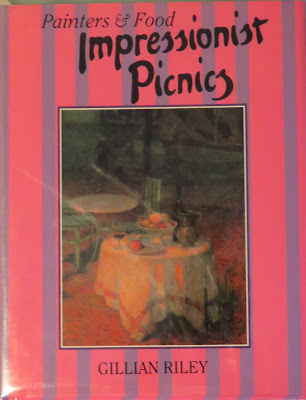
A book by Gillian Riley that I really enjoyed: Impressionist Picnics.
(Review Here)


The New Yorker still publishes a few food-themed cartoons.

Books I Love

A curiosity: the following list illustrates some of the books that I mentioned on my blog in 2008. These food books were on my shelves then, and they still are there.

  • Jennifer 8 Lee, The Fortune Cookie Chronicles
  • Tom Standage, A History of the World in Six Glasses
  • Gary Paul Nabhan, Why Some Like it Hot
  • Michael Pollan, In Defense of Food
  • Pollan, The Botany of Desire
  • Pollan, The Omnivore’s Dilemma
  • Jordan & Brady, eds, The World is a Kitchen
  • Julian Barnes, The Pedant in the Kitchen
  • Mary Taylor Simeti & Grammatico, Bitter Almonds
  • Elizabeth L. Ortiz, The Book of Latin American Cooking
  • Claudia Roden, A Book of Middle Eastern Food
  • Michelle Stacey, Consumed: Why Americans Love, Hate, and Fear Food
  • Henry Hobhouse, Seeds of Change
  • Julia Sahni, Moghul Microwave
  • Madhur Jaffrey, World Vegetarian
  • Harold McGee, On Food and Cooking
  • Ayla Algar, Classical Turkish Cooking
  • Gillian Riley, Painters & Food: Renaissance Recipes

Friday, January 17, 2025

Winter Wonderland (not!)

What I'm Watching 

New episodes of “Vienna Blood” to be continued next week and the week after.

Watched the first episode. It’s a bit over-the-top in its faithfulness to the book.


Dreaming of Birds in Trinidad


Current Reading


I found my very old paperback edition of this classic by Nobelist Gabriel Garcia Marquez.
It’s a very dense read to say the least. Long & long-winded. I’m not its perfect audience.
I was curious about how it would be made into a Netflick. Now I know.

Sometimes One Hundred Years of Solitude makes me think of Dickens. Each Dickens novel has at least one very eccentric or unusual character that’s not quite natural, but very exaggerated, and these characters provide contrasts with the other characters who are more naturalistic (though not 100%). But in this book ALL the characters are eccentric, unusual, bizarre, and beyond realistic. And sometimes it’s too strange for me. In other words, Dickens had a little slant towards magical realism, before the genre had a nice name.

One strange passage from the strange book

“He was convinced that his own officers were lying to him. He fought with the Duke of Marlborough. ‘The best friend a person has,’ he would say at that time, ‘is one who has just died.’ He was weary of the uncertainty, of the vicious circle of that eternal war that always found him in the same place, but always older, wearier, even more in the position of not knowing why, or how, or even when. There was always someone outside of the chalk cirde. Someone who needed money, someone who had a son with whooping cough, or someone who wanted to go of and sleep forever because he could not stand the shit taste of the war in his mouth and who, nevertheless, stood at attention to inform him: ‘Everything normal, colonel.’ And normality was precisely the most fearful part of that infinite war: nothing ever happened. Alone, abandoned by his premonitions, fleeing the chill that was to accompany him until death, he sought a last refuge in Macondo in the warmth of his oldest memories. His indolence was so serious that when they announced the arrival of a commission from his party that was authorized to discuss the stalemate of the war, he rolled over in his hammock without completely waking up.” (p. 161)


Another classic that I’ve been wanting to revisit. This one is fun.

An extremely short and not very satisfying sequel to
Clarke’s Jonathan Strange and Mr. Norrell.
Rather insipid illustrations.

Eating Out

Coffee at our local Argus Coffee shop.


Downtown: a fun diner. Wish I remembered its name! Can’t find it online.

New fried chicken shop in Maple Village Shopping Center: food pretty good, service lousy.

Carol’s Great Cooking

Carol invited us for dinner: bouillabaisse and fougasse (a special flatbread with olives)

The Back Wall of Zingerman’s Roadhouse

We haven’t eaten here lately. We should do it soon.


Sharing with the weekend people: Eileen’s Critters, Deb’s Sunday Salon, and Sami’s Murals.
Photos © 2025 mae sander for maefood.blogspot.com

Wednesday, January 15, 2025

Our Country is Burning. Our Culture is Burning

"The iconic Eames House, Getty Villa, and other Los Angeles landmarks are still at risk of destruction amid raging wildfires across Southern California. But what are the other buildings impacted by the Palisades fires?"

"For some design geeks... the heart and soul of L.A.’s architecture resides not just in its museums and office towers but also in its exalted, often otherworldly houses."


Will Roger's house, January, 2025.


"The only works of art America has given are her plumbing and her bridges"
— Marcel Duchamp

"Composer Arnold Schoenberg's archive destroyed in LA fires"

At the Senate hearings on the nominee for Secretary of Defense: "Hegseth’s past comments [about women in combat] didn’t distinguish women who meet certain standards from other women; he said women shouldn’t serve in combat, period. As recently as November — shortly before Trump picked him — he said, 'I’m straight up just saying we should not have women in combat roles.'"

"U.S. securities regulators sued Elon Musk in federal court in Washington on Tuesday in an enforcement action arising from his $44 billion purchase of Twitter, now called X."

"Donald Trump raised alarm last week when he refused to rule out military intervention to bring Greenland and the Panama Canal under US control"

"Amid the parade of surreal images from the last few days, few have been stranger than this one: a FEMA disaster recovery center for L.A. fire victims inside the former Westside Pavilion. Alongside the escalators and signs for the now-defunct movie theater in the carcass of what was once L.A.’s premiere shopping mall, dozens of government agencies have gathered to offer fire aid." 

"For President-elect Donald Trump and his supporters, the fires are a parable of liberal ineffectiveness. And the villains are Democratic politicians like the feckless mayor of Los Angeles, Karen Bass, who had left town just as the National Weather Service issued warnings about the increased dangers of the approaching winds. But the edging out of the Los Angeles middle class has been a long-running, bipartisan project. Today, the budget-slashing values of Ronald Reagan and the taxpayer revolt remain woven, by law, into the fabric of California life."
— OpEd in NYT by 

"Over the past month, we’ve learned that Donald Trump’s inauguration fund has received million-dollar donations from, among others, Google, Meta overlord Mark Zuckerberg, Amazon founder Jeff Bezos, OpenAI CEO Sam Altman and Apple boss Tim Cook. Hard to know whether it’s encouraging or quite the opposite to find them being so public about it."

Monday, January 13, 2025

The Glass Maker by Tracy Chevalier

 
Have you visited Venice? If so, you are probably aware of the glassblowing industry on the nearby island of Murano. You may have seen shops selling the art glass as well as the kitchy souvenirs that are made on the island at the present time.

Perhaps you purchased a little glass animal statue or a glass-bead necklace made in Murano. Art beads were invented by a woman in the glass-making trade in Murano (and this real person appears among the fictitious characters in The Glass Maker). Maybe you visited a demo of the ancient craft of glass-making or encountered art glass in museums or antique shops. 

Even if you have never been to Venice, you surely have some idea of the famous canals and the small boats and gondolas used to get around there. Or you may have an idea of the historic buildings and bridges. Perhaps you know about the long history of the city and its former military and commercial domination of the Eastern Mediterranean.

Tracy Chevalier’s current best-seller, The Glassmaker, explores the history of Venice by inventing a family of glass workers who lived and worked in Murano from the fifteenth century until now. In each century, the members of the family age only about a decade, and thus these miraculous individuals seamlessly experience the vast changes of history and the constant decline of the Venetian Republic. Tracy Chevalier somehow manages to make this a convincing story, despite its utter improbability!

The story’s central character, Orsola Rosso, is the main focus of the novel, beginning with her girlhood in a household that’s also a glassblowing shop. The head of the Rosso family and master artisan is first her father and after his death, her brother. The women and younger men were subordinate to them. 

Over time, Orsola teaches herself to make beautiful beads, using the glass rods that were essential in glassblowing. Her craft does not involve blowing glass, but using a flame to melt a small blob of glass and bits of colorful other glass and sometimes gold, to make a cleverly decorated bead: a technique now known as lampwork. Her identity as a skilled worker and her determination to contribute to her family’s livelihood, not simply to do women’s work (which seems to be mainly doing laundry) is a key part of the novel. As the history of Venice constantly changes the way the family needs to live, we learn both the personal stories and the march of history.

The Rosso family must deal with many challenges, including friction and rivalry between the family members, changes in demand for their craft work as the centuries pass, and quite a few hard times. During the plague years of the sixteenth century, they are quarantined with the house sealed off and sick members taken away. History more or less repeats itself in the twenty-first century, when the Covid epidemic is handled in very much the same way, and the characters in the book actively remember their experiences from centuries before. In fact, the way they remember and compare their experiences through the ages is a very fascinating aspect of the novel. It seems utterly impossible but the author makes it work!

Many characters outside the family also play a role in the story, including the dealers, rivals, and customers for the glasswares they produce, and for the shop that they eventually found to sell their wares. Tracy Chevalier has created a very interesting way to present this large amount of historic research and make it relatable. 


The author acknowledges this painting as her inspiration for the character of a gondolier of African origin. He was enslaved by the agent who bought the family’s products, and played an interesting role in the novel throughout the centuries that are covered. The image shown is a detail from a large painting.

I have only read a few of the novels of Tracy Chevalier, specifically, Remarkable Creatures, The Last Runaway, and The Glass Maker. I may read more of them eventually, as I have enjoyed them and learned from them. In 2003 when living in Santa Barbara, I attended a pre-release showing of the film “Girl With a Pearl Earring” based on her most successful book, and it was a very memorable experience to hear a lecture from the film maker along with the preliminary version.

A close look at a decorated glass bead 
from Murano made by “lampwork.” 
— source: Venetian Bead Shop

Review © 2025 mae sander

Sunday, January 12, 2025

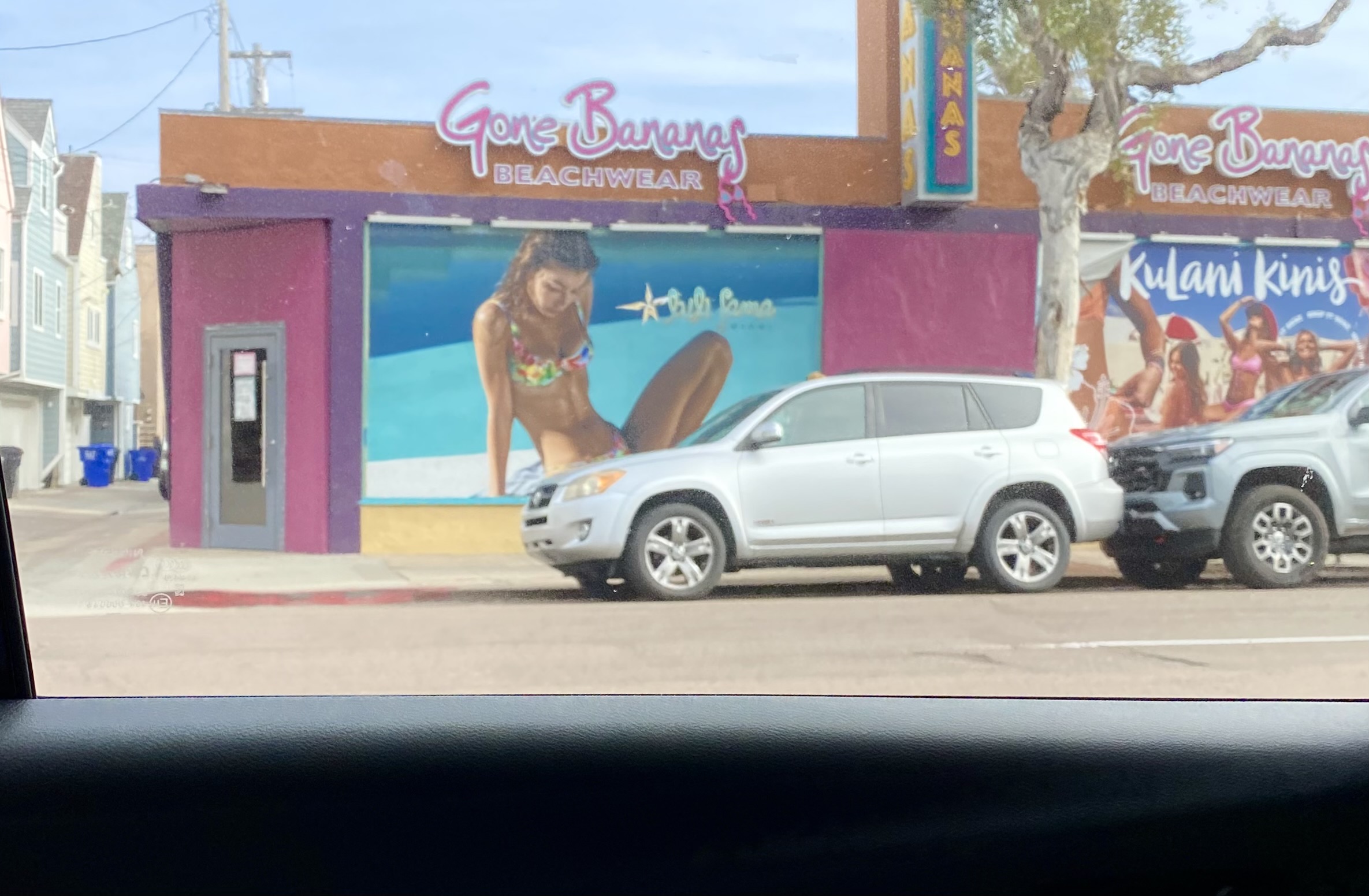
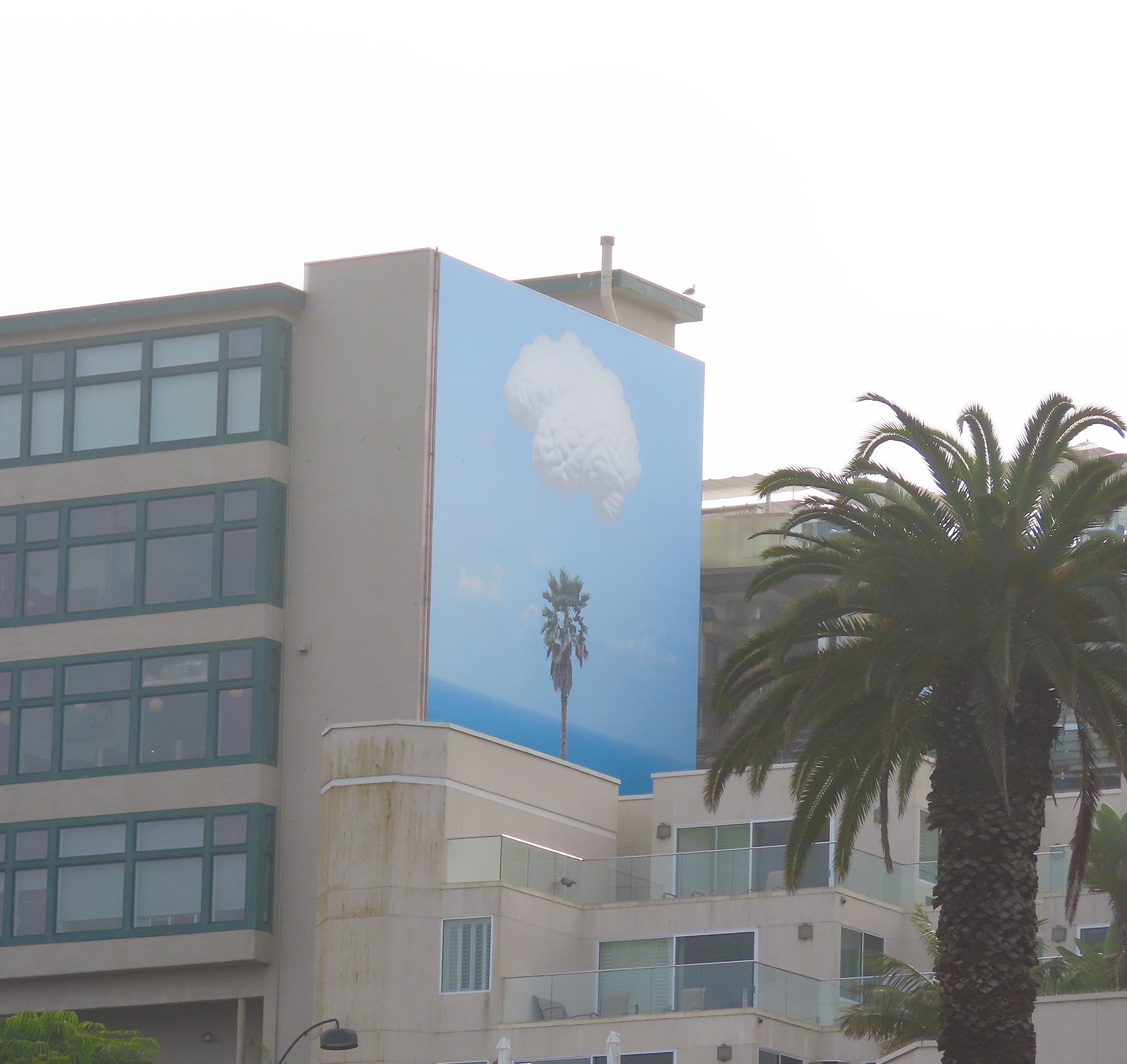
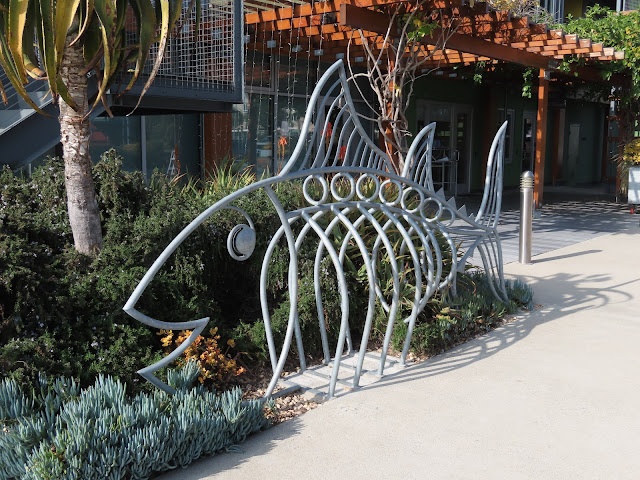
San Diego Street Art


Near La Jolla Cove.


I’ve been saving some photos from our December trips to post during the long grey month of January in Ann Arbor. As we drove through San Diego, I was amazed at the number and variety of murals and other street art, and also frustrated because it’s so hard to get photos from a moving car! 

Shared with Sami’s Colorful World — Photos © 2024 -2025 mae sander

Friday, January 10, 2025

Books and Movies

Reading


The first sentence of the introduction to The Autobiography of an Ex-Coloured Man, which was published in 1912: “This vivid and startlingly new picture of conditions brought about by the race question in the United States makes no special plea for the Negro, but shows in a dispassionate, though sympathetic, manner conditions as they actually exist between the whites and blacks to-day.” 

The book is a fictional narrative of the life of one man, featuring his observations on what it meant over 100 years ago to be black both in the north and in the south (also in Paris and London). I was amazed at how many aspects of the “race question” have remained unchanged. Only the choice of words (“race question”) is different. So much is the same. The book vividly combines the specific events of one character’s life with insights about the way that being either black or white created a person’s opportunities and experiences. The protagonist/narrator is a black man who can pass for white, and thus experiences life from both points of view.

James Weldon Johnson (1871-1938) was an author, a poet, a civil rights leader, and a participant in the Harlem Renaissance. His most famous poem is “Lift Every Voice and Sing,” which is viewed as the Black National Anthem. Johnson was the head of the NAACP from 1920-1930. His novel The Autobiography of an Ex-Coloured Man is an American classic.


The latest Detective Galileo novel was a little disappointing to me. The plot wasn’t as interesting or as compelling and the suspense wasn’t as dramatic as in earlier novels in this series. If you are hooked on this series you can’t miss it!

Reading Next

The Glassmaker by Tracy Chevalier: a bestselling author whose books
 I have enjoyed reading


Watching

“A Haunting in Venice” stars Kenneth Branagh as Hercule Poirot along with an all-star cast.
Creepy but a little too contrived.

 
The final episode of  “Vera” is very emotional and nostalgic, but with a good mystery to wrap up a great series. 

Blog post shared with Deb’s Sunday Salon
© 2025 mae sander

Wednesday, January 08, 2025

Ann Arbor Afternoon with Sushi and Art

Totoro Japanese Restaurant, Ann Arbor, where we often have lunch.
Named for our favorite Miyazaki film character, the Totoro.

Soup bowls, chopsticks, and Diet Coke.

The Totoro whose creator film-maker Hayao Miyazaki just celebrated his 84th birthday.

Sushi roll

Vegetable tempura … not shown: teriyaki salmon and orange chicken.
Always a nice place to have lunch.


A Brief Visit to the Art Museum

A very ancient pot in the shape of a bird.

A Duck-Shaped Vessel made in 2004 by Korean potter Kim Yik-yung (b. 1935)


Another duck-shaped vessel, Korean, 3rd-4th Century.

Chinese snuff bottle with bat design, 19th century.
Photos and blog post © 2025 mae sander