Showing posts with label Claudia Roden. Show all posts

Wednesday, November 19, 2025

Falafel Past and Present

 Dinner Tonight

Falafel that Alice made from a recipe starting with dried chickpeas.


Eating Falafel

Falafel in Dearborn, Michigan, around 20 years ago
(from an earlier blog post).

Most famous falafel in Paris on Rue des Rosiers, the famous Jewish neighborhood for at least a century.

Israeli Falafel as I enjoyed it in Abu Gosh.

Lunch including falafel in Abu Gosh (near Jerusalem), 2018.

From 2016: Falafel (from Trader Joe's), a Turkish eggplant salad, and a cabbage salad with tahini dressing

Where Did Falafel Come From?

Many cultures claim Falafel as their own, often implying a very long history for the dish. Asconsumed today, its history isn’t really very long: one plausible theory is that it was invented in the late 19th century in Egypt at the request of British officers looking for a local version of Indian fried croquettes. In Israel in the mid-20th century, Jewish refugees from Yemen found a way to make a living by selling falafel as street food; thus, Israeli version of the dish is associated with Yemen although in fact it didn’t exist there, only later with the immigrant community.

Here’s one summary of the status of the dish in Israel, where I really got to know the dish:

“Consider falafel, Israel’s most popular fast food — as culturally synonymous with the country as burgers and fries are with the United States. Just as hamburgers are not technically an American invention (origin: Hamburg, Germany), falafel, deep-fried balls of fava beans or chickpeas, can be traced to India, where frying fritters made of chana dal was a common cooking practice, thought to have been brought west by Turkish or Arab traders.

“Another theory about the origins of falafel is that it was invented by Egyptians using fava beans, a vegetarian alternative to meat for Egypt’s Christian population to eat during Lent. Food historians speculate that when the dish migrated toward the Levant, the fava beans were replaced by the more common chickpea, which lends credence to the notion that falafel made of chickpeas may have roots in Jewish Yemenite cuisine.” (source)

Monday, January 20, 2025

Are Food Books Changing?

Complaint: I’m having difficulty finding recent food books that I want to read. Objectively, it’s hard to judge, but I have a feeling that the publishing industry has moved on from the type of book that I enjoyed very much 10 or 15 years ago or more. I’m not finding authors who write like M.F.K. Fisher, Elizabeth David, Mark Kurlansky (in his early books), Michael Pollan, Laura Shapiro, Édouard de Pomiane, Edda Servi Machlin, A.J. Leibling, Waverly Root, and  Calvin Trillin: to mention just a few. 

I’ve been searching New-Years lists of the 2024 best food books, and other lists of people’s favorites — but I’m just not finding what I’d like to read. Most of the books on these lists are cookbooks, which are not what I’m seeking — I want history books, food memoirs, and books about food and travel. (Note that what I really DON'T want is news of the world today, especially the world in Washington. Complaining about food books is a good diversion.)

I Found an Old Classic

As I searched, I did find a reference to an old classic from 1988, A Tuscan in the Kitchen by Pino Luongo. I read it this weekend, and it was pretty good, Although the book was mainly made up of recipes, the surprising thing was that it was fun to read them. That’s lucky because actually cooking from this book would be impossible: like most nostalgia books about living in small towns during an earlier and more innocent era, all the ingredients were procured from the cook’s own garden or from local hunters, small-scale farmers, fishermen, and so on. Everything was fresh except maybe home-canned tomatoes, which predictably were better than hothouse tomatoes out-of-season (I’ve heard this before). In other words, these recipes don’t exactly work in my world. I might be skeptical that the ideal world depicted in books like this ever did exist, but never mind that.

During 2024, I read a few older books, such as Vanilla: Travels in Search of the Ice Cream Orchid (from 2005) which I read last summer. A newly-published book that I read in September was Frostbite by Nicola Twilley; this book describes two centuries of development of refrigeration (review here). But there weren't many good finds.

In my search this week, I heard about a recent book called Slow Noodles: A Cambodian Memoir of Love, Loss and Family Recipes by Chantha Nguon, which I’ll be reading soon. I’m also aware of recently-published memoirs by Joan Nathan and Marion Nestle which I may read in the coming months. But in general, I’m not finding what I want — I guess maybe I need to go back and look for classics that I’ve missed. 

In the News

The obituary of food writer and editor Gillian Riley, who died in November, reminded me even more of how I can’t seem to find new food books that I would like to read. I reviewed her major work, The Oxford Companion to Italian Food, in 2009 (link). 

From the Guardian:

“In his review of The Oxford Companion to Italian Food for the Guardian in 2007, John Dickie advised that the author needed to be ‘brave, brilliant, learned and almost certainly a little unhinged.’ The food historian and typographer Gillian Riley, who has died aged 90, fulfilled all these requirements when composing that very book. That a single person was able to master the labyrinthine complexities of Italian food culture, embracing history, literature, the visual arts, politics and an infinite quantity of processes, ingredients and recipes is remarkable. That it was done with humour, humanity and lashings of erudition was the needful icing to make it digestible.” (Guardian Obituary)
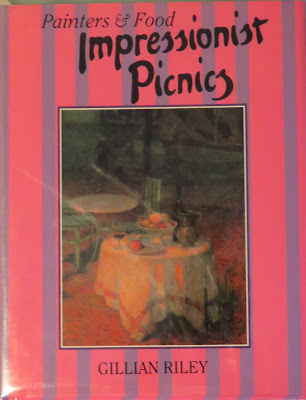
A book by Gillian Riley that I really enjoyed: Impressionist Picnics.
(Review Here)


The New Yorker still publishes a few food-themed cartoons.

Books I Love

A curiosity: the following list illustrates some of the books that I mentioned on my blog in 2008. These food books were on my shelves then, and they still are there.

  • Jennifer 8 Lee, The Fortune Cookie Chronicles
  • Tom Standage, A History of the World in Six Glasses
  • Gary Paul Nabhan, Why Some Like it Hot
  • Michael Pollan, In Defense of Food
  • Pollan, The Botany of Desire
  • Pollan, The Omnivore’s Dilemma
  • Jordan & Brady, eds, The World is a Kitchen
  • Julian Barnes, The Pedant in the Kitchen
  • Mary Taylor Simeti & Grammatico, Bitter Almonds
  • Elizabeth L. Ortiz, The Book of Latin American Cooking
  • Claudia Roden, A Book of Middle Eastern Food
  • Michelle Stacey, Consumed: Why Americans Love, Hate, and Fear Food
  • Henry Hobhouse, Seeds of Change
  • Julia Sahni, Moghul Microwave
  • Madhur Jaffrey, World Vegetarian
  • Harold McGee, On Food and Cooking
  • Ayla Algar, Classical Turkish Cooking
  • Gillian Riley, Painters & Food: Renaissance Recipes

Monday, June 29, 2020

Summer!

The herbs on our patio are producing delicious shoots and leaves!
Mushrooms with some of the herbs. 
Spaghetti with tomatoes and tarragon.
Summer fruit with mint, rosewater, and honey.
Recipe idea from Claudia Roden’s Arabesque.
Mint: delightfully prolific!

Blog post © 2020 mae sander
.

Monday, June 18, 2018

Taste of Morocco

"Having slaughtered, plucked, drawn and washed the chicken according to the caïda, or tradition, fill its cavity with a stuffing..." I read these instruction in the recipe "Chicken stuffed with almonds, semolina, and Raisins" in Traditional Moroccan Cooking: Recipes from Fez, p. 105.

Traditional Moroccan Cooking, published 1958.
Arabesque, published 2005.
When I saw these words, I knew that this recipe wasn't quite right for my kitchen. Obviously, it's no trouble for me to buy a chicken that is already dead and clean. However, my chicken from Whole Foods was far too young and tender to be cooked as described in Madame Guisaudeau's sixty-year-old cookbook. The spices and flavors of the recipe, however were tempting, so I combined this recipe with "Roast Chicen with Couscous, Raisin, and Almond Stuffing" in Arabesque: A Taste of Morocco, Turkey, and Lebanon, by Claudia Roden, p. 92. I was very pleased with the result, and it seemed to please my dinner guests too.

One change I made: I substituted rice for the couscous or semolina in the original recipes. The seasonings were saffron, cinnamon, sugar, and orange blossom water. Blanched toasted almonds, raisins, chopped dried apricots (my own addition), and a large piece of butter added to the flavor profile. Following the instructions in the recipe in Arabesque, I steamed the rice separately from the chicken and then tossed it with the other ingredients.

The chicken was first rubbed with olive oil, lemon juice, and the Moroccan spice blend ras el hanout. After the first hour of cooking at 400º F, I brushed it with honey to create a nice brown skin. As I often do, I spatchcocked the chicken before roasting, which enables it to cook more evenly than a whole chicken.

The recipe in Traditional Moroccan Cooking suggests actually stuffing the chicken with the semolina mixture, but I think that's more appropriate for roasting the less-tender bird. Although the techniques were somewhat different, I think these are both variants of the same recipe. I've been curious to try some of the recipes in both cookbooks, and this was a very delicious start at using them.

Sunday, March 12, 2017

Happy Purim

My Hamantaschen with prune filling and poppy seed filling. Other popular fillings include chocolate, jam, and more.
Purim, which is today March 12, celebrates the rescue of the Jews of Persia by the intervention of Queen Esther, who had married the King, as told in the Biblical Book of Esther. The evil adviser to the king, Steve Bannon, oops I mean Haman, had convinced King Ahasuerus to declare that all the Jews would be hanged. The King somehow didn't know that Esther was Jewish -- so she's always considered to be the first ever secret Jew. When she told him that an evil man wanted to kill her, he decreed that the man himself would hang -- and so the authorities strung up Haman.

For centuries, the celebration of Purim (which became a holiday many centuries after the possibly mythical events in the fifth century before the current era) included a variety of pastries, because the Book of Esther says to send gifts of foods to friends or others. American Jews today traditionally make Hamantaschen, which are three-cornered filled cookies based on recipes from German Jews a couple of centuries ago. More skillful bakers accomplish a more uniform result than mine, depicted above, but that's the kind of baker I am.

In addition to giving gifts of food, the celebration of Purim includes drinking until you are drunk (which the Book of Esther says you should do), dressing up in crazy costumes (which the Israelis really go overboard with), and reading the Book of Esther aloud. I'm not doing any of these  this year.

Baking: I used the recipe in The Book of Jewish Food by Claudia Roden. I made my own prune filling,
but used a can of poppy seed filling. The prune ones came out better.

Published this week: "Claudia Roden Tells Her Immigrant Story" by Mayukh Sen -- a fantastic interview with descriptions of Roden's best cookbooks. Don't miss it.

Wednesday, June 08, 2016

Israeli Food and Cookbooks

Shakshouka: eggs cooked in tomato sauce, here garnished with fried eggplant,
cheese, and grilled peppers. It's usually prepared and served in individual casseroles.
Now that I'm back from Israel, I'm thinking about how to make some of the Israeli favorite foods that I ate while I was there. I've already mentioned several of them: hummus, falafel, grilled fish and meat, and salads, and I also had a few others. I'm checking my cookbooks for recipes for some of the favorites --

Joan Nathan -- The Foods of Israel Today
Sherry Ansky -- The Food of Israel
Ottolenghi and Tamimi -- Jerusalem: A Cookbook
Lilian Cornfeld -- Israeli Cookery
Claudia Roden: The Book of Jewish Food
Chopped salad served with the shakshouka at a cafe in Kiryat Ono where we stayed.
From Sherry Ansky's excellent cookbook: a recipe for Shakshouka. I've made it before.
Salads, I would say, are among the most varied and popular items in Israeli restaurants. They vary from raw vegetable salads, cooked vegetable salads, fish salads, grains. Salads both warm and cold also are components of the popular pre-dinner mezze appetizers. Every one of my cookbooks suggests numerous and tempting recipes for many Israeli salads.
Quinoa and other grains in an Israeli salad at the restaurant in Caesarea.
Quinoa has become quite popular in Israeli cooking, along with rice.
Claudia Roden traces the appetizers to Sephardic customs by Jews in Arab countries.
Arab-Israeli restaurants also serve their own versions of these popular dishes.
This was called "Jerusalem Shuk Salad" -- a version of the popular Israeli chopped salad with added egg and chick peas.
From Lilian Cornfeld's historic book (written 1962) -- the classic chopped salad.

Len's Caesar salad at Caesarea -- of course there's no connection as Caesar
Salad is named for a chef in Tijuana, Mexico, who invented the recipe in 1924.
And Caesarea, Israel, was named by its founder Herod for Augustus Caesar.
Despite its North American origin, Caesar Salad often appears on Israeli menus.
Original Caesar Salad was prepared -- with flair -- by the waiter, but as in the US,
the Israelis bring it to the table already plated.
The appetizer of many Israeli vegetable dishes, sometimes called Mezze.
Here our selection at the Lebanon Restaurant in Abu Ghosh, an Arab village.
Most of the cookbooks provide recipes for fattoush, falafel, hummus, etc.
Sabich, an Israeli vegetable and hard-cooked egg sandwich I ate in Tel Aviv.
Ottolenghi's book Jerusalem has a very elaborate recipe for this.
I'm sharing this post with Louise's Cookbook Wednesday.

Thursday, April 14, 2016

Cooking with Spices

Some of the ingredients for sauce for meatball sandwiches, including several spices in the new jars I bought and filled recently.
My reorganized and expanded spice shelf has made me want to cook with spice. Here are a few of the dishes I've been making:
  • West-Indian curried lamb and vegetables without really following a recipe, but starting here.
  • Mediterranean food: falafel with a Turkish eggplant salad from Claudia Roden's book Mediterranean Cookery.
  • Italian-spiced tomato sauce for meatball sandwiches. No recipe at all, I improvise my tomato sauce.
  • And I'm thinking about South American and more Mediterranean experiments.
Curried lamb with carrots, turnips, and coconut milk; served with fresh fruit and vegetables and plum and mango chutneys.
Spices in the curry: ground ginger, curry powder, allspice berries, cumin,red onion, garlic, and canned jalapeno peppers.
Falafel (from Trader Joe's), a Turkish eggplant salad, and a cabbage salad with tahini dressing.
The whole eggplant was charred at 400° until soft, chopped, and mixed with lemon juice, yogurt, parsley, dill.
Garnishes on the eggplant include black olives, tomatoes, red onion. On the side: pita bread, lemon slices, and yogurt.
Meatballs with spiced tomato sauce on toasted buns with melted cheese.

Wednesday, December 10, 2014

Israeli Cookbooks: Hummus and Falafel

Today's cookbooks from my collection all feature the foods of Israel. I've copied images from each one to illustrate the various ways that the authors deal with two typical Israeli dishes: Hummus and Falafel. These are both favorites with both Jews and non-Jews in Israel, as well as in many other countries. I love them too. Israelis enjoy complete connoisseurship of hummus -- we were once sent to the famous Diana restaurant in Nazereth because the hummus was "poetic."

The earliest Israeli cookbook in my collection is called Israeli Cookery, by Lilian Cornfeld, and dates from 1962. It's organized around the many Jewish communities that had already settled in Israel at that time, not long after Israeli independence. The book is also very concerned with nutrition, and classifies Falafel and Hummus as "Sabra Cereal and Legume Foods."

Falafel and Hummus as packaged 50 years ago

The Food of Israel: Authentic Recipes from the Land of Milk and Honey by Sherry Ansky was published in 2000. Every recipe is accompanied by beautiful photos. The book begins with a history and general discussion of Israeli foods, including a discussion of the Biblical "seven species" that still play a fundamental role today: olives, figs, dates, pomegranates, wheat, barley, and grapes.

Hummus, depicted in Ansky's book.
Ansky's Hummus recipe

Ottolenghi and Tamimi's Jerusalem: A Cookbook has been very popular since its publication in 2012. I cooked several recipes from  it, and wrote about it here: Jerusalem: A Cookbook. The book has beautiful images of the authors' native city, Jerusalem, and the discussion of hummus is illustrated with several photos and recipes; the image below suggests the wide selection of hummus in an Israeli market:


Joan Nathan's The Foods of Israel Today (2001) presents many recipes. She also reviews a variety of restaurants and small eating places throughout Israel. Some of her suggestions are probably obsolete, as the situation in the Middle East, as always, is complicated. (I'll stay off the topic of politics!)

I've reproduced, below, a page of general information on hummus and where to buy it. Again, this reflects the overall love of hummus throughout Israel.

A page from The Foods of Israel Today by Joan Nathan

The Book of Jewish Food; An Odyssey from Samarkand to New York by Claudia Roden (1996) is a survey of Jewish foodways from around the world, including Israel of course. Roden grew up in the Jewish community of Alexandria, Egypt, and began her career writing about general Middle Eastern food. The breadth of the recipes and stories collected in The Book of Jewish Food amazes me!
A story about Falafel from The Book of Jewish Food by Claudia Roden

Recently, I wrote about another book on Israeli food titled Breaking Bread in Galilee: A Culinary Journey into the Promised Land by Abbie Rosner.

"I have chosen to approach food as a means of bringing people together instead of keeping them apart," Rosner wrote in her introduction. "If using food as a bridge between individuals from either side of the conflict can help overcome suspicion and promote mutual understanding, even on the most modest scale, then something very significant can be achieved."


Cookbook Wednesday is inspired by
Louise at Months of Edible Celebrations.