Showing posts with label Pomiane. Show all posts

Monday, January 20, 2025

Are Food Books Changing?

Complaint: I’m having difficulty finding recent food books that I want to read. Objectively, it’s hard to judge, but I have a feeling that the publishing industry has moved on from the type of book that I enjoyed very much 10 or 15 years ago or more. I’m not finding authors who write like M.F.K. Fisher, Elizabeth David, Mark Kurlansky (in his early books), Michael Pollan, Laura Shapiro, Édouard de Pomiane, Edda Servi Machlin, A.J. Leibling, Waverly Root, and  Calvin Trillin: to mention just a few. 

I’ve been searching New-Years lists of the 2024 best food books, and other lists of people’s favorites — but I’m just not finding what I’d like to read. Most of the books on these lists are cookbooks, which are not what I’m seeking — I want history books, food memoirs, and books about food and travel. (Note that what I really DON'T want is news of the world today, especially the world in Washington. Complaining about food books is a good diversion.)

I Found an Old Classic

As I searched, I did find a reference to an old classic from 1988, A Tuscan in the Kitchen by Pino Luongo. I read it this weekend, and it was pretty good, Although the book was mainly made up of recipes, the surprising thing was that it was fun to read them. That’s lucky because actually cooking from this book would be impossible: like most nostalgia books about living in small towns during an earlier and more innocent era, all the ingredients were procured from the cook’s own garden or from local hunters, small-scale farmers, fishermen, and so on. Everything was fresh except maybe home-canned tomatoes, which predictably were better than hothouse tomatoes out-of-season (I’ve heard this before). In other words, these recipes don’t exactly work in my world. I might be skeptical that the ideal world depicted in books like this ever did exist, but never mind that.

During 2024, I read a few older books, such as Vanilla: Travels in Search of the Ice Cream Orchid (from 2005) which I read last summer. A newly-published book that I read in September was Frostbite by Nicola Twilley; this book describes two centuries of development of refrigeration (review here). But there weren't many good finds.

In my search this week, I heard about a recent book called Slow Noodles: A Cambodian Memoir of Love, Loss and Family Recipes by Chantha Nguon, which I’ll be reading soon. I’m also aware of recently-published memoirs by Joan Nathan and Marion Nestle which I may read in the coming months. But in general, I’m not finding what I want — I guess maybe I need to go back and look for classics that I’ve missed. 

In the News

The obituary of food writer and editor Gillian Riley, who died in November, reminded me even more of how I can’t seem to find new food books that I would like to read. I reviewed her major work, The Oxford Companion to Italian Food, in 2009 (link). 

From the Guardian:

“In his review of The Oxford Companion to Italian Food for the Guardian in 2007, John Dickie advised that the author needed to be ‘brave, brilliant, learned and almost certainly a little unhinged.’ The food historian and typographer Gillian Riley, who has died aged 90, fulfilled all these requirements when composing that very book. That a single person was able to master the labyrinthine complexities of Italian food culture, embracing history, literature, the visual arts, politics and an infinite quantity of processes, ingredients and recipes is remarkable. That it was done with humour, humanity and lashings of erudition was the needful icing to make it digestible.” (Guardian Obituary)
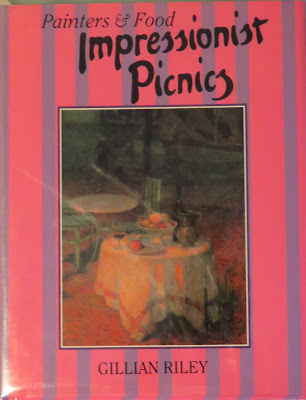
A book by Gillian Riley that I really enjoyed: Impressionist Picnics.
(Review Here)


The New Yorker still publishes a few food-themed cartoons.

Books I Love

A curiosity: the following list illustrates some of the books that I mentioned on my blog in 2008. These food books were on my shelves then, and they still are there.

  • Jennifer 8 Lee, The Fortune Cookie Chronicles
  • Tom Standage, A History of the World in Six Glasses
  • Gary Paul Nabhan, Why Some Like it Hot
  • Michael Pollan, In Defense of Food
  • Pollan, The Botany of Desire
  • Pollan, The Omnivore’s Dilemma
  • Jordan & Brady, eds, The World is a Kitchen
  • Julian Barnes, The Pedant in the Kitchen
  • Mary Taylor Simeti & Grammatico, Bitter Almonds
  • Elizabeth L. Ortiz, The Book of Latin American Cooking
  • Claudia Roden, A Book of Middle Eastern Food
  • Michelle Stacey, Consumed: Why Americans Love, Hate, and Fear Food
  • Henry Hobhouse, Seeds of Change
  • Julia Sahni, Moghul Microwave
  • Madhur Jaffrey, World Vegetarian
  • Harold McGee, On Food and Cooking
  • Ayla Algar, Classical Turkish Cooking
  • Gillian Riley, Painters & Food: Renaissance Recipes

Monday, July 17, 2023

Ten

Today at Elizabeth's blog we have been asked to celebrate the number ten, because it's the tenth anniversary of her weekly blog party called "T Stands for Tuesday." Each week participants link any blog post they would like to share, as long as it features a picture of a drink or a drinking vessel like a tea cup or a beer stein. Here is my contribution of several miscellaneous images from various google searches and from my trip to the supermarket — each one includes the number ten, starting of course with a beverage.

Food and Drink


An old classic cookbook from 1930: for my review, see this post:
Distracted by a Lark
Since this is a French cookbook, I'm also sharing with Paris in July.

THE BIG 10


I live in Ann Arbor, so this is required. Go Blue!


Michigan player Tom Brady in 1999. (Source)

Number 10 Miscellany


One of the world's most famous addresses: Number 10 Downing Street.

"The Tenth Man" — film from 1936.

A totally different book by Graham Greene, 1985.

"10" the movie, 1979.


Skylab US 10¢ stamp.


This crazy blog post © 2023 mae sander.
Images from all over!


Wednesday, January 26, 2022

Library Shelfie Day

A bookcase in my living room.

 A very new celebratory day: Library Shelfie Day. Today for the seventh year, on the fourth Wednesday in January, is a day to celebrate your library shelves with a photo. You can celebrate your Kindle too. When I read about this obscure celebration, I couldn’t resist!

My Kindle bookshelf showing most recently read books.

A corner of my bookcase featuring a recently-purchased reprint of a book by Edouard de Pomiane
which I hope to read soon, and other books by or about this author, some in their early-20th-century editions.

Blog post and photos © 2022 mae sander.


Friday, May 25, 2018

French Food Books


Cookbooks, history books, and memoirs about French cuisine are popular and fascinating, and I've read and cooked from quite a few of them. The majority of these works, however, were not written in French or written by French people. I've challenged myself to find books on the history and culture of food written in French by and for French readers -- and thus to learn what French people read when they want to read about food. I hope to find some books that will be appropriate for future reading in my culinary history reading group, to whom I've suggested that we try to read some actual French sources rather than just Americans.

Using google.com, google.fr, amazon.com, amazon.fr, and the bibliographies of books I've read, I have identified some such books, though I've mainly located academic sources rather than books written for a general reading public. Quite a few of these are very general histories of food in human history or of French food throughout all of French history, while I would like to find more specific histories comparable to those popular in the US. Also, I haven't yet found many very recent ones, although I've searched the best-sellers in amazon.fr -- a few sound interesting but do not seem to have appeared in English translation.

The photo above shows some of the French food books, other than cookbooks, that I own. I have read several of them, and have already written about a few on this blog. This is a preliminary list of French food books translated into English.
  • Jean Anthelme Brillat-Savarin, The Physiology of Taste: or Meditations on Transcendental Gastronomy.
  • Alexander Dumas, Le Grand Dictionnaire de Cuisine, translated into English under various names, usually abridged.
  • Madeleine Ferrières, Sacred Cow, Mad Cow: A History of Food Fears.
  • Jean-Louis Flandrin, Arranging the Meal: A History of Table Service in France.
  • Jean-Louis Flandrin and Massimo Montanari, Food: A Culinary History, collection of essays.
  • Prosper Montagne, Larousse Gastronomique: The Encyclopedia of Food, Wine & Cookery. (Obviously not a book to be read for a single discussion!)
  • Anka Muhlstein, Balzac's Omelette.
  • Jean-Robert Pitte, French Gastronomy.
  • Edouard de Pomiane, Cooking with Pomiane. (I did a big project on Pomiane a few years ago.)
  • Jean-François Revel, Culture And Cuisine: A Journey Through The History Of Food.
  • Herve This, Molecular Gastronomy: Exploring the Science of Flavor and other books on molecular gastronomy.
  • Maguelonne Toussaint-Samat, A History of Food.
There will be more ... I hope!

All photos and text copyright 2018 by Mae E. Sander. Published at maefood dot blogspot dot com. If you read this elsewhere, it has been stolen.

Thursday, September 15, 2016

A Classic Cookbook: Olney's "Simple French Food"

1992 Edition of Simple French Food,
which I recently purchased.
Richard Olney's Simple French Food dates from 1974, with a second edition in 1992 and a more recent commemorative edition. It's a famous classic, known to be a favorite of Alice Waters and the source of quite a few of her ideas at her famous restaurant Chez Panisse in Berkeley, California.

I bought my first copy of this (or any other) Olney book this week. I can't really explain what took me so long, but let's face it, the number of classic cookbooks out there is very large, especially French cookbooks by American authors. Other than my own favorite, Julia Child, I usually tend to stick with cookbooks by actual French authors.

Some of the recipes in Simple French Food actually do appear simple, though in some cases, I think Olney complicates dishes that in actual French homes and restaurants really are simple. Consider cruditès, the simple plate of raw or blanched vegetables that makes quite a lovely hors-d'oeuvre. Olney suggests quite a few embellishments for these that I've never seen in France. But he did live there for almost 50 years, and I have only lived or stayed there from  a week to 12 months on various occasions.

Aside from simple things made more complicated, there's plenty of real complication in Olney's book. The chapter titled "Cold Terrines, Pâtes, Mousses," for example, has recipes that are just as elaborate as any I've seen elsewhere for these scrumptious but labor-intensive delicacies. Take the first recipe, "Rabbit Terrine," which makes 20 portions. It starts with the ingredient "1 rabbit, approximately 3 1/2 pounds, skinned and cleaned;" however, the entire previous page explains the other possible choices, such as domestic ducks, or any "small game, furred or feathered." The preparation requires a marinade (5 ingredients), stock (5 ingredients and 5 herbs/spices), and forcemeat (around 12 ingredients plus a number of spices and seasonings). Not what I would call simple!

Bravely, I tried one of the simplest chicken dishes, Braised Chicken Legs with Lemon, which is said to be borrowed from French Catalan cooking. This requires around an hour of intense prep and cooking, including carefully peeling 25 garlic cloves, and more time for simmering sauce and oven-baking the dish, as well as preparing a rice pilaf to accompany the dish.


Ingredients:
20 to 25 large, firm, crisp garlic cloves, peeled without crushing, par-boiled for 5 minutes, and drained
2 1/2 cups veal or chicken stock
4 chicken legs (I used 6)
Salt, pepper
3 tablespoons butter
1 lemon, peeled (all white inner peel removed), thinly sliced, seeds removed
2 tablespoons flour
1/2 cup dry white wine

After par-boiling the garlic cloves, you simmer them in the stock for 40 minutes in a small saucepan.


Meanwhile, you slowly brown the chicken legs in the butter, and arrange them in a baking dish with the poached garlic cloves (being very careful to keep them whole and perfect) and lemon slices. Then you remove the excess fat from the pan, blend the flour and fat, add the wine and then the stock, and return the entire sauce to the small saucepan to boil down for another 15 minutes or so. After adding the sauce to the baking dish, you bake it in a 400º oven for 40 to 45 minutes. 

Out of the oven. You can see the garlic cloves and lemon slices in the sauce.
The recipe concludes: "The lemon will have almost completely disappeared into the sauce; the garlic cloves should be absolutely intact with a consistency of melting purée; the sauce must be tasted to be believed."

Yes, it was an exceptional dish. I made the recommended rice pilaf to go with it,
and added some undocumented tomatoes for color.
This dish should not be confused with the better-known chicken with 40 cloves of garlic, which is the recipe that follows in Simple French Food. Olney is sometimes credited with inventing this dish, which is mentioned in his New York Times obituary (1999). In fact, the 40-cloves recipe had appeared a couple of years earlier in a James Beard book, and I've also seen a much earlier version in cookbooks by the French author Edouard de Pomiane. Subsequently it's been published numerous times -- a web search turns up a version of chicken with 40 cloves of garlic by almost every chef and TV food personality you can think of -- from Nigella to Betty Crocker!

To conclude, here's a quote from Olney's obituary by Julia Child:
''I think he enjoyed being difficult,'' she said. ''But on the other hand, he could be absolutely charming if you treated him like the genius he considered himself to be.''

Monday, August 04, 2014

Curnonsky and Rouff

Curnonsky (pseudonym of Maurice Edmond Sailland,1872-1956) and Marcel Rouff (1877-1936) were gourmands who traveled around France in the early 1920s and wrote a series of guidebooks. The following illustrations are screen shots of a few that have been for sale on the internet ... most of them no longer available. I'd love to see some of these guides and read about the "culinary marvels and good inns of France."

I would especially like to see this one,
and find out where they liked to eat in Paris.


During my recent research on Edouard de Pomiane's cookbooks and culinary influence, I came across Curnonsky in various lists of cookbooks and especially because of Curnonsky's election as "Prince of Gourmands" and because of his many accomplishments after his travels and publications with Rouff. I might follow up by studying more of gastronomic history between the two world wars.

Monday, July 28, 2014

Colette's Life

I have just read Secrets of the Flesh: A Life of Colette by Judith Thurman. Besides many details of Colette's life that I had never learned before, the book was full of wonderful historic, cultural, and social background about Paris, the two World Wars, and the artistic environment in which Colette lived.

Especially interesting was that each of her three husbands came from a different social and political stratum of French life, and each influenced her writing and her choices in a different way. Her liaisons with many prominent lesbians of the era were also an influence, and her early dependence (on husbands, lovers, and her mother) and her eventual attainment of independence were portrayed in a fascinating way. Thurman wrote quite early in the book that Colette was an entrepreneur "whose notion of a bottom line would never be Virginia Woolf's five hundred a year and a room of one's own, but fifty thousand a year and a villa of one's own, with a great chef, a big garden, and a pretty boy."

I had known that Willy, her first husband, married her when she was a girl and then managed to get her to write the Claudine books, which he published as his own. Willy was connected to a number of prominent literary people in Paris in the 1890s and pre-war era, and enjoyed a strong but entirely undeserved reputation, as almost everything published in his name was ghost-written by some other author. He at most edited these works; in the case of the Claudine books, he influenced Colette a lot at first, but she found her own voice. By the end of her marriage, she wanted independence and recognition, and no longer needed his help.

Her second husband, Henri de Jouvenel, had a much higher social position than she did or than her first husband did. He was a prominent editor and became a politician who held various national offices in French legislative and diplomatic circles. She did little to assist him in his political activities: though she sometimes appeared at official social functions, she resented the time away from her writing.

Her third husband, Maurice Goudeket, was much younger than Colette, and was a caregiver and gatekeeper, protecting her from journalists, fans, and curiosity seekers in her old age. During the Nazi occupation, because he was Jewish, he was sent to a concentration camp. He was released from custody, then exiled to unoccupied France, and eventually lived in hiding in Paris in order to be near her. All during this time Colette was writing for pro-Nazi journals and was ignoring what was going on. A very sad story, but she chose to be blind to many unpleasant and repugnant things going on around her. Thurman's treatment of her life and attitudes is extremely penetrating and was totally revealing to me, as I had little idea of the details of the betrayal of many intellectuals in Paris in those years, only a general idea.

About Colette's reaction during the occupation, Thurman writes: "Colette's reluctance to take any sort of stand, even privately, or to voice any sentiment of outrage at the persecutions, even in her letters, is a symptom of that moral lethargy she admits so candidly.... 'I was born under the sign of passivity,' she writes then." (p. 456)

I chose this book because of my my current research project about food writer and molecular biologist Edouard de Pomiane. I've read several books of social and culinary history and several memoirs about life in Paris during his lifetime: the lifetime of both Colette and Pomiane (born in 1873 and 1875).

The number of different intellectual and political currents of the time, the interactions and cross-pollinations of the era are amazing. Here are two of the huge number of examples of connections between Colette and contemporary figures that I learned from Thurman's book:
  • Food writer Curnonsky (pseudonym of Frenchman Maurice Edmond Sailland), became famous in the 1920s, first for guidebooks to regional French food and later as elected "Prince of Gourmands." Earlier in his life, he was one of the many young writers who ghost-wrote books for Willy, Colette's first husband. Later Willy, Colette, and Curnonsky were all members of a group called "The Farm," which included Alfred Jarry, Sarah Bernhardt, and a number of other creative Paris people.
  • Cookbook author and chef Raymond Oliver was chef of Le Grand Véfour restaurant in the Palais Royal in the 1940s. Colette, at the end of her life, lived in an apartment upstairs; she was ill and unable to go out often. Thurman writes that Oliver: "made Colette's favorite dishes -- cassoulet, blanquette a l'ancienne, colibiac of salmon -- and he would often have a portion of something special, such as a lark pie or a pot of apricot jam, sent up to her. On dark winter afternoons, in the lull between lunch and dinner, Oliver himself would come to visit, uncorking a bottle of old champagne and a store of equally fresh gossip." (p. 490)

Thursday, July 17, 2014

Pomiane in Montmartre

Old postcard of Montmartre in 1890
Edouard de Pomiane was born in Montmartre in 1875 at 28 rue des Abbesses. From time to time, in his radio broadcasts and his cookbooks, he provided brief memoirs of  his childhood in what was then a semi-rural area of Paris. He wrote:
Moulin de la Galette, Montmartre, 1885
Public domain image from Wikipedia
"Looking back on my childhood, I remember the delicious golden galette I ate from time to time at the Moulin  de la Galette on the summit of my dear Butte Montmartre. There was a garden round the windmill with arbours and a showcase with cardboard pastrycooks rolling out sheets of dough ... I knew the Moulin de la Galette when Montmartre still had its vineyards, its streams and its fields of oats. 
"Do you know that in 1830 there were still twenty windmills on top of the Butte Montmartre? And do you know that on 30 March 1814 Pierre-Charles Debray, the miller who owned all these mills, fired the last cannon shot which, alas, did not halt the charge of the Russian troops. ... Perhaps my digression  has wearied you, and I ask your forgiveness. When I think of my dear Butte Montmartre of long ago I could go on and on..." (Cooking with Pomiane, p 243-244)
The Sundays of Pomiane's boyhood were special with exceptional treats to eat. He particularly remembered friands, which were small stuffed pastry rolls made in charcutrie shops, and delivered to homes in "shining metal containers" along with piping hot cutlets, sausages, and black puddings. After lunch, "the children went to play on the Butte at the edge of the fields of oats which grew where the busy rue Caulaincourt now runs. As they were wearing their Sunday clothes, they were not allowed to paddle in the streams which flowed all about the Butte Montmartre of my childhood." (Cooking with Pomiane, p. 58)

Life had not been perfectly idyllic for Pomiane's parents, who were of Polish origin, and whose name was Pozerski. (He later used his alternate Polish surname, Pomiane, as a pen name for his cooking publications, and I use it exclusively, for consistency.) Both parents had participated in the Polish revolution against Russia in 1863, and both were arrested. His father served time in Siberia -- where he was Dostoevski's only Polish friend. His mother, who was the daughter of a Russian general and a Polish woman, was condemned to death. She escaped to Paris; his father eventually escaped also, and joined her there.

The Pozerskis' first son starved to death during the Paris Commune in 1871. Pomiane's sister was born in 1873, and he in 1875. Pomiane attended a Polish primary school, and then continued his education at the Lycée Condorcet, a French secondary school and continued with scientific and medical studies at the University of Paris and various laboratories. These facts of his life appear in both Ginette Mathieu's book A Table avec Edouard de Pomiane, p. 9, and in his official biography at the Institut Pasteur where he was employed as a scientist. The preface to the English edition of Pomiane's The Jews of Poland: Recollections and Recipes claims that he was born before his parents left Poland, but this is contradictory to many other facts of his life.

As Pomiane became a scientist, a food writer, a radio personality, and a recognized expert on both biology and cuisine, he appears to have been grounded in his early experiences as a French boy with a dual French and Polish identity. He often offered recipes from Polish and other cuisines as a supplement to the fairly classic French family cooking that he documented. During World War I, he was in an ambulance company and often tried to help find and prepare food for the troops as well as treating the wounded. During World War II, he wrote several books about how to deal with the extreme deprivation caused by the occupation of Paris, and how to make the best of very sparse available rationed food. While I have not seen any direct reference in Pomiane's own writings to the misfortunes of his parents prior to his birth, I wonder if he saw in his life a repetition of some of their experiences.

Note: this is one of a series of blog posts I've been writing about Edouard de Pomiane, French food writer and broadcast journalist -- he was the first person to have a cooking show on radio, in 1923. Pomiane spent his entire life in Paris, so I'm linking this post to the ongoing blog event "Paris in July." For more of my Pomiane posts, click on the "Pomiane" label.

Wednesday, July 16, 2014

"Bien Manger pour Bien Vivre"

1922 edition:
Still available from amazon.fr
Edouard de Pomiane's first food book was Bien Manger pour Bien Vivre: Essai de Gastronomie Théorique (eat well to live well: an essay in theoretic gastronomy) published in 1922. It's never been translated into English and was reissued only once in 1948 to my knowledge. Pomiane's other books have been more influential and better liked: his French Cooking in 10 Minutes has been in print in English for over 50 years and is cited frequently in popular articles about cooking.

I found to my surprise, when I received my copy of Bien Manger, that it is not in fact a cookbook, but a book about gastronomy and gastrotechnie (Pomiane's word for food science), about French and international foodways, about nutrition, and about a number of other subjects. Pomiane expanded on many of these topics in his later cookbooks and in his radio broadcasts, which he began in 1923.

Most impressive about Pomiane's works is his ability to see his subject matter from several points of view at once. When he eats, he is a gastronome, a lover of food, a French gourmet. When he cooks he is an excellent amateur in the tradition of French home cooking and hosting dinners for friends. He never forgets that he is also a physician and a scientific researcher -- as the then-famous food writer Ali-Bab (Henri Babinski) says in the preface to Bien Manger: Pomiane is before all else "un savant biologiste" -- an expert biological scientist. But he is also a doctor, and in a general way, says Ali-Bab doctors fear no one in the area of gourmandise. He praises Pomiane for not proposing the traditional scientific solution to the general question of food: for Pomiane, there's no joy in thinking of a pill to replace all nutrients efficiently. For Pomiane, in my view, there's joy in food, cooking, eating, and understanding the processes.

Most of Pomiane's topics are still of interest to readers, though we now, of course, want to read about the state of the art today, not 90 years ago. The science Pomiane called gastrotechnie has in the last 25 years or so become identified with the modern area called molecular gastronomy, which combines science and cuisine, and whose practitioners include both laboratory scientists and famous chefs. In many of their works, Pomiane is acknowledged as a precursor of their activity. When reading Bien Manger, it's interesting to contemplate how he compares to this recent intellectual trend.

The first third of the book treats the science of cooking and choosing food. Pomiane describes his area of research, that is, the processes of digestion. He treats the chemistry of cooking, the composition of nutritional elements in food (remember, vitamins were a pretty recent discovery at that time), the idea of a balanced diet, and the choices of foods in the order that they appear in a traditional French meal. He gives a charming treatment of what people in various places drink with food (red wine? white wine? beer? water?...).

To contrast with his French-centered discussion, he then offers a chapter about food traditions outside France: a little anthropology to balance all the hard science, I guess. He greatly admired the food of  his own ancestors in Poland and Russia, as well as the foods of Italy and a few other countries. In later works he covers North and South American foodways in addition to those of Europe -- but not here.

The remainder of the book is about cooking. First, "Les Grands Principes Culinaires" (major culinary principles) -- twelve cooking methods, or principles, including boiling, grilling, roasting, braising, frying, and more, ending with pastry-making. A few years later, in La Cuisine en six leçons (cooking in six lessons) Pomiane used some of these principles as the basis for an elementary cookbook. Here, he explains them in detail.

I found the discussion of the chemistry of mayonnaise, an example of the principle of using emulsions in cooking, especially interesting. Pomiane tried to present some very new physical chemistry discoveries about emulsions at the molecular level. He tried to explain exactly, scientifically, what happens when you beat egg yolk and oil together -- a daunting undertaking. I find it ironic that some molecular cuisine writers of the current era are critical of Pomiane because he didn't get this science right by today's standards -- I'm pretty unwilling to accept criticism of someone who didn't know about things that hadn't yet been discovered. (Herve This, I'm looking at  you). In a footnote Pomiane acknowledged a collaborator on this chapter, Marcel Houdard, a young and promising chemist who had died as a result of experiments with radium!

The last three chapters of Bien Manger cover basic foodstuffs (like milk, butter, eggs, meats...), fermented foods (including a discussion of microbial actions), and conserving food by various methods including sterilization, freezing, preserving in alcohol or acid, smoking, and more.

At the beginning of the book, Pomiane asks: Is gastronomy an art or a science? As an art, Pomiane says, gastronomy allows us to find joy in eating. As a science, he implies, we find joy in understanding the processes of cooking and even digesting. I think these appealing ideas permeate the book.

Pomiane's contemporary Curnonsky identified four types of French cookery: "La Haute Cuisine, la cuisine Bourgeoise, la cuisine Régionale, et la cuisine Improvisée" -- quoted in Elizabeth David, French Provincial Cooking, p.15. I doubt if you need a translation as these terms have been adopted into English. Pomiane's numerous books, beginning with Bien Manger, covered all of these and more.

Monday, July 14, 2014

Why Welsh Rarebit?

Yes, it's an American dish...
so American that we can buy it in a box
and not bother melting cheese ourselves.
A little mystery: why did French food writer Edouard de Pomiane classify welsh rarebit as a typical American dish? Specifically in his Radio Cuisine, a book of transcripts of his popular 1920s radio show, welsh rarebit appears in the broadcast titled "A little American Cuisine." Also included: clam chowder and beef cube steak. His welsh rarebit recipe includes beer, cheddar cheese, mustard, and fresh-ground pepper, which are melted, poured over toast, and grilled briefly to brown the top.

Welsh rarebit was the only American recipe given in the book A Table avec Edouard de Pomiane, compiled by Ginette Mathiot from these same radio broadcasts. Many other cuisines were represented in Mathiot's extensive section titled "Recettes Étrangères" (foreign recipes). The Russian recipes, for example, were Koulibiak, borscht, and four others, all of which Pomiane quite liked and mentioned often. Of six British recipes, two are for curry, one for Christmas pudding. There are Turkish dolmas, pilaf, and two eggplant recipes; several South American countries are also represented by one recipe each.

Pomiane's view of what was typical, as shown in the various transcripts and re-writings of his radio programs, is quite interesting. Earlier, in Pomiane's first book titled Bien Manger pour Bien Vivre (eat well to live well) he has an interesting section on international foodways, but no mention of America or welsh rarebit at all, nor does the much later English-language adaptation Cooking with Pomiane mention this example of American food. Pomiane traveled widely in Europe and in the various provinces of France, always collecting recipes; however, in his broadcast about American food, he said he had never been to America, perhaps a reason why he provided such a small number of recipes.

Welsh rarebit seemed an obscure choice, so I've checked a few sources to see if I can understand why Pomiane considered it typical. I found some clues as to its popularity and iconic status in America of the decades before World War II and also some clues about its recognition in France at that time.

Laura Shapiro's biography of Julia Child supports the idea that welsh rarebit was a typical American supper dish. During Child's girlhood in California in the 20s, according to Shapiro, Child remembered eating "good, plain New England food." Shapiro says: "The family always employed a cook, and only on her night out would Julia's mother step into the kitchen to make baking powder biscuits and Welsh rarebit. ... The truth was, food hadn't been important to her when she was growing up." (Shapiro, Julia Child, p. 1)

Recipes for welsh rarebit appeared in the 1918 Fanny Farmer, in early editions of the Joy of Cooking, and the 1921 Settlement Cookbook. They still appear in many cooking columns, food TV shows, and so on, though I'm not convinced that they are any longer as iconically American as they once were.

Welsh rarebit as an example of American cuisine had appeared in Paris by the end of the 18th century. Specifically, Brillat-Savarin brought the recipe back to France from America after a period of exile during the French Revolution, according to a New York Times article: "His poverty and anguish during his two years in New York and its vicinity did not prevent him from visiting Fraunces and other good taverns and bringing back to France a recipe for welsh rarebit. ("Americans Hear Tribute to Savarin" by May Birkhead, NYT, Sept. 18, 1927).

Another article, "Step by Step Paris Becomes American," published July 8, 1928, in the New York Times also mentioned the dish: "... the Champs Elysees retains one special feature. It is one of the few streets in Paris in which one cannot eat outdoors... One may still drink... One may not eat a meal, but he may eat a sandwich or a Welsh rarebit." The article stresses many emerging similarities between Paris and New York in the late 1920s. Its subtitle was "Strollers Wonder Whether They are in Boulevard or Broadway Surroundings."

I think I have answered my own questions of why welsh rarebit might have seemed typically American to Pomiane, and of whether it was a popular dish in America at the time he wrote. And I've only spent a little time looking for examples -- I imagine there are many more.

As you know if you follow this blog, I'm working on a project about Edouard de Pomiane, and that is why this somewhat peculiar subject occurred to me.

Saturday, June 14, 2014

Molecular Gastronomy

French scientist and author Hervé This claims to be the inventor of molecular gastronomy. He and physicist Nicholas Kurti invented the name molecular gastronomy in 1992. Their goals were to explore recipes; collect and test cooking lore; invent new dishes; introduce new tools, utensils, ingredients; and use cooking to popularize science in general. While these goals have changed over time, molecular cuisine is still expanding and producing new research results and new influences. (The Science of the Oven, Kindle location 161)

Hervé This is also active in molecular cuisine: that is, cooking that applies the knowledge from molecular gastronomy. Under the influence of himself and his fellow molecular scientists, he says, "today's cooks use liquid nitrogen to make their ice cream and sorbet, and ... they distill, infuse, and jell with the aid of jelling agents long used by the food industry." (The Science of the Oven, Kindle location 173)

Hervé This from Nature article
The laboratory of Hervé This has been a major source of techniques for the inventions of molecular cuisine, including the world-famous innovative ideas of Spanish chef Fernand Adrià. An article in the Guardian described their relationship: "Adrià's scientific approach [was] inspired by the work of, among others, French physical chemist Hervé This, who led Adrià to deconstruct ingredients and dishes." (source/link)

An interview in the journal Nature provides some insight into his methods. He states:
"Meat, fish, fruits and vegetables are organized mixtures of compounds. Cooking traditionally means mixing mixtures, and is not precise. This is why I proposed the concept of note-by-note cooking — using specific compounds to build consistency, taste and odour. It is difficult, but a huge unexplored continent is ahead of us." (Nature, vol 464, March 18, 2010, p. 355)
In the book The Science of the Oven Hervé This reviews a wide variety of research on specific reactions that take place during cooking or food preparation. He talks about "note by note" cooking, an advance beyond the original molecular cuisine. Purified flavors (specific molecular extracts) are added to a dish one by one, in contrast to the normal way using basic foods. Recognizable food products such as vegetables or chicken have many flavors -- in  his view, too many unpredictable flavors. He asks: "In the twenty-first century, why could we not produce a sauce beginning with water, glucose, tartaric acid ... and polyphenols, such as certain producers extract from grape seeds, for example?" (Kindle location 2654)

In one example, Hervé This explores the question of whether one can make a jelly from tea. The chemicals in a cup of brewed tea aren't compatible with gelation -- so he suggests making the tea, removing the chemicals that prevent jelling, and adding back distillations of the flavor molecules. (Kindle location 1512)

To me this sounds like what industrial food processors do. In fact, many of the techniques used by Hervé This and the chefs under his influence sound like an artisanal version of industrial food to me, and he seems to admire some of the work of food chemists who work in their laboratories. In the Nature interview, he says: "The food industry already recaptures and reincorporates ‘essential oils’ that are lost during cooking processes. As a result, jams and orange juice, for example, are now much better." I wonder if he's read some of the American books about the food industry and how they manipulate consumers' tastes! Or similar French ones, if there are any.

Unfortunately, in his books  Hervé This often repeats various linguistic quibbles, such as his dislike of the word "flavor," or his attacks on the term "applied science," where he spends a lot of time on peevishly attacking the names of a lot of existing university applied science departments, research programs, and publications. Aside from this annoyance, Hervé This is a very interesting author of many books, at least five available in English, and teacher of influential courses.

Hervé This acknowledges a variety of predecessors in exploring science as it relates to cooking. One of these is Edouard de Pomiane, the medical scientist and cookbook author that I've been researching. The book Cours de gastronomie moléculaire n° 2: Les précisions culinaires (not translated into English) offers a several page biography of Pomiane and summarizes many of the books he published between 1920 and his death in 1964. While acknowledging Pomiane's accomplishments, Hervé This is critical because Pomiane didn't do the type of laboratory research that has been done recently. He points out that Pomiane made some mistakes, or uncritically accepted commonly held ideas about (for example) the process of making mayonnaise and other chemical or physical reactions. He doesn't accept that Pomiane was a scientist -- though he's a little harsh considering that some of the science was still in the future.

Monday, June 09, 2014

At the World's Fair, 1939

"It is possible for the collector of wine and food books to do a bit of international browsing at our World's Fair." So began a New York Times article published July 30, 1939, titled "New Editions, Fine & Otherwise: International Gastronomy or Notes for the Xenomanic Pantophagist" by Edward Larocque Tinker.

The article provides readers first with a description of cocktails and rum drinks that appeared in an "educational leaflet" at the Cuban Pavilion, continues with a few notes on the Brazilian, Swedish, and Swiss reading materials, and finally reaches the French Pavilion, naming five books on sale, including their prices -- which can be compared to the 75-cent admission fee to the fair (eventually reduced to 50 cents), and similar additional fees for specific attractions.

The list begins with Auguste Escoffier's Le Guide Culinaire at $2.50. "Its author, who was born in 1847 and died only four years ago, was the most famous chef of the last two centuries, greater, some think even than Carême," Tinker says. Escoffier's Guide, with 5000 very sketchy recipes meant for professionally trained chefs, had been in print for a couple of decades by this time. A current edition of this classic is depicted at left; it's available in English translation as well.

Next: "La Bonne Cuisine de Madame E. Saint-Ange" ($1.50), described as "a useful book for the house-keeper exhausted with the arranging of daily menus," including "800 recipes and 500 planned meals."Madame E. Saint-Ange had written for a cooking magazine called "Le Pot au Feu" for years, and "La Bonne Cuisine" was a compendium of her writings that had been published in 1927. An English translation became available only relatively recently.

For "families who live on a more modest scale," the bookshop offered "La Véritable Cuisine de Famille" by Tante Marie. It was "designed to achieve an intelligent economy" and included 1000 recipes, 500 seasonal menus, and a glossary.  I've checked and Tante Marie's popular book had been in print in various editions since at least 1903. Tante Marie was probably fictitious, sort of like Betty Crocker, but very little information about her appears to have survived. The front cover of one of the many early editions is shown at right. The book is still popular enough to merit an English-language Kindle edition!

The next book on the list is by Pomiane, the author I've been researching. (In fact, I found this article when searching for information about him.) Tinker writes:

  "A very different kind of book is Edouard de Pomiane's '365 Menus, 365 Recettes' (90 cents). The author is a physiologist who, in accordance with the latest scientific discoveries, balances each menu with the proper relative quantities of fats, carbons, proteins, vitamins, etc. A preface contains a general discussion of the chemical role food plays in keeping us in  health and a treatise on diets for different ages and for those suffering from various diseases. Under each meal's menu is printed the recipe for the main dish."

The final two books from the French Pavilion were "L'Art Culinaire Moderne" by Henry-Papul Pellaprat, and "L'art du Bien Manger" compiled by Edmond Richardin. There may of course have been other books available, not mentioned in the article.

The French Pavilion at the New York 1939 World's Fair is a famous source of American gastronomy. At the French Pavilion (shown in a postcard, right) the French government decided to install a completely French restaurant, with restaurant professionals and all food products sourced from France. This was a major undertaking, but its importance long outlasted the fair itself because several of the French staff remained in the US after the end of the fair to work in restaurants in New York. The most famous offshoot was the restaurant Le Pavillon, run by Henri Soulé who had been the maitre-d'hotel at the fair.

Soulé and Le Pavillon have been written up numerous times. For example, in an article a few years ago, Le Pavillon was classified as one of the ten best restaurants ever in New York City:
"Under restaurateur Henri Soule, Le Pavillon began life as Le Restaurant du Pavillon de France, the eating establishment of the French pavilion at the 1939 World's Fair. The food it presented was a revelation to New York diners, who were still eating French food directly descended from Delmonico's, with heavy cream-based sauces and massive portions. Le Pavillon presented the cuisine for the first time in its evolved form." -- From "Our 10 Best NYC Restaurants," by Robert Sietsema, Jan. 14, 2011, Village Voice blogs. 
The enduring fame and influence of Soulé has been covered in the press ad infinitum and maybe ad nauseum if like me you don't appreciate New York restaurant snobbery. I find this list of historic cookbooks, which seem more or less forgotten, to be of at least equal interest.

Saturday, June 07, 2014

Becoming a Cookbook Author

"Looking back to the earliest days of my youth, I remember the chestnut sellers at the corners of the Paris streets, close to the wine shops at the onset of winter. 
"'Hot chestnuts! Hot chestnuts!' cried the Auvergnat with the fur cap as we passed in groups on the way to school, and later to the lycée. The richest among us bought a sou's worth -- in those days, seven chestnuts -- and, when it was very cold he lent a couple to one or two of his comrades, who put a chestnut in each pocket to warm their hands. On arriving at school we gave them back to the 'rich' boy. We had benefited a little from his opulence, and we didn't resent it. In those days humanity was perhaps, in some ways, better than now." -- a memory from Cooking with Pomiane, page 177

At the start of World War I, a medical researcher at the Institut Pasteur in Paris named Edouard Pozerski took leave from his research to be a military doctor, working in an ambulance company that treated front-line troops. In the course of his duties, he saw many young men who were poorly nourished. When he returned to his research in 1918, he also began to expand his professional interest in the chemistry of digestion with an interest in cooking. His scientific career is summarized in a biographic sketch published by the Institut Pasteur.

Under his alternate family name, Edouard de Pomiane, in 1922, he published a cookbook based on his expanded interest. In writing, he developed and shared his perception of the information home cooks needed to make themselves and their families better nourished. The preface to this book, Bien Manger pour Bien Vivre (Eat well to Live Well), was by Ali Bab, pen name of Henri Babinski, also a Polish-Frenchman and author of an earlier successful cookbook.

In 1923, Pomiane began to broadcast a weekly radio show about food and nutrition. Radio was very new, and the process of broadcasting regular programming was just becoming established. Pomiane's show became very popular. From this point he became a well-known personality and expert in cooking -- an accomplishment added to his prestige after more than 20 years as a scientist at a major research laboratory.

Each week docteur de Pomiane, as he was known, discussed a single topic from his many interests. The science of cooking which he called gastrotechnie was an important part of his material: he included what he knew about the process of cooking and tried to show how to apply this science for better results in the kitchen. He suggested menus for good health and digestion. He talked about economies in the kitchen -- how his listeners could save money without giving up nutritional value; for example he pointed out how much less expensive fish was compared to meat. That's not at all true any more, is it?

Sometimes he described his life as a boy in Montmartre, as in the example at the top of this post. And he gave recipes for a wide variety of dishes. Transcripts of his radio presentations were collected in two volumes called Radio Cuisine, published in 1933 and 1936. These transcripts were also used by the compilers of Cooking with Pomiane, a translation that's still in print.

In his broadcasts he described various aspects of his background as a Polish-Frenchman. Edouard Pozerski de Pomiane was born in Paris on April 20, 1875, and he grew up in Montmartre, then a poor neighborhood. His parents belonged to a community of Polish expatriates, many of whom had, like them, fled from Poland because they had been involved in its struggles for independence, especially in the large uprising of 1863. His mother's cooking was an influence on him: she often cooked Sunday dinner for groups of these friends -- dinners that included many Polish dishes.

Both French and Polish traditions contributed to his repertoire, along with recipes collected from his travels. He gave recipes for dishes such as pierogi and borscht; his methods of cooking vegetables come from both French and Eastern European traditions. Sometimes he made comparisons: for example, in one episode transcribed in Radio Cuisine, he describes a very elaborate preparation for fois gras. The recipe used a 900 gram whole fattened goose liver. I'm sure  his listeners were thinking just as I did when I read this: who could afford such a luxurious piece of meat? Fois gras has always been expensive: today in France 900 grams of it would cost upwards of 160 euros/$225. However, after describing the preparation, he proceeds to explain that as an alternative, one could make a delicious but much less costly Polish-style dish from pork liver, as his mother did in the old days when they lived on his beloved Butte Montmartre. (Radio Cuisine, pages 202-204)

In 1921, Pomiane began to teach at l'Institut scientifique d'hygiène alimentaire as well as continuing his medical research at Institut Pasteur. During the 1920s his work, both technical and popular, was prolific. His cookbook publisher was the prestigious Albin Michel.

As well as his first cookbook, Bien manger pour bien vivre, essai de gastronomie théorique, in 1922 he published a technical work titled Hygiène alimentaire, under the name Pozerski. In 1924 he published Le Code de la Bonne Chere, translated in 1932 as Good Fare -- dust jacket of the translation is shown at left. In it he presented his ideas on scientific cooking and how to plan meals for better health, as well as a large collection of recipes.

Pomiane also became a sort of ethnologist: he was interested in the cooking of the Jews he met or saw in Paris. On trips to Poland after World War I he made many observations of the customs and foodways of Jewish communities in Warsaw, Cracow, and other Polish cities in Poland, which had finally become an independent country after 1918. He published a book on Jewish cooking titled Cuisine Juive: Ghettos Modernes in 1929 (translated in 1975 as The Jews of Poland: Recollections and Recipes). I wrote about it here.


By 1927, Pomiane was widely recognized as an authority on cooking, as reflected in a contest where 5000 chefs and gourmets voted to choose the "Prince of Gastronomes." Pomiane was a runner-up in this competition, along with the famous chef Escoffier. The winner was the cookbook and guidebook writer: Curnonsky. (Though he sounds like another Polish immigrant, Curnonsky was pseudonym of Frenchman Maurice Edmond Sailland).

Pomiane published his most lastingly popular book, La Cuisine en Dix Minutes, or Cooking in Ten Minutes, in 1930, and continued publishing throughout his life. Today, I've tried to show how he emerged as a cookbook author. If you follow this blog you know that I'm reading quite a lot about him, including trying out recipes from several of the originals and translations of his cookbooks. I'll be continuing to explore his career and accomplishments in later posts.

Edouard de Pomiane (1875-1964)
Photo from 1961; published in the Guardian article in 2010 naming
Cooking in Ten Minutes one of the 50 best cookbooks of all time.