Showing posts with label Harlem. Show all posts

Friday, July 21, 2023

Colson Whitehead, “Crook Manifesto”


I’ve been looking forward to Crook Manifesto, the sequel to Colson Whitehead’s great novel Harlem Shuffle. The publication date was Wednesday, so in preparation, I reread Harlem Shuffle, and liked it just as much as I did the first time. Unfortunately, I am finding the sequel somewhat disappointing. It’s a pretty good book, full of action, comic detail, and accurate descriptions of life in Harlem during the 1970s, but it doesn’t reach the high standard of the first volume or of the two other brilliant novels by Whitehead that I have read -- The Underground Railroad, The Nickel Boys. (The three first books were blogged here, here, and here

Whitehead's main character, an entrepreneur by day and a fence for various thieves and burglars by night, is named Carney. In Harlem Shuffle he's the center of all three individual stories. In some ways, he is an Everyman: Whitehead seems to view him simultaneously as an individual and a representative of a type of man of his time. For this, Carney reminded me of Langston Hughes' character Simple and his penetrating and seemingly naive views of Harlem in the 1950s. 

Carney is complex and we know what's in his head in Harlem Shuffle, but not so much in Crook Manifesto. He's not the center of the stories any more, which dilutes the effect of knowing his conflicts over honest business and family loyalty versus his criminal side gig. He is loyal to his wife Elizabeth, who comes from a higher social stratum than he does, and to his children, but neither book presents Elizabeth as a fully-realized character. In reading Crook Manifesto, I felt that this omission was even more troubling.

One of the three stories in Crook Manifesto features Pepper, Carney's shady associate and family friend. Pepper is not as complex or thoughtful as Carney, so his story is more of a crime drama with historic asides than the richer drama of knowing how Carney thinks. It's not at all bad, in fact quite exciting, but just not as deep as Harlem Shuffle, in my opinion.

Both books have a strong awareness of Harlem history. Harlem Shuffle does it delicately and discretely, but Crook Manifesto is somewhat obsessed about injustice and government amplification of Black poverty as well as about a number of other issues that emerged in the 1970s. The underlying reasons for unequal results between Black and White people may have been obvious at that time; however, the characters' language at times seems too much like a present-day New York Times editorial about racially-based economic discrimination. In some passages, I found that the choice of words seemed more appropriate for a twenty-first century writer than for the characters in the novel who speak them. Also, the length of their socioeconomic analysis can be longwinded and a bit pompous: in Harlem Shuffle, Whitehead shows you how social conditions affected the characters; in Crook Manifesto, he lectures you about it. Here's a quote from a character in the novel that shows what I have in mind:

"Before the current fiscal crisis and all the cutbacks, Pierce said, there were decades of urban renewal projects that obliterated communities and industrial zones in the name of progress. 'Ramming the highways through, bulldozing so-called slums, but they were places people lived—black, white, Puerto Rican. Knock down the factories and warehouses, and you wipe out people’s livelihoods, too. The white people take advantage of those new highways out to the suburbs and flee the city into homes subsidized by federal mortgage programs. Mortgages that black people won’t get. And the blacks and Puerto Ricans are squeezed into smaller and smaller ghettos that were once thriving neighborhoods. But now those good blue-collar jobs are gone. Can’t buy a house because the lenders have designated the neighborhood as high-risk—the redlining actually creates the conditions it’s warning against. Unemployment, overcrowded tenements, and you get overwhelmed social services. It’s started—the breakdown... it’s years of shitty urban planning biting us in the ass. You see it in Harlem,' Pierce said." (Crook Manifesto pp. 257-258). 

Colson Whitehead is a genius at making people and events come to life -- all of the four books of his that I've read are brilliantly written with a fantastic sense of timing and sense of humor. Crook Manifesto has lots of this writing, but unfortunately in some instances, I found it to be somewhat overdone, and not just for ironic or comic effect. Here's a paragraph about a Harlem restaurant run by a woman from the south known as Lady Betsy. Carney eats there one day, and his thoughts are merged with the history of the place. It's brilliant -- but flashy. 

"In the midst of the daily Jim Crow tribulations and humiliations, Lady Betsy’s family had assembled the instructions for an eternal feast. A refreshing scorpion spike of heat lay hidden in the collards, and the mac and cheese was a symphony of competing textures, but the chicken was divine, fried in the very skillet of heaven. The house dredge was no mere spicy dusting of cornmeal but a crispy concoction of buttermilk, flour, and dream stuff. To penetrate that wall of batter and gain the meat inside was to storm the keep of pleasure. Local politicians and famous songsmiths posed with the owner in photographs, amid framed citations and plaques from the spectrum of Harlem organizations—the big, the small, and the spurious. A tour bus used to make a special trip uptown and white people from all over the country—perhaps kin to the same white people who had persecuted Lady Betsy down South—poured out of the vehicle to partake, until an incident in which a neighborhood rummy exposed himself in an especially aggressive anatomical display. That put an end to the anthropology." (Crook Manifesto pp. 170-171). 

Harlem has been central in American Black history for at least a century, and I like to think of Whitehead as a superb present-day writer in a wonderful line of predecessors. For example, in 1925, literary scholar Alain Locke edited a book of essays, poetry, and other writing by Harlem authors titled The New Negro. It featured work by Langston Hughes, Zora Neale Hurston, and many others in the Harlem Renaissance. Since that time, many authors have written fiction and essays set in Harlem. Just a few examples: Chester Himes' detective novels including Cotton Comes to Harlem, Claude Brown's Manchild in the Promised Land, and James Baldwin's autobiographical writing such as Another Country

Although I wasn't thrilled by the newest Whitehead book, I consider him to be definitely one of the best current American authors and extremely worth reading.

Review © 2023 mae sander

Shared with the Sunday Salon at Readerbuzz

Tuesday, April 05, 2022

Romare Bearden Exhibit


"Bearden once said that 'an artist is an art lover who finds that in all the art that he sees, he sees something missing.' For him, what was missing was the experiences, dreams and projections of his people. Today’s prominent black artists, including Kerry James Marshall, Mickalene Thomas (whose collage aesthetic was heavily influenced by Bearden), Amy Sherald and Kehinde Wiley, are similarly motivated. Correcting this became Bearden’s life’s work. He wanted, he said in 1964, to 'establish a world through art in which the validity of my Negro experience could live and make its own logic.'” (Washington Post, 2019)

We recently visited an exhibit of Romare Bearden’s works at the University of Michigan Museum of Art.

“The Blues Has Got Me,” 1944.

Romare Bearden was born in Charlotte, NC in 1911. His parents moved to New York when he was a small child, so he grew up there with frequent visits to his grandparents in Pittsburgh. The UMMA exhibit provided documentation about his life and work, including his development of several art styles, which were influential — particularly collage. While the exhibit concentrated on Bearden’s abstract works, it referred to his many other creative works, of which a few were included.


“Fish Fry,” 1967.

“Young Students,” 1964. (From the Romare Bearden Foundation)

“Eastern Gate,” 1961. (From the UMMA Website)

"Evening 9:10, 461 Lennox Avenue," 1964.
One of Bearden's photo-based works that he called "projections." (source)

Many of the biographical facts of Bearden's life fascinated me: he wrote song lyrics and he made a living as a social worker, as well as producing paintings, collages, and other innovative art works. In New York, where Bearden lived for most of his life, he participated in the active intellectual and artistic life of the city, and was friends with many of the important figures in the Harlem Renaissance and other key art movements, for example James Baldwin, Stuart Davis, Duke Ellington, Langston Hughes, Ralph Ellison, Alvin Ailey, and Jacob Lawrence. In mid-career, in 1950, he used funds from the GI Bill to study in Paris, where he also met some of the famous artists of the time. He was also prominent in promoting the arts, and participated in the Harlem Cultural Council, an African-American advocacy group, as well as supporting art venues such as the Studio Museum in Harlem and the Cinque Gallery. Recognition of his achievements grew as his career continued. He died in 1988.

Outside the Museum

We stopped for coffee -- which we haven't done for ages!

Flower from the Matthaei Botanical Gardens.

Blog post © 2022 mae sander.
Potos as credited.

Tuesday, September 21, 2021

"Harlem Shuffle"

Colson Whitehead's newest book (published in August) is Harlem Shuffle, the adventures of Ray Carney, a resident of Harlem. The three sections of the book take place in 1959, 1961, and 1964. As far as I can tell, Whitehead gets all the details of that era in Harlem -- and in the USA -- right. These details of Carney's picaresque life, and that of his even more criminal cousin Freddie make it a fun book to read: Movies. Food. Diners. Traffic. Danger. Robbing a hotel safe. The ever-changing streets of Harlem and New York City. Apartments good and bad. Furniture...

Wait, why furniture? Because Carney is the owner of a furniture store: a good businessman, improving his business in each of the three sections of the book. In addition, Carney's a good family man, very fond of Elizabeth, his faithful wife, who works as a travel agent specializing in creating safe itineraries for black people who want to avoid hotels and towns where they will be turned away or put in danger. Ray and Elizabeth have two beloved children named May and John, and an idealized home life (except that Ray is often out). Unfortunately, Ray Carney is also a crook, participating in a variety of thefts and cons in cooperation with Freddie and several lowlifes that he knows, some of them former associates of his late father, who was also a crook. Well, if he had just been a decent stay-at-home family man it would have been a rather boring book. 

Discrimination and various prejudices against people of color seems to be the one part of popular culture in the book that's virtually unchanged until now, maybe excepting the denial of hotel or dining accommodations. Futile actions against inequality, such as the protests and sit-ins of the 1960s, seem all too similar to what's happened recently (lots of words, not much change). The characters in the book live with the institutional biases against them, and deal with the inequality they experience, but their lives proceed anyway. This is in extreme contrast to the horrendous result of discrimination described in Whitehead's earlier book The Nickel Boys. That was a very sad book (blogged here). This one is not so sad, but still enlightening.

It's a good story, wonderfully told. Whitehead's descriptive abilities are a joy to read. I loved being immersed in both the plot and the many descriptive details. As always, I cultivate awareness of how authors use food to create atmosphere in a book. Whitehead is especially wonderful at spinning out analogies between food and other things going on. Some examples of food in the novel:

At a Chinese restaurant  "There was a fish tank with greenish water over by the kitchen door. Something moved inside it. Red-and-orange dragons writhed on the wallpaper, roiling like clouds....The cookies were stale and the fortunes discouraging." (pp 85-86)

A family memory, and a lesson, from a petty crook called Pepper:
"His grandpa Alfred had kept a steel-drum smoker out back in Newark, on Clinton Ave. He'd do ribs, brisket, make his own sausage. Grandpa Alfred's father had been a butcher and cook on an indigo plantation in South Carolina and passed down the mysteries. 'You throw chops on some coals,' Pepper's grandfather said, 'that's one way to cook a piece of meat. Few minutes later, you got that black on it, you're done. But barbecue is slow. Put it in that smoke, you got to be ready to wait. That heat and smoke is going to do its work, boy, but you got to wait.' 
"One was fast and one was slow, and it was the sane for stickups and stakeouts. Stickups were chops -- they cook fast and hot, your'e in and out. A stakeout was ribs -- fire down low, slow, taking your time." (p. 175)

Characterizing a diner: "Sometimes when Carney jumped into the Hudson when he was a kid, some of that stuff got into his mouth. The Big Apple Diner served it up and called it coffee." (p. 175)

Two criminals called Bumpy and Chink cultivated a perhaps-undeservedly favorable public opinion: "Take the publicity trick with the hams. Bumpy had started the Christmas good-will giveaway, handing out turkeys to the Harlem needy from the back of a truck. Chink followed suit, tossing out free hams the day before Easter, sometimes to people who were unaware that he'd killed their husband or son. Or were too hungry to care." (p 226)

A man who cooperates with the police against the mob, just wanting to do his civic duty, disappeared: "Washes up in New Jersey three weeks later, throat cut so bad his head is barely hanging on. Like a Pez dispenser." (p. 244)

Finally, a very long interchange about Carney's cousin Freddie's experience during the riots in 1964 that followed the police murder of a young, innocent, unarmed Harlem boy. This really shows Whitehead's writing power to use food to illustrate a point:

"'It was nine o'clock,' Freddie said. 'I get out of the subway to look for a sandwich and the streets are full of people. Raising their fists, waving signs. Chanting, "We want Malcolm X! We Want Malcolm X!" and "Killer cops must go!" ... I'm hungry. I don't want to deal with all that. I'm trying to get a sandwich....

"Freddie followed the crowd to the station house on 123rd, where a CORE field secretary with dark horn-rimmed glasses and a red bow tie listed demands: Police Commissioner Murphy must resign; set up the long-requested civilian review board...

""This old lady elbows me in the stomach, we're packed in. Hot. All these angry Negroes in one place, and they are pissed -- but all I want is a sandwich. I start heading back up to 125th and people are all buzzing, saying the police have beat up and arrested some CORE people. That was that! Boom -- it was on... Rocking cars throwing shit through windows.

"'I'm like, how am I going to get my sandwich in all this mess?

"'On 125th, everybody's closed or closing up early because of the unrest. That Cuban place with the pickle they put on the meat is closed. Jimmy's, the Coronet's got its lights out. That's when I really got hungry -- you know how you want something more when you know you ain't going to get it? Negroes are wrapping chains around those security gates and then pulling the gates off with their cars. Then they break the glass and step inside. I'm a simple man. Put something between two slices and I'm happy. But how am I supposed to get a motherfucking sandwich with all that going on? People running up and down, screaming. I'm like, damn, this riot stuff will cramp a brother's style.'

"Freddie had no recourse but to split uptown and hit Gracie's Diner. 'Got my ass a turkey sandwich, finally. And it was good too. But that was some wild shit, man.'" (pp 217-219)

When I wrote about Whitehead's earlier book (here), I said "Clearly the twenty-first-century reader is challenged to question how much progress we've made to date, in achieving the vision of a better society." While this book is much gentler than The Nickel Boys, the challenge is still here.

Review © 2021 mae sander.

Thursday, April 15, 2021

Toni Tipton-Martin's Jubilee


Let’s celebrate the great contribution of Black Americans to the many cuisines of our country. In 2015, author Toni Tipton-Martin collected over 400 Black-authored cookbooks from more than two centuries of American food ways, and wrote a book documenting them: The Jemima Code: Two Centuries of African American Cookbooks. 

In Jubilee: Recipes from Two Centuries of African-American Cooking, published in 2019, Tipton-Martin presents recipes that she found in her collection of books by Black cooks, along with their role in American culinary life. Tipton-Martin's history of Black American cuisine begins with the African sources, and continues with much more. She incorporates narratives of Black lives from sources like the Federal Writers’ Project (1935-1940), published memoirs and letters, and historic slave narratives from the 19th century. 

For the recipes in Jubilee, Tipton-Martin uses mainly Black sources for her recipes, which she explains thus:
"A common refrain in historic cookbooks about rather than by black cooks is that these cooks made delicious food through some kind of mystical power, an innate talent, rather than through honed skills and hard work. It’s a stereotype that, while on the surface complimentary, only served to pigeonhole and limit black cooks by declaring them inscrutable and denying them their earned wisdom and abilities to adapt, learn, and create." (p. 128).
The recipes in Jubilee come from many regions of the country, including California, the Southwest, and the urban North. One of her sources is a collection of "recipes and remembrances from three historically black colleges: Alabama’s renowned Tuskegee Institute, the Hampton Institute in Virginia, and Howard University in Washington, DC." (p. 112). Tipton-Martin cites recipes with an origin in the Caribbean, as well as the expected recipes and food ways from the South and the special cuisine of New Orleans. Food customs and recipes from middle-class writers, owners of restaurants and other food professionals, and well-off homes figure in this broad view, not just the foods of poor people. In sum: it's "not just Southern cooking or the soul food African Americans are known for and pigeonholed in, but immensely broad culinary interests and recipes." (p. 9). 

Tipton-Martin is one of the most upbeat writers that I have read, and I love the way she presents the material, concentrating on one general type of recipe at a time. For example, the introduction to the chapter of recipes for biscuits, breads, and other such products credits a number of cooks, the books they wrote, and the history of these baked goods, concluding:
“With so much knowledge and experience in the community, it’s no surprise that black inventors developed ways to turn out perfect loaves, rolls, muffins, and cakes without all the strenuous and time-consuming effort. In 1875, Alexander P. Ashbourne devised a spring-loaded die cutter that cut biscuits into a variety of thin, uniform shapes. Two years later, Joseph Lee, known as the ‘bread specialist,’ designed a bread crumb machine to reuse stale bread. In 1884, Willis Johnson of Cincinnati patented an improved mechanical egg beater with two chambers that allowed a cook to beat eggs in one section and mix batter in the other, and Judy Reed patented a hand-operated dough kneader and roller. And in the mid-twentieth century, Lucille Bishop Smith, a chef, home economist, entrepreneur, and author, developed and sold the first packaged hot roll mix—a commercial product that was a boon to housewives. ...

“Distinctively endowed. Professionally grounded. Supremely industrious. The recipes in this chapter memorialize these innovators as role models, equipped as they were with an inheritance from ancestors who fashioned flatware from oyster shells, carved mortars and pestles from tree logs, sewed baskets for winnowing rice using bones and sweetgrass, burned corncobs to make baking soda, and distilled salt from the soil under a smokehouse.” (p. 83)

Besides the fascinating documentation of this history, the recipes look scrumptious. Along with her own, modernized recipes, the author provides old recipes in their original format, to allow you to compare and judge what the historic version would have been like -- or to cook the original, if you wish. In addition, the illustrations are beautiful. Here is an example: Rice Muffins, a recipe belonging to the rice-growing tradition of South Carolina, from the chapter on bread and baked goods:

Rice Muffins, inspired by Plantation Recipes by
Leslie Bowers, published 1959. (p. 106)

Tipton-Martin never forgets the terrible elements of Black American history: the forced voyages, cruel family separations, abuse, and especially the misuse of women slaves. She is aware of the racism, economic injustice, social injustice, and cruel treatment of Black Americans in the centuries since the abolition of slavery. The frequent choice of slave owners or later of employers to take credit for their Black slaves or employees' work is a painful one; by giving credit to the Black professional cooks and restaurant workers, as well as family cooks who wrote their own cookbooks or left recipes to their families, Tipton-Martin in a sense is making up for these practices.

Jubilee often presents evidence of how individuals struggled against these evils, especially pointing out how employment as cooks, caterers, restaurant owners, railroad dining-car staff, and other food-service workers could create opportunities for Black Americans to improve their situation. She writes:
"Service workers who had fought for social status during the post–Civil War years by continuing to work in 'every day' careers gradually moved into the privileged class. Culinary arts helped them resist illiterate servant stereotypes, such as Mammy and Aunt Jemima, the way that the creative, visual, musical, theatrical, and cultural arts promoted notions of the 'New Negro' during the Harlem Renaissance." (p. 122).
"And while the pain of enslavement reverberates for centuries, and through the centuries, too, black bakers have used their skills and savvy to create wealth, self-sufficiency, and generations of protégés to carry on their legacy and to build their own economic power." (p. 263). 

Finally, I want to emphasize the appeal of the recipes in this book! I have not made any yet, but I love some of the ideas like the Savanah pickled shrimp, sweet potato salad, bread pudding, okra dishes, jambalaya, and many more. I'll end with a very intriguing tradition that I am sure I'll never have the nerve to try:

“Bake a sweet potato pie, a coconut pie, a custard pie, a mincemeat pie, and an apple pie. After removing from pie plate, stack each pie on top of each other. Press the stack gently, then cut into thin wedges so that everyone gets a taste of each pie.”  (p. 303, quoted from author Charlemae Rollinsee)

Book review © 2021 mae sander. 

Friday, July 10, 2020

Best American Food Writing 2019

Best American Food Writing 2019.
Published October, 2019.
We are living on a completely different planet now than we were around two years ago, when the works in this collection were written. Samin Nosrat selected these short pieces, most of which were actually published in 2018, but it takes time to publish. Since then, the world of food and food writing has been utterly changed, along with much else.

To take a pretty extreme example from the essays in the book; Burkhard Bilger wrote "Bean Freaks," for the New Yorker; it was published in April, 2018.  This essay describes the life of Steve Sando, founder of Rancho Gordo, a business which specializes in a number of varieties of heirloom beans. The background of the article includes a description of how Sando became a recognized expert in all things bean, creating a niche for a specialty product for foodies — at least for the few bean-lovers among them. Rancho Gordo has a brick-and-mortar location in Napa, California, and also ships online orders and runs a "bean of the month" club. Among other things, Bilger accompanied Sando on a visit to a remote farming community in Mexico, the source of many types of beans offered by his company, and provided details about the history of bean cultivation in the Americas.

Yes, it's a well-written article, typical of the New Yorker, covering a highly specialized and obscure food product. But how things have changed! Last March and April Rancho Gordo’s beans became an incredibly hot commodity because pandemic panic caused demand for all types of beans to skyrocket. A large number of feature articles covered the huge explosion in new orders beginning in March and how Sando handled them. There were articles about Rancho Gordo in the New York Times, the San Francisco Chronicle, Sunset Magazine, Eater.com, gq.com, motherjones.com, grubstreet.com, and more. By mid-March, orders increased from an average of 200 per day to over 1000, then to over 1600. Rancho Gordo's response time to fill orders increased, of course, from around a day to several weeks; according to the Rancho Gordo website, it's now around a week. Strange times we live in!

In Best American Food Writing 2019, editor Samin Nosrat also included a few articles about Big Agriculture and Big Food Processors. There's an in-depth study of the billionaires Stewart and Lynda Resnick — "A Kingdom from Dust" by Mark Arax covers their enormous farms in California growing pistachios, almonds, and pomegranates; their dubious marketing techniques (including paying for medical research to show the health benefits of POM Wonderful, their pomegranate juice); and their even more dubious acquisition of water rights for irrigating their vast tracts of land. Another article, "Bison Bars Were Supposed to Restore Native Communities and Grass-based Ranches. Then Came Epic Provisions" by Marilyn Noble has a title that reveals its subject about contrasting big and small agriculture. In our new utterly changed world, concentration on these types of industrial food producers is still interesting, but the focus has changed; most articles on this general topic would tend to cover instead the impact of coronavirus on the workers in meat packing plants and chicken packing plants.

Articles on food and health cover various topics. An interesting one is "Why Do Poor Americans Eat So Unhealthfully? Because Junk Food is the Only Indulgence They Can Afford" by Priya Fielding-Singh. In our new, sad, food world even this indulgence may be too much for the subjects of this study: these days far fewer "poor parents ... could almost always scrounge up a dollar to buy their kids a can of soda or a bag of chips" (p. 101) The topic of food and poverty is more important than ever, but the subject now is the much more pressing desperation of needing to provide for families affected by job losses, the spread of the pandemic, and the lack of medical care. 

The article "Black History at Harlem Hops" by Hannah Goldfield describes a lively bar scene at the Harlem Hops Bar, "a thoroughly modern establishment... and a mostly young, hip crowd." Goldfield tells about all the great beers and whiskies and "snappy skinned bratwursts... served on griddled pretzel buns" that you'll want to try. I hardly need to point out what's changed since that was written!

Goldfield’s review of a bar/restaurant is in fact the only restaurant review in the collection — the introduction explains “People often assume that food writing is just another term for restaurant criticism. But as a food writer myself, I couldn’t be less interested in writing about restaurants.” (p. xix) However, the final essay in the book is a sad appreciation of the career of food writer Jonathan Gold by Benjamin Alders Wurgaft, written soon after the untimely death of the famous LA Times reviewer, an article that includes some very interesting thoughts on what makes restaurant criticism difficult. Unfortunately, the communal spirit among restaurant goers that’s most expertly described by Wurgaft is what’s totally missing from virtually the entire world right now! Even more tragically, the early death of beloved public figures has become so much more commonplace.

Collectively at this moment, we may be obsessed with food and may be occupying ourselves with cooking as we never have before — but our interest in the world of food may be completely different. Does the detailed study of Japanese Kit Kat flavors and specialty chocolate bars for the tourists, described in “Big in Japan” by Tejal Rao, hold one’s interest now as maybe it did last year? Or the article on salty licorice in Finland? Can we still muster any indignation at the scientific frauds of Brian Wansink as revealed by writer Stephanie M. Lee? And Samin Nosrat's insightful remarks about the exclusion of non-white-male food writers now seem only one detail in the larger framework of indignation about exclusion of non-whites from our society.

My frame of reference has changed, and these seem less important now than they may have seemed “before.” This is an excellent anthology, well worth reading, but as I said, seems to be about some other planet than the one where we live now.

Review © 2020 mae sander.


Sunday, March 01, 2020

Zora Neale Hurston

During the Harlem Renaissance, Zora Neale Hurston was one of the outstanding authors -- now remembered for several of her novels. She also wrote many stories, which were published in obscure and hard-to-locate little magazines and newspapers in the 1920s and 1930s. Some determined editors have recently collected a number of these stories in this book: Hitting a Straight Lick with a Crooked Stick.

Hitting a Straight Lick with a Crooked Stick.
Published January, 2020.
I found much to like in these stories of ordinary people in Harlem and in Neale's native state, Florida.  Quite a few of her characters began life in the rural south, but left to settle in the big city. The stories usually highlight some particular characteristic of one or two characters, often portraying the tensions within couples. I enjoyed Neale's sense of irony where characters would get even with one another, or would make some mistake in a relationship.

Of course I watched for especially interesting descriptions of what these characters cooked and ate. Here are some quotes:
"Missie May fanned around in the kitchen. A fresh red and white checked cloth on the table. Big pitcher of buttermilk beaded with pale drops of butter from the churn. Hot fried mullet, crackling bread, ham hock atop a mound of string beans and new potatoes, and perched on the window-sill a pone of spicy potato pudding." Zora Neale Hurston, "The Gilded Six-Bits" in Hitting a Straight Lick with a Crooked Stick, Kindle Locations 3133-3135).
"On Saturday he went to Orlando to make his market. It had been a long time since he had done that. Meat and lard, meal and flour, soap and starch. Cans of corn and tomatoes. All the staples. He fooled around town for awhile and bought bananas and apples. Way after while he went around to the candy store." ("The Gilded Six-Bits," Kindle Locations 3281-3283).  
"Stella was a gracious hostess, and while her husband proudly showed the envious 'Blue-front' around, put supper on the table, and invited him to stay. She had veal-cutlet and fried sweet potato, tea and hot biscuit." ("The Conversion of Sam," Kindle Locations 960-962). 
"Jim was fat, black, and indolent; and his eating house reflected the character of its owner. In his fly-specked shop-window were displayed fish, pigs’ feet and ears, and chitterlings that one more than half suspected had had the same attention." ("The Conversion of Sam" Kindle Locations 770-772).  
The stories are revealing about life in another time and place that sometimes seems quite close to the present, sometimes very long ago. Especially interesting are the stories "set in urban environments that reflect the tumult of the Great Migration. More than two million African Americans left the largely rural South between 1910 and 1940 for the industrialized cities of the North." (Introduction by Genevieve West, Kindle Locations 139-140).

Because many of these were Hurston's very early efforts in writing fiction, I would say that the quality of the stories is a little uneven. Her transcription of the dialect or accents of the characters is sometimes challenging to read.  Overall, it's worth reading this new collection along with the introductory material by several modern scholars.

This review is written for maefood dot blogspot dot com, © 2020 mae sander.


Thursday, September 19, 2019

“High on the Hog” by Jessica Harris


Our culinary reading group, sponsored by Motte and Bailey bookshop, met last night to discuss High on the Hog: A Culinary Journey from Africa to America by Jessica Harris (published 2011). In the photo above, you can see the bookstore setting where we meet. Gene Alloway, owner of Motte and Bailey, is at left. I thought I had included everyone, but unfortunately cut off one participant at far right.

Each of us who read the book liked it very much. Several participants praised the consistent and useful organization and the author's skillful writing. The ten chapters are in chronological order, and each chapter has three parts: a historical/sociological description of Black Americans during the selected era, a description of the foods and foodways that characterized the era, and information about restaurants at the time.

I also liked the many illustrations, the detailed descriptions of foods, and  the way Harris used quotes from many authors, like this one:
"In Harlem, as in other northern communities around the country, the newly arrived had to survive on what African American writer Ralph Ellison called 'shit, grit, and mother wit.'" (p. 174). 
In the chapters on the era of slavery, we were all quite fascinated to learn about the lives of the slaves who worked in the kitchens of the "Big House." We wondered about those who escaped in one way or another, and often became proprietors of restaurants, catering establishments, or food carts in the North. So many new ideas. For example, we were all quite fascinated by the information about Black cowboys and about the responsible role of Blacks as cooks on the cowboy chuck wagons out West.

In previous book selections, we had learned about Hercules, the enslaved cook of George Washington, and about James Hemings, the mixed-race cook who worked for Thomas Jefferson. (Hemings was the half-brother of Jefferson's wife, and brother of Sally Hemings, Jefferson's mistress: the heartlessness of Jefferson's treatment of these enslaved relatives never ceases to amaze us all!) Their stories, and many others, really capture something about the deeply troublesome and immoral aspects of slavery. Here's a very interesting passage about the escape of Hercules (also called Harkless) --
"His escape troubled the Washington family. 'The running off of my cook has been a most inconvenient thing to this family,' wrote Washington, who spared no expense in attempting to find him. No doubt finding it difficult to understand why one such favored slave would leave, Washington charged Frederick Kitt, his former house hold steward in Philadelphia, with finding Hercules and returning his property to him, noting, 'but little doubt remains in my mind of his having gone to Philadelphia, and may yet be found there, if proper measures were employed to discover (unsuspectedly so as not to alarm him) where his haunts are.' Several weeks later, Washington renewed his request to Kitt, stating that any expenses incurred in finding Hercules and returning him to Mount Vernon would be paid by Colonel Clement Biddle, but it was to no avail. Hercules had slipped off into the night. His six-year-old daughter, who remained enslaved at Mount Vernon, expressed thoughts that were probably more representative of those of Uncle Harkless himself. When asked by a guest at Mount Vernon if she were upset to never see her father again, she replied, 'O! sir, I am very glad, because he is free now.' Despite our lack of knowledge of him or his dishes, Hercules, the chef who doesn’t even have a last name for history, was more than a grace note to the history of African American chefs. He was the first black chef for the country’s first chief executive." (p. 76). 
Our discussion turned to one interesting twentieth-century phenomenon: the rise of Elijah Muhammad and the Black Muslims or Nation of Islam (NOI). We were interested in the way that the Black Muslims challenged traditional foodways of the American Black community. The following passage illustrates what Harris had to say:
"Pork is haram, or forbidden, to traditional Muslims. Pork, especially the less-noble parts, was also the primary meat fed to enslaved African Americans. Pork in any form was anathema to NOI members, as were collard greens or black-eyed peas seasoned with swine. The refusal of the traditional African American diet of pig and corn was an indictment of its deleterious effects on African American health, but also a backhanded acknowledgment of the cultural resonance that it held for most blacks, albeit one rooted in slavery. Pork had become so emblematic of African American food that the forbidding of it by the Nation of Islam was radical, and the refusal to eat swine immediately differentiated members of the group from many other African Americans as much as the sober dress and bow ties of the men and the hijab-like attire of the women. Forbidding pork made a powerful political statement, but the real culinary hallmark of the Nation was the bean pie— a sweet pie, prepared from the small navy beans that Elijah Muhammad decreed digestible. It was hawked by the dark-suited, bow-tie-wearing followers of the religion along with copies of the Nation’s newspaper, Muhammad Speaks, spreading the Nation’s gospel in both an intellectual and a gustatory manner." (pp. 210-211).
A recipe for this counter-cultural bean pie, along with many more traditional recipes, appears in the recipe section at the end of High on the Hog. A very interesting and enjoyable book!

Text and photos © 2019 by Mae Sander for Mae's Food Blog

Saturday, April 06, 2019

The Great Migration: Two Books

The New Negro: The Life of Alain Locke by Jeffrey C. Stewart and The Warmth of Other Suns: The Epic Story of America's Great Migration by Isabel Wilkerson have been my recent reading. Both books are very long, very dense, and very thought-provoking. I have not finished The Warmth of Other Suns, and I find it emotionally challenging to learn details of the depths of mistreatment, bigotry, and abuse that was the horror show of southern treatment of black people from the era after the Civil War until well into the twentieth century. The biography of Alain Locke was a fascinating companion to this book, because it showed one way that Black Americans were able to overcome the evils of white supremacy of that era.

Alain Locke (1885-1954) was a highly accomplished scholar and public intellectual who is very little known. This prize-winning book has probably introduced Locke to many other people besides me. Unfortunately it's extremely long -- I found it excessively long, though mainly fascinating.

One of the most amazing things about Locke is that he was incredibly flexible in his intellectual life, and was a leader in several areas of scholarship about Blacks in America and in creative support of several forms of emerging Black American culture. He wrote, among other things about the effects of the Great Migration, which began around the time of his birth, and continued throughout much of his life.

As a young man, prior to World War I, Locke attended Harvard and then was the first Black recipient of a Rhodes scholarship -- and it's interesting that he was the last one until around 50 years after his was awarded. Although his British hosts were reasonably welcoming, he had trouble finding a college where he would be accepted. Worse yet, he was very badly treated by the severely racist Southern Rhodes scholars (the scholarship is distributed evenly among the US States). For example, the Southerners forced the Rhodes social organization to exclude him from an invitation to the traditional Rhodes scholars' Thanksgiving dinner.

Despite the bigotry he experienced, Locke assimilated European culture, and came back to the US to finish a doctorate in philosophy at Harvard.  He then became a professor at Howard University in Washington, D.C. Soon after receiving his PhD, Locke became a leader and a creator of the Harlem Renaissance, and subsequently a driving force in other important intellectual and artistic Black cultural creations. The book title, "The New Negro," comes from a concept that Locke invented in the 1920s to encourage poetry, painting, sculpture, and fiction-writing that reflected the Black experience. As a member of a minority group, and also as a mainly closeted gay person, he was alienated from mainstream society in a number of ways. As author Jeffrey Stewart explains it:
"Locke did something remarkable with his alienation. He decided to use art, the beautiful and the sublime that nurtured his and his friends’ subjectivities in a world of hate, to subjectivize the Negro, to transform the image of the Negro from a poor relation of the American family to that of the premier creator of American culture." (p. 8)
Locke was an encourager and a colleague of a number of still-famous participants in the Harlem Renaissance; among those that are still famous are authors Zora Neal Hurston and Langston Hughes. Two of his collections of works, including his own essays are still in print today, particularly the volume titled The New Negro, published in 1925. 

During the 1930s and 1940s, Locke continued to be an innovator in encouraging Black culture. Stewart's book documents this at length, but I'm not going to try to summarize these activities. I would like to share something that I learned from this book, as well as from reading a biography of Paul Robeson (blog post here). These books forced me to think about Black Americans' response to the patriotism and idealism that predominated the nation during World War II. While Blacks were highly patriotic and willing to volunteer to work in the war effort, bigotry against them was rampant. Stewart writes of Roosevelt's famous "Four Freedoms":
"Almost as soon as the president laid out the Four Freedoms— Freedom of speech, Freedom of worship, Freedom from want, and Freedom from fear— for which the war would be fought, African Americans made it known that for them these rights were unattainable in America. A. Philip Randolph, having left the National Negro Congress, proposed in 1941 a march on Washington to demand desegregation of the armed forces, elimination of discrimination in hiring, and equal opportunity for Negroes in federal government contracts as the price of full-throated Black support for the war effort. FDR avoided that embarrassing protest in the nation’s capital by issuing Executive Order 8802 that banned discrimination in the hiring in wartime jobs, the awarding of contracts, and established the toothless but symbolically valuable Federal Employment Practices Commission (FEPC), but the Chicago Defender kept the pressure on by announcing a “Double V” campaign— victory in Europe and victory in America— to tie the loyalty of Negroes in war to an expected transformation of American race relations in peace." (pp. 821-822)
I'm ashamed that I had never thought this deeply about the Four Freedoms, which I've written about before (link). I learned a great deal in reading these two history books, but this is all I have to say right now.

Wednesday, March 06, 2019

"Blackface"

Sadly, the mistakes our society has made in the past remain with us seemingly forever. One cruel and despicable mistake that's been in the news recently is the practice of Blackface. I doubt if anyone needs a description, but here's a particularly insightful one from an op-ed in the New York Times yesterday:
"Blackface is a performance historically grounded in white supremacy and as such, an act of epistemological and ontological terror. In other words, blackface is a form of 'white knowing' (in reality, of white unknowing), of white projection, and of stipulating through performance of what it means to be black by way of lies about what it means to be white. Hence, to understand blackface, we must return to the white face that refuses to see itself in its own monstrous creations."
The article was titled: "Why White People Need Blackface: To understand this degrading practice, we must examine the white face that refuses to see itself in its own monstrous creations" It was written by George Yancy, professor of philosophy at Emory University. Yancy treats the practice of blackface as a way of making fun of blacks and alienating them from consideration as full human beings:
"Within the white American antebellum context and after, anti-blackness was at the very heart of white blackface minstrelsy. The black body functioned as the repulsive and revolting object of white disgust, with whites 'throwing forth' their hatred and lies onto what they themselves had created. White American blackface performers engaged in exaggerated and distorted gestures, warped dialect and racist clowning, all creations of the white American imaginary. As white performers blackened their faces with burnt cork, re-presented the black body in caricatured, silly, ersatz, inferior, horrible, and damnable ways, they were able to mark black bodies publicly as appallingly stupid and subhuman."
Recently, I've been reading  Martin Duberman's Paul Robeson: A Biography about the great singer, actor, and political activist Paul Robeson (1898-1976). Blackface was very much an issue during Robeson's debut as an actor in 1924 in two plays, The Emperor Jones and All God’s Chillun Got Wings  by Eugene O'Neill. In both plays, Robeson acted the role of a black protagonist: roles that had previously been played by white actors in blackface. The discussion of his being chosen for these serious roles provides interesting insight beyond the use of blackface as burlesque, illustrating what happened when a serious black character role was assigned to black actors:
"In March [1924], shortly before rehearsals for Chillun were to begin, Paul acquired additional experience by acting in a revival of Roseanne, by the white playwright Nan Bagby Stevens. The play, about a transgressing black preacher in the South saved from his 'avenging congregation' by Roseanne, had first been produced in 1923 with a 'burn-corked' all-white cast (despite the acclaim Charles Gilpin had received in 1920 in O’Neill’s The Emperor Jones, the long-standing practice of whites playing black roles in blackface remained widespread). But the revival at the Lafayette in Harlem in 1924 had an all-black cast, headed by Robeson as the preacher and Rose McClendon in the title role." (Kindle Locations 1320-1324).
The casting of Robeson in these three roles, was not only controversial (despite his distinct abilities), but resulted in near-riots and terrible harassment via letters and other comments from a widely racist public. Although a few years later, he was widely popular in London and New York as star of two hits -- Porgy and Bess and Showboat -- these early experiences are significant.

Later in his career, Robeson was passed over for roles where producers preferred to cast a white man playing in blackface. They refused to cast Robeson, an extraordinarily talented black actor, in serious roles. In 1928, the Metropolitan Opera chose to feature a white singer in blackface for a role as a black jazz musician in the opera Johnny Strikes Up the Band by Ernst KÅ™enek. In 1933, an opera based on The Emperor Jones gave the title role to a white man in blackface in preference to Robeson, though a few minor black characters were played by black singers. While the Met may have evolved since that time, our society still has many perplexed issues with this fraught subject.

Another highlight of Robeson's career was his performance in the 1940s as Othello, which he achieved with great success. For at least a century before this production, most American versions of the great Shakespeare play had de-emphasized Othello's blackness, employing white actors in the role with at most a hint of dark makeup. These versions avoided the play's obvious racial issues. Robeson completely changed this; he expressed the "view that Othello was a great— and persecuted—'Negro warrior,' and that his own responsibility was to convey the tale of a man who had managed to rise to a position of leadership in an alien culture— only to be destroyed by it." (Kindle Locations 6264-6266). 

Paul Robeson was a complex, multi-talented man of great genius. He was mistreated in many ways, and eventually became more and more dissatisfied with American society and racial attitudes.  I'm a life-long admirer of Paul Robeson. My father had huge respect for him, loved listening to recordings of Robeson singing spirituals, and was dismayed at the terrible treatment Robeson received at the hands of certain fanatics after World War II.


Friday, November 02, 2018

Briefly Noted

Recent reading and TV: a few more books and series from BBC TV. I don't feel like doing a full review of these: I want to move on and read and blog other things. So here's a little bit about each one:

Another book that found me because it
was in a Little Free Library!
My Name is Lucy Barton by Elizabeth Strout (published 2016).

Here is a quote that I feel captures the spirit of the character Lucy Barton, a fragile woman who can't believe she's worth anything:
"This is not the story of my marriage; I have said that I cannot write the story of my marriage. But sometimes I think about what first husbands know. I married William when I was twenty years old. I wanted to cook him meals. I bought a magazine that had fancy recipes, and I gathered the ingredients. William passed through the kitchen one evening and looked at what was in the frying pan on the stove, then he came through the kitchen again. "Button," he said, "what's this?" I said it was garlic. I said the recipe called for a clove of garlic to be sautéed in olive oil. With gentleness he explained that this was a bulb of garlic, and that it needed to be peeled and opened into the cloves. I can picture the unpeeled big bulb of garlic now -- so clearly -- sitting in the middle of the olive oil in the frying pan." (p. 172-173)  

The Widow Clicquot: The Story of a Champagne Empire and the Woman Who Ruled It by Tilar J. Mazzeo (published 2008). 

Barbe-Nicole Clicquot Ponsardin was born in 1777, and thus came of age during the French Revolution. With her husband François, she started a champagne business in Rheims, France. When he died, she became known as Veuve Clicquot, or the Widow Clicquot. With force and initiative she figured out how to improve the methods of making champagne, to find markets, and to create brand identity for her product, making it wildly successful. Her name still is on bottles of Veuve Clicquot Champagne.

Author Tilar J. Mazzeo, using the scant information available about the early life of Barbe-Nicole, and researching the archives of the business from later in her life, creates an amazing biography, though sometimes a bit gushing in describing Barbe-Nicole's imagined emotions.
"We know this wine as champagne. François and Barbe-Nicole would have called it just vin mousseux— sparkling wine. It wasn’t regularly called champagne even in France until the 1860s, when it had all become big business. What is most surprising is how different champagne looked and tasted at the end of the eighteenth century. It would have been virtually unrecognizable to most of us." (p. 25). 
A remarkable woman, a workaholic to the end of her life:
"Years later, the traveler Robert Tomes remembered 'Madame Clicquot [as] a dwarfish, withered old woman of eighty-nine years, whose whole soul was in business, scanning over each day to her last the ledger of the commercial house to which she had given her name." (p. 160). 
This book is labeled by amazon.com as an "oenobiography" -- a wonderful word! Remember, the prefix oeno- means wine! As in oenophile, a lover of wine. Or my made-up word oenophony, a wine poseur.

If He Hollers Let Him Go by Chester Himes (published 1945).

An NPR review describes this novel:
"In 1945, Himes' novel If He Hollers Let Him Go was published — both his first, and the first in the vein of what some contemporaries would deride as protest novels. And they were. Himes never soft-pedaled his disdain for the systemic racism of the day or for black integrationists, whom he referred to as 'whining beggars.'" (source)
If He Hollers is a very powerful book. As I read, I was amazed at how well it holds up to the test of time, how completely Himes' sentiments about racism and alienation are in tune with the attitudes and problems our society, sadly, continues to harbor. Its almost unbearable to read it and know that we are in fact losing the tiny advances that we may have made for a while.

Himes is more famous for his series of hard-boiled detective fiction, the Harlem Cycle, featuring NYPD Detectives "Coffin" Ed Johnson and "Grave Digger" Jones. I've read some of these, but was curious about this one, which conveniently turned up in the Little Free Library.

The Muralist by B.A.Shapiro (published 2015).

I only read half of this. With what's happening in the world, especially in Pittsburgh, I couldn't read another word of a Holocaust novel. The following quote illustrates what type of book it is.
"Grand-mère was sitting in a chair in the communal living room, sun brushing her right shoulder, the rest of her in dusk. When I was a child, my favorite thing was to bake with her. She taught me how to make pain d’amande and challah; dripping the melted butter over the braided loaf is one of my sweetest memories. I still bake the cookies, often when I’m feeling a little lonely; the intoxicating aroma of almonds and butter never fails to lift my spirits. It hurt to see Grand so small, so pulled inward, so vacant. I wondered if the large woman who made potato latkes so rich and crisp they melted and crunched in your mouth at the same time, who beat the pants off her friends at the poker table, who loved her family with a fierceness that was scary at times, was somewhere inside this tiny husk of a woman. If she still existed at all." (p. 66). 
Strike and Ellacott as the BBC casts them.  
Galbraith's Cormoran Strike on BBC TV.

Also recently, we watched the BBC dramatization of the first three Cormoran Strike novels by Robert Galbraith. The executive producer is J.K.Rowling, who also admits to having written the books under the name Robert Galbraith.

The series stars Tom Burke as Cormoran Strike and Holliday Grainger as Robin Ellacott, the two main characters from the books. They and all the rest of the cast seem perfect to me, and sometimes I had the feeling that I had already "seen" the sets when I read the books. And yes, they do show the two partners in detection eating Pad Thai or the like, and drinking wine or beer at many bars with lots of English pub atmosphere.

I'm now looking forward to the next in the BBC series: four promised episodes of Lethal White, the new Cormoran Strike book which I read in September (review here). After reading Lethal White I reread the first two novels in the series as well. I guess I'm really hooked. Can't wait for the fifth novel!

Friday, November 24, 2017

Black Friday: At the Carnegie Museum

A work of conceptual art: Mel Bochner's "Measurement: Plant (Palm) 1969."
Today we enjoyed several hours in the Carnegie Museum, where we particularly looked at the Renaissance art, the Impressionists, and quite a few rooms of modern art. The work titled "Measurement..." is made of black tape on a white wall. According to the documentation, this work exists "only as a set of directions when not on display." When it's time to display it, the directions are applied to the "architectural features of the display space."

Read it for yourself!

Besides seeing the works from the museum's very impressive permanent collections, we enjoyed two special exhibits:
Thornton Dial, detail from "The Soul of the Tiger," 1991.
Shown in the "20/20" exhibit.
  • "20/20: The Studio Museum in Harlem and Carnegie Museum of Art" which is at the museum from July 22 to December 31, 2017, described thus: "Conceived at a tumultuous and deeply divided moment in our nation’s history, 20/20 offers a metaphoric picture of America by mapping the many ways in which artists respond to the social and political conditions that shape our lives. Featuring a diverse array of makers, including many artists of color, the exhibition’s thematic sections consider our democratic ideals, histories of labor and economy, the social and physical landscapes of our country, spiritual introspection, and forms of resistance." (link)
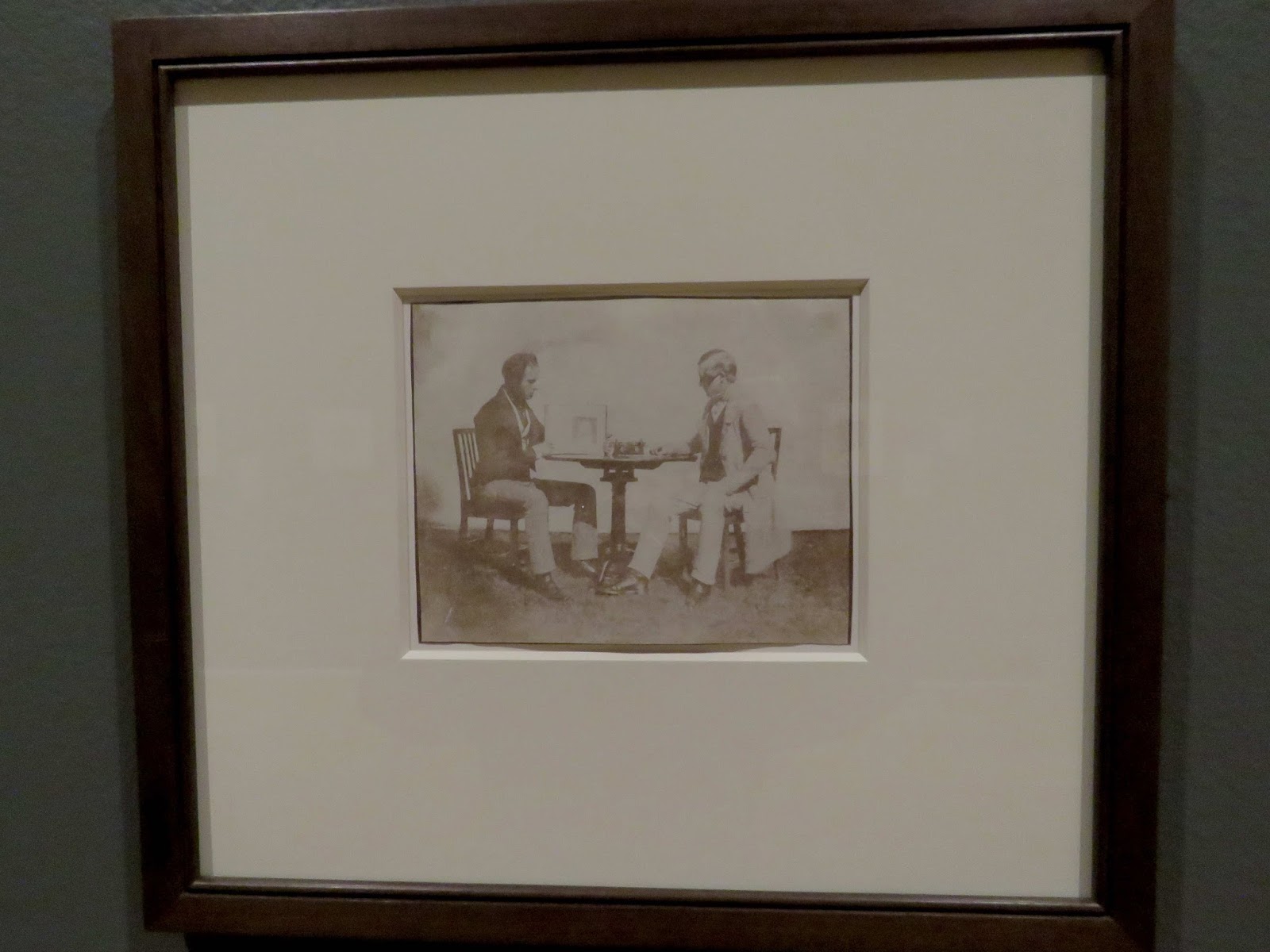
  • "William Henry Fox Talbot and the Promise of Photography" on view from November 18, 2017 to February 11, 2018. This exhibit shows 30 works from one of the inventors of photography. Talbot invented the process of producing multiple prints from a photographic negative. We were amused that he seemed to know every possible use for photography that still exists today. He made household inventories, photos of his kids, selfies (see the photo at right), nature and landscape photos, artistic photos, and more. (link)

Sunday, February 22, 2015

New York Food Revisited

Puerto Rican immigrants to New York often left back-breaking and overwhelming jobs harvesting or processing sugar cane. Though their lives may have improved, they remembered the taste of cane and many sayings about sugar cane ... a girl is "like sugar cane in February... when the cane is barely mature and the sweetest for plucking.... His machete is blunt, one might say of someone dull. That's worse less than the chaff. He's stingier than the knot of the cane. ... May your cane juice be always sweet."

Sugar played an incredible role in New York City history, not just in the lives of Puerto Ricans, but of many other people who worked in the Domino sugar factory, or much earlier were involved with the sugar trade from the islands to Europe, as well as the well-known distilling of rum from molasses.

A few days ago I wrote about Arthur Schwartz's enjoyable romp through high-end restaurant history in New York -- see my post "The Snob's Guide to New York City Food."

To follow up, I read Robin Shulman's book titled Eat the City: a tale of the Fishers, Foragers, Butchers, Farmers, Poultry Minders, Sugar Refiners, Cane Cutters, Bee Keepers, Wine Makers, and Brewers Who Built New York. Obviously, it covers more or less the reverse of Schwartz's book. It's just what I had in mind when I said I was hoping to learn about "supplying food in such a huge city and about just what the people ate and how they cooked it." The sugar cane quotes illustrate how imaginatively this author works with materials on New York's food history (from p. 172-173).

Shulman interlaces two threads in each chapter: long-ago food history and tales of present day artisans. In the past, New York processed its own food -- up until the mid-20th century, for example, cattle and pigs were brought live into the city to a large number of slaughterhouses that served New Yorkers' demand for meat. The original Dutch settlers and their immediate successors raised wheat, wine grapes, vegetables, and many more foods in Manhattan, Long Island, and other areas that now are totally urban. The Diamond sugar factory, large-scale breweries, and other industrial food processors were large employers with customers far beyond the city.

Present-day New Yorkers have resumed bee-keeping, beer-brewing, raising grapes for home-made wine, growing vegetables -- and even sugar cane -- on windowsills, or slaughtering an occasional pig or chicken. Fishing, eeling, or shellfish-gathering, even in waters full of industrial pollution, is something New Yorkers never gave up. Upscale trendy examples of new-type foodies doing things like bee-keeping or winemaking are easy to find. Shulman also covers the way poorer members of minority or immigrant communities supplement their diet by growing food in cans or on rooftops, by fishing and ignoring warnings about the danger of pollutants, and how Harlem residents for a while turned large tracts of burned-out land into vegetable gardens (now mainly reclaimed by developers). The details for each activity are compelling, and I enjoyed every chapter!

Above all, I enjoyed Shulman's treatment of New York's transition from an industrial city to a what is now. New York was "the country's manufacturing center." By mid-19th century Manhattan was
"rimmed with meatpackers, coal yards, gasworks, ink factories, ribbon makers, iron works, breweries, bottling plants, bone boilers, dairies, slaughterhouses, glue factories, stockyards, tar dumps, garbage transfer stations, rubber factories, masonry yards, flour mills, icehouses, lumberyards, sugar houses, distilleries, oil refineries, plumbing supply houses, and elevator and dumbwaiter manufacturers." (p. 236)
The pollution from these now-departed industries stays with New York despite efforts to clean up. The reality of present-day New York is extremely different from that of the past. Now few heavy industrial or manufacturing activities remain -- most people are in white collar, financial, or service jobs. The comparison that emerges from the perspective of raising and foraging foods in this ultra-urban setting makes fascinating reading.

While I was in New York last month, ironically, I missed the discussion of this book by my culinary book club -- but I hear that they all liked it too.

Wednesday, February 04, 2015

"Paris Noir"

Soul food in Paris, 1949: Leroy Haynes, an expat American Black, founded a restaurant where French people could taste chitlins, cornbread, red beans and rice, fried chicken and black-eyed peas. Located in Montparnasse, the restaurant was convenient to Americans who moved to the Left Bank, and appealing to adventurous French people. It remained a left-bank institution for 60 years (until 2009), run by Haynes’s widow and a “predominantly” African-American staff after his death in 1985.

Also in the Latin Quarter in the 1940s: Chez Inez, run by another expat Inez Cavanaugh, served soul food and featured jazz and blues: “eager Frenchmen who had never tasted the like” could try corn muffins and home fried chicken. In winter mostly Black American students ate there; in summer American and Scandinavian tourists were made to feel that “they owned the place.”

And in the area of Rue Mouffetard – another left-bank neighborhood – was the Rib Joint, owned by African-American expat, Randy Garrett: “a classic soul-food restaurant serving barbecued ribs, fried chicken, corn bread, and coleslaw. ... Its customers included a mixture of African american tourists and residents, other Americans, Parisians, and foreigners.” The Rib Joint was in business from the 1970s until 1994.

Leroy Haynes at his restaurant
from "Haynes" by Jean Segura
The availability of soul food and soul music offers one of many insights into Black American life in Paris in the twentieth century, as documented in Tyler Stovall's comprehensive history Paris Noir: African Americans in the City of Light (1996). The expats established a loosely-connected community that included soul food and meeting places, jazz clubs and restaurants. They were highly fascinating to the French, who particularly loved the music, and evidently were willing to try the food. Since American expats mainly lived in hotels without the ability to cook their own meals, the restaurants were especially important.

Black Americans in Paris early in the century particularly enjoyed an atmosphere of French color-blindness that contrasted to the discrimination they experienced in American cities, North or South. Some of them experienced France first as American soldiers in the World Wars when American military segregation was extreme. Some came as students with limited means, or after World War II on the GI Bill or other stipends. Mature writers, musicians, and artists went to Paris looking for creative freedom; others came as unknowns with aspirations and succeeded, or didn’t. In the early years, these expats lived in Montmartre; later the center of this loosely coherent community moved to the Left Bank.

Stovall describes the lives of the most high-profile and successful American Blacks in Paris such as Josephine Baker, Bricktop, Sidney Bechet, Langston Hughes, Romare Beardon, Richard Wright, James Baldwin, Chester Himes, and quite a few others. American Blacks in Paris included leaders of the Harlem Renaissance in the 1920s, the most exciting jazz musicians of the Jazz Age, or the best in Black American writing in the 1950s and 1960s.

Paris Noir also chronicles the lives and motives of many less well-known American Blacks who studied art, established studios, played back-up to the big Jazz names, wrote books or essays, performed in cabarets, or ran restaurants. Some lived ordinary lives, married French spouses, and more or less assimilated into French life.

Stovall covers the major time periods and events of the twentieth century – the chaos of the World Wars;  the excitement of the 1920s when Paris was a draw to Blacks as well as to other Americans; and the appeal of Parisian cultural scene and open atmosphere after World War II. Especially in the earlier years of the century, the French in turn were highly interested in the American Blacks who lived in Paris. American Jazz musicians contributed a modern alternative to traditional popular music in the 1920s and 1930s, and again in the 1950s. French musicians learned from Americans. French musicians sat in on jazz performances in cafes and concert halls, developing their own style of jazz in turn – notably Django Reinhardt and Stéphane Grappelli, and later Boris Vian.

In the 1930s, when economic depression cut off the livelihood of many expatriates, the Black community declined. After World War II -- the racist Nazi era when Blacks had to leave Paris or be deported to camps – Blacks returned. Especially, the GI Bill recognized several art schools and universities in Europe, providing a new type of opportunities. The 1950s also were the time of French colonial wars in Vietnam and Algeria and arrival in Paris of many non-white colonials, with heavy implications for American Black expats.

In the sixties, Americans in Paris were highly aware of civil rights struggles in the US; Paris, the author points out, was also a gateway to awareness of and living in emerging African countries, though that didn’t always work out too well as African countries were far from stable. Black expatriates, like everyone in Paris, were heavily affected by the near-revolution of May 1968.

Throughout the century, many expats retained strong ties to American life. Although some virtually turned their backs on America and its racial problems, others such as James Baldwin, moved back and forth between the two countries, committed to civil-rights activism in the US and to the peace that Paris offered.

Paris Noir wraps up with a summary of events in the 1970s until the early 1990s when Stovall, a professor of history at the University of California, Santa Cruz, and later at UC Berkeley, wrote and published the book. Stovall had many sources, including interviews he conducted with various Paris expats. During this time, the color-blind atmosphere of Paris became more and more of a myth, as mistreatment of large immigrant populations from former French colonies increased.


Having spent quite a bit of time in Paris over the years, and having read quite a bit about Americans in Paris, I found this book particularly appealing. The terrorist murders in Paris in January of this year have focused worldwide attention on the current racial tensions there, so the book (which has been on my list for quite a while) seems especially timely despite having been published 20 years ago. Alas, the apparent color-blind atmosphere that attracted American Blacks through much of the twentieth century is only a memory now, as Paris has gigantic racial and ethnic problems that in many ways dwarf even the situation in America.