Sunday, January 28, 2024

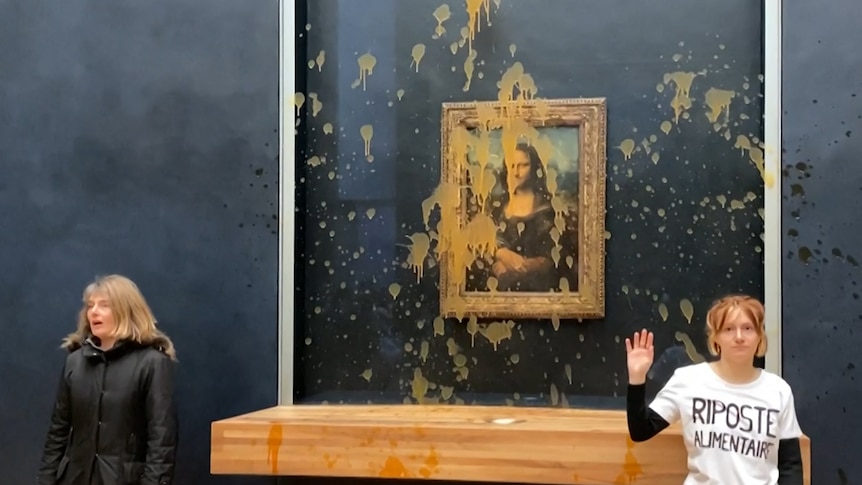
NEWS FLASH! Mona Lisa Attacked with Soup!


It’s only been a few hours since two protestors threw soup at the glass enclosure around Mona Lisa —
but already someone posted this cartoon.

News sites had quite a few action shots. No surprise— 
on an average day probably 100 people have cameras aimed at Mona Lisa.
Now the bullet-proof glass is tested: it’s also soup-proof
and an earlier protest has showed that it’s cream-pie proof.


I feel an obligation to include this important event on my blog since I am a committed collector of Mona Lisa objects, also known as jocondology.

Mona Lisa loves soup.

Normal crowd around Mona Lisa (from my most recent visit).


Saturday, January 27, 2024

A Book for International Holocaust Remembrance Day


W.G. Sebald (1944-2001) was a novelist and literary scholar at the University of East Anglia in Britain. He was born in Bavaria, and wrote in German. Austerlitz, his last book, is about the life of a man named Jacques Austerlitz, who was born in Prague in the 1930s. As the Nazis take over Czechoslovakia, his  Jewish mother in desperation sends him, at age four and a half, on a Kindertransport to England, He is taken in by a cold-hearted Welsh couple who never tell him his origin. As an adolescent, he finally learns his real name, but discovers that all paperwork about his family and where he came from had been lost in the bombings of London. 

The narrator of the novel is of an acquaintance of Austerlitz, who has occasional contact with him, and who relates a series of narratives that occur when he, the narrator, gets together with Austerlitz. The descriptions of his search for his birth parents and family are related with an overwhelming sense of alienation, which is in any case intrinsic to the existence of a man desperate to know who he really is. For years Austerlitz cannot even remember his own early life, and recovers a few faint memories through a series of coincidences and voyages to discover his identity.

Today is Holocaust Remembrance Day

From the United States Holocaust Museum in Washington, DC:

“The United Nations has designated January 27, the anniversary of the liberation of Auschwitz-Birkenau, as International Holocaust Remembrance Day—a time to remember the six million Jewish victims of the Holocaust and the millions of other victims of Nazi persecution. In 2024, the commemoration coincides with a surge in antisemitism worldwide.”

The background events of Sebald's novel are not as well known as the major events of the Holocaust. While millions of murdered victims died in Auschwitz, there were a number of other camps. Millions of Jews from Eastern Europe were shipped to these camps, but smaller numbers of victims came from other countries, where Jewish communities were also destroyed, Jewish property stolen, and synagogues, made unrecognizable, were converted to other uses. Very few efforts to save Jewish people occurred during this era. Here are a few of the facts and how Sebald's novel includes them.

An Early Effort to Save Jewish Children: The Kindertransport 

Children arriving in England brought by the Kindertransport (source)

The Kindertransport was an effort in 1938-1939 to rescue Jewish children from several countries in Nazi-occupied Europe. Ten thousand of these threatened children were taken from their parents and brought to England. Most of them were adopted or fostered by British families. Although the intent was that their rescue would be temporary until they could return to their homes, most could never be reunited with their families because the families had perished in the Holocaust. 

In the novel, Austerlitz for years is unable to recall his journey to England, but eventually he goes to Prague and finds an elderly woman named Vera, who had been a friend of his mother Agata Austerlitz. Finally in conversations with Vera, he learns about his early childhood. Vera explains that his mother, because she was Jewish, was banned from her profession as an opera singer and deprived of all the freedoms she had enjoyed. As the Nazis implemented their anti-Jewish policies, she slowly realized the danger to her life and that of her child:

"She finally decided, Vera told me, said Austerlitz, that she would send me at least to England, having succeeded through the good offices of one of her theatrical friends in getting my name put down for one of the few children’s transports leaving Prague for London during those months. Vera remembered, said Austerlitz, that the happy excitement Agáta felt at this first successful outcome of her efforts was overshadowed by her grief and anxiety as she imagined how I would feel, a boy not yet five years old who had always led a sheltered life, on my long railway journey and then among strangers in a foreign country. ...She was torn between wishful thinking and her fear that she was doing something irresponsible and unforgivable, and who knows, Vera said to me, whether she might not have kept you with her after all had there been just a few more days left before you were to set off from Prague." (p. 173)

Austerlitz himself has never had more than fleeting and unreliable memories of his journey, and almost no memory at all of his mother. Vera offers him his first real grasp of his childhood experience:

"I have only an indistinct, rather blurred picture of the moment of farewell at the Wilsonova Station, said Vera, adding, after a few moments’ reflection, that I had my things with me in a little leather suitcase, and food for the journey in a rucksack—un petit sac à dos avec quelques viatiques, said Austerlitz, those had been Vera’s exact words, summing up, as he now thought, the whole of his later life. Vera also remembered the twelve-year-old girl with the bandoneon to whose care they had entrusted me, a Charlie Chaplin comic bought at the last minute, the fluttering of white handkerchiefs like a flock of doves taking off into the air as the parents who were staying behind waved to their children, and her curious impression that the train, after moving off very slowly, had not really left at all, but in a kind of feint had rolled a little way out of the glazed hall before sinking into the ground." (pp. 173-174).  

One of Many Camps: Theresienstadt

Austerlitz continues with his efforts to discover his mother's fate, and learns that after he had been sent to England, she was deported from Prague to the Theresienstadt ghetto.

“Theresienstadt, established as a ghetto and transit camp in 1941, was presented as a model Jewish settlement for propaganda purposes. Despite congestion, hunger and forced labor, educational and cultural activities abounded. 35,440 Jews died in the ghetto and 88,000 were deported.” (From Yad Vashem Holocaust Museum)

A detailed history of Theresienstadt, as documented in a book that Austerlitz finds, makes up quite a long passage of the novel, but learning about this does nothing for his alienation and isolation. 

One of the somewhat mysterious illustrations from the novel (p. 244)

The Deportation from Paris

Austerlitz has much more difficulty discovering the eventual fate of his father, Maximilian Aychenwald, who had left Prague and had gone to Paris where he hoped to be safer from the Nazis. Living in Paris decades later, Austerlitz tries to find any documented record of his father. He studies the fate of the large Parisian Jewish community where his father presumably had lived. His efforts to imagine his father in Paris as the Nazis are destroying the Jewish community are poignant:

"I sat in this bar too for hours on end, trying to imagine him in his plum-colored double-breasted suit, perhaps a little threadbare now, bent over one of the café tables and writing those letters to his loved ones in Prague which never arrived. I kept wondering whether he had been interned in the half-built housing estate out at Drancy after the first police raid in Paris in August 1941, or not until July of the following year, when a whole army of French gendarmes took thirteen thousand of their Jewish fellow citizens from their homes, in what was called the grande rafle, during which over a hundred of their victims jumped out of the windows in desperation or found some other way of committing suicide. I sometimes thought I saw the windowless police cars racing through a city frozen with terror, the crowd of detainees camping out in the open in the Vélodrome d’Hiver, and the trains on which they were soon deported from Drancy and Bobigny; I pictured their journey through the Greater German Reich, I saw my father still in his good suit and his black velour hat, calm and upright among all those frightened people. Then again, I thought that Maximilian would surely have left Paris in time, had gone south on foot across the Pyrenees, and perished somewhere along his way." (p. 257).

In this blog in the past, I've written about the horrendous deportation from Paris, when the Jewish population was rounded up, held in appalling conditions at a bicycle-racing stadium called the Velodrome d'Hiver, and eventually deported to Auschwitz to die. I remember this because our apartment in Paris on one of our long stays was extremely close to this site, and I often walked past the commemorative marker on the street. My memories seem appropriate for this Holocaust Remembrance Day.

Memorial to the Parisian Jews who were deported to Auschwitz.

His Father’s Fate

Finally, almost at the end of the book, Austerlitz learns of his father's fate, which he relates to the narrator:

"When I met Austerlitz again for morning coffee on the boulevard Auguste Blanqui, shortly before I left Paris, he told me that the previous day he had heard, from one of the staff at the records center in the rue Geoffroy-l’Asnier, that Maximilian Aychenwald had been interned during the latter part of 1942 in the camp at Gurs, a place in the Pyrenean foothills which he, Austerlitz, must now seek out. Curiously enough, said Austerlitz, a few hours after our last meeting, when he had come back from the Bibliothèque Nationale and changed trains at the gare d’Austerlitz, he had felt a premonition that he was coming closer to his father." (pp. 290-291). 

 It's hard to describe how sad and desperate the character of Austerlitz is, and obviously the use of history -- including the reproduction of many photos -- makes the book a masterpiece of fictional use of historic facts. I can't tell you how sad the book made me, and I am not able to do justice to its literary accomplishment. Reading it seems very appropriate as a commemoration of Holocaust Remembrance Day, and also as a reminder of how Jews in our own time, right now, are struggling for their very existence. We are more and more being reviled and persecuted again by a new wave of antisemitism and antipathy to Israel, which was hoped to be a refuge from a future Holocaust.

Review © 2024 mae sander
Shared with Sunday Salon At Readerbuzz


Friday, January 26, 2024

Reading Sci-Fi and Fantasy

Best American Science Fiction and Fantasy, 2023
 
Science fiction isn’t usually part of my reading, but I try it occasionally: I read the stories in this annual collection with interest. R.F.Kuang, who made the final selection here is an author I admire, which encouraged me to choose this volume. All of the stories were published in North America in 2022, and all appeared in nationally-available sources, not self-published.

Unexpectedly, I found that many of the stories in this volume have a focus on well-known contemporary issues. The authors use science fiction, fantasy, or a setting in the future to highlight their perspective on a more or less controversial subject. Some of these themes: societies, both real and imagined, where abortion is prohibited and punished; creepy families where ghosts express their view on trans children; unnatural pressure on young women to be beautiful and pleasing; and the uncanny potential of chatbots to threaten individuals and maybe undermine the social order. 

Here’s the final passage from a story called “Rabbit Test” by Samantha Mills, which describes women in desperate search of an abortion throughout history and well into the distant dystopian future. The story also tells the history of the “rabbit test” that was used in the 20th century for early diagnosis of pregnancy:

“It is 2084 and she is crying, ‘Our grandmothers fought so hard for this.’
“It is 2206 and she is crying, ‘Our grandmothers fought so hard for this.’ 
“It is 1878 and Madame Restell is bleeding to death in her bathtub rather than submit to another trial. 
“It is 1821 and Asenath Smith is fleeing town in disgrace. 
“It is 1972 and seven of the women of Jane have just been arrested in a raid. 
“It is 2086 and Grace’s medical record has been officially upgraded to that most precarious of categories: potential to become pregnant. 
“It is 2022 and it isn’t over. 
“It is 2022 and it is never over.” (p. 98)

In the story “White Water, Blue Ocean” by Linda Raquel Nieves Pérez, a young man is tormented by his relatives as he tries to see his perhaps ghostly grandmother who oozes “cursed foam” from her face and eyes. Finally, his mother defends him:

“‘Their name is Gabriel, Lorena,’ said my mother as she passed her the cursed bottle. 
“‘Her name,’ Lorena spat as she stood up, the loud scratch of the chair against the floor adding an out-of-tune cord to the wild beat of my heart, ‘is Patricia, no matter what she’s led your husband and you to believe.’” (p. 130)

Of course these stories also contain other themes, such as the threat of semi-human or robotic dictators in a horrifying, dystopian future on earth or in other planetary systems. Also in the stories: lots of made-up words, names, and places and fanciful “lifeforms.” Some are very intriguing in a good way. Others are kind of silly, and I skimmed them quite quickly. But it’s an amusing anthology.

Review © 2024 mae sander

Monday, January 22, 2024

Zadie Smith: "The Fraud"

Zadie Smith: The Fraud

Genteel British society in the 19th century is at the center of a wide variety of fiction. Many famous authors at the time documented the ways of the British aristocracy and upper middle class, and many authors have continued to be fascinated by this era. It has featured in many TV treatments as well as novels. Rarely have these authors fully faced the source of the wealth and privilege of their subjects: many of them made their money as "planters" — and thus as slave owners — in the Caribbean island sugar and rum trade. 

Enslaved Africans in the Caribbean, harvesting sugar cane (source)

Sugar cultivation, sugar refineries, and rum distilleries all functioned because they depended on the insanely brutal system of slave labor. The native populations of the islands had been driven to extinction by the early settlers through disease and slavery. By the 1800s, the enslaved workers were all African Black people and mixed-race African-British people. The system was utterly inhumane, and most writers who documented the white beneficiaries of the system didn't choose to mention the fundamental horrors of the system or to acknowledge the abolitionist movement that opposed slavery. The slave trade — that is, bringing enslaved Africans to the British colonies, officially ended in 1807. Continued enslavement of human workers was abolished in the 1830s when the British government generously repaid the slave owners for the loss of their human property, and their wealth was preserved. The slaves were never compensated for their losses. The British upper class beneficiaries quickly forgot the brutality of slavery, as well as the rebellion that preceded emancipation. Here’s a link about the rebellion that preceded emancipation.

Slaves working at a Caribbean rum distillery, 1800s. (From a rum advertisement: source)

In her recent novel, The Fraud (published last September) author Zadie Smith portrays a family of genteel white English folks very much like the ones in so many earlier novels. The details of the plot are based both on historic characters, particularly on a successful novelist of the time, now totally forgotten. and also on historic events, particularly a court case about a fraud that fascinated the public in the 1870s, as well as looking back on the lives of the characters from the 1830s onward. Themes in The Fraud include the relationships of literary figures of the time, as well as many political and social issues: it’s a complex novel with a complex central character, Eliza Touchet, through whose eyes we see political, social, and personal relationships. In the rest of this review, I'm concentrating only on the topics of race and slavery as the author presented them, but there is much more.

Smith uses the many events and characters with great success to illuminate these issues, including the attitudes of white people towards black people and towards the institution of slavery, for example, white women including Eliza who belong to abolitionist organizations. Smith explores the way that the black residents of England, who were often former slaves from the Caribbean plantations, reacted to a profoundly racist society, and how they formed their own way to see themselves. It’s subtle and detailed.

As the plot about the trial continues to unfold, there's a kind of a pause for a sequence of chapters about the life and family of Andrew Bogle, a former slave who played a big role in the notorious court case. Bogle’s father was forcibly brought as a slave from Africa, and his biography includes his experiences of slavery on Jamaican plantations and sugar mills. Bogle himself begins life as a slave and then as a freed man in England and Australia. 

Bogle’s story begins thus:

“‘My life has had many parts,’ said Bogle. ‘It is difficult to say how many lives I have lived, or where my story truly begins. One thing I know for certain: my story is not what it should be. I should have been a great man. I come from great men, on my father’s side. But I hardly remember my father and can only speak of what Myra told me. Myra was my mother, and much of what I know of my father’s life she gave to me. Poor woman, that she should have nothing else to give me but that!” (p. 239)

Bogle's father was born as an elite member of a tribe in Africa. As a boy, he was kidnapped and taken to Jamaica on a slave ship. Through the events of his father's life, Smith illustrates the way that all the enslaved African workers on the plantation were subjected to hardship, cruelty, and inhumanity. Bogle's story reveals the hardships of laboring on a plantation in the overwhelming heat of Jamaican summer, whether assigned to work in the offices, in the fields, or in the sugar refineries and distilleries. Eventually, he moved to England with his master and later, as a free man, went to Australia as a settler. Finally, he returned to England where he became a witness at the notorious trial that is central to the novel. 

Bogle is very aware of his place in English society as a black man, a son of an African tribal elite, an ex-slave, a witness in a highly popular trial, and as a relatively literate and politically aware person. Here are his thoughts as he reads about the 1831 slave uprising in the newspapers — at that time he was in London working for his former owner, Mr Doughty:

“Every evening, in the newspapers, the tale of this negro uprising expanded, and Mr Doughty expressed some variation on his relief to no longer be in any way involved with the ‘cursed sugar trade’. Bogle snuck the newspaper back to his quarters after dark and read the long columns by the light of a single candle, trying to understand if only the north coast was burning and who exactly was being executed in the town squares for refusing to work. But of all the negroes in Jamaica there was only one with a name, as far as The Times was concerned – Sam Sharpe – and after a while he understood that he was only upsetting himself. What he wanted to know no English paper would ever tell him.” (p. 308)

The rewards to the planters of using slave labor for growing sugar, refining it, and making rum are all very clearly described, but there’s little in the novel about the British side of this trade; for example, about the consumption of sugar and rum in England at the time. When the genteel people in the novel drink an alcoholic beverage, it would be an after-dinner glass of port, not rum! Though the content of their meals is sometimes described, the role of sugar isn’t much mentioned — in their world, sugar is mentioned only when the abolitionists ask housewives to boycott this product of slave labor. Sugared tea (I know from other sources) was the mainstay of the lower classes, but not relevant to the novel’s literary and social elite. I think this is an interesting choice on the part of the author.

The Guardian reviewer last August thus summarized the novel:

“Smith presents a coruscating picture of twin societies in flux, the ways in which 19th-century England and Jamaica were ‘two sides of the same problem, profoundly intertwined,’ joined at the hip by Andrew Bogle’s ‘secret word’: slavery. But she is also devastatingly good on the lesser delusions, the ways in which we are consistently blind to our own privileges.” (source)

Review © 2024 mae sander 

Sunday, January 21, 2024

CATIE Botanical Garden, Turrialba, Costa Rica

A mural inside the visitor center of CATIE.
(Centro Agronómico Tropical de Investigación y Enseñanza)

CATIE is a research and educational institution in Turrialba, Costa Rica. In English, CATIE stands for “Tropical Agricultural Research and Higher Education Center.” We visited there one afternoon during our birding trip — it was quite close to Rancho Naturalista, where we were staying. The gardens and research areas are very beautiful, especially the lake where we photographed a number of bird species. Besides the visitor center, CATIE has a large research building that we didn’t visit.


The small lake belonging to CATIE


I waited to post these photos so that I could share the art work with Sami’s Monday Murals and the group of people who enjoy public art of various types (https://sami-colourfulworld.blogspot.com/ All photos © 2024 mae sander. I’m also sharing next Saturday with Eileen’s Saturday Critters:


Friday, January 19, 2024

A Murder Mystery With Birds


Sarah Caudwell's fourth novel in the Hillary Tamar series, The Sibyl in her Grave, is an amusing and rather arch British mystery, very similar to the first two in the series (reviewed here and here). Like the others, it takes place towards the end of the 20th century (published 2000). It revolves around several legal scholars and lawyers, especially tax and financial lawyers, but is full of very eccentric people. And like the others, the story is virtually all revealed by letters. 

A major eccentric character in The Sibyl is the title character, Isabella, a clairvoyant who makes her living telling people's fortunes. At the start, she moves into a large house in a small English village a few hours outside of London, where she makes major changes to the building in the form of a large bird cage. The local resident whose letter describes this situation describes her first encounter with Isabella:

"The conservatory and the area beyond it had been turned into an aviary, now occupied by a flock of ravens—I don’t know how many exactly, but there must have been at least a dozen. It wouldn’t have been so bad if the French windows had been closed, with the ravens safely on the far side—but they were open, and the horrible creatures were flapping and hopping about the drawing room as if they owned the place. ... I was already more disconcerted than I would have liked by finding myself in the same room as a dozen or so ravens. When I realised that I was also sharing it with a vulture, I came closer to screaming than I care to admit." (The Sibyl in Her Grave, p. 36 & 40).

Within a short time, Isabella dies suddenly and somewhat mysteriously, and the various characters spend the rest of the book trying to work out who her clients were and what information was being exchanged, as the major crime mostly seems to be not murder, but insider trading. Can this make an amusing and suspenseful novel? 

Well, yes if Sarah Caudwell is the author. Her style is inimicable, and her choice of material is totally weird but it ends up very amusing because it's so self-consciously clever and arch. For example, a clergyman in the village, who plays a large role in the story is always worried about sin, and the insider trading aspect of the goings-on preys on his mind. His mental state begins to concern the letter writer who mainly tells the story:

"I know nothing of the complexities of the clerical conscience—is there anything I can do to repair the damage? Would it be possible to persuade him that insider dealing, having been a criminal offence only since 1980, cannot in fact be a sin? Or, if it is, venial rather than mortal? Or, if mortal, still not beyond redemption?" (pp. 182-183). 

Another example and then I'm done. One of the characters is invited to an English country hunting retreat, and is getting his guns ready:

"It was, as I have mentioned, the second week of August: that season of the year when the warm days of summer draw luxuriantly towards their fruitful and abundant climax and there is an almost universal impulse to give thanks in some way for the richness and generosity of the earth; that is to say, in the case of an upper-class Englishman, to go out and kill something." (p. 116). 

Sarah Caudwell's books may or may not be to your taste. They are really quite exaggerated but I think the style has grown on me. Unfortunately, Sarah Caudwell died in 2000, so there will never be any more.

Review © 2024 mae sander

Thursday, January 18, 2024

“Ultra-Processed People”


Chris van Tulleken: Ultra-Processed People
(Published June, 2023)

Reading this book was a very fascinating experience, and very different from my expectations. It’s not just another rant about big food companies, it’s a detailed survey of the science of ways that humans can be caused to eat too much. It's about how the brain can create the conditions for obesity when you give it a chance. But above all, it's about how artificially created flavors, nutrients, emulsifiers, and other manufactured ingredients have changed the modern diet, and have contributed to a big increase in obesity and related diseases, especially diabetes. The author builds the case for this carefully and in detail, which I'm not qualified to try to replicate in my review.

For example, think about these: saccharine, high-fructose corn syrup, xanthan gum, aspartame, dimethyl cellulose, modified food starch, canola oil, sodium stearoyl lactylate, calcium sulfate, ammonium sulfate, calcium propionate, sodium acid pyrophosphate — random ingredients from packaged food labels that I searched for on the web. 

Are these really foods? Yes and no! Van Tulleken provides a general view of the enormous expansion of ultra-processed food in our diet since the invention of saccharine in 1879, and the explosion of new additives in the last quarter of the 20th century. He talks about the motive of food companies: making money, and how they market these foods to achieve their ends. He explains: 

"Usually the aim of UPF is to replace the ingredients of a traditional and much loved food with cheaper alternatives and additives that extend shelf life, facilitate centralised distribution and, it turns out, drive excess consumption. Pies, fried chicken, pizza, butter, pancake mix, pastries, gravies, mayonnaise – all these began as real food. But the non-UPF versions are expensive, so their traditional ingredients are often replaced with cheap, sometimes entirely synthetic, alternatives." (p. 20). 

An enormous number of such substitutes and additives are included in a diet of ultra-processed food:

"It’s not clear how much or even how many additives we eat. In the EU, there are more than 2,000 permitted for use. In the US, the number is (terrifyingly) unknown, but is thought to be higher than 10,000. As production has become entirely automated, with computer-controlled robots cutting vegetables, grinding meat, mixing batter, extruding dough and wrapping the final product, many additives are required so that food can withstand the process. If colours or flavours are lost as food is subjected to this robotic mauling, then, as we’ve seen, they can simply be chemically replaced." (p. 210). 

The consequences of more than a century of creating food and drugs that derail the brain’s natural control over hunger and satiety are documented in a fascinating way, which I can’t begin to summarize. I've picked one passage that I find essential:

"UPF, especially products with particular combinations of salt, fat, sugar and protein, can drive our ancient evolved systems for ‘wanting’: ‘Some ultra-processed foods may activate the brain reward system in a way that is similar to what happens when people use drugs like alcohol, or even nicotine or morphine.’ This neuroscience is persuasive, if still in its early stages. There is a growing body of brain-scan data showing that energy-dense, hyperpalatable food (ultra-processed but probably also something a really good chef might be able to make) can stimulate changes in many of the same brain circuits and structures affected by addictive drugs." (p. 153).

Even if you think you know all about ultra-processed foods and how they affect their consumers, you really ought to read this book and find out more than you already know! You may be more ignorant than you realize — I thought I had read a lot about the subject, and I certainly was ignorant. You may also have seen quibbles that say that no one really knows what ultra-processed food is. Reading the book, I concluded that this argument is tendentious. Maybe you can find some marginal items. So what.

Throughout the book, van Tulleken reviews the research literature on each scientific topic, which is fascinating and also challenging. I was particularly interested in his analysis of which researchers were compromised because they accepted funding from the food and additive industries, which often resulted in their finding what the big food corporations wished they would find. This is a sad state of affairs, but often documented by other writers as well.

Everywhere, since I read van Tulleken’s book, I see journalists' accounts that seem to support or amplify the major points of he made. Ultra-Processed People does not discuss one huge current trend: the use of injectable drugs to change human cravings for food and thus to offer a new way for people to lose weight. These articles are documenting the way the newly popular drugs reverse effects that in many cases could be due to consequences of ultra-processed food. I hope that van Tulleken will eventually add this topic to his book and to this: “Most UPF is not food. It’s an industrially produced edible substance.”

Ultra-processed food is everywhere!

Here are two examples of articles on topics relevant to the book that appeared in the New York Times on January 16, 2024, just to show how this seems to be everywhere:

Review © 2024 mae sander

Wednesday, January 17, 2024

Recent Reading


While traveling earlier this month, and since I returned, I read three highly enjoyable mystery stories. During this time, I was busy documenting my experiences, so I did not write reviews of these books although I liked them very much. Here is a very brief summary of my impressions.

  • Kiego Higashino, The Final Curtain (published December, 2023) — a very long book that ties up the details of the life of Tokyo Police Detective Kyoichiro Kaga. The plot is very very involved and the number of characters and subplots is huge, but I still found it readable. 
  • Gwen Bristow and Bruce Manning, The Gutenberg Murders (published 1931) — set in New Orleans, this is very much a mystery in the classic who-done-it tradition of Hammett and Chandler. Other than the fact that all the characters smoke cigarettes nonstop, it could just about be modern.
  • Jason Goodwin, The Baklava Club (published 2014) — this series features the mystery-solving Yashim, who works for the Ottoman Emperor in Istanbul in the mid-19th century. While I very much like the well-researched details of Yashim’s life, especially when he shops in the market and cooks for his friends, I also appreciate the increasing suspense around the murder he had to solve in this, the final volume of the series so far. Goodwin’s characters are always very intriguing.
Reviews © 2024 mae sander for maefood.blogspot.com

Monday, January 15, 2024

Mona Lisas For 2024


I haven’t posted any Mona Lisas for a while. Several friends (and I thank them very much) sent me the Mona Lisa Wolverines fan image. My friend Roberta found me a new one: Spaghetti-Strap Mona. In the last two images I collected, Mona is having a drink. As always, Mona Lisa parodies stand on their own, I don’t bother to figure out where they came from other than which friend remembered my little obsession.

Shared with Elizabeth at Altered Book Lover (https://alteredbooklover.blogspot.com/) and her Tuesday circle of friends.

Saturday, January 13, 2024

Costa Rica Wrap-Up


Our return from Costa Rica was one week ago today. In the week since then I’ve been catching up on documenting this wonderful birding trip. I’ve enjoyed thinking about all the spectacular and colorful birds we saw, such as the six species of owls depicted above. (Crested Owl, Ferruginous Pygmy Owl, Black & White Owl, Spectacled Owl, Mottled Owl, and Tropical Screech Owl.) Now I think it’s time to move on and start writing about life back here in very dreary Ann Arbor where we have not yet seen a moment of sunshine!

A full-color photo of the view from our living room window yesterday afternoon.
Guess what? I’m staying inside and reading books, which you’ll be hearing about.

Shared with the Sunday Salon at Readerbuzz.

Blog post © 2024 mae sander

Friday, January 12, 2024

Costa Rica: What I know about food and drink

Diet Coke, of course! We also drank 
lots of fresh fruit juice.

We saw ads for Imperial Beer everywhere! Here shown with two of the ever-present hot sauces.

Whenever I had a chance, I took a few photos of the inside or outside of supermarkets.
Here’s the beer!

A supermarket featuring Imperial Beer.

I especially liked the mural on the wall of this market with several of the birds we were looking for.

The artist’s signature.

A fruit and vegetable stand on a street.

Produce in one of the supermarkets where we bought drinks & snacks.

Costa Rica agriculture is very productive both in tropical fruits and other produce.


Just like at home.


Some of the group with our drinks.

As we walked along rural roads looking for birds, we also saw lots of growing crops.
The chayote (called mirliton in the US south) was growing on a tree.

I also tried to capture the look of the many bakeries.


Two Restaurants

Other than the hotels where we stayed, we ate in only two restaurants, one on the
way from San Jose to Rancho Naturalista, and one on the way back.
This restaurant is located on the road up to the volcano, right near where we saw the quetzel!
I’ve included a few photos of these two places, which feature local Costa-Rican food.

The bar at the restaurant on the way back.


Lunch on the way there: a soft tortilla with a variety of roast vegetables and cheese.

Lunch on the return: trout, french fries (ubiquitous!) and palm heart salad.


I’ve already written about the meals at our hotels, but here’s another photo of
my favorite: tortillas, meat, beans, cheese, etc. And a diet coke!


Blog post and photos © 2024 mae sander