From Alice in Germany


From Sheila in Puerto del Rosario, Fuerteventura
 |
| Our friends Sheila and John are on a very interesting and long cruise. |

|
| Our friends Sheila and John are on a very interesting and long cruise. |
 |
| Len rolls out the dough… |
 |
| Twisting the filled dough for one roll. |
 |
| Forming a cardamom knot. |
 |
| Baked until golden. |


 |
| Miriam in Augsburg where she, Evelyn, Alice, and Tom are spending Christmas week. |

 |
| At the market. |

 |
| Christmas Eve Dinner in Augsburg with Tom’s family. |
 |
| Christmas Eve dinner in Ann arbor with Evelyn, Tom, Miriam, and Alice: Bavarian tradition: sausages and potato salad. |
 |
| Dessert: Buche de Noel and raspberries. |

 |
| — source |
 |
| Celebrities |
 |
| From the Guardian Photo Essay for Holocaust Remembrance Day 2025. |

W.G. Sebald (1944-2001) was a novelist and literary scholar at the University of East Anglia in Britain. He was born in Bavaria, and wrote in German. Austerlitz, his last book, is about the life of a man named Jacques Austerlitz, who was born in Prague in the 1930s. As the Nazis take over Czechoslovakia, his Jewish mother in desperation sends him, at age four and a half, on a Kindertransport to England, He is taken in by a cold-hearted Welsh couple who never tell him his origin. As an adolescent, he finally learns his real name, but discovers that all paperwork about his family and where he came from had been lost in the bombings of London.
The narrator of the novel is of an acquaintance of Austerlitz, who has occasional contact with him, and who relates a series of narratives that occur when he, the narrator, gets together with Austerlitz. The descriptions of his search for his birth parents and family are related with an overwhelming sense of alienation, which is in any case intrinsic to the existence of a man desperate to know who he really is. For years Austerlitz cannot even remember his own early life, and recovers a few faint memories through a series of coincidences and voyages to discover his identity.
“The United Nations has designated January 27, the anniversary of the liberation of Auschwitz-Birkenau, as International Holocaust Remembrance Day—a time to remember the six million Jewish victims of the Holocaust and the millions of other victims of Nazi persecution. In 2024, the commemoration coincides with a surge in antisemitism worldwide.”
The background events of Sebald's novel are not as well known as the major events of the Holocaust. While millions of murdered victims died in Auschwitz, there were a number of other camps. Millions of Jews from Eastern Europe were shipped to these camps, but smaller numbers of victims came from other countries, where Jewish communities were also destroyed, Jewish property stolen, and synagogues, made unrecognizable, were converted to other uses. Very few efforts to save Jewish people occurred during this era. Here are a few of the facts and how Sebald's novel includes them.
 |
| Children arriving in England brought by the Kindertransport (source) |
The Kindertransport was an effort in 1938-1939 to rescue Jewish children from several countries in Nazi-occupied Europe. Ten thousand of these threatened children were taken from their parents and brought to England. Most of them were adopted or fostered by British families. Although the intent was that their rescue would be temporary until they could return to their homes, most could never be reunited with their families because the families had perished in the Holocaust.
In the novel, Austerlitz for years is unable to recall his journey to England, but eventually he goes to Prague and finds an elderly woman named Vera, who had been a friend of his mother Agata Austerlitz. Finally in conversations with Vera, he learns about his early childhood. Vera explains that his mother, because she was Jewish, was banned from her profession as an opera singer and deprived of all the freedoms she had enjoyed. As the Nazis implemented their anti-Jewish policies, she slowly realized the danger to her life and that of her child:
"She finally decided, Vera told me, said Austerlitz, that she would send me at least to England, having succeeded through the good offices of one of her theatrical friends in getting my name put down for one of the few children’s transports leaving Prague for London during those months. Vera remembered, said Austerlitz, that the happy excitement Agáta felt at this first successful outcome of her efforts was overshadowed by her grief and anxiety as she imagined how I would feel, a boy not yet five years old who had always led a sheltered life, on my long railway journey and then among strangers in a foreign country. ...She was torn between wishful thinking and her fear that she was doing something irresponsible and unforgivable, and who knows, Vera said to me, whether she might not have kept you with her after all had there been just a few more days left before you were to set off from Prague." (p. 173)
Austerlitz himself has never had more than fleeting and unreliable memories of his journey, and almost no memory at all of his mother. Vera offers him his first real grasp of his childhood experience:
"I have only an indistinct, rather blurred picture of the moment of farewell at the Wilsonova Station, said Vera, adding, after a few moments’ reflection, that I had my things with me in a little leather suitcase, and food for the journey in a rucksack—un petit sac à dos avec quelques viatiques, said Austerlitz, those had been Vera’s exact words, summing up, as he now thought, the whole of his later life. Vera also remembered the twelve-year-old girl with the bandoneon to whose care they had entrusted me, a Charlie Chaplin comic bought at the last minute, the fluttering of white handkerchiefs like a flock of doves taking off into the air as the parents who were staying behind waved to their children, and her curious impression that the train, after moving off very slowly, had not really left at all, but in a kind of feint had rolled a little way out of the glazed hall before sinking into the ground." (pp. 173-174).
Austerlitz continues with his efforts to discover his mother's fate, and learns that after he had been sent to England, she was deported from Prague to the Theresienstadt ghetto.
“Theresienstadt, established as a ghetto and transit camp in 1941, was presented as a model Jewish settlement for propaganda purposes. Despite congestion, hunger and forced labor, educational and cultural activities abounded. 35,440 Jews died in the ghetto and 88,000 were deported.” (From Yad Vashem Holocaust Museum)
A detailed history of Theresienstadt, as documented in a book that Austerlitz finds, makes up quite a long passage of the novel, but learning about this does nothing for his alienation and isolation.
 |
| One of the somewhat mysterious illustrations from the novel (p. 244) |
"I sat in this bar too for hours on end, trying to imagine him in his plum-colored double-breasted suit, perhaps a little threadbare now, bent over one of the café tables and writing those letters to his loved ones in Prague which never arrived. I kept wondering whether he had been interned in the half-built housing estate out at Drancy after the first police raid in Paris in August 1941, or not until July of the following year, when a whole army of French gendarmes took thirteen thousand of their Jewish fellow citizens from their homes, in what was called the grande rafle, during which over a hundred of their victims jumped out of the windows in desperation or found some other way of committing suicide. I sometimes thought I saw the windowless police cars racing through a city frozen with terror, the crowd of detainees camping out in the open in the Vélodrome d’Hiver, and the trains on which they were soon deported from Drancy and Bobigny; I pictured their journey through the Greater German Reich, I saw my father still in his good suit and his black velour hat, calm and upright among all those frightened people. Then again, I thought that Maximilian would surely have left Paris in time, had gone south on foot across the Pyrenees, and perished somewhere along his way." (p. 257).
 |
| Memorial to the Parisian Jews who were deported to Auschwitz. |
"When I met Austerlitz again for morning coffee on the boulevard Auguste Blanqui, shortly before I left Paris, he told me that the previous day he had heard, from one of the staff at the records center in the rue Geoffroy-l’Asnier, that Maximilian Aychenwald had been interned during the latter part of 1942 in the camp at Gurs, a place in the Pyrenean foothills which he, Austerlitz, must now seek out. Curiously enough, said Austerlitz, a few hours after our last meeting, when he had come back from the Bibliothèque Nationale and changed trains at the gare d’Austerlitz, he had felt a premonition that he was coming closer to his father." (pp. 290-291).
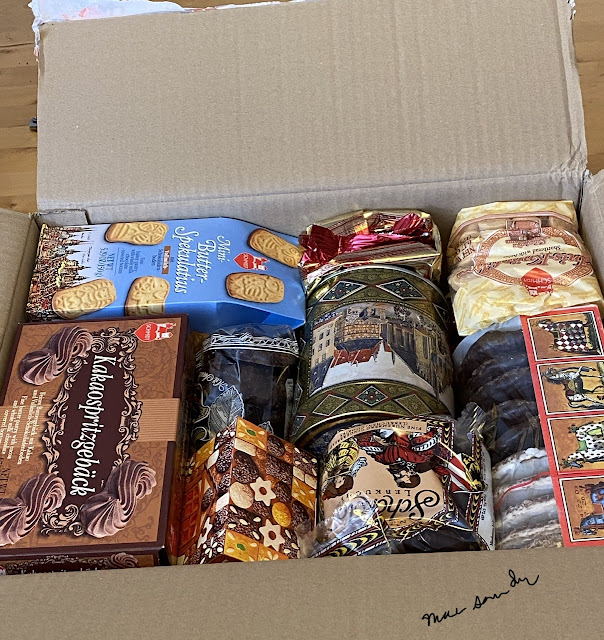 |
| Gingerbread -- Lebkuchen -- was served at the family Christmas dinner in the novel Buddenbrooks. In the picture you can see the Lebkuchen ready for the holidays at Evelyn and Tom's house this year. |
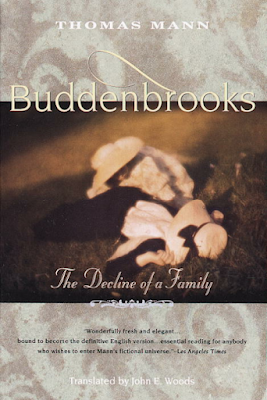
Specifically, the novel included a very long description of the family Christmas celebration in approximately 1870. Because many American Christmas traditions originated in Germany, reading about the family Christmas dinner is fun as well as appropriate for sharing this month. The Buddenbrooks' celebration started early in December. The youngest child, Johann, only son of Thomas Buddenbrook the head of the family awaited Christmas eagerly:
"With a pounding heart Johann counted the days, tearing them off one by one from the Advent calender Ida had made for him, until the day of days would arrive—the page with a Christmas tree on it. There were more and more signs of its coming. On the first day of Advent, a colorful, life-size picture of St. Nicholas was hung on the wall in Grandmama’s dining room." (p. 514).
Soon after, an old man dressed as Saint Nicholas comes to the door. Johann must say the Lord's Prayer to convince Saint Nicholas that he is a good boy. As a reward, he is allowed to reach into the sack that's for good children, and he receives gifts. As December advances, the weather becomes colder, and mysteries appear throughout the house and in the town:
"The doors to the grand salon were kept closed, guarding mysteries; marzipan and gingerbread appeared on the table. And it was Christmas out on the streets, too. Snow fell, it turned cold, and the sharp, clear air was full of the cheerful and melancholy melodies of black-mustached organ-grinders, Italians who had come to town dressed in velvet jackets for the holidays. Dazzling Christmas displays appeared in the shop windows. And the gay, colorful booths of the Christmas fair had been set up around the tall Gothic fountain on the market square. Wherever you went, you could smell the sweet fragrance of fir trees being sold for the holiday." (p. 515).
Gift giving and family meals continue through December 23 and Christmas Eve. Poor families come to the door for gifts, the employees of the family firm are given treats and presents, and before the family Buddenbrooks' dinner, choirboys from the local church sing carols for them. As they prepare to dine, a family member reads the Christmas story aloud. Four generations gather around a candle-lit tree in the very much decorated dining room and sing "O Tannenbaum." Then they open their lavish gifts, and finally their servants (about whom they don't think very much) serve sweets followed by a magnificent meal.
"Mamselle Severin and the housemaid now moved about the room with refreshments, and Hanno found time to look about him as he sat dunking a cookie in his tea. Chatting and laughing, people stood beside the table or walked up and down alongside it, showing off their own gifts or admiring those of others. There were objects of every sort—made of porcelain, nickel, silver and gold, of wood, silk, and linen. On the table was a long row of gingerbread cakes, glazed and sprinkled with almonds, alternating with loaves of marzipan bread, so fresh they were still moist inside. The presents that Frau Permaneder had wrapped or decorated—a needlework bag, a doily to put under a potted plant, a hassock—were trimmed with large satin bows." (p. 523)
"Since they had all eaten lunch earlier than usual today, they consumed large amounts of cookies and tea. But no sooner had they finished than a large crystal bowl filled with a yellow, grainy puree was passed around: almond crème, a mixture of eggs, ground almonds, and rosewater. It tasted quite wonderful, but one spoonful too much and you ended up with the most awful stomach ache. Nevertheless, even though Madame Buddenbrook begged them 'to leave a little corner for dinner,' they helped themselves freely. And Klothilde performed miracles. In grateful silence, she spooned up almond crème as if it were porridge. And now came little glasses of sabayon to refresh their palates—served with English plum cake...."
"As always on Christmas Eve, the table had been set in the columned hall. Madame Buddenbrook said the traditional grace with great fervor: 'Come, Lord Jesus, be our guest and bless what Thou hast given us.' As always on Christmas Eve, she concluded with a little admonition, the primary thrust of which was that on this holy night they should remember all those who were not as fortunate as the Buddenbrook family. And once this was taken care of, they sat down with a good conscience to a lengthy meal, which began with carp in drawn butter and a vintage Rhenish wine.
"The senator slipped a few of the fish scales into his wallet so that it would not lack for money throughout the coming year.... The turkey, stuffed with chestnuts, raisins, and apples, was praised by all. Comparisons were made with birds of years past, and it was concluded that this was the largest in a long time. There were roast potatoes, plus two kinds of vegetables and two kinds of stewed fruit, the bowls heaped so full that each looked like a hearty filling main course, rather than a side dish. They drank vintage red wine ...."
"Little Johann sat between his parents and managed to force down a piece of white meat and some dressing. He certainly could not eat as much as Aunt Thilda, and he felt tired and a little queasy. But all the same, he was proud that he was allowed to dine with the adults, proud that one of those tasty buns strewn with poppyseed had been placed on his napkin, too, and that there were three wine glasses set at his place, whereas normally he drank from the little gold beaker that Uncle Kröger had given him at his christening. But then, when Uncle Justus began pouring some oily, yellow Greek wine in the smallest glasses and the iced meringues appeared—red, white, and brown—his appetite returned. He ate a red one, although it hurt his teeth something awful, and then half of a white, and had to sample at least a little of the brown one, filled with chocolate ice cream. He nibbled on a little waffle, too, and sipped at the sweet wine while he listened to Uncle Christian, who was talking now. ..."
"Before the last course of butter and cheese was served, old Madame Buddenbrook used the opportunity for another little speech. Even though not everything had turned out over the years quite the way one, out of shortsightedness, might have wished, she said, nevertheless there still remained such manifold and obvious blessings that their hearts should be filled with gratitude." (p. 525-530)

"There are not two Germanies, a bad one and a good one, but only one, in which the best qualities have been corrupted with diabolical cunning into evil. The evil Germany is the good one in misfortune and guilt, the good Germany perverted and overthrown." (Thomas Mann, lecture, 1945, cited in Colm Tóibín, The Magician, pp 406-407)
Thomas Mann (1875-1955) is a fascinating author and public figure. He became a successful writer quite early in life with his famous book Buddenbrooks, published in 1901. He was a leading thinker as well as the author of several more novels, for which he won the Nobel Prize for literature in 1929. During the rise of the Nazis he was cautiously in opposition to them, which increased as they took power, and by 1933 his life was in danger. He spent the Nazi years after 1933 in exile from Germany, first in Switzerland, then, during the war, in the United States, where he wrote the novel Dr. Faustus. (I read it recently: blogged here.) Mann never returned to live in Germany, and died in his final exile home, Switzerland.

Tóibín's approach is to dramatize the events and relationships of Mann's life through imagined conversations -- or maybe conversations discovered in diaries and letters of the participants. As you read these vivid conversations, you can never lose sight of Mann's major life focus on writing novels, essays, and speeches, but there is really less about the actual content of his works than I would have expected. Despite Mann's reputation and success as a novelist, much of the novel's focus is on his family life, and often on his rivalry with his brother Heinrich Mann (1871-1950). During World War I, Thomas Mann was a German patriot and supporter, while Heinrich opposed the war. Later, in the 1920s and 1930s, politics came to dominate life in Germany, especially in Munich where Mann lived at the time. Tóibín showed how the author resisted making committed statements, and how he quarreled about politics and commitment with his two oldest children, who were flamboyantly anti-Nazi. Eventually, reluctantly, he left his home -- or rather, never returned from a vacation in 1933, when his life was threatened by the Nazis.
The political tensions and the way that Mann adapted to living as a German -- a very famous German -- in prewar and wartime America -- is the part of the book I found most fascinating. Mann's encounters with prominent Americans, including Eleanor Roosevelt and many others, were depicted in detail. His life in California, along with many other German exiles, was an especially intriguing part of Tóibín's presentation. Despite the fictional nature of the novel, I think these interactions were probably portrayed with accuracy and based on good sources, but of course there's no way to know, and there's nothing in Tóibín's novel that explains his sources or methods, just a list of books he used. Maybe this is a flaw: I would like to know, but I'm not about to consult those sources or try to become an expert.
The Washington Post reviewer recently called The Magician "an incisive and witty novel that shows what good company the Nobelist and his family might have been." (source) The novel also showed how Mann's success affected the people closest to him. He was at best a challenging father and brother, and at worst highly destructive, especially to his oldest son, Klaus Mann (1906-1949) who had aspirations as a writer, and succeeded for a while, but was unable to keep going. Klaus's eventual suicide in his early 40s was a crucial event in the book. Similarly, the early success of Mann's brother Heinrich Mann ended half a century later in disillusionment and poverty, with Heinrich -- whose novels were out of print and who failed as a writer in Hollywood -- overshadowed by Thomas Mann's popularity with American readers. For Klaus and all of Mann's family, the disaster of Nazi takeover in Germany forced them to flee to new and alien environments -- mostly in the US. The loss of their native land was also a major contributing factor in their failure, in contrast to Thomas Mann's ability to adapt to the new situation.
Above all Tóibín's novel is a study of identity, including Mann's identity as a German, his consciousness of the changes in what it meant to be German, his identity as a writer, as a family man and a husband, as a very closeted gay man, as an exile, and as a political figure, though Mann never wanted to be one. He comes to see Mann as a Magician in many senses of the word. All very complex.
Review © 2021 mae sander.

The narrator of Dr. Faustus is Adrian's childhood friend, Serenus Zeitblom, a modest man who presents himself as a simple biographer, putting together the important facts of his famous friend's life and work. Serenus often says "this is not a novel," but of course it's a novel! And the reader has to try to understand both characters: the narrator and his subject, to see what Thomas Mann was doing. Serenus isn't exactly an unreliable narrator -- maybe he's too reliable, too detailed, too apologetic and self-effacing, too insistent on his unworthiness. But in any case, it's a novel about two men, not a biography of one man.
Narrator Serenus, who lived in Germany, began his biographical task after Adrian's death in 1940, and his writing takes place during the worst times of World War II. He is highly aware of the significance of the advancing armies that are conquering Germany as he is writing. His narrative dwells constantly on German choices, German responsibility, and German shame: his word. He's humiliated at the failure of German culture: and German culture is a major theme of his narrative. It's not evident that Adrian was particularly aware of these events, and in any case Adrian's conscious life ended in the early 1930s. As a result there's a kind of tension between the political consciousness in the two intellectual lives intertwined in the novel.
Many features of Adrian's life and work are of great interest to Serenus. In particular, the novel includes very detailed information about Adrian's musical theories and his compositions. At one point, music is described as a kind of direct link to thought and mind, a kind of pure abstraction. Obviously, the book can't include actual music that the reader can hear. Thus, the music in the novel really is mental only, though it has been identified with the 12-tone works of contemporary composers, particularly Arnold Schoenberg. Most of Adrian's music is vocal music, including settings of poems by famous German poets, operas and oratorios based on Shakespeare's work, and the like. These textual references also help to bring the non-existent music to life.
Just half-way through the novel, there's a long chapter detailing Adrian's encounter with the devil. The devil is a very vivid character who radiates penetrating cold and speaks in a very eerie way. This chapter is presented as a document written by Adrian himself. Serenus doesn't speculate as to whether Adrian's experience with the devil is real or entirely in his head, though Adrian (both at that time and later) is completely convinced of the objective existence of the devil and his bargain. The complete lack of speculation about this reality is one of the interesting characteristics of Serenus as a narrator.
Thomas Mann was indisputably a fantastic writer, especially an observer of incredible detail. I was amazed at his descriptions of faces, that made me able to image the individuals that he was describing, and even of his characterization of certain pet dogs that were present in the lives of the characters. I was bothered by some of the stereotyping of women and especially of Jewish people, which I found a bit dated and uncomfortable. However, I see that these features are meant to characterize the rather oblivious Serenus, not necessarily to reflect Mann's own thinking.
As always, I look for descriptions of food in a novel, and there were several passages where food was used to characterize a household or a person. For example, at the beginning of the book, Adrian's mother offers visitors "the grainy dark bread with fresh butter, the golden honey in the comb, the delicious strawberries in cream, the curds in blue bowls sprinkled with black bread-crumbs and sugar." (p. 11-12) Later, the landlady with whom Adrian was to live most of his productive life "promised him light diet, milk, eggs, toast, vegetable soup, a good red beefsteak with spinach at midday, and afterwards a medium-sized omelet, with apple sauce -- in short, things that were nourishing and agreeable to a delicate stomach like his." (p. 256)
 |
| My very old copy of Dr. Faustus. |
Why did I read this novel? I chose to read it because I'm planning to read Colm Tóibín’s new novel, The Magician, which is a fictionalized biography of Thomas Mann. As the amazon review of Tóibín’s book says: "The Magician is an intimate, astonishingly complex portrait of Mann, his magnificent and complex wife Katia, and the times in which they lived—the first world war, the rise of Hitler, World War II, the Cold War, and exile." I decided to read something by Mann himself before I read the novel. This is the second time I have read Dr. Faustus, both times reading the English-language edition from 1948, which originally belonged to my father. (I probably should have made the effort to get a later, and better, translation.)
Here's something puzzling: when it was first published, Dr. Faustus was a selection of the Book-of-the-Month Club (though my father's copy seems to have been a regular commercial edition). It's hard for me to imagine the mainstream and not very intellectual subscribers of this "Book Club" at that time dealing with this ponderous book, but maybe it was simply chosen because of Mann's reputation and fame -- he had won the 1929 Nobel Prize for literature, and was admired for his politics and for fleeing Nazi Germany. The New York Times review from October, 1948, remarked: "Members of the Book-of-the-Month Club, whose co-selection for November it is, are in for a shock when they tackle 'Doctor Faustus.'" (source)
Blog post/review © 2021 mae sander.
