 |
| Four nights so far! |
 |
| At the table |
 |
| Latkes and salmon |

 |
In the Kitchen
 |
| Alice grating the potatoes. |


 |
| Len’s bread. |

|
| Four nights so far! |
|
| At the table |
|
| Latkes and salmon |
|
|
| Alice grating the potatoes. |
|
| Len’s bread. |

 |
| — source |
 |
| Celebrities |
 |
| A number of orchid societies from nearby areas presented displays of orchids at this show, which we visited this weekend. Below are photos of the orchids, as well as other plants on display in the greenhouses. |
 |
| Two orchids and one cactus from the cactus room in the greenhouse. I am very amused at finding a plaid plant! |
 |
| From the Bonsai and Penjing display. |
 |
| A stone plant: Lithops. |
 |
| The orchid show. |


 |
| An illustration from the tale “The Hunter and the Tortoise” about a hunter who finds a miraculous singing tortoise, promises to keep it secret, but finally betrays it. |
“Anansi’s wives could not even get proper food; they had to live on unripe bananas with peppers.” (p. 26)
“Egya Anansi was a very skilful farmer. He, with his wife and son, set to work one year to prepare a farm, much larger than any they had previously worked. They planted in it yams, maize, and beans—and were rewarded by a very rich crop. Their harvest was quite ten times greater than any they had ever had before. Egya Anansi was very well pleased when he saw his wealth of corn and beans. He was, however, an exceedingly selfish and greedy man, who never liked to share anything—even with his own wife and son. When he saw that the crops were quite ripe, he thought of a plan whereby he alone would profit by them” (p. 47)
“Once upon a time there was great scarcity of food in the land. Father Anansi and his son, Kweku Tsin, being very hungry, set out one morning to hunt in the forest.” (p. 66)
“There once lived upon the earth a poor man called Ohia … . Ohia thought of a plan which many of his neighbours had tried and found successful. He went to a wealthy farmer who lived near, and offered to hew down several of his palm-trees. He would then collect their sap to make palm wine. When this should be ready for the market, his wife would carry it there and sell it.” (p. 71)
 |
| Cutting down palm trees in order to make palm wine. |

 |
| The Village Carp Pond |
 |
| A Purim Play: children watch through the window. |
 |
| Sabbath Candle-Lighting: wine, candles, challah. |
For Elizabeth’s tea party — two types of wine!
 |
| Elijah the Prophet, from a 16th century Haggadah. The traditional belief is that Elijah will herald the coming of the Messiah. To welcome Elijah a cup of wine is left on the Seder table -- "Elijah's cup" -- and near the end of the ritual, someone opens the door, inviting him in, all hoping that his arrival will bring peace to mankind. |
From the Haggadah: “This is the promise — not only once did they arise to destroy us, rather in every generation they rise to destroy us. But the Holy One Blessed Be He will save us from their hands.”
This evening, April 22, is the first Seder, the traditional meal that celebrates the beginning of Passover. The Passover holiday is celebrated mainly in people’s homes, though there are sometimes communal meals as well, especially for those who are separated from their families such as students who live away from home. The “Haggadah” is the book of rituals, readings, and prayers that is used for the service that accompanies the meal. I suspect that the above quotation is on a lot of people’s minds this year, along with the irony of a wish for a peaceful world.
Although not religiously observant, we usually celebrate Passover in our home or with family or friends. I’ve written about it many times. Because we had a family visit last week, we ate Passover food early, so here are some pictures illustrating traditional foods that we enjoyed ahead of time.
 |
| “Conundrum” is a great name for a wine at Passover. |
 |
| Two foods that are part of the ritual: Matzo, the unleavened bread eaten as the Israelites fled Egypt, and Charoset, a combination of grated apples and nuts, representing the mortar that the enslaved Israelites used to build the Pyramids. |
 |
| Our table setting for our pre-Seder meal. |
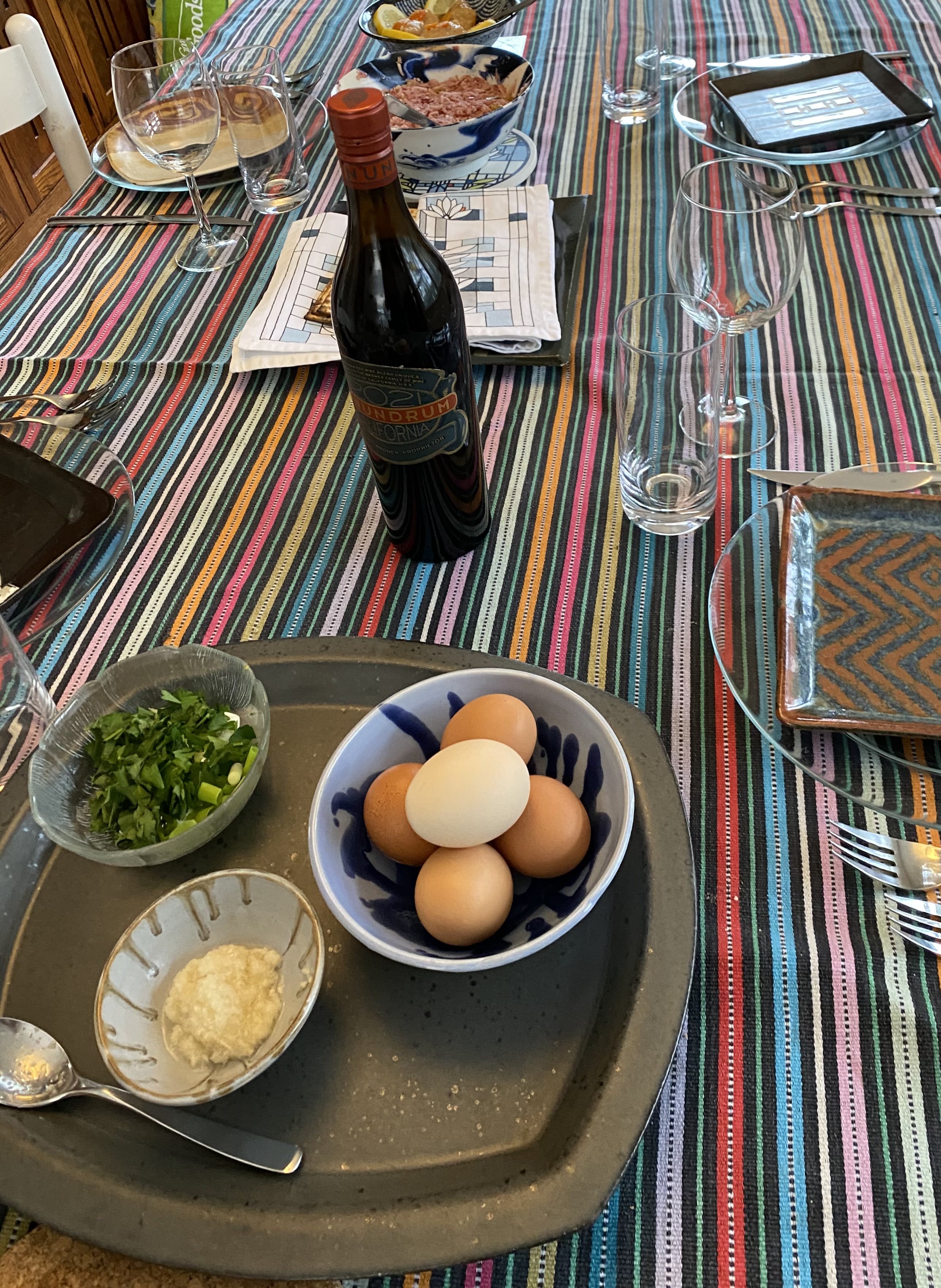 |
| Symbolic foods: egg, parsley, horseradish, wine. |
 |
| Another food that’s not required but is traditional: matzo ball soup. |
 |
| Gefilte fish is not part of the Haggadah ritual, but it’s a key dish in many people’s Passover meal. |
 |
| Recipes using dried fruit such as prunes are a Passover tradition. |

 |
| The first candle to light tonight — in my home. Israeli menorah with doves of peace! |
"Two months into a war with Hamas, the faces of Israelis taken hostage to Gaza still appear on individual posters plastered across Jerusalem bus stops and flashed across buildings. The sombre mood was all-consuming on Thursday at the start of Hanukkah, the first Jewish festival since 7 October … It was a solemn moment for all of Israel and not only for families of the 138 Israelis still held hostage."
 |
| At a rally in Tel Aviv last month |
“Barely eight weeks have passed, but this needs saying: Hamas committed crimes against humanity in Israel on Oct. 7. That much should be obvious from the terrorists’ own mass-murder video recordings, but it is indisputable for anyone who has visited, as I have, the ravaged sites of their attack. … As a Muslim woman, a physician and a journalist, I have devoted much of my work to battling radical Islam. …Islamism is a monster I know too well. And I know its hatred of Israel, hatred of Jews is especially poisonous.”
As this holiday begins, we should be celebrating the end of a war in Israel when Jewish life was threatened — of course I mean the victory of the Maccabees over 2000 years ago. But celebrating this ancient victory is hard when forces around the world and direct violence in Israel once again are threatening to destroy Israel!
Here at home in the US, we Jews are facing the most extreme antisemitism of our entire lives. The Anti-Defamation League reported on the incidence of antisemitism in October after the Hamas orgy of murder, rape, and kidnapping in Israel: “Preliminary data from ADL Center on Extremism indicates that reported incidents of harassment, vandalism and assault increased by 388 percent over the same period last year.” (source)
Over three-quarters of Jewish college students have recently encountered antisemitic verbal or physical attacks since the war began. (source) At congressional hearings this week, several prestigious college presidents embarrassingly refused to take a stand on whether a call for the genocide of Jews was against their free-speech policies. This is a complicated issue, but the safety of Jews on campuses is clearly not being taken seriously by the administrators.
In an article titled "There Is No Right to Bully and Harass," writer David Frum in the Atlantic describes this horror show:
"Rhetoric drawn from the Jefferson-Mill tradition is now being used to defend behavior that is meant to intimidate or harm. Important elements of our society have shifted from their former claim that speech can be violence to a bold assertion that violence should count as speech. ... Rifle through the news accounts of the past few years and you find dozens, if not hundreds, of similar cases of vandalism, bodily interference, even outright assault as forms of anti-Israel expression. Only this week, the Biden White House and the governor of Pennsylvania issued statements condemning the mob action against a falafel restaurant in Philadelphia owned by an award-winning Israeli-born chef and entrepreneur. But such menacing behavior has become the preferred style of anti-Israel expression in the United States and Canada."
This new American antisemitism pretends to be something else — it hides itself in a variety of ways. Another article in the Atlantic explains how this is working: "How to Be Anti-Semitic and Get Away With It: Too many communities have developed ways to excuse or otherwise ignore prejudice," by Yair Rosenberg. He writes:
“Out of 8 billion people on the planet, there are only 16 million Jews—but far, far more anti-Semites. … I have become a reluctant expert in all the ways that anti-Jewish activists obfuscate their hate. … too many communities have developed ways to excuse or otherwise ignore anti-Semitism. Today, such prejudice is growing in high and low places because powerful people around the world are running the same playbook to launder their hate into the public sphere.”
From the White House last month:
“We can’t stand by and stand silent [in the wake of Antisemitic and Islamophobic incidents]. We must, without equivocation, denounce Antisemitism. We must also, without equivocation, denounce Islamophobia.” – President Biden (source)
Earlier this week, the US House of Representatives approved a resolution opposing antisemitism. However, the wording of this measure is controversial; several thoughtful representatives preferred a more effective measure.
“Nadler, Goldman and Raskin on Monday introduced an alternative resolution that condemns antisemitism and calls on executive branch agencies and Congress to implement the Biden administration’s national strategy to counter antisemitism.” (source)
The issue of intensified antisemitic behavior and speech may seem complicated, but the problem is pretty obvious: classic antisemitism is back, along with some new forms as well. Throughout the US, Jews are now subject to verbal and physical attacks on their organizations, their businesses, and their very existence, and old racial slurs that had become socially unacceptable are now becoming normalized.
It’s not a pleasant time to celebrate the holiday, but we will try.
Blog post by mae sander. © 2023
 |
| Cookbook author Leah Koenig in the Zingerman's Classroom in Ann Arbor. |
 |
| On the table: cheese, egg yolks, butter for the gnocchi recipe. |


 |
| Chocolate and Almond Cake, Leah's recipe at Real Simple |
 |
| From the cookbook: a delicious-sounding pastry bar with pine nuts, almonds, and dried fruit. A specialty of a famous bakery in the Roman Ghetto. Leah told us quite a bit about her experiences in Rome and about this bakery. |
 |
| Portico: Cooking and Feasting in Rome's Jewish Kitchen |
Passover starts on Wednesday. The ritual meal on the evening when the holiday begins has many traditions, which include drinking four cups of wine at specified points in the communal reading of the Haggadah, the special book with the order of the service, or Seder.
|
| Elijah the Prophet, from a 16th century Haggadah. The traditional belief is that Elijah will herald the coming of the Messiah. To welcome Elijah a cup of wine is left on the Seder table -- "Elijah's cup" -- and near the end of the ritual, someone opens the door, inviting him in, all hoping that his arrival is immanent. |
Planning our Seder, I was thinking about common wisdom and common expressions that have to do with wine and other beverages. Like describing a sad drunk person as crying in his beer, or a loser as crying over spilled milk. So I searched, and found a number of quotes about water, wine, and even whiskey. Here are some of them:
 |
| African proverbs about water are especially poignant because of life-threatening droughts in many regions of the continent. (Photo source.) |
 |
| W.C.Fields did not drink water. |
 |
| Drinking wine at a Passover Seder from the Sarajevo Haggadah, around 1350. |
