Showing posts with label New Orleans. Show all posts

Wednesday, January 17, 2024

Recent Reading


While traveling earlier this month, and since I returned, I read three highly enjoyable mystery stories. During this time, I was busy documenting my experiences, so I did not write reviews of these books although I liked them very much. Here is a very brief summary of my impressions.

  • Kiego Higashino, The Final Curtain (published December, 2023) — a very long book that ties up the details of the life of Tokyo Police Detective Kyoichiro Kaga. The plot is very very involved and the number of characters and subplots is huge, but I still found it readable. 
  • Gwen Bristow and Bruce Manning, The Gutenberg Murders (published 1931) — set in New Orleans, this is very much a mystery in the classic who-done-it tradition of Hammett and Chandler. Other than the fact that all the characters smoke cigarettes nonstop, it could just about be modern.
  • Jason Goodwin, The Baklava Club (published 2014) — this series features the mystery-solving Yashim, who works for the Ottoman Emperor in Istanbul in the mid-19th century. While I very much like the well-researched details of Yashim’s life, especially when he shops in the market and cooks for his friends, I also appreciate the increasing suspense around the murder he had to solve in this, the final volume of the series so far. Goodwin’s characters are always very intriguing.
Reviews © 2024 mae sander for maefood.blogspot.com

Thursday, October 15, 2020

Beautiful Soup!

 Beautiful Soup! Who cares for fish, 
Game, or any other dish?  
Who would not give all else for two 
Pennyworth only of beautiful Soup? 
 Beau--ootiful Soo--oop! 
 Beau--ootiful Soo--oop! 
 Soo--oop of the e--e--evening, 
 Beautiful, beauti--FUL SOUP!
-- The Mock Turtle's Song 
from Alice in Wonderland
by Lewis Carroll
image by John Tenniel

Cellophane noodle soup with cherry tomatoes, broccoli, lettuce, and fried onions.
Recipe from Asian Noodles: 86 Classic Recipes from Vietnam, Thailand, China, Korea, and Japan by Maki Watenabe.

Fried onions for the soup.

New-Orleans flavored soup with okra and tomatoes.
Wild-caught gulf shrimp: to be added at the last minute.

A bowl of shrimp and okra soup.


 Blog post and photos © 2020 mae sander
Mock Turtle from wikipedia.

Monday, April 16, 2018

Ten Restaurants that Maybe Didn't Change America That Much

Selection for the next meeting of my culinary book club is Ten Restaurants that Changed America by Paul Freedman. The book is organized in ten chapters -- one for each of the selected restaurants -- with an epilogue. I found the last few chapters and the epilogue to be the best part.

Here is Freedman's explanation, from the epilogue, of why American restaurants didn't particularly adopt the fad called molecular gastronomy. This fad involved scientific experimentation with food substances and flavors for shock value and snobbish appeal, most notably at a Spanish restaurant called elBulli:
"... the American food industry has for ages been dedicated to the transformative scientific manipulation of food. Pringles or cornflakes are in their way as startling as any of those 1,846 dishes invented by elBulli. One reason the United States may not have embraced molecular gastronomy is that we already eat lots of peculiar, non-natural, scientifically manipulated products -- they just aren't crafted, complex, or trendy." (p. 422)
What a wonderful idea! Just think of Coca-Cola, whose sweeteners with or without calories most definitely involve far more elaborate scientific procedures than anything those pompous molecular show-offs do. Making high-fructose corn syrup from ordinary corn syrup requires a whole series of enzymes and heat control. NutraSweet (aspartame) uses chemicals called phenylalanine, methanol, and aspartic acid. Or just think of Cheetos and Velveeta. But I digress.

My favorite chapter of all was the description of The Pavillon French restaurant, a New York icon, which has certainly had its share of coverage in earlier books, magazines, and web sources. Freedman's description is insightful and highly amusing because his focus is on the extreme self-absorbtion and exclusive love of celebrities and "important" customers rather than on the food or atmosphere of the restaurant. He writes:
"Le Pavillon and Henri Soulé raised the standards of fine dining, but also adversely affected the reputation of French restaurants. Snobbery, discrimination, and intimidation were majestically deployed by the imperious if often entertaining Soulé, and these imputed characteristics have damaged the reputation of French cuisine in America ever since. French restaurants aspiring to anything higher than bistro steak-and-frites cooking are now exceptionally rare. It is easier to find Indian vegetarian or Ethiopian food in the United States than an actual French restaurant." (p. 294)
So .... the influence of this restaurant was not to popularize its unarguably fine cuisine, but to demean it and make it totally unpopular! Freedman underscores this point in great and enjoyable detail. How did it change America? It made us safe from the extreme New York style snobbery embodied in the restaurant!

Freedman's Figure 51: Lower East Side Restaurants, The New Yorker, 1938.
Along the left side are typical ethnic dishes from the depicted eateries.
Overall, I wonder: did Freedman make the point that he had selected ten truly influential restaurants? I'm not sure he even tried, with one or two exceptions, especially in the last chapter about Chez Panisse and Alice Waters. Around eight of the very detailed chapters, in fact, are general social history of food combined with the story of one typical restaurant, and he often has trouble sticking to the one he chose. In quite a few of the chapters there's little new material -- I've read many of his major sources so it was clear to me that he offers very little that's new or original. One very good thing: the very carefully selected illustrations, including many restaurant menus and relevant New Yorker covers. Interestingly, in the acknowledgements, credit for this feature is given to "picture-researcher Brian Meyer." (p. 450)

Freedman's chapter on one very high-end Chinese restaurant, The Mandarin, in San Francisco was especially disappointing. As with quite a few other restaurants, he's very impressed by success with rich and famous diners, believing that their approval indicates wide influence. In this chapter, he reiterates the history of the Chinese immigrants to the US pretty much as it's been told by Jennifer 8 Lee in The Fortune Cookie Chronicles and Andrew Coe in Chop Suey. Both of these books demonstrate that the influence of Chinese food in America was from the bottom up -- low-end popular and inexpensive Chinese restaurants really did change America. In a way, it seemed as if he just didn't get it. If The Mandarin was that influential, he wouldn't need to cover more than a century of preliminary popularity of Chinese food, would he?

Far from being influential, most of these restaurants reflected the trends and tastes of the times and cities where they were founded -- mostly New York, which already shows a lack of imagination. Though Freedman shows that they were popular and well-known, he doesn't really demonstrate that they "changed" anything.

Thursday, January 11, 2018

Dreaming of warm places with spicy food

Spices in the Machane Yehuda Market, Jerusalem, 2006.
Cold, cold winter here: frequent snow storms, grey skies with rare glimpses of blue. Thursday's temperatures exceptionally went into the fifties, but Friday will be back well below freezing with a low of 9º F.

I'm dreaming of warmer places and of the spices from exotic cuisines in faraway places. At right is a random selection of images of spicy food that I've enjoyed on past journeys.

And here are my dreams of places I've been and new ones where I want to go:
Herbs in the Machane Yehuda Market

I dream of the lands surrounding the Mediterranean.  Friday in Rabat, Morocco, it's forecast to be 64º -- I dream of eating a special Moroccan tagine with the hot red sauce called harissa. I've never been there, but I can dream!

In Jerusalem, Friday's temperature is 60º and if I were there, I could eat falafel with the Yemenite sauce called zhoug made from cilantro, parsley, cumin, coriander, hot hot pepper, and olive oil. I love to think of Israeli markets full of amazing spices and herbs as well as many exotic foods all ready to eat.
Provence: spices in the market at Arles, 2016.

In Nice, France, it is forecast to be 60º. I dream of fish stew with the sauce called rouille made of olive oil with breadcrumbs, garlic, saffron and cayenne pepper. I remember Provencal open-air markets full aromatic spices.

Closer to home, I dream of New Orleans where it's 70º. Imagine a plate of newly-opened oysters with lemon juice, horseradish, and a handy bottle of Tabasco sauce  -- on Avery Island near NOLA, the McIlhenny family has made Tabasco Sauce since 1868.

I dream of San Diego where high temperatures this week will be 68º and I could go to a nice taco stand and enjoy a burrito with some hot salsa in sight of the beautiful Pacific Ocean.

San Diego, California: Roberto's Burritos in 2009.
Near LA (Friday expected high 71º) they make sriracha which started as an ethnic Asian condiment and is now everywhere. And I could also enjoy the beach.

The vast Pacific offers many exotic islands to dream about. I'd love to travel to Fiji, Easter Island, New Zealand, New Guinea and more. I also love Hawaii where temperatures are in the seventies, as they are almost all winter. I dream of several favorite restaurants in and near Kona like Island Lava Java where I often have ordered fish tacos or Salade Niçoise -- Hawaii is home to Pacific Rim cuisine which includes almost every warm-weather cuisine in the world!
lunch4662
Saint Lucia in the Caribbean: a spicy lunch some years ago.

The Caribbean includes Cuba where the temperature is in the eighties and though I've never been there, I'd like to try the famous spicy black beans and more, as well as see the fascinating island with its famous old cars.

On a trip to Saint Lucia we tried the local curry chicken roti, a dish influenced by East Indian people who came to various British colonies in the Caribbean. At the resort where we stayed, we also enjoyed lots of interesting fish dishes. It's 83º there and that would feel good. So would snorkeling!


Florida Keys: The Fish House, 2017. Their "Matacumbe" preparation
with tomatoes and onions is very delicious!
In Key Largo, Florida it's 81º and I dream of the spicy fish at the Fish House there: not to mention key lime pie! Also driving the beautiful long road across many causeways, eventually arriving in Key West.

I dream of many other exotic locations, where the food is spicy and the weather is pleasantly hot. It's 103º in Buenos Aires and 90º in Rio -- maybe too hot, though I'd love to see them! It's only 81º in San Salvador de Bahia, Brazil, where I'd love to taste the foods made famous in the books of Jorge Amado -- especially the spicy dish called Feijoada. Enough dreaming!

Finally: this is loco moco, a Hawaiian special plate lunch including hamburger, rice, gravy, and a fried egg.
It's total fusion food including flavors from several of the immigrant groups that make up the Hawaiian melting pot.

Saturday, November 18, 2017

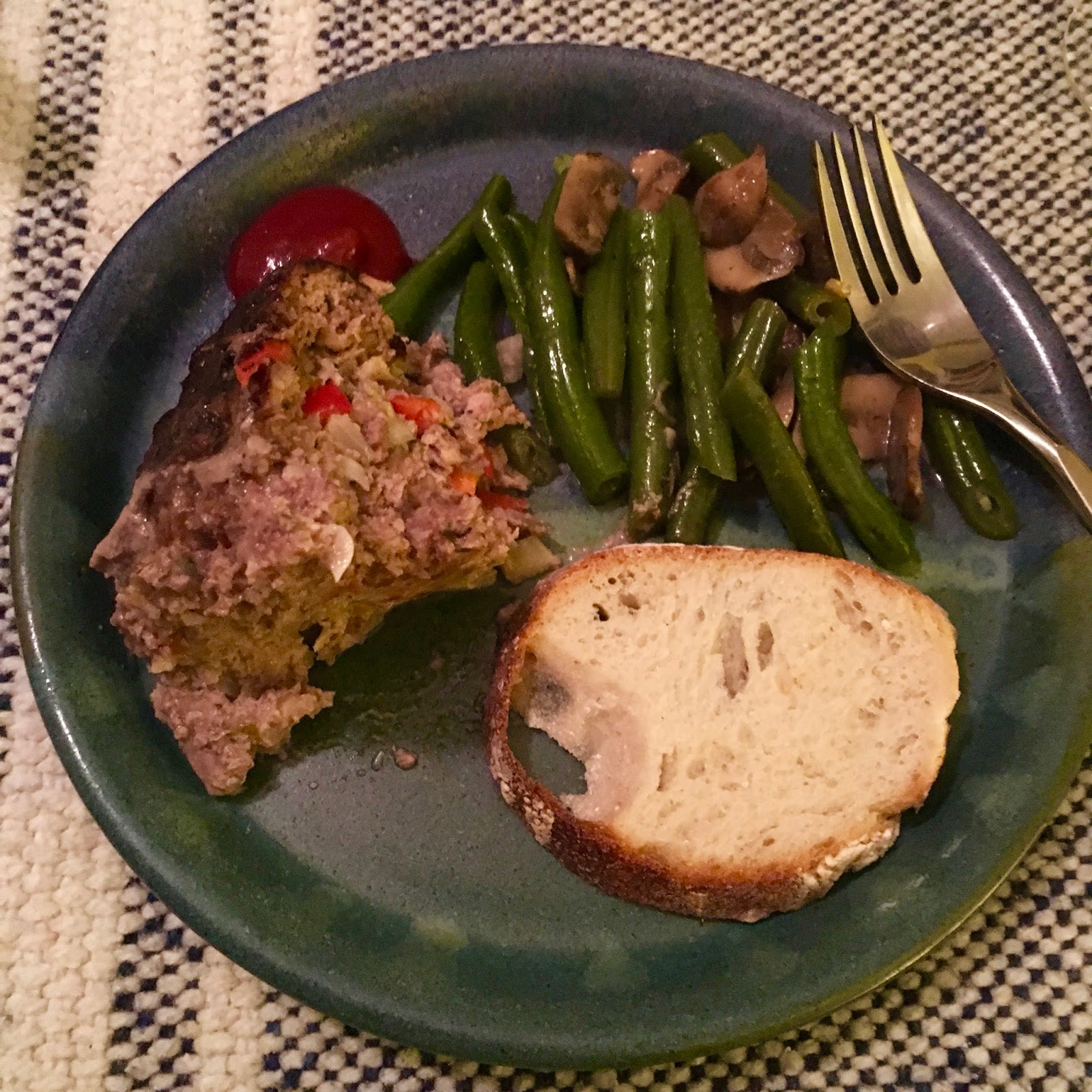
Saturday Night Supper: Meatloaf

Meatloaf is something I rarely make, but tonight I decided to do it. I also made green beans with mushrooms.
I was thinking of meatballs, but I decided to find and follow a real meatloaf recipe!
I chose the recipe in the Dooky Chase Cookbook by Leah Chase.
I substituted red bell pepper for green pepper, and keffir for Pet milk.
Otherwise I made the recipe pretty much as it appears on the page above.
It's hard to take a photo of a meatloaf in a baking dish! But it was quite tasty.
Leah Chase's restaurant in New Orleans is famous for its cooking, as well as for having
been a gathering place for Civil Rights activists over the years. I've written about her,
about the cookbook, and about the restaurant before. 

Wednesday, December 03, 2014

Louisiana Cookbooks for Cookbook Wednesday

My favorite Louisiana cookbook is The New Orleans Cookbook by Rima and Richard Collin, first published in 1975. It begins with lists. First, ingredients -- alphabetical from Absinthe through Tabasco, Tomatoes, and Yam. Second, techniques from Boiling to Smothering. Its recipe organization is just as indicative of the unique New Orleans cuisine: Chapter 1, Gumbos and Soups; Chapter 2, Red Beans and Rice! and Jambalya; then chapters titled Crabs, Crawfish, Oysters, Shrimp, and so on until Desserts and Drinks. I've written about New Orleans and Louisiana cookbooks before, starting with this, and I've based today's post on my earlier ones. 

The New Orleans Cookbook's illustrations of historic food ads, restaurants, and menus are fascinating, and the descriptions are lushly appealing:
"The steaming aroma of fresh caught crabs, shrimp, and oysters; the smell of butter and flour browning slowly in a large iron pot over an open fire; the sizzle of freshly chopped onions, green peppers, and 'shallots' added at just the moment the flour and butter turn a rich brown; the scent of chicken or duck slowly cooking into the mixture of onions, vegetables, and roux; the taste of good fresh okra or exotic sassafras -- this adds up to a good Louisiana gumbo." (p. 15)
For simpler home cooking, people from Louisiana recommend River Road Recipes, which is published by the Junior League of Baton Rouge, LA. It's another book with staying power. The number of copies was already in the hundreds of thousands when I bought one of 20,000 copies in the forty-fourth printing (November 1976).

My copy of River Road Recipes is yellowed and marked up. First, there's a little red check-mark next to many recipes, indicating the favorites of a woman we met in Baton Rouge (the mother of my brother's college friend). She recommended, for example, the Sauce Meuniere or Remoulade Sauce (p. 119) on trout. Over the years I've tried a large number of cakes and cookies from this book, and found most of them quite nice. As in many charity collections, some of the contributors were much more skilled at cooking, baking, and recipe writing than others.

Both of these books reflect the old-style Creole, Cajun, and New Orleans traditional cooking styles. Just reading through them is a fascinating reprise of one of our rapid trips into the city, when I seem to recall we ate three large meals between noon and evening, because our host wanted us to sample everything we possibly could. The dish that most impressed me was the bread pudding with rum sauce at a little home-style restaurant a bit away from the tourist area, but I've never had another bread pudding that delicious again.

Evelyn's Gumbo from Tiana's Cookbook: 
Evelyn says the recipes are good & amazingly easy to follow!
Another New Orleans cookbook in my collection is a spin-off of Disney's film "The Princess and the Frog." 

Tiana's Cookbook: Recipes for Kids,
includes quite a few serious recipes that kids may like to eat, but it takes a grownup to really cook them. Tiana's two most special dishes: beignets, which are deep-fried and gumbo.

There are also some very Disney things such as cupcakes frosted to look like frogs and a cake made in the shape of an alligator, which aren't precisely New Orleans cooking, more like Disney movie cooking. I wrote about the movie here: What do princesses eat?


Tiana's Cookbook includes versions of several recipes from another New Orleans classic: The Dooky Chase Cookbook which documents the life and recipes of Leah Chase, owner of the Dooky Chase restaurant in New Orleans. Leah Chase was a source of ideas for Disney studios when they planned the movie.

I did a full review of this fascinating cookbook and memoir in two posts -- Leah Chase: New Orleans Princess and Cooking.

The Louisiana Seafood Bible is the title of a series of cookbooks by Jerald and Glenda Horst. There are separate volumes for oysters, clams, crayfish, and two for fin fish, of which I have the first volume. There's an encyclopedic coverage of all types of information about fish, and lots of recipes. I've been meaning to try some of the recipes, but so far I have not, and I haven't written about it.


Finally, Tom Fitzmorris, a food journalist with a widely followed radio show originating in New Orleans, provided a great overview of the fascinating cuisines of New Orleans, along with a selection of recipes. When my culinary book club read his Hungry Town: A Culinary History of New Orleans, I'd never heard of him, but I read his book with enthusiasm. I wrote much more about this book here: "Hungry Town": All About New Orleans.

I liked Fitzmorris's view of food, food fads, food celebrities, and food hype. His observations of trends that started in New Orleans and were misappropriated elsewhere are interesting -- blackened redfish would be one of them. I've definitely eaten some bad burned fish as a result of that fad, and he suggests that I can't blame the originators as much as the pathetic imitations.

Again, this post celebrates both the wonderful food of Louisiana and New Orleans, and Cookbook Wednesday as invented by Louise at Months of Edible Celebrations.

Friday, March 22, 2013

Not just crab cakes


Baltimore's inner harbor is impressive, and home to a variety of dining places. So yes, I did eat crab cakes for dinner last night at an old-time restaurant called Phillips Seafood, which has been in that neighborhood for over 30 years, though mostly in another location. Now it's next to the really cool Barnes and Noble that occupies a former power plant, and incorporates all sorts of chimneys and other mechanical leftovers.

The inner harbor used to be unsightly and industrial, before becoming a tourist attraction full of shopping malls with not only seafood but also lots of chain restaurants. Once upon a time, the McCormick's spice factory was right on the harbor: just where our hotel now stands. I found the photo at right on the McCormick website, to try to picture how much the harbor has changed. I had always heard that the aromas of spices sometimes flooded the harbor area, though the aromas of many other industrial processes competed in a not so nice way.

In the shopping mall that now stands in front of the hotel (where the shipping buildings stood in the old photo) there's now a McCormick spice store with a selection of spices from their various divisions in the US and internationally. This includes Zatarains New Orleans spices, Old Bay spices, and a number of others. They even have smell-o-vision; that is, a game where the aroma of various spices is presented as a multiple-choice challenge. Since they also fill the air of the shop with cinnamon (as sort of a memorial to the old factory) it's hard to pick out the challenging smells. I got 3 out of 4.


During the afternoon, I spent some time at the Baltimore museum, where there were a couple of recent works depicting food, or at least using images of food to make some sort of statement. I also ate fried clams in their restaurant. Full Baltimore experience.

Wade Guyton and Kelley Walker Inkjet Print on Drywall, untitled, 2011

Rachel Harrison Inkjet Prints, also untitled, 2008

Friday, February 03, 2012

"Hungry Town" -- All about New Orleans

Tom Fitzmorris, whom I'd never heard of before reading his memoir Hungry Town, is a food journalist with a widely followed radio show originating in New Orleans. I have only spent a few days in New Orleans in my life, having made several short visits. I already admired the cuisine: he didn't need to convince me of its greatness. Over the years, I've bought regional cookbooks (though none by this author) and remember when NO cooking was a fad in the 1980s.

My slight knowledge of NO food doesn't make me an ideal audience for Fitzmorris's memories, but I found the whole book highly readable and enjoyable. He has a way of making each story vivid and making each dish he describes sound delicious beyond imagining. A small selection of recipes adds to the fun.

Three themes intertwine in the book. First, the history of NO cooking and restaurants, beginning mainly with the mid-20th century food trends. Second, the intense importance of food in NO culture. Fitzmorris makes a pretty convincing case that NO people have a deeper interest in food and what he calls a lust for food than those in other parts of the country. Third, the history of the damage and recovery from hurricane Katrina, the largest natural disaster to strike anywhere in the US, at least the largest in any recent memory. His selection of memories of cooks and waiters who died in the floodwaters or otherwise as a result of the storm is poignant (and I usually hate that word).

I like Fitzmorris's view of food, food fads, food celebrities, and food hype. His observations of trends that started in NO and were misappropriated elsewhere are interesting -- blackened redfish would be one of them. I've definitely eaten some bad burned fish as a result of that fad, and he suggests that I can't blame the originators as much as the pathetic imitations. Since he has spent his entire life in NO (except a few weeks as a refugee from Katrina) his point of view on this is especially enlightening.

Another interesting food trend that Fitzmorris covers is the decline of local and traditional foods; however, what makes this relatively common view more interesting is that he demonstrates that during the rebuilding of NO after the disaster, much of the local food made a comeback. He cites various reasons. For one thing Orleanean's exceptional food fascination is also reflective of their love of their city; when faced with near annihilation, they turned to the past for comfort.

As the rebuilding began and progressed, he describes how the locals recreated local restaurants in difficult circumstances; the fast-food places and national chains turned their backs and didn't necessarily reopen. His tales of heroic restaurant rebirths under terrible conditions are amazing. Within a short time after the waters receded, quite a few restauranteurs began serving free food to the clean-up crews and dedicated residents who remained in town.

Natives felt that their neighborhoods could only rebuild if they had good comfort food, and that the city as a whole also needed the fine dining establishments that gave the city its character. At times, Fitzmorris says, a small diner serving local specialties could be the only sign of life in a vast stretch of ruined homes; the people who were still there were scarcely visible.

I especially enjoyed his stories of east-coast journalists who were convinced that the small restaurants had died out, and how he convinced them that in fact, they were more numerous than before, while the chains were in eclipse. (I wonder what's happening more recently -- his book is a couple of years old, and as the city comes back the predators will surely return, I fear.)

All in all, this is a really good food memoir. I haven't tried the recipes, but maybe I will.

Saturday, September 11, 2010

Cooking

dookey4070

At the farmers' market today I bought ingredients for trying out recipes from my new Dooky Chase Cookbook. (See my post on the book from a couple of days ago: Leah Chase, New Orleans Princess).

From Ernst Farm I bought chicken gizzards, from other favorite market stalls I bought green pepper, onion, and corn. I didn't find celery or other chicken at the market, but bought them elsewhere -- and above you can see that I made the very exotic dish "Giblet Stew" (p. 35). It was delicious, spiced with thyme, paprika, and parsley.

dookey4072


dookey4073

I have some okra from the market in reserve for another of Leah Chase's Creole recipes. And earlier in the day, for lunch we had a more usual salad of red and yellow tomatoes, basil, and yellow pepper from the market. We have apples, a disappointing melon, and some leeks that I already made into leeks vinaigrette. The Ann Arbor Farmers' Market strikes again!

Friday, September 10, 2010

Leah Chase, New Orleans Princess

The Dooky Chase Cookbook documents the life and recipes of Leah Chase, owner of the Dooky Chase restaurant in New Orleans. Her father-in-law, "Dooky" Chase, founded the restaurant in 1941, at a time when black people in New Orleans had few places other than home where they could sit down to a meal -- after years of selling lottery tickets door-to-door, Dooky Chase opened a "meager po'boy stand" where he sold both lottery tickets and food. She writes:
"With 'Dooky,' Sr., being so popular with the lottery and his wife, Emily, being such a good cook, before long they were outgrowing the little corner. Five years later the lottery passed from the scene but the shop was still a popular place to go. It was the only place of its kind for black people at the time." (p. 7)
Leah Chase's involvement with the family business started years later, but eventually she became the soul of the restaurant: owner, chief cook, and important local personality. During the Civil Rights era, the restaurant became a meeting place for activists as well as being popular with New Orleans establishment figures. Recent high-profile visits to Leah at her Dooky Chase Restaurant by George Bush and Barack Obama, and her long struggle to reopen after Hurricane Katrina are part of the story, but those events were long after she wrote the book. I enjoyed reading her description of her girlhood and her food memories, which interspersed with detailed recipes, which I look forward to trying.

Vegetables, for example, were the main dish for most family meals in the country atmosphere where she grew up. The family just couldn't afford much meat, though her mother loved fishing for perch and similar fish in local waterways, which were far from the sea.

"Coming up in the depression days," she wrote, "Daddy always planted everything. He planted greens, okra, and onions." The kids in the family had a lot of work to do, and she was often unhappy when her Daddy insisted on giving away tomatoes or onions that she had worked hard to cultivate. She's anything but nostalgic for her early labor:
"If you have ever grown vegetables yourself, you don't care if you grow another one in your life. I'd just as soon go down to the French Market and buy it off some vendor. Some of my sisters still grow herbs for me, but I don't care if I never grow another thing. Farming has got to be the hardest thing in the world. Having grown vegetables does make you more conscious of the quality of the things you are buying, though. There is nothing like fresh vegetables." (p. 168)
Since the original publication in 1990, Leah Chase has written another cookbook and also has been interviewed as a model for Disney's Princess Tiana, whose dream of owning her own New Orleans restaurant is a key plot item in the movie. Leah Chase is credited with one of the recipes in the tie-in cookbook -- which to our great surprise is actually a fantastic source of recipes:


For my previous posts on New Orleans cooking see: New Orleans Cookbooks, Alice's Birthday Cake, and What do princesses eat?

Sunday, February 07, 2010

Alice's Birthday Cake

From the recipe in Tiana's Cookbook.
See today's earlier post for more about New Orleans Cookbooks.
Happy Birthday, Alice!

New Orleans Cookbooks

Louise at the blog Months of Edible Celebrations is celebrating some sporting event today. Evidently one of the teams is from New Orleans, and she wondered if I would write about some New Orleans cookbooks I had mentioned. I don't mind, as long as I don't have to say anything about sports. So here goes.

The New Orleans Cookbook by Rima and Richard Collin was first published in 1975, and it's still in print. It begins with lists. First, ingredients -- alphabetical from Absinthe through Tabasco, Tomatoes, and Yam. Second, techniques from Boiling to Smothering. The recipe organization is just as indicative of the unique NOLA cuisine: Chapter 1, Gumbos and Soups; Chapter 2, Red Beans and Rice! and Jambalya; then chapters titled Crabs, Crawfish, Oysters, Shrimp, and so on until Desserts and Drinks.

The illustrations of historic food ads, restaurants, and menus are fascinating, and the descriptions are lushly appealing:
"The steaming aroma of fresh caught crabs, shrimp, and oysters; the smell of butter and flour browning slowly in a large iron pot over an open fire; the sizzle of freshly chopped onions, green peppers, and 'shallots' added at just the moment the flour and butter turn a rich brown; the scent of chicken or duck slowly cooking into the mixture of onions, vegetables, and roux; the taste of good fresh okra or exotic sassafras -- this adds up to a good Louisiana gumbo." (p. 15)
My notes tell me I've made several recipes over the years; for example, in 1981, I tried Fricasseed Wild Duck with Brandy and Wine (p. 153), but noted that I used an ordinary duck -- never having even seen any game that I could cook. I don't really recall making this very interesting recipe. Although the recipes in this book are often challenging, I have always been glad to have this cookbook!

For simpler home cooking, people from Louisiana recommend River Road Recipes, which is published by the Junior League of Baton Rouge, LA. It's another book with staying power -- the 50th anniversary edition was published last September; several sequels are also in print. The number of copies was already in the hundreds of thousands when I bought one of 20,000 copies in the forty-fourth printing (November 1976).

My copy of River Road Recipes is yellowed and marked up. First, there's a little red check-mark beside many recipes, indicating the favorites of a woman we met in Baton Rouge (the mother of my brother's college friend). She recommended, for example, the Sauce Meuniere or Remoulade Sauce (p. 119) on trout. Over the years I've tried a large number of cakes and cookies from this book, and found most of them quite nice. Like many charity collections, some of the contributors were much more skilled at cooking, baking, and recipe writing than others.

Both of these books reflect the old-style Creole, Cajun, and New Orleans traditional cooking styles. Just reading through them is a fascinating reprise of one of our rapid trips into the city, when I seem to recall we ate three large meals between noon and evening, because our host wanted us to sample everything we possibly could. The dish that most impressed me was the bread pudding with rum sauce at a little home-style restaurant a bit away from the tourist area, but I've never had another bread pudding that delicious again.

The latest New Orleans cookbook I know about is a spin-off of Disney's latest princess movie.

Tiana's Cookbook: Recipes for Kids,
to our surprise, includes quite a few serious recipes that kids may like to eat, but it takes a grownup to really cook them. Tiana's two most special dishes: beignets, which are deep-fried, or gumbo, which is rather complex, both appear in the book.

There are also some very Disney things such as cupcakes frosted to look like frogs and a cake made in the shape of an alligator, which aren't precisely New Orleans cooking, more like Disney movie cooking. The photo at left shows the gumbo as made by Evelyn, who has been cooking her way through this unexpectedly useful book.


Several weeks ago, I wrote about the movie, see: What do princesses eat?

ADDENDUM: About Indianapolis cooking:
  • Louise's wonderful post about Indianapolis food is here: Winning Recipes From The Junior League of Indianapolis.
  • Bobbs Merrill publishers of Indianapolis are responsible for the many editions of The Joy of Cooking.
  • I think the most famous food in Indianapolis was at the 5 Laughner's cafeterias (there were a few elsewhere in Indiana as well). The last one closed in 2000. They had middle-American food like roast beef, fried chicken, and plain sides of mashed potatoes or corn. Googling you can find their cookie recipes -- which appear completely undistinguished. But people loved them. I ate in one once -- it wasn't one of the memorable meals of my life. A long description appeared here: Michael Stern and Jane Stern, A Reporter at Large, “CAFETERIA,” The New Yorker, August 1, 1988, p. 37
  • Maybe this web page -- discovered by my sister who lives in Indiana -- is the last word on Indiana foods: it lists the breaded pork tenderloin sandwich and Indiana Cream Pie (or Hoosier pie) as the specialties of Indiana. They are ambivalent about the corn dog. Maybe it's from somewhere else. But they really have corn!

Friday, December 25, 2009

What do princesses eat?

"The Princess and the Frog" is a great fairy tale. The characters include the beautiful young Tiana (a girl with a dream), her hard-working parents, an evil New Orleans voodoo man, cajun fireflies, a jazz-playing alligator, a handsome prince, and magical Mamma Odie who can reverse an evil spell and ensure that Tiana becomes a princess. A complete fairy tale -- visually, musically, and magically. AND a culinary fable as well.

Tiana's dream -- to have a splendid and successful restaurant in the best part of New Orleans. At the very beginning of the movie, as a very tiny child, she cooks gumbo for her parents, and seasons it perfectly -- with Tabasco sauce!

After the brief introduction, we jump forward in time and she's a young woman, working overtime in a restaurant and saving money to buy a decrepit waterfront building where she imagines creating her restaurant. Reality is harsh -- she seems to have little chance to succeed. But she imagines cooking etouffee, gumbo, jambalaya, and all kinds of New Orleans dream food for people from all over, and imagines (in beautiful jazz-age imagery) the atmosphere of her wonderful restaurant.

But this is a fairy tale! A handsome though penniless prince arrives on a luxury liner, just in time for a big Mardi Gras party. Her first challenge: to make hundreds of beignets for her rich friend's party. Of course the movie then presents a great adventure -- lots of magic, voodoo, danger, characters of all species from human down to firefly, and comic action. For me, the emphasis on lots of New Orleans food and cooking is what makes it most special of all.

Disney is up to his usual tricks. Of course there's lots of merchandise for sale -- even a cookbook.