Friday, June 17, 2022

Paris in July 2022


Coming soon: the ultimate blogger party of the year, an entire month of "Paris in July." Paris is surely my favorite tourist destination, and I've been lucky to visit there and even live there a number of times. This year the blog sponsors are Tamara at Thyme for Tea and Deb at Readerbuzz. Participants can write about any Paris topic — food, travel experiences, travel wish lists, books, films, TV shows, magazines, personal experiences or whatever their imagination comes  up with. Each week, Tamara and Deb will write a summary of the week’s activities. If you are a lover of Paris, with or without experience, you can be part of the fun — see “It's coming - Paris in July 2022.”

My Reading Plans

This year, I hope to read some books in French, and some books translated from French — and of course, write about them. Above all, I want to read books that have a French point of view, especially about Paris, and to read some of them in the original language. I have been looking at a number of lists of books that fit my goals. Here are a few that I hope to read and to write about:

Kiffe Kiffe demain by Faïza Guène, published 2010
So far I have read 2/3 of it in French.

Marie by Madeleine Bourdouxhe, published 1943.
I have ordered a copy of this obscure classic,
which was translated in 1997.


Le Larousse du Pain by Eric Kayser, published 2019.
Len has begun baking bread from the many recipes here:
so far so good, in fact delicious!

Possibilities -- If I'm Ambitious!

Georges Perec. A book written in 1975 about watching the
Place de Saint Sulpice in Paris. I'm not sure whether I will
try to read this in French or in translation. Or if I even have the
courage to try it! Perec’s books are challenging in any language.

One Hundred Twenty-One Days by Michèle Audin,
published in French in 2014.

Hunting and Gathering by Anna Gavalda,
published in French in 2004.

Thursday, June 16, 2022

Owls

Owls are fascinating and hard to see when bird watching. I love it when we find one. Their eyes are very strange and a bit frightening. Owls must have always seemed strange to people, as illustrated by the large number of symbolic meanings and legends that have been attached to them in many cultures. Here are four ways of looking at an owl, depicted in paintings from the Dutch Golden Age of painting.

"Malle Babba" by Frans Hals, 1633 (Wikipedia)
This owl may illustrate the Dutch proverb "Drunk as an Owl."

"The Wise Owl" by Cornelis Bloemaert, 1603-1684. (Source: Museum of Fine Arts Boston)
The owl symbolizing wisdom appears in many cultures. 


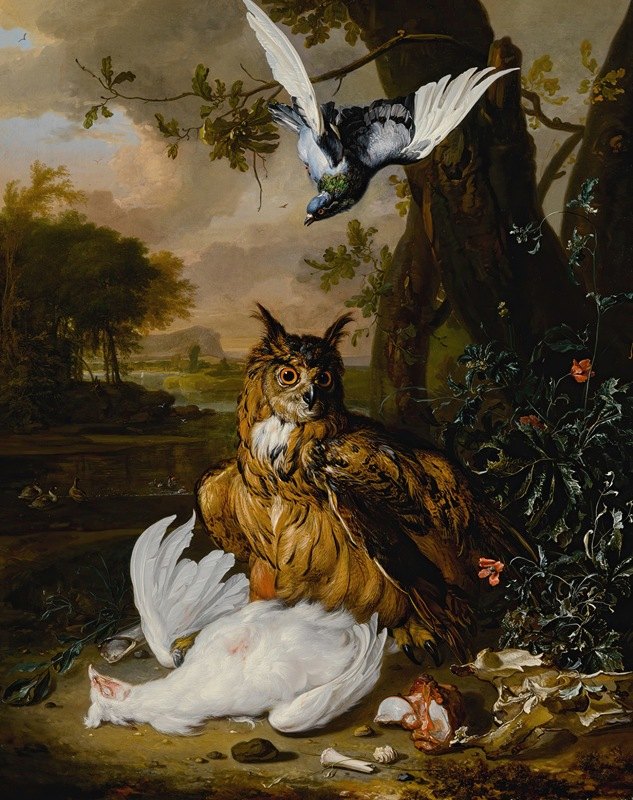
"A Eurasian eagle-owl with other birds in a landscape,"
 Dirk Valkenburg, 1675–1721 (ARTVEE)
A realistic depiction of birds by a minor wildlife painter.

Rembrandt van Rijn, “The Flute Player,” 1642. (Christies)
The owl on the flute player’s shoulder suggests the proverb “To play Eulenspiegel’s flute.”
That was a reference to the trickster Til Eulenspiegel, whose name means owl.
The flute player in this painting is playing a trick: looking up the skirt of the shepherdess.

Tuesday, June 14, 2022

"A Jewish Refugee in New York"

A Jewish Refugee in New York: A Novel, by Kadya Molodovsky is a new translation from a serialized Yiddish publication that ran in the New York Yiddish newspaper Morgn-zhurnal (Morning journal), beginning in 1941. It consists of the entries of a fictitious journal of a girl called Rivke Zilberg. She relates the first 10 months of her life in New York, between December, 1939, and October, 1940. Rivke had escaped from Lublin, where the Nazis were just beginning to execute their plan to destroy the Jewish communities and their residents in Eastern Europe. She lives first with her aunt and uncle, and then with generous strangers who help her find work and some independence.

A question that has troubled me all my life is this: How much did American Jews know about what was happening to the Jews in Europe during the war? Over time, I have learned that from the earliest days of the war, there was no mystery about the ongoing destruction of Jewish life there. This book makes that perfectly clear. 

Often, I also wonder what was life like for a "greenhorn" -- the mocking term which the more assimilated Jews applied to newcomers. My mother's family arrived in the US in 1905, and she was born a few years later, and went to American school from kindergarten through college. So she was never subject to this treatment, but her sisters remembered the arrival of their cousins in the early 1920s. Their adjustment was swift but it must have been painful. In the 1990s, one of the immigrant sisters still complained because she said someone treated her "like a greenhorn."

A Jewish Refugee in New York offers a variety of insights into the thoughts and experiences of a refugee from Hitler as she joins an assimilated community and tries to learn English and not be a burden to others. Rivka's journal entries tell a fascinating story. After all these years, this book has just been translated for the first time by Anita Norich, who says: "It is the story of a young woman shaped by historical crises, trying to make sense of her place in a bewildering, threatening world." (Kadya Molodovsky. A Jewish Refugee in New York: A Novel, p. vii). 

Rather than reviewing the book, I'm going to quote passages that make clear how it illuminates the life of a 20-year-old woman.

Far away from New York: Quotes from A Jewish Refugee in New York

"Today, I read in the newspaper about what is being done to Jews in Lublin. Even though I already knew about it earlier, it was upsetting. Yesterday I dreamed that I saw my brother Mikhl standing deathly pale, and suddenly he jumped wildly as if he was in great pain."  (pp. 24-25). 

"My father writes that he’s living at Krasulye’s and Krasulye is no more. I received the letter this morning and read it aloud to my aunt and uncle. My aunt said, 'So, thank God, at least they have a roof over their heads!' She thought that Krasulye was someone’s name, but when I told her that it was the name of our cow and that my father and brother were now living in Krasulye’s shed, she stopped thanking God. I wept uncontrollably. The letter was mailed in January, in the coldest weather. Where are they living now? And what’s happened to our home? Has it burned down? Did the Germans take it away? Who knows?" (p. 47). 

"I dreamt about my father last night. He was lying in Krasulye’s stall, on the ground, with his back against the wall, and I saw how cold he was, how he held his hands under a mound of straw. It tugged at my heart, and I jumped up wide awake." (p. 50).

"I want to know what’s happening in Lublin. What’s happening with my father and brother? The newspapers say that they’re sending all the young men away to be slaves in Germany." (p. 98). 

"I was at the wedding, but I was seeing Lublin, my father in Krasulye’s stall, Chatskel, and poor, blind Janet [other relatives who had not escaped Europe]. It was as if they were all standing near me, behind a curtain." (p. 171). 

American Life from A Jewish Refugee in New York

"Everybody says something different about America. The laundress says you have to take America with aspirin in the beginning, and Mendl Pushcart says that you can’t take the measure of your headache here. Maybe he’s right. Should I be upset just because I’m tired? Maybe it’s all not so hard. I just thought . . . and then my heart ached again because I saw how alone I was on Grand Street. Will I be able to bear it? What will become of me? I don’t know. I don’t know. I don’t know anything." ( p. 101).

"Awlriyt is the kind of word that always comes in handy. Awlriyt means good. But if you say it twice—awlriyt, awlriyt—it means leave me alone! Enough already! Awlriyt also means I understand you fully. And that must have been what Eddie’s awlriyt meant." (p. 90). 

"So, despite the fact that my grandfather, Reb Mottele, lived in the forest near Lublin, and despite the fact that he’s been dead for about ten years, and even despite the fact that he probably never gave a single thought to New York, he’s still more important in New York than I am, even though I’m already able to ride the subway. Rebbe Finkl and Mrs. Rubin both thought it mattered a great deal that I was Reb Mottele Zilberg’s grandchild." (p. 120). 

Food in A Jewish Refugee in New York

"My aunt made blintzes for Shavuos." (p. 131).

"When I got home, I found my aunt pickling herring. The smell of vinegar and cloves was all over the apartment. It smelled like Purim." (p. 50).

"All of New York called us up on the phone because of the Purim ball. My aunt heads the table committee, so the phone never stopped ringing. Mrs. Rabkin, the new vice president, called up to say that she had a kayk, and what a kayk. She didn’t say what she meant by 'what a cake.' All she said was, 'You have to see it.' Mrs. Erlich called to say that she was bringing fifty hamantaschen and a poppy seed cake to the ball. She also reported that Mrs. Rubin had gotten a hundred bottles of Coca-Cola. Mrs. Sunshine called to say that she had twelve bottles of Carmel wine." (p. 55). 

"We drank a few cups of coffee, and I ate the sendvitch she offered me. I’m not so fond of eating sandwiches. As soon as I try to take a bite, either cheese or salami or some other filling falls out. Americans make a big deal of a sendvitch, but I think of it as three separate things that should remain separate." (p. 30). 

"No matter what’s going on, there are sendvitches. It’s really something, these sandwiches. You can always find them on a walk, at a party, or at a wedding. We had dairy sandwiches and meat ones. Mrs. Shore made two cheese sandwiches, so my aunt made two with chopped liver. Mrs. Shore made two with eggs, so my aunt made two with salami. Mrs. Shore made two with herring, so my aunt made two with chicken. Mrs. Shore made two with lox, so my aunt made two with meatloaf. Mrs. Shore made two with mayonnaise and green peppers, so my aunt made two with chicken gizzards. And whether the sandwich was dairy or meat, every one came with half a cucumber covered in salt. I looked at that mountain of sandwiches and saw Chatskel and Janet  before me, dragging themselves around who knows where and who knows how long it’s been since they’ve had any food in their mouths." (p. 139). 

A neighbor tells Rivke: “When my Harry gets a little crazy, it doesn’t matter to him who he fights with. He just has to find an enemee. He fights with whoever he finds.... Do you know what I do then? I make potato pancakes! My Harry really likes them. No matter how angry he is, if I bring in a plate of potato pancakes, he makes up with his enemee right away. I don’t know how we’d live if there were no potato pancakes in the world." (p. 42). 

Afterthought

Remember: A Jewish Refugee in New York was published at the very beginning of World War II, long before many the worst atrocities of the Holocaust happened, and before many other more famous Holocaust books were written! If you have been reading recently published novels that try to create a "feel good" attitude towards the Holocaust or purporting to create moral lessons from the fate of the Jews, you might consider reading A Jewish Refugee in New York -- or even consider reading a real first-hand account of life and death in wartime Europe. For more on this, see Dara Horn's book People Love Dead Jews, which I reviewed here.

Blog post © 2022, mae sander.
Q
uotes from A Jewish Refugee in New York as attributed.

Monday, June 13, 2022

Why Are They Called Coasters?

A friend wrote me a question: Do you know why coasters are called coasters (the mats that you put glasses on, not the smaller ships that hug the coastline)?

My favorite beer-advertisement coaster.

I found the history of the word "coaster" from Etymology Online:

1570s, "one who sails along coasts," especially one who trades from port to port in the same country, agent noun from coast (v.) in its sense "to go around the sides or border" of something. Applied to vessels for such sailing from 1680s.

The meaning "tabletop drink mat" to protect a wooden table surface from condensation, etc., was in use by 1913, extended from bottle-coaster "low, round tray used for a decanter" (1874); it was formerly on wheels and so called probably because it "coasted" around the perimeter of the table to each guest in turn after dinner.

A 19th-century bottle coaster. (source)
 

Once I started reading about coasters, I couldn't stop. Most of the information I found is about cardboard advertising coasters given out in bars and restaurants and the hobby of collecting them. In addition to these promotional coasters, I've seen many souvenir coasters of all sorts in tourist shops throughout the world. Further, traditional artistic or fashionable table settings have included designer coasters made of silver, wood, stone, or glass, including coasters for glasses and for wine bottles. Most people now have coasters of one type or another in their homes, to protect the furniture when they serve drinks.


Mid-Century Modern Dansk Coasters designed by Jens Quistgaard (1960s)


The History of Coasters 

Caution: this timeline is a very weird collection of obscure facts, mainly about advertisements. Most of the information below is from "Who Invented Drink Coasters?" by Alyssa Mertes.

1880s: A German printer named Friederich Horn made the first cardboard beermats with advertising printed on them. Bar keepers loved them because they protected the tables and they were free -- paid for by the advertisers.

1892: In Dresden, wood pulp version called bierdeckels were patented by Robert Sputh. Cork beermats also became popular. Soon alehouses, pubs, and restaurants all had beermats.

1903: The Katz Group (which was originally founded as a sawmill in 1757) entered the beermat business. Over time, they introduced a variety of innovations for manufacturing them, and captured almost all of the market. (source, source)

1913: The first use of the word "coaster." This became the more common term for the increasingly popular beermats and table accessories. As the dictionary says, a "coaster" was originally a round wheeled tray that would "coast" around a table, used to serve beverages. 

1931: An Australian trademark for the Kookaburra Cigarette Paper Tube Manufacturing Company showed two kookaburras smoking -- this image then appeared on coasters. (source)


1939 New York World's Fair: The Ballantine Inn produced coasters that could be mailed like a postcard, with a place for the address written on the back -- and a stamp.


1940s - 1950s: Piel's brewery of Brooklyn, NY, advertised its beer with coasters that had different cartoon characters holding up a glass of beer. (source)


1960s and 70s: Coasters were becoming more popular in England, Australia, and around the globe.

A French Beer Coaster

1979: The Katz group, which dominated the production of advertising coasters, opened coaster-manufacturing plants in New York and Tennessee to make coasters for American advertisers.

A German beer coaster.

2009: The Katz group, still responsible for 60% of European coasters and 97% of American coasters, declared bankruptcy, but they were saved by Kohler, a global paper company. In the US, they produce something like 1.5 billion coasters a year. (source, source)

Toucans: in the Guinness ad campaign since 1954.

2014: The New York Library Association targeted legislators in Albany, New York, by placing advertising coasters in bars where these legislators were drinking. The legislators soon voted to restore $4 million in library funding -- maybe influenced by the coasters. A Restaurant Association later ran a similar coaster-ad campaign in Albany to influence the vote on New York's blue laws.

2016: Over 1000 different advertising coasters were exhibited at the Kyneton Museum in New South Wales, Australia, in a show called "Coast to Coasters." The exhibit included a vast collection owned by an Australian collector as well as a collection of German advertising coasters from the 1950s.

Terry Moore and his coaster collection at his pub.
He loaned the collection to the Kyneton Museum for "Coast to Coasters." (source)

NOW: The Guinness Book of World Records has an entry for the largest collection of coasters: 152,860 different designs from 192 countries collected by Leo Pisker of Langenzersdorf, Austria. Many collectors' organizations and advertisements for collectible coasters can be found by simple web searches. (source)

Coasters from the Kona Brewing Company in Kona, Hawaii.
A wonderful place to have a beer and a hamburger!


Blog post © 2022 mae sander, images as credited.

Sunday, June 12, 2022

Flags of my Neighbors


Bench donated by two brownie troops and the PTO of the school.

“Flags” is another name for irises, at least in some places.

And a mural on the door to the park building.

… also a random cat.

I didn’t see anyone flying this flag
Photos © 2022 mae sander


Friday, June 10, 2022

Picasso's Birds of War and Peace

"Art is the elimination of the unnecessary"-- Picasso

"Cat Catching a Bird," 1939, Pablo Picasso.

In 1939, the Spanish Civil War was turning beautiful urban areas of Spain to rubble. The Spanish Fascists, who were seeking to overthrow the elected democratic government, enlisted the support of Nazi Germany. German military forces enthusiastically employed their weapons in attacks on Spanish cities where inhabitants opposed the Fascists. The British, French, Soviets, and Americans adopted a policy of "nonintervention," and embargoed weapons shipments to Spain.

Pablo Picasso -- a Spaniard who lived and worked in Paris -- reacted to the fate of his countrymen by creating dark and foreboding works of art, like this cat preying on a bird. His memorable work "Guernica" two years earlier had commemorated a terrible bombing of the Basque city of Guernica by Nazi war planes, causing the destruction of much of the town and large number of casualties. Picasso's imagery is unforgettable, and remains familiar as a symbol of the horrors of war.

"Guernica," 1937, Picasso.

The Spanish Civil War lasted from 1936 until 1939, and resulted in the overthrow of the legitimate government and the institution of a Fascist government — a regime that lasted until the 1970s. This tragic war has been on my mind because of the frightening parallels between Nazi and Fascist attacks on Spanish civilians and the current brutal attacks of the Russian army against the civilians and civilian property throughout Ukraine and because of the Russian goal of overthrowing a legitimate government.

Picasso, "Dove," 1949.
Image used as the symbol of the 1949 Paris Peace Conference.


"Dove of Peace"

"Dove"

Picasso, who had been apolitical before the Spanish Civil War, became an advocate for peace, and after World War II, he created a number of images of doves of peace that were used by pro-peace organizations. Throughout the post-war era, the greatest fear was of a nuclear war between the great powers: the United States and the Soviet Union. Can these symbols of peace still bring us hope?


History now views the Spanish Civil War, with its use of modern weaponry against civilians, as a prelude to World War II. As in the 1930s, now in 2022 we don't know what will come next after the war in Ukraine. We fear the worst. We hope it won't happen.


Blog post © 2022 mae sander. 
Idea about Picasso from Deb at Readerbuzz.

Wednesday, June 08, 2022

“Kalmann,” an Icelandic Mystery


Iceland is a wonderful place. We toured there last summer, and hope to return when such travel is possible. So I was excited to hear about a new mystery novel named Kalmann by Joachim Schmidt. It’s set in a very small town called Raufarhöfn in the remote northeast of Iceland. The town is in “the snowy hinterland of the Melrakkaslétta.” (p. 5) It's a real town, though the events and characters are fiction.  We visited some places not extremely far from there, but not that town in particular. 

Kalmann, a thirty-four-year-old man, is the narrator. He lives alone and loves to watch many American TV shows. When he goes out, he pins an American sheriff star on his coat, and he wears a cowboy hat and a holster in which there's a real gun (but most people think it's a toy). He quickly reveals that he has mental disabilities, but as he describes his life and in particular, his adventure with the police and a murder, he seems to have his own sort of intelligence and self-awareness.  For example he says: 

"I have a superpower. I notice when people glance at one another, and I can read those glances. When I meet someone I’ve never met before, these kinds of glances always get exchanged. But I’ve learned to ignore them. Sometimes people look at me, stare at me in this completely backward way, and then I can’t help but grin, even though I don’t want to grin, but I do, and sometimes someone or other says: 'Why is he grinning like that?'” (p. 67). 

By trade, Kalmann is a fisherman: he sets out baited lines and brings in Greenland sharks from very deep water. He's also a hunter, and closely observes the birds and animals in the rugged environment: "A hunter has an eye for these things. On the Melrakkaslétta, there were Arctic foxes and wild geese, falcons and snow grouse. Once, and only once, I saw a snowy owl." (p. 102).  I loved hearing about the birds he saw, some of which I've seen when in the far north. He writes about the snow grouse and the falcon:

"I would see snow grouse for sure, because at this time of year the cocks were still in their white winter plumage and easy to spot against the brown terrain. The females already had brown flecks in their feathering, camouflaging them against the falcons. The men sacrificed themselves for the women, so that at least their offspring would be protected. That’s the balance of nature. You can’t change it. That’s just how it is. Women and children first. The falcons’ favourite dish was snow grouse, and when there are only a few, there are fewer falcons, because then they have nothing to feed on. And if there are fewer falcons, there are more snow grouse. And when there are more snow grouse, there are more falcons. This example can most likely be applied to humans too, but at this moment I can’t think how." (p. 198). 

After each successful catch of a shark, which doesn't happen often, Kalmann ages and treats the shark meat, which is inedible without processing. His secret cure for the shark meat makes it into an Icelandic delicacy called hákarl. The odor of this delicacy is very strong and even many of his fellow townspeople find it offensive, but he and a few others are quite fond of eating it. He claims to make the second-best hákarl in all of Iceland -- the best having been made by his grandfather. 

Foods, including both Icelandic foods and imported foods and drinks, are of great interest to Kalmann; for example, his favorite drink is cola. And he likes "a hamburger with fries and Thousand Island dressing." (p. 108).  At a reception, he attended, he mentioned "the dried fish, the rye bread, the smoked lamb, the cake and the coffee," that were served to the guests. (p. 274).

When Kalmann describes the little he knows about his grandmother, who died before he was born, he says that she cooked only a few things: "broiled fish with potatoes, fish balls with potatoes, or lamb soup with carrots, turnips and potatoes." (p, 57) His grandfather is very much alive though he's lost his memory, and is now a patient in a nursing home in a neighboring town, and unable to do anything much at all. On a visit, Kalmann joins the residents for a meal:

"Then the lunch gong rang, and we went to eat, but Grandfather wasn’t hungry and silently pushed his plate away. I ate only the mashed potatoes, the sauce and the pork, but when it came to the vegetables my stomach was full to bursting. ... For dessert there was carrot cake. It was delicious. I ate Grandfather’s piece too."

Grandfather perks up when Kalmann brings out a treat: 

"Once we were back in the room, I pulled out my little plastic container of hákarl. I always had a little folding knife with me. It had a good edge to it. I cut the hákarl into little pieces, and Grandfather watched me impatiently. Once I was done, he helped himself and hummed contentedly. 'It’s enough to bring tears to your eyes,' he sighed. I was so proud. ...

The taste and aroma of this favorite food trigger a moment of clarity in Grandfather’s mind. He asks about the fishing boat and Kalmann’s activities. And:

"Grandfather studied me. 'You’re really good at it,' he said. 'I always knew you would be.' I nodded and tried to suppress a grin. Grandfather grabbed my hand and squeezed it tightly, so much so that it almost hurt. 'Your shark is really delicious. The best shark in the whole of Iceland!'” (p. 118-120)

Later on, during an exciting moment in the police investigation into the mystery of the novel, Kalmann participates in an impromptu meeting of a few of the residents of Raufarhöfn (population less than 200). They have another Icelandic treat, which amused me because we sampled some when we were there.
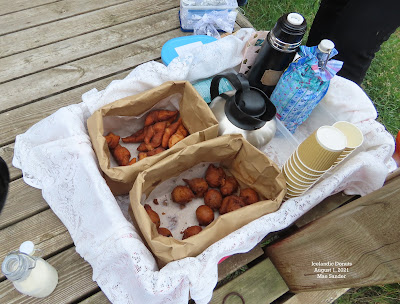
Icelandic Donuts and Coffee, served by our local
guides on a long hike not very far from Raufarhöfn.

Kalmann's words:

"We waited impatiently until Siggi had finally arrived in the harbour. Sæmundur fetched a pitcher of coffee and fried kleinur doughnuts, so the atmosphere was great. A few more people came and joined us, for example the poet Bragi."

This paragraph also suggests how the author creates brief and amusing portraits of many townspeople in Raufarhöfn, as well as vivid depictions of the land, the sea, and the wildlife. I can't tell you very much about the wonderfully crafted murder mystery that is the center of this book, because I don't want to spoil the story in case you decide to read it. It's very much worth reading!

I'm sure many readers will be tempted to compare Kalmann to The Curious Incident of the Dog in the Night-Time by Mark Haddon, because the central characters of the two books have some disabilities in common. I suggest that Haddon's statement about his novel applies to both books. He says his work is "a novel about difference, about being an outsider, about seeing the world in a surprising and revealing way." But that it's not about a specific disorder. True also of Kalmann.

Blog post © 2022 mae sander.

Tuesday, June 07, 2022

In the English Countryside

I wrote this in 1999 after being in Cambridge, England, for several weeks, while Len was attending a workshop at the Isaac Newton Institute at Cambridge University. I was thinking of this long-ago experience when I watched a performance of “A Midsummer Night’s Dream” at Shakespeare in the Arb last week.

1999: Riding my bike in Grantchester, near Cambridge, England.

Along the Cam river towpath watching the crews practice rowing, we left our apartment in Chesterton near Cambridge. We cycled towards Bait's Bite Lock. Pleasure boats use the lock by pushing a button to let water in or out. Cyclists push the bikes up a narrow ramp alongside the stairs to get to the other side of the river. From there, we began our ride through fields and past farm yards, using a distant power line with its tall steel pylons as a goal. At one point the track narrowed to a single beaten path across a field, not much wider than a single tire, marked by occasional stakes. The final trek followed a disused railway line, detoured around an old mill race, and entered a small town where Sunday family activities included loading furniture into station wagons, and doing bits of yard work in well-kept yards of substantial English houses.

Anglesey Abbey, a National Trust Property (Source: the Abbey Website)

After a short stretch of too-busy paved road, we reached the entrance to Anglesey Abbey, a stately home that long ago served as a religious building, so still is called an Abbey. The complex includes the usual large tourist facility, with a vast parking lot and a modern ticket-sales area including public restrooms and a cafeteria capable of seating several busloads of tourists. Inside the gates, the grounds extend northeast to the mill which we had circuited on our bikes, and west through a vast expanse of formal gardens and manicured woods.
 
We toured the mill as well as the house. Because of the proximity to appropriate water, the site has probably provided milling power since Roman times. The present building, much restored, has stood for a few hundred years. First a grain mill, and later a cement mill. No direct mention, but the disused railway line went right up to the mill, and must have been important for bringing in raw materials and taking away the milled gravel and cement products. Now, associations of young milling hobbyists run the mill on chosen weekends, as well as other mills in the area and throughout England.

Anglesey Abbey is in an English Fairy Tale setting. It invokes all kinds of half-remembered children's stories about the long history of small-statured immortal tribespeople who lived in these fields. The National Trust documentation and souvenir shop was more interested in selling tea towels, boxes full of miniature jam jars or chocolate bars, and monogrammed crockery than in offering any maps of local fairy rings. So use your imagination, call up your memories of fairy tales, of Shakespeare's Puck and his royal masters Oberon and Titania, of the Irish Pooka who came to America as Harvey the Rabbit in the Broadway play, and of the Welsh creature called pwcck. They all wander on these long-trodden paths.

Above all, I am reminded of Rudyard Kipling's book, Puck of Pook's Hill. It begins with "Puck's Song."  


Puck's Song

See you the dimpled track that runs,

  All hollow through the wheat?

O that was where they hauled the guns

  That smote King Philip's fleet.


See you our little mill that clacks

  So busy by the brook?

She has ground her corn and paid her tax

  Ever since the Domesday Book.


See you our pastures wide and lone,

  Where the red oxen browse?

O there was a City thronged and known,

  Ere London boasted a house.


She is not any common Earth,

  Water or wood or air,

But Merlin's Isle of Gramarye,

  Where you and I will fare.

Throughout the story, Kipling interlaces little verses among the adventures of two children and their meeting with the short, ancient Puck, who doesn't want to hear the word "Fairies." They have called him out of the magical hills, especially his own, Pook's Hill, by acting, in a fairy ring, some scenes from Shakespeare's Midsummer Night's Dream. A millstream ran nearby, its banks overgrown with plants. As it had for generations, the stream still carried water to a nearby mill. 

Upon emerging and surprising the children, whose names were Dan and Una, Puck claims the land, and they dispute it, countering with their father's ownership. "I'm Puck, the oldest Old Thing in England, very much at your service if — if you care to have anything to do with me. If you don't of course you've only to say so and I'll go." They ask him to stay and share their biscuits, which he eats with salt, calling attention to the significance of his gesture. He borrows a knife, cuts a clod from the earth, and presents it to them ceremoniously, explaining that this makes the land theirs in a much more significant way. All the formalities over, he begins a tale of the Norse god later known as Weland, describing the god's arrival in England, his long stay while people worshipped him, and finally, his departure. 

The first chapter of Kipling's Puck thus sets a scene that enchantingly calls up my experience at Anglesey Abbey and especially in the fields surrounding it, and the mill that it now owns (though the actual setting of Kipling's story is quite far from there.) While lots of other fairy tales evoke similar fields and streams, I find the childhood discovery described in this book to be the most appealing. 

The main point of Kipling's book is imaginative retelling of certain key areas of English history. Puck represents the place: he sees all the others: Saxons, Romans, Normans, Jews — as newcomers. Kipling presents him as totally rooted. Unlike supernatural figures from other sorts of stories, Puck does not come from some mysterious or dangerous "other side." 

I want to see Puck as Kipling's creation and prior to that as Shakespeare's creation. These literary figures are not folklore, though they owe their origin to folk tales where they are called Pucks or Pookas. (Also in another literary creation, the play "Harvey," the chief but invisible character is a human-scale rabbit named Harvey, identified as a Pooka, or mischievous but harmless character from Welsh and Irish myth.)

In reading Puck of Pook's Hill, I was astonished that Puck/Kipling depicted a figure from medieval Jewish history as a key to understanding the events of the twelfth century. I waver between fascination and dislike for the characterization of Kamiel, the Jew who has the gold -- and I'm particularly unfond of Kipling's poem attributing possession and love of gold to a Jewish destiny. However, I do love the character Puck in both Shakespeare's and Kipling's works.

Text © 2022, 1999, mae sander.  


Monday, June 06, 2022

A Midsummer Night’s Dream


Since 2001, "Shakespeare in the Arb" has presented outdoor performances of a chosen Shakespeare play each June, except during the pandemic. This year's play is "A Midsummer Night's Dream." The first scene was presented in the peony garden, which is a very popular site in the Nichols Arboretum -- "The Arb." Here you can see the introductory musicians. Behind the performers, you can see many people (the ones without costumes) visiting the peony beds which are at their peak this weekend.

The audience and players move from one location in the Arb to another. This performance had four or five such changes. It was a beautiful evening and very pleasant to walk in the woods and open spaces.

The "rude mechanicals" rehearse their play-in-a-play.


Bottom the Weaver.

The character Puck was played by three actors.
I would prefer the traditional choice: just one Puck!

Queen Titania about to go to sleep,
with her four fairies chanting a lullaby.

Queen Titania, bewitched by Oberon, falls in love with Bottom.
He now has the head of an ass, thanks to a mischievous magic spell.

Bottom with the fairies.

Final applause for the players. Some cast members are students, and some are from the local community.

2007: "The Tempest"

In 2007, the play was "The Tempest." The photo is from that performance.
We have attended several other presentations of "Shakespeare in the Arb."
The Arboretum and the presentation are sponsored by the University of Michigan.

We took some sandwiches for a pre-performance supper.
Our beverage: sparkling water (to share with Elizabeth).
NOTE: This is not an ad!

Blog post and photos © 2007, 2022, mae sander.