Monday, July 20, 2020

"A Long Petal of the Sea"

A Long Petal of the Sea, published 2019.
A young medical student named Victor Dalmau serves at the battle front where Spanish Republicans are fighting the fascists, inspired by "Dolores Ibarruri, appropriately known as La Pasionaria because of her ability to rouse fanatical enthusiasm among the Republicans." (A Long Petal of the Sea, p. 18).

At the defeat of the Republicans, Victor finds himself as one of thousands of refugees begging for asylum in a cruel concentration camp on the border of France; again he does his best to treat their wounds and illnesses. His release comes from the actions of Chileans who sympathize with the Spanish republicans: they overcome conservative opposition and welcome a ship full of refugees into their country. The leader of this effort is the famous poet Pablo Neruda.

Rescued with Victor is Roser Bruguera, the brave and talented woman he has married to save her and her child, the son of his brother who had died on the battlefield. Chile was an unknown place to them as they approached it after weeks at sea:
"THAT SUMMER DAY, AUGUST 4, 1939, remained forever engraved on the minds of Victor Dalmau, Roser Bruguera, and the other two thousand or more Spaniards sailing toward that long, narrow South American country that clung to the mountains so as not to topple into the sea. None of them knew anything about Chile. Years later, Neruda was to define it as a long petal of sea and wine and snow… with a belt of black and white foam, but that would not have left the migrants any the wiser. On the map, it looked slender and remote." (p. 136). 
As Victor Dalmau adapts to life in Chile, he fully assimilates into life there. He continues an acquaintance with Pablo Neruda, the poet with enormous sympathy for common people. He plays chess with Salvador Allende, who is both a doctor and a Chilean politician, eventually its far-left President. Throughout his life, Victor's wife becomes more and more remarkable, a memorable if somewhat idealized character in this wide-ranging work of literature, advising him wisely and supporting him unselfishly. The novel describes the many events of their lives and that of their son, as well as the parallel lives of a very rich family of long-established Chileans.

At sixty, after a peaceful life as a highly respected doctor in Chile, Victor Dalmau again becomes a victim of tyranny when the fascist dictator Pinochet takes over from Salvador Allende. He thus witnesses yet again the torment of political prisoners at the mercy of inhuman military officials. Victor starves with them while he tries to treat their wounds and illnesses. After eleven months in the camp, he is freed and yet again becomes a refugee, in Venezuela. Roser's advice on having to adapt to another new country: "Pain is unavoidable, but suffering is optional.” (p. 300).

Isabel Allende's A Long Petal of the Sea is a wonderful historical novel, which I enjoyed for a number of reasons: above all for how much I learned about history and for how much I admired the characterizations of many many people in Victor Dalmau's life. I love the way that these fictional characters play a serious though somewhat idealized role in historical events, especially in Spain during the Civil War of the 1930s and in Chile from 1940 until 1995. Through their experiences, the reader can share the experience of history as it happens, witnessing right and wrong, as well as making the acquaintance of various historic figures like Salvador Allende and Neruda. I enjoyed the quotations from Neruda at the start of each chapter. I also loved the author's use of food as a marker of rich people, poor people, and utterly deprived victims (blogged here).

The idealism and the horrors of the twentieth century are embodied in the entire work, as well as speaking to us now in 2020 as we seem about to repeat the mistakes of the past. Oh, please, I think as I read -- don't let us have another bout with fascist repression of humanity! Don't let another Franco or another Pinochet take over the world! Don't let democracy die!

My only reservation about the novel concerns the character of Roser Bruguera. She's too perfect! She's very intelligent and gifted, creative and able as a pianist and organizer of music, fearless and adaptable in the face of horrific circumstances, loyal to Victor and his family, dedicated to her son -- flawless. Her idealized existence may be believable in the context of the novel; however, in a way the author seems to just use Roser to advance the themes and events of the work, not to explore the human spirit or the role of women in all the events.

After I wrote the paragraphs above, I looked at the review that were published a few months ago when A Long Petal of the Sea was first published. The reviewer in the Washington Post hated the book; I think this was an outlier! The New York Times reviewer, Paula McLain, was enthusiastic:
"In 'A Long Petal of the Sea,' as in much of Allende’s fiction, there is the sense that every human life is an odyssey, and that how and where we connect creates the fabric of our existence: the source of our humanity. If what happens to us — the axis of our fate — is nearly always beyond our control, stubbornly unchangeable, we can still choose what we cleave to and fight for, refusing to be vanquished. This is true belonging, and how we build a world." (source).
In the Guardian, also a favorable view from Hephzibah Anderson:
"At this point in Allende’s long career, it’s easy to forget what a trailblazer she was, a rare female voice in a wave of Latin American literature that was overwhelmingly male. Vivid vignettes serve as reminders here, among them an opening scene in which Victor brings a smooth-cheeked young soldier back to life by massaging his heart, and another in which he feels his own break. 'It was at that moment he understood the profound meaning of that common phrase: he thought he heard the sound of glass breaking and felt that the essence of his being was pouring out until he was empty, with no memory of the past, no awareness of the present, no hope for the future,' Allende writes." (source)
Isabel Allende is one of the most famous South American authors. I've read very little of her work and hope to read some of the older works.
This review by mae sander copyright © 2020. 

Summer food & drink

Getting ready for outdoor, distanced dining. Separate serving dishes for us & our guests,
including Len’s fresh-baked kaiser rolls which were fantastic. Our guests are from
Poland and Serbia, where these rolls are also popular — as they were in the St.Louis
bakery of my fond childhood memories!
Down the street, Kathy's Bear was also preparing for a picnic
with a bottle of wine. The bear continues to have new things
to use or play with every day, and is a neighborhood magnet.
Salad lunch with Diet Coke. We used to drink it every day.
But we stopped when shopping became so problematic,
and we don’t miss it. Just have it every few weeks.
Onion soup and wine.
Rice pudding with apricot compote and Grand Marnier, in addition to rosewater.
Recipe by Sherry — at this blog post — the rosewater and cardamom flavors are great.
Another summer treat: local blueberries.
Breakfast: more rice pudding with fresh peaches & berries.
This time with cinnamon. And of course, coffee.
Tortilla covered with vegetarian red beans, cheese,
avocado, etc. And of course red wine with dinner!
Happy Tuesday beverage celebration
at Bluebeardand Elizabeth’s weekly blog party.
Blog post and all photos by mae sander, © 2020.

Sunday, July 19, 2020

"The First Thing You See"

"Long" is a very small town in France, probably fictional, very reminiscent to me of Garrison Keillor's Lake Woebegone, Minnesota. In the novel The First Thing You See, author Grégoire Delacourt presents a rather strange tale about Long's lifelong resident Arthur Dreyfuss, a garage mechanic, and his unexpected visitor, who at first appears to be the famous film star Scarlett Johansson.

Here is a rather detailed description of the town:
"On the third evening of his life with Scarlett Johansson, Arthur Dreyfuss came home with Vicky Cristina Barcelona and The Island, the two DVDs that he had managed to find at the Planchard hairdressing salon (where you could also leave your ink and laser cartridges to be refilled). Easily recognisable by its boring brick facade, the salon had two little picture windows, a red brick mezzanine floor and a washed-out sign saying Édonil Hair Care. He was also carrying their dinner: cheese puff-pastry rolls (cheese again!), two plates of charcuterie, and a bottle of wine from Tonnelier – butcher, delicatessen and catering – in the Rue du 12 Novembre 1918.
"The butcher’s shop was a place that never dated. It was like something out of a Depardon photo, with its red and white facade and its black lettering, capitals with serious-looking serifs, like the lettering in a radiologist’s consulting room, each letter stuck on a different white cube. If there hadn’t been any cars or advertisements in the background you might have thought you were back in the 1950s. In Long, time seemed to have stood still, with its low-built houses, made of brick or cement, pitched tiled roofs, walls painted cheerful colours – yellow, ochre, or a happy sky-blue like the butcher’s shop." (Grégoire Delacourt, The First Thing You See, Kindle Locations 487-496).
Long is a very ordinary, even boring town, a perfect background for this rather bizarre and dramatic tale of love, sadness, and identity. The novel centers on the way that films, film stars, popular music, performers of music, classic literature, and many more cultural things swirl around in the consciousness of both the characters and the narrator. Delacourt explores the clash between imagination and reality. Ordinary people (like the residents of Long) are fascinated by famous film stars and the ideals of beauty that the stars represent. In the novel, these idealistic creations collide with the humdrum quality of their day-to-day life.

Ironically, the film star Scarlett Johansson, the real one, sued the author because he made her into a kind of symbol in the book. She won the case in French court, and received damages -- in the US, of course, the protection of free speech would have made such a judgement impossible. This says something about the book, I'm not sure what. Note that Grégoire Delacourt is a very famous and successful author in France, maybe not so well-known here in the US.

Just let me mention this: the town of Long and the life of Arthur Dreyfuss are both very French in many details, sometimes funny and often sad. One example of how French it is: Arthur Dreyfuss takes the seeming-but-not-real Scarlett Johanson to the town's best restaurant, the Relais des Orfèvres, which was run by the chef Jean-Michel Descloux and they have an expensive meal (at least by Arthur's standards). At the restaurant:
"The traditional menu, for real gourmets, was as follows. First course: a crusty timbale of fillet of smoked black pollock with creamed cauliflower; main course, roast hake with seaweed butter, crisp ham tuiles with piquillo sauce – made with a kind of sweet pepper grown in Lodosa in the Spanish Basque region – and finally, Julien Planchon’s cheese trolley or the dessert menu. The economic miracle of those 30 euros was contained in that ‘or.’" (Kindle Locations 829-832). 
Because of details like these, and because of the eventually compelling plot, I enjoyed reading the book, but no spoilers. However, without telling the end, I want to quote this thought from the book:
"Unfortunately, there isn’t a musical score to accompany life as there is in films, only noises, sounds, words, coffee machines going cling, the castors on hospital trolleys going rrr-pfft-rrrr-pffft, and tears, sometimes cries reminding you that this is all horribly real, particularly in a hospital with deranged patients, emergencies, fear and goodbyes going on forever..." (Kindle Locations 1246-1249).
Because this book is set in France I'm sharing this review with this month's blog event "Paris in July," hosted by Tamara at Thyme for Tea. One of the other participants reviewed another book by Grégoire Delacourt, and gave me the idea to read this one -- I apologize, but I can't find that post any more!

This review is copyright, © 2020 mae sander. 

Saturday, July 18, 2020

On the River

At Gallup Park, the Huron River is very wide: a good place for crew practice.
Far upstream, at another park along the river, we saw these
fishermen in their waders. You are warned not to eat the fish!
Our kayak is small, but it has allowed us to enjoy a bit of fun paddling on the Huron River at various spots where the current is mild, and it’s not too hard to go both upstream and downstream. Truth be told, Len does most of the paddling. Some time I’ll manage to get a photo that includes the kayak, but I don’t like to take along a camera for fear I’ll drop it in the river.

We did stop a moment the other day to take a photo — with Len’s iPhone. You can see the boathouse for the crew team of Skyline High School with an impressive mural of a raptor. As we paddled around, we also saw the crew members practicing in single or double skiffs — keeping their distance from one another, of course. The crew teams for the other local high schools have boathouses elsewhere on the river.

  Blog post © 2020 mae sander.

Thursday, July 16, 2020

Cancelled!

Today, July 16, would be the start of the annual Ann Arbor Art Fair, which has taken place every year since 1965. This year, such an event is unthinkable. Right now, as in almost every past year, I would be an early bird, walking around as the booths open up and the artists begin their sales.

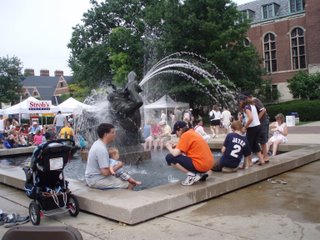
One of my favorite sites at the fair is the Carl Milles
fountain called "Sunday Morning," shown here during a past art fair.
During the most recent few art fairs, it's been the central site for food vendors.
This year on the University of Michigan campus: the fountain remains
inside of its winter plywood protective covering. Very few people are on campus.
I am especially sad that we can't even enjoy this extraordinary work of outdoor art!
Around the fountain each year, people eat at tables provided by the fair. This is a photo from last year.
The fountain in 2008.
Around the fountain: enjoying the Art Fair in 2016.
Art fair dining last year.
artfair3501
The one thing I won't miss: the actual food served by the mobile vendors who bring their trucks to the art fair.
I think they are the same vendors that set up at local carnivals all summer long.


Last year at the Art Fair. Another tradition missing in 2020: the annual t-shirt designed by a selected artist.
A favorite vendor: Marvin Blackmore in 2016.


Blog post and all photos © 2008-2020 by mae sander.

Wednesday, July 15, 2020

Looking for a good book to read.

I'm having a run of bad luck choosing books to read. In the past, I've enjoyed the mindless comedies of Christopher Moore, such as Coyote Blue (published in 2009). So I thought I would be cheered by his latest, Shakespeare for Squirrels. It's a send-up or mash-up or screw-up based on the Shakespeare play A Midsummer Night's Dream, narrated by a character not in the Shakespeare play. It features all the characters from the original -- especially Puck, the fairies Peaseblossom, Cobweb, Moth, and Mustardseed, and the fairy king and queen Oberon and Titania.

Let me mention that I have a great fondness for the fairies in this play, and I don't mind if they are borrowed by another writer. The very first Shakespeare re-write I encountered (well, the first one after Lamb's Tales) was written by my 9th grad Latin teacher Miss Gorse for our graduation from junior high school. She assigned me the role of Moth, and all of us had to memorize the Shakespeare scene where the fairies dance, which was fun to rehearse and not too bad to perform. However, you can imagine how the other kids reacted in relation to the four of us who were assigned to be "fairies." Never mind. Sorry for the digression.

My problem is that Shakespeare for Squirrels didn't do anything for me. The humor is crude -- no Shakespearean light touches. And the plot is forced. I didn't find it very amusing or at all enlightening as a reading of the play. I didn't even like the few food scenes, such as when Pocket helps himself from the dining table where Oberon is eating:
"I tore a leg from the roasted bird, a duck methinks, and had a taste of the greasy flesh, sans plate, settings, or goblet.
“'Oh, scrumptious. Well done,' said I. 'Do you have any wine?'” (Kindle Locations 2461-2462). 
Moore's efforts at humor just seemed to fall flat in this novel. Oddly enough, in his Afterword, Moore completely summarized my reaction (except that somehow throughout the years I've actually read virtually all of Shakespeare's plays and enjoyed most of them) --
"I know what you’re thinking. You’re thinking, 'A Midsummer Night’s Dream is my favorite Shakespeare play— it’s the only one I’ve ever made it all the way through without thinking about things I’m going to eat— and you, sir, have besmirched this delightful, spirited sex comedy with murder, goblins, and gratuitous squirrel shagging. You, sir, you cad, you dilettante, you scrofulous scribbler of unscrupulous satire, have made a sow’s ear from a perfectly lovely silk purse. Why? Why, why, why?'
"Okay, harsh, but fair." (Kindle Locations 3799-3803).

A Food Novel that Missed

Another failure in my efforts to find a book that I would enjoy reading: High Bonnet: A Novel of Epicurean Adventures by Idwal Jones, originally published in 1945. Considered a very obscure classic, it was republished in the Modern Library series selected by Ruth Reichl in 2009. While I'm very fond of most of the books in this series, I just couldn't get into this one -- in fact, I didn't even finish it.

High Bonnet is in the picaresque tradition -- that is, adventures of single character who is typical of something. In this case, the adventurer is a chef, and his adventures are mostly about cooking and relating to other chefs and chef mischief.

Despite how much I like food and food books, the combination of food and personalities here didn't click for me. For one thing, the cheffy descriptions in the narrative seemed to interrupt it awkwardly rather than to advance the novel. Too many different things were going on at the same time.

Here's an example of a description that goes too far for a novel:
"We sent up the consommé. Then a baked pike à la Genoise. After that a pair of langoustes from some Devonshire cove. Jules had boiled them; he cut up the meat, stirred it into thick velouté sauce with the pounded coral, a spoonful of meat extract, seasonings, chives, sherry, a half cupful of grated Parmesan, some sherry, and sliced truffle. It was the veritable black truffle with veinings of white. With this mixture he filled the shells, baked them a while in the oven, then coated them with buttered crumbs which he browned with a red-hot salamander. Finally a Grand Marnier soufflé was put into the oven." (p. 23).
Or another one:
"Connoisseurship exacts too often its penalty. Savors pall, the taste buds dull, the palate grows as indurated as the sole of an old boot or the conscience of a judge. Guido feared it. He judged the perfection of his soups by the twitch of his nose in the steam. He was protected also by a childlike gift of wonder. This drew him nearly every night into some remote quarter, in quest of surprises. He knew all the bistros at Clichy where red-sashed navvies engulfed their ragouts. For months he made a pilgrimage to the Annamese colony in Grenelle, where he had surrendered himself to a beef-and-veal soup. It was tinctured with a few drops of nuoc-man, a briny exudation of decaying fish, mellowed for years in a jar." (p. 32).  
At the risk of too much punning, I'll say this book is neither fish nor fowl -- neither a real novel nor a real work about cuisine. Too bad.

Finally, a Rather Sensationalistic Novel 

I read this a few weeks ago. I can't remember where I heard of it. I finished it, but did not enjoy it:


Wish me luck finding something better!

Blog post © 2020 mae sander. 

Tuesday, July 14, 2020

Happy Bastille Day

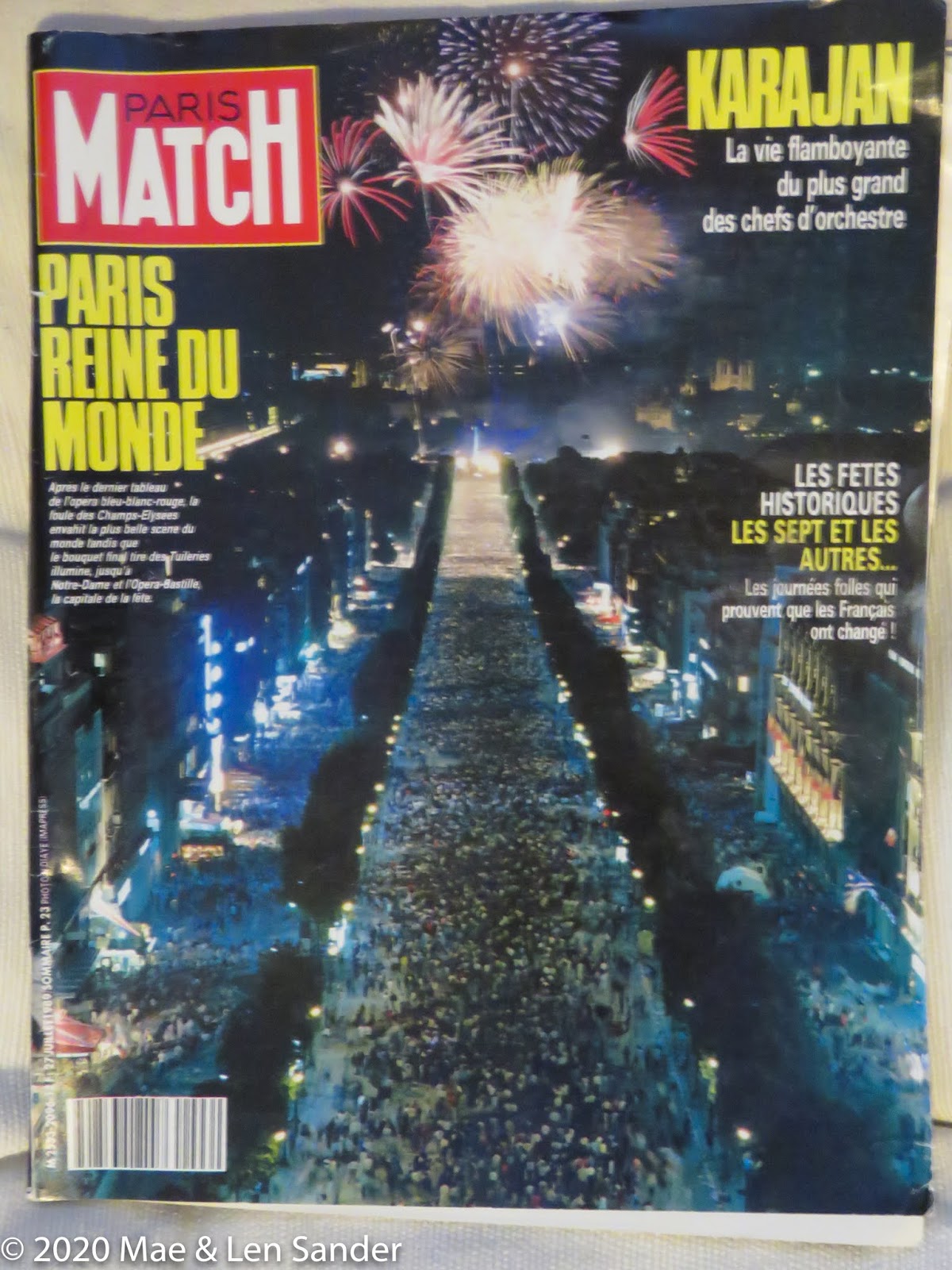
Paris Match, July, 1989.
Fireworks seem like the natural way for a nation to celebrate freedom. As we do on July 4, the French have fireworks for Bastille Day, July 14, celebrating their nation's freedom from monarchy and tyranny. If you overthink this, you might wonder why fireworks are the natural choice, but let’s not do that.

On July 13, 1989, we arrived in Paris for a planned 1-year stay; of course we chose that date to be sure we would be present for the biggest Bastille day of the century, and we weren’t disappointed! That night, we watched the incredible show at the Eiffel Tower, which was very close to the apartment where we were spending our first night of our year there. The next evening, we joined the millions of people trying to get a glimpse of the parades and fireworks along the Champs Elysée.

I didn't take photos, but I did save a copy of Paris Match published just after the event. Our viewpoint was much less dramatic than the ones in the magazine!

The parade moving toward the Arc de Triomphe.

Also in honor of the 200th anniversary of the French Republic, the newly built Pyramid of the Louvre was dedicated.
Besides parades and fireworks and building dedications, the unexpected way that Bastille day is celebrated every year is with bals des pompiers, that is, firemen’s balls. For at least a century, these dance parties have been organized by the firemen at the fire houses in each arrondissement of Paris as well as in many other locations in the suburbs and other French cities. There's an admission fee (or requested donation) to enter, long lines at the door, and refreshment on sale. Like so many things, the 2020 firemen’s balls have been cancelled as the crowds would be impossible to control for social distancing.

Our only other Bastille Day in Paris was in 1975. Our good friends Michelle and Jean (then a couple, later not) took us around Paris on the eve of the holiday to see the celebrations. We spent a long night of roaming around Paris. Not only at fire stations, but everywhere in the streets and squares of the city, we saw people dancing to live music by a variety of bands and small ensembles. From what I read on tourism sites on the web, recent celebrations have been much more crowded than the ones we experienced: I think we just went into the fire station and watched the dancing without having to wait in line.

At the time, Michelle and Jean had a minuscule apartment in central Paris, as well as a large house far out in the suburbs; they loaned us the apartment for our week in Paris. After our long walk around the city, we went to bed very late. A few hours later, around 6 AM, a lone trumpet player -- no doubt coming from a gig at a fire station -- strolled down the now-empty street outside our window, playing cool jazz on his trumpet: our wake up call for Bastille Day. I know we saw a parade go by but I'm not sure where or what time. I think it was near the apartment, which was on the Left Bank, not near the Champs Elysée.

For the 1989 celebration, many people wore "Revolutionary"
hats and clothing. A bit later in July, 1989, we attended
another celebration at a friend's country house, where we
met these costumed children.

For 2020, many of the festivities, like the major parades and the street dances, have been scaled down or cancelled. The Champs de Mars, where we sat on the grass in 1989 to watch the fireworks at the Eiffel tower, will be closed this year, with a limited fireworks show visible from the river. If I understand correctly, the French are being pretty disciplined in order to reduce the spread of the virus. It’s miserable that just about every day I think about something that isn’t happening!

This post will be shared with "Paris in July" hosted at Tamara's blog; © 2020 mae sander.

Monday, July 13, 2020

My Cactus Takes a Drink!


Every Tuesday for the last few years I have given this cactus two ice cubes, which slowly melt into the soil. I water it on Tuesday because that way I won’t accidentally over-water it. So far the cactus seems to be growing more and more shoots, so I guess I’m doing ok.

For a while the cactus tried to spread out, and it looked
rather strange, but I’ve convinced it to straighten up.
My granddaughter gave me this cactus, along with the very nice hand-made ceramic flower pot, for my birthday a few years ago. She was visiting us during the Ann Arbor Art Fair, and she could see that I would like the work of this potter, which I did. Sadly, for the first time in over 50 years, there will be no art fair this year. But I have my cactus! I also have many other wonderful things I’ve bought from many past art fairs, or have been given.

Well, by chance, recently I have been participating in a blog event which is hosted every Tuesday at Altered Book Lover’s blog. Many bloggers share posts that include some reference to a beverage, often tea. Usually they are drinking it themselves, or depicting some drink-related theme like coffee cups or wine glasses. But I thought I would share the habits of my cactus for this event.

This blog post © 2020 by mae sander.

Sunday, July 12, 2020

Music for the King of France


The fountains at Versailles were modernized a few years ago to include beautiful recorded music from the era when the palace was built. We were charmed and delighted when we visited there in 2013, as we arrived unaware of this renovation.

At the blog party "Paris in July," host Tamara at Thyme for Tea, posted some beautiful French classical music. To continue her theme, I'm adding this musical video from the management of Versailles. Happily, the fountains are operating this summer -- with appropriate safety measures. For more information, see the website for the Chateau of Versailles.

"Shoot the Piano Player"

During the blog party Paris in July, out host Tamara and a few other bloggers have posted links to some excellent music. Here's one of my favorite Paris film songs, from Tirez sur le pianiste -- Shoot the Piano Player, which was released in 1960. I've seen it a number of times. The director was François Truffaut and it stars Charles Aznavour as the piano player -- you can see him playing piano in this excerpt.


This July, I have been sharing mostly posts about maps of Paris, but I couldn't resist adding this link to support the music theme.

Saturday, July 11, 2020

Ann Arbor Murals


I'm not going very far from home these days -- you probably are not traveling much either. A few days ago, I did manage to drive around Ann Arbor and find one or two murals that I've never photographed before. The first one, above, is on a busy corner facing a parking lot downtown -- the colors are vibrant and I like the geometric style.

Stepping back, you can see how the mural is placed on the building.

Under the Bridge

When I saw this news photo of a truck stuck under a RR bridge, I decided to go
see the mural on the supporting wall. I guess the truck is just over 10' 6" high!
I don't know how it was rescued -- the article says "crews freed the truck."

I located the RR bridge last week, and took this picture of the whole mural that's just
visible in the news photo. It took me months to visit there! The news article is from March 11.
A detail of the mural under the bridge.
The companion mural on the other side of the street.
Blog post © copyright mae sander 2020

Friday, July 10, 2020

Best American Food Writing 2019

Best American Food Writing 2019.
Published October, 2019.
We are living on a completely different planet now than we were around two years ago, when the works in this collection were written. Samin Nosrat selected these short pieces, most of which were actually published in 2018, but it takes time to publish. Since then, the world of food and food writing has been utterly changed, along with much else.

To take a pretty extreme example from the essays in the book; Burkhard Bilger wrote "Bean Freaks," for the New Yorker; it was published in April, 2018.  This essay describes the life of Steve Sando, founder of Rancho Gordo, a business which specializes in a number of varieties of heirloom beans. The background of the article includes a description of how Sando became a recognized expert in all things bean, creating a niche for a specialty product for foodies — at least for the few bean-lovers among them. Rancho Gordo has a brick-and-mortar location in Napa, California, and also ships online orders and runs a "bean of the month" club. Among other things, Bilger accompanied Sando on a visit to a remote farming community in Mexico, the source of many types of beans offered by his company, and provided details about the history of bean cultivation in the Americas.

Yes, it's a well-written article, typical of the New Yorker, covering a highly specialized and obscure food product. But how things have changed! Last March and April Rancho Gordo’s beans became an incredibly hot commodity because pandemic panic caused demand for all types of beans to skyrocket. A large number of feature articles covered the huge explosion in new orders beginning in March and how Sando handled them. There were articles about Rancho Gordo in the New York Times, the San Francisco Chronicle, Sunset Magazine, Eater.com, gq.com, motherjones.com, grubstreet.com, and more. By mid-March, orders increased from an average of 200 per day to over 1000, then to over 1600. Rancho Gordo's response time to fill orders increased, of course, from around a day to several weeks; according to the Rancho Gordo website, it's now around a week. Strange times we live in!

In Best American Food Writing 2019, editor Samin Nosrat also included a few articles about Big Agriculture and Big Food Processors. There's an in-depth study of the billionaires Stewart and Lynda Resnick — "A Kingdom from Dust" by Mark Arax covers their enormous farms in California growing pistachios, almonds, and pomegranates; their dubious marketing techniques (including paying for medical research to show the health benefits of POM Wonderful, their pomegranate juice); and their even more dubious acquisition of water rights for irrigating their vast tracts of land. Another article, "Bison Bars Were Supposed to Restore Native Communities and Grass-based Ranches. Then Came Epic Provisions" by Marilyn Noble has a title that reveals its subject about contrasting big and small agriculture. In our new utterly changed world, concentration on these types of industrial food producers is still interesting, but the focus has changed; most articles on this general topic would tend to cover instead the impact of coronavirus on the workers in meat packing plants and chicken packing plants.

Articles on food and health cover various topics. An interesting one is "Why Do Poor Americans Eat So Unhealthfully? Because Junk Food is the Only Indulgence They Can Afford" by Priya Fielding-Singh. In our new, sad, food world even this indulgence may be too much for the subjects of this study: these days far fewer "poor parents ... could almost always scrounge up a dollar to buy their kids a can of soda or a bag of chips" (p. 101) The topic of food and poverty is more important than ever, but the subject now is the much more pressing desperation of needing to provide for families affected by job losses, the spread of the pandemic, and the lack of medical care. 

The article "Black History at Harlem Hops" by Hannah Goldfield describes a lively bar scene at the Harlem Hops Bar, "a thoroughly modern establishment... and a mostly young, hip crowd." Goldfield tells about all the great beers and whiskies and "snappy skinned bratwursts... served on griddled pretzel buns" that you'll want to try. I hardly need to point out what's changed since that was written!

Goldfield’s review of a bar/restaurant is in fact the only restaurant review in the collection — the introduction explains “People often assume that food writing is just another term for restaurant criticism. But as a food writer myself, I couldn’t be less interested in writing about restaurants.” (p. xix) However, the final essay in the book is a sad appreciation of the career of food writer Jonathan Gold by Benjamin Alders Wurgaft, written soon after the untimely death of the famous LA Times reviewer, an article that includes some very interesting thoughts on what makes restaurant criticism difficult. Unfortunately, the communal spirit among restaurant goers that’s most expertly described by Wurgaft is what’s totally missing from virtually the entire world right now! Even more tragically, the early death of beloved public figures has become so much more commonplace.

Collectively at this moment, we may be obsessed with food and may be occupying ourselves with cooking as we never have before — but our interest in the world of food may be completely different. Does the detailed study of Japanese Kit Kat flavors and specialty chocolate bars for the tourists, described in “Big in Japan” by Tejal Rao, hold one’s interest now as maybe it did last year? Or the article on salty licorice in Finland? Can we still muster any indignation at the scientific frauds of Brian Wansink as revealed by writer Stephanie M. Lee? And Samin Nosrat's insightful remarks about the exclusion of non-white-male food writers now seem only one detail in the larger framework of indignation about exclusion of non-whites from our society.

My frame of reference has changed, and these seem less important now than they may have seemed “before.” This is an excellent anthology, well worth reading, but as I said, seems to be about some other planet than the one where we live now.

Review © 2020 mae sander.


Thursday, July 09, 2020

Architecture Walks In Paris

Paris is full of extraordinarily famous monuments and museums, architectural wonders, and streets lined with beautiful facades. The oldest buildings in Paris are the first-century Roman Arènes de Lutèce and the Baths at Cluny, the largest Roman building in Northern Europe.  The newest Paris monuments may be in progress right now. Perhaps the best-known recent addition to Paris architecture is the Pyramid of the Louvre, which opened in 1989. Or maybe most famous is the Musée du quai Branly, which opened in 2006.

Even more astonishing than the many famous monuments, though, is the great beauty, variety, and historic significance of the more ordinary neighborhoods throughout the city. Just walking randomly, you can see vast numbers of impressive and fascinating facades, and you can peek into courtyards for a glimpse of more intimate Paris life. Locating typical examples of every-day architectural styles is challenging, since Paris is huge: the inner city of 2.2 million contains most of the interesting architecture. The vast surrounding suburbs have another 8.5 million residents.

Exploring the city: "Architecture Walks in Paris"
by Bert McClure & Bruno Régnier,
published in the 1980s.
One guide to finding interesting walks through the more obscure parts of the city is called "Promenades d'Architecture à Paris." The six maps with detailed explanations introduce you to a variety of architecture and engineering methods, to specific designers and architects, and to the distinctiveness of various Paris neighborhoods.

In the folder are six very informative maps of relatively obscure Paris areas.
Each one unfolds to a single page the size of a standard city map.

"Guimard et l'art nouveau" is a map showing where to find Art Nouveau buildings from the late 19th and early 20th centuries. This is probably my favorite among these walks, as I am very fond of this style of art and architecture. 

The entire map, folded out. The reverse side is blank.
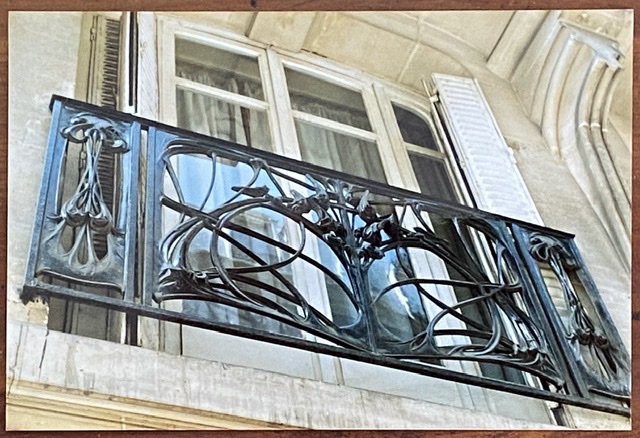
Hector Guimard (1867-1942) is probably best known for his design of the Art Nouveau metro entrances, which I documented on my previous posts about the Paris Metro and about Paris maps. Guimard designed many residential buildings in Paris including the facades, metal grilles and railings, interior details like staircases and wall decorations, and even furniture. These buildings, situated in the newly urbanizing parts of the city, were meant for upper middle-class and upper-class Parisians. As far as I know the current residents must be very wealthy, as the apartments are spacious and Paris real estate is very expensive.

Guimard's work, as well as that of other Art Nouveau creators, is on display in many museums in the US and Europe -- notably the Musée d'Orsay in Paris. These objects include furniture, lighting fixtures, textiles, and architectural features such as cast iron railings. A few museums in the US even own entire examples of Guimard's metro entrances, for example the Museum of Modern Art in New York and the Toledo Museum of Art in Ohio. It's fascinating to look at these museum pieces, but even more exciting to see the actual buildings that appear on the map.

More about the Guimard map and guide


On the east side of the Seine: finding buildings designed by Hector Guimard.
Each map has walking routes with numbers to indicate what to look for.
Locations of more Art Nouveau buildings around the Arc de Triomphe/l'Etoile.

Images of buildings by Hector Guimard and others.

From the Decorative Arts collection of the Musée d'Orsay:
The central panel of a large balcony, made in cast iron between 1905 and 1907.
Taken from a building on rue de la Fontaine. (Source)
The following photos are from various walks I took in the Passy and Auteuil neighborhoods during various visits to Paris in the 1990s. Paris is such a beautiful city!


This section of the fold-out map describes the work of Le Corbusier and locates the
Le Corbusier Foundation in the neighborhood covered by the map.
Visiting the Le Corbusier Foundation as suggested by the guide was my introduction to the work of the famous architect. I am still learning about the history of architecture in the twentieth century and how Le Corbusier fit into it.


A summary of the other five maps

"Fer et Verre autour de la Bourse." This map documents the 19th century use of  iron (fer) and glass (verre) in architecture -- a great advance in the engineering of large modern buildings, enabling major changes in design and size of structures. This style was characteristic of department stores such as the Galleries Lafayette and Printemps, both still in business near the Opera, as well as other buildings. The building that now houses the Musée d'Orsay is such a structure. It was originally a railroad station, built in 1900.

"Avec l'Autobus de petite ceinture." How to take the bus around the outskirts of Paris, and what to look for when you get there. I never actually followed this map.

"Ateliers à Montparnasse." Artists' studios around Montparnasse, now one of my favorite Paris neighborhoods.

"Habitat Social à Ménilmontant." A walk to see the various designs of low-cost government housing at Ménilmontant -- probably the most unusual subject for a tourist guide! Definitely off the beaten track. I wonder what the neighborhood is like now, as gentrification has utterly changed most of Paris.  When I was following this walk in 1990, a man wearing the clothes of a construction worker stopped me very politely and asked what motivated tourists to come to Paris, and in particular what interested me about his neighborhood. A hard question!

"Arts Déco à Passy et Auteuil" -- the Art Deco movement between the two World Wars created another important look characteristic of certain Paris neighborhoods.

... and many more guidebooks.

Quite a few other guides to Paris architecture have been published both before and after this one — many are listed on amazon.com. I chose to write about this particular guide because it's subject matter is so unusual, and because I have used it to discover very surprising places. I learned a great deal while exploring its various routes during the year I spent there in 1989-1990 and also on later visits. I’ve concentrated on one map today: perhaps I will add more pictures and information about the other five maps in a later blog post.

I will share this blog post with other bloggers at the online party "Paris in July" hosted by Tamara at the blog Thyme for Tea.  My blog post and original photos are copyright © 2020 by mae sander for mae food dot blog spot dot com.