Showing posts with label Spain. Show all posts

Wednesday, January 21, 2026

Identities

“After hundreds of years, if there were so many sinners left, what had the Inquisition accomplished? They might root out Jews and Muslims and Erasmists and alumbrados, but then what was left?” (p. 367)


“When Luzia had seen the burnt bread, she hadn’t thought much about passing her hand over it and singing the words her aunt had taught her, “Aboltar kazal, aboltar mazal.” A change of scene, a change of fortune. She sang them very softly. They were not quite Spanish, just as Luzia was not quite Spanish. But Doña Valentina would never have her in this house, even in the dark, hot, windowless kitchen, if she detected a whiff of Jew. Luzia knew that she should be careful, but it was difficult not to do something the easy way when everything else was so hard.” (p 6)

From the beginning, The Familiar is a book about secrecy and identity. Luzia, at the center of the novel,  has both an out-facing identity as a servant in an impoverished upper-class home in late-medieval Spain, and also a secret identity as a Jew who would like to flee to Salonika where she could practice her true religion openly. The novel adds an element of magical realism to this identity: Luzia can also do magic. 

Here is  Luzia’s view of the conversion which her ancestors had experienced a few generations earlier:

“Their great religion can make bread into flesh and wine into blood. But they don’t believe that any amount of holy water or prayer can truly make a Jew a Christian.” (p. 121)

“I have been baptized, she reminded herself. She went dutifully to mass. She knew her Pater Noster, the Ave Maria and Salve Regina, her psalms and commandments. She would happily eat ham and mend a dress after sundown on the Sabbath. And yet she felt her magic like a damning thread, binding her to the past, and to every Jew in every synagogue who still bent their head in prayer.” (p. 198)

The counter-theme of this book is a completely different identity: that of an immortal and magically created human-like being named Santángel who becomes Luzia’s friend and ally in struggling to survive and escape. He says: 

“In another life, in another world, I would be called a familiar. My gifts are not my own. They exist only to serve others. People fear me because I want them to, because their fear makes my life easier.” (p. 165)

The plot of this book is elaborate (maybe too much so). There are many twists as the stories of several characters are being told. That’s all I have to say about it. 

Blog post © 2026 mae sander

Tuesday, March 26, 2024

Another tale of the Promised Land

‘Although I wrote Kantika as a novel, I played with the line between fact and fiction and drew on the experiences of some real people, most centrally my maternal grandmother, Rebecca (née Cohen) Baruch Levy (1902–1991).” (From the author’s Acknowledgements, Kantika, p.283)


Kantika by Elizabeth Graver is a story of a family with deep roots in one place: Turkey. After the first World War, Turkey experienced major changes in government and policy. The long-enduring Sultanate was overthrown by nationalists, and thus minority communities were abused, persecuted, and expelled or driven to flee. The most extreme victims of this extremist nationalism were the Armenians: between 600,000 and 1.2 million Armenians were killed between 1915 and 1916 in what is now viewed as the first genocide of the twentieth century. 

A historic Jewish community in Turkey also suffered from the emerging policy. Kantika is the story of just one family from this community, told through the experiences of Rebecca, the author’s grandmother. Rebecca’s parents belonged to the Sephardic-Iberian Jewish community that had lived in the Ottoman Empire since their ancestors were expelled from Spain in 1492. They proudly identified as Turkish Jews and as long-term residents of Istanbul. Her father’s thoughts: “This city, the ground beneath his feet, here where he was born and his parents are buried—is his homeland.” (p. 39)

Rebecca’s father had a factory, and the family were well-off, able to pay for their children’s education (and not to rely on charity schools). They had a solid and respected position in the community, and a fairly luxurious house. Because the novel is presented from Rebecca’s point of view as a child and very young woman, there’s not an excess of historic or socio-political detail. Just this: her father loses his factory, and sees that he can no longer make a living under the increasingly hostile new regime. He can find nowhere to take the family except Barcelona, Spain, where there’s a very small Jewish community to which they can move. Somehow, her father was unable to find a way to go to much more promising places that other members of the community were managing to emigrate to: specifically, to Cuba or New York. 

Kantika follows Rebecca as she adapts to life in Barcelona, learns to make a living as a dressmaker, and marries an unreliable man who abandons her and her children. Her struggles and her optimism are fascinating to read: it’s not the broad events of history and politics that make this book relatable — it’s the way she deals with her circumstances. The way she realizes that she must conceal her Jewish identity. The way she deals with many setbacks. Spain in the 1920s was becoming a less and less safe place, so she agrees to an arranged marriage with a man from their original community in Turkey who has successfully immigrated to New York and become a citizen. 

Thus, by the mid-1930s, Rebecca is living in New York. Her story continues as she adapts to living in the US, managing to bring her two sons from Spain, and having three more children, besides the child of her husband and his first, deceased wife. One of the final chapters vividly describes her son's experiences in combat in the Pacific during World War II.

A fairly typical immigrant story? Yes, but it’s not the story, it’s how you tell it. The characters and events in Rebecca’s story, and above all, Rebecca herself, are in one way undistinguished, ordinary, and quite similar to many others in stories of how we American descendants of immigrants all got to where we are. But the telling: that’s special. The author loves these people — all her own relatives and their peers. And reading this, one gets to love them too. 

review © 2024 mae sander

Sunday, January 22, 2023

Civilizations by Laurent Binet


It all starts here at a Viking farm in Greenland, where I visited last summer.

Civilizations: A Novel by Laurent Binet is a counterfactual history of the relationship between the peoples of the old world and the peoples of the new world. Published in French in 2019, and in English in 2021, it is a best seller in France and won prizes there.

The novel starts with the Vikings; as the Guardian review explains it:

“First up is a spoof Norse saga, describing how Vikings not only made it to Vinlandia, the coast of North America, but as far south as what is now Panama. Erik the Red’s daughter Freydis (whose party trick of beating her breast with a sword is faithfully entered into the record) befriended the local skraelings – as the Vikings called Native Americans – and, crucially, introduced them to two technologies: horses and iron. (She also set them on the painful road to herd immunity to Old World diseases.)” (source)

Centuries later, Columbus lands in the same area that had been affected by the arrival of the Vikings; however, he has no luck. His men are killed and his ships rendered useless. 

But wait! Counter-history goes on, and the Inca and other native American heirs of those who defeated him sail to Lisbon, and gradually take over the kingdom of Spain. They learn many things, including the religious rivalries, the food, the wine (which they call “the black drink”) and the oppression of the peasants. As their power grows, they grant the religious rights and protection to the many minorities of Spain including conversos, Jews, Moriscos, Lutherans, Erasmians, sodomites and witches, and repeal the edict of 1492 that led to vast persecutions. So there, European history!

The history of the takeover of Spain by the Inca leader continues in many places that I’ve been, including
the Cathedral of Cordoba, a completely fascinating place. (Image from Wikipedia)

Both Islamic and Christian architecture styles are visible in he interior of the cathedral of Cordoba, which is a complete church inside a huge former mosque. The Inca, Atahualpa, significantly chooses this location for his marriage to Isabella, widow of the king of Spain. After this marriage, the Inca arranges for Isabella’s son, the child-king of Spain, to be drowned, seemingly by accident, as he had also killed King Charles. With them out of the way, he can take over the kingdom:

“Isabella, destroyed by her son’s death, did not have the strength to deny Atahualpa’s request a second time; and so Charles Quint’s widow became his secondary wife. The ceremony was more solemn than joyous, since she was still in mourning. In order not to deepen the bride’s sadness, it took place not in Seville’s cathedral – where Charles’s remains now rested – but in Córdoba’s. Inca pomp met royal Spanish pomp. The king of Spain placed sandals on the feet of his new bride, then llamas were sacrificed, as custom dictated. Crates of jewellery were delivered to the queen.” (Civilizations, p. 167)

Everything historic turns upside down. In counter-history, it’s the Inca conquerors who change agriculture in their new world. Instead of destruction of a prosperous people as in actual South American history, the Spaniards are transformed from poverty to wealth, and the foods of the Americans and the social programs of the conquering ruler improve their welfare:

“He created granaries. The meat of the slaughtered sheep was cut into strips, salted, dried. The grains of corn and quinoa were turned into flour. The potato tubers were frozen at night and dried during the day so that they could be conserved for several moons. Food supplies were kept in earthenware jars or buried in deep holes. With these reserves, he would be able to feed anyone who was hungry in times of scarcity, plague or ruined harvests.” (p. 172) 

The Inca continues with conquests and reforms in Europe and North Africa — which he refers to as “the Fifth Quarter.”  He is either fighting or making alliances with many of the most famous rulers and leaders of the time. I found it fun to read the author’s rewriting of the lives and identities of so many famous people. Here is another of the many examples: 

Portrait of Anton Fugger c. 1525 by Hans Maler.
(Philadelphia Museum of Art)

“When [the Inca] arrived in Augsburg, he immediately held talks with the most powerful man in the city, and perhaps in the whole of Germany. … The banker welcomed him into his vast estate, situated in the heart of the city, just as he had once welcomed his predecessor, Charles Quint. The Inca liked Fugger’s palace, which was made of a sandy stone. It had a solid simplicity that reminded him of the buildings in Quito. … He enjoyed the feast that the banker had had prepared for him. And the beer wasn’t bad either. The two men had a lot to discuss. Anton Fugger was dressed simply, if a little strangely, even by the standards of the Fifth Quarter. He wore a black coat, with a collarless white shirt visible beneath it, and a hat in the shape of a wide, soft pancake. His hair was enveloped in a sort of bag and there was something vaporous about his beard, which was thick in places and patchy in others. His hands were concealed beneath fine white gloves.” (p. 195)

The reign of The Inca over the major areas of Europe continues dramatically, as he meets more and more famous people and as they meet a counter-historical fate. There's a logical end to the tale, but then there is a kind of coda about the Spanish author Miguel de Cervantes, which seems to me a bit of an afterthought.

Mural of the Battle of Lepanto, October 1571, by Antonio Vassilacchi (1556-1629). (source)
Cervantes’ participation in the Battle of Lepanto is part of the weirdly revised history; that is, the author’s invention of the Inca conquest of Europe. After the battle, Cervantes is sheltered by the French writer Montaigne, and eventually is sent to the Americas. The counter-historical version of Cervantes doesn’t clearly manage to write Don Quixote, as far as I know. Understanding these episodes asks the reader to rely on a detailed knowledge of history and literature that’s challenging, at least for me, and I found this final chapter a bit too much!

Civilizations is a very strange novel, both in concept and in style. Sometimes I felt as if the author was showing off, while sometimes it seemed quite interesting. For example, I enjoyed the descriptions of art works depicting the conquering Inca by famous artists such as Titian and Michaelangelo. But there were parts of the novel that were somewhat overdone. I didn't really appreciate all the different narrators and voices that were introduced, such as the epic poet who glorifies the conquest, the excerpts from a diary said to be by Columbus, and other stylized ways that the author told the story. As I say — strange and not entirely readable.

Book review © 2023 mae sander
 

Monday, May 09, 2022

Getting our Cooking Groove Back

Cooking Less Meat Again

After three weeks of travel, and not cooking much, I have been back home for a week. Truthfully, for the last few days on the road, I was eating quite a bit of real junk food, including several McDonald's hamburgers. So it feels good to get back to my ongoing experiments cooking with less meat -- or no meat.

Jamaican Curried Tofu

Tofu is really an unfamiliar food for me, and it's taken quite a few experiments to find ways that we might enjoy it. My approach is to view it as a food in itself, not as an imitation of meat, because it's nothing like meat. This week, I tried a recipe for a Jamaican curry using tofu, and it was not bad at all. I was inspired by a blog called From the Comfort of My Bowl, written by Jhanelle Golding, a native of Jamaica who now lives in the US. I was inspired by a recipe called Vegan Jamaican Curry Tofu (Traditional Recipe!) 

The ingredient prep -- I didn't use the Scotch Bonnet pepper, which would have
been true Jamaican, because it would be too hot for us.

I added a few snow peas to the original recipe.

The final dish: tofu, vegetables, and brown rice. Quite enjoyable!

Mushroom Pancakes, Broccolini, and Gochujang Sauce

What's new here is a box of gochujang paste that I found in the supermarket Asian section. I was inspired by several recipes for a gochujang dipping sauce, as well as for some recipes for Korean pancakes. Since I was using up sourdough discard for the batter, I prepared  my normal savory pancake recipe and added lots of green onion and a few mushroom slices for each pancake. I stir-fried broccolini as the vegetable for dipping -- and we also dipped the pancakes. And I improvised a cucumber salad.

Ingredients for dipping sauce:
2 tablespoons gochujang Korean red chili pepper paste
2 tablespoons rice vinegar
1 tablespoon agave nectar
1 teaspoon sesame oil
1/2 teaspoon sesame seeds


Vegetables: broccolini, chopped green onions, mushrooms.

Mushroom pancakes, stir-fried broccolini, gochujang sauce, and cucumber salad.

Spaghetti Squash with Lemon-Olive Sauce

I don't remember ever cooking spaghetti squash before. Several food writers mentioned that this vegetable may look like spaghetti, but the texture and the taste are not in fact like pasta. I was warned! So I tried to find a recipe that would highlight the squashiness. My source recipe was from Food and Wine Magazine. Using an immersion blender, I emulsified lemon juice, oil, lemon zest, chopped green olives, and scallions, as the recipe suggested. I added some parsley as well. In addition to the garnishes of toasted almonds and feta cheese, I used some sunflower seeds (for part of the almonds) and additional lemon zest and parsley. We enjoyed the resulting dish.

The sauce, the nuts and seeds, the lemon zest and parsley, and the feta cheese.

Spaghetti squash roasting in the oven. The recipe says to boil the squash.
I think boiling squash halves sounds dangerous -- and not as tasty.

Squash: just out of the oven and spooned out of the skin.

The finished dish with a glass of white wine to share with the bloggers at Elizabeth’s weekly blog get together.

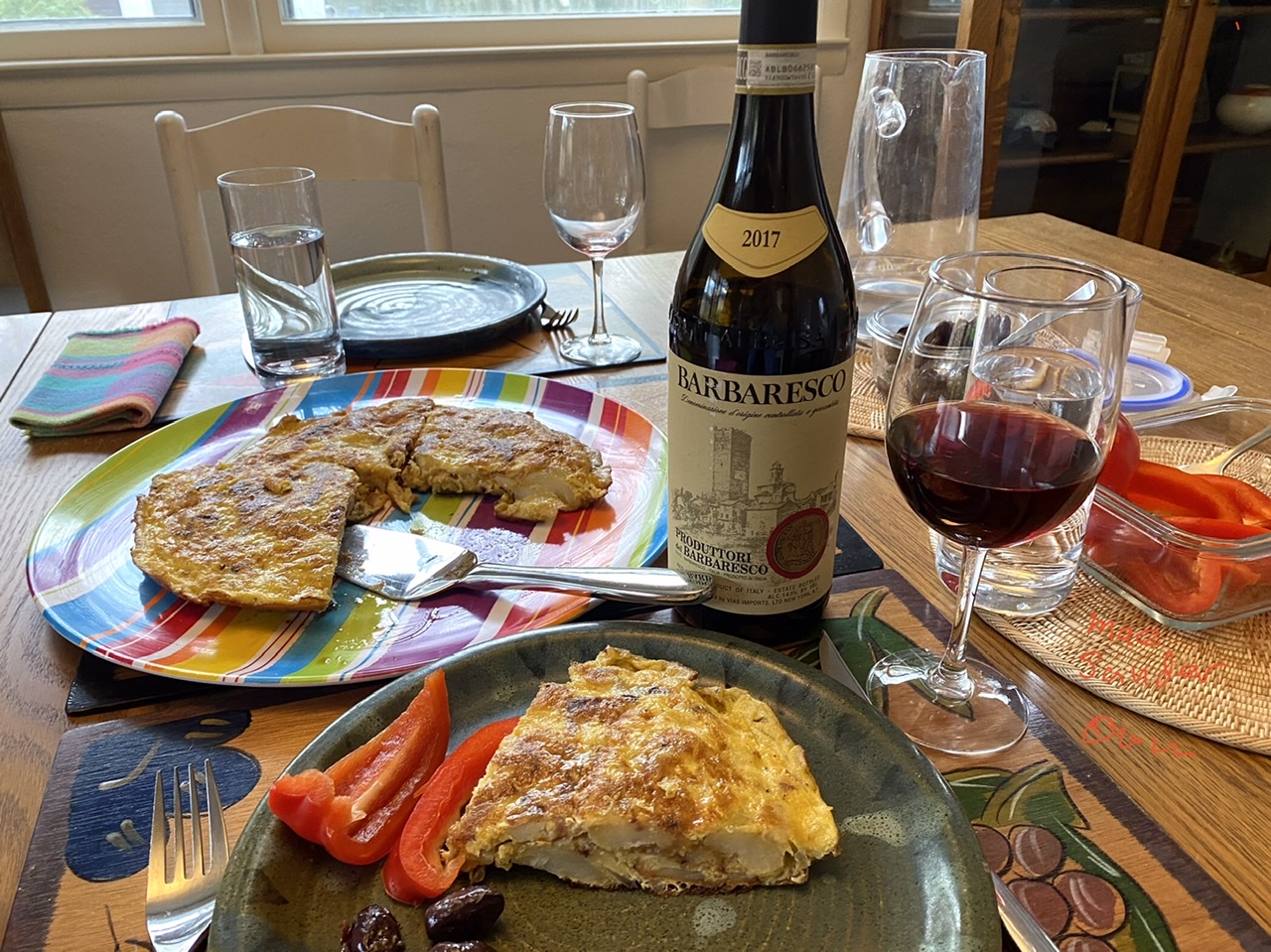
Mother's Day by Len: Tortilla Española

I'm not the only cook in the house! For Mother's Day, Len made me a Spanish potato omelet: Tortilla Española. He found a recipe that used lots of onions and lots of olive oil, so it was really delicious.

He flipped the tortilla and slid it back in the pan,
just as it should be done.

Of course we had some wine with the tortilla.

blog post © 2022 mae sander
 

Wednesday, December 23, 2020

The Aztecs' Own Story

The Spanish conquest of the Aztec empire was recorded in fairly much detail by the conquering Spanish troops, and that's the version of history that's been cemented in our heads (if any version is in our heads at all). Historian Camilla Townsend in Fifth Sun: A New History of the Aztecs offers an alternative, based on accounts recorded by the descendants of the conquered people approximately a generation after Hernando Cortés conquered them. 

Like many academic history books, it's challenging to follow every thread in this narrative, but it's full of fascinating detail. It begins in very early times, and chronicles the interactions, rivalries, and wars among a number of ethnic and political groups in the Valley of Mexico during the several centuries before the Spaniards arrived in approximately 1519. The conquest is described in very detailed terms from the point of view of the conquered peoples, including those who allied with the invaders because the rulers had been their enemies for a long time. After the conquest, Townsend covers the slow decline of the native people, who suffered not only from military defeat but also from the European diseases that were introduced and spread wildly among the non-resistant native population. Some of this is a familiar story, but much was fascinatingly new to me.

I can't possibly summarize this complex book, so I'm just going to say that I really enjoyed the rich detail about the lives and times of the historic peoples. And I'm just going to quote some food descriptions that show you how much wonderful detail is there.

Here's a description of the food that the rulers of Mexico would have enjoyed in the late 15th century, a generation before the conquest:

"Their hosts offered them food, and they feasted. The tamales boasted decorative designs on top, such as a seashell outlined with red beans. Guests could choose between turkey, venison, rabbit, lobster, or frog stewed with chilis of various kinds. On the side, there were winged ants with savory herbs, spicy tomato sauces, fried onions and squash, fish eggs, and toasted corn. There were all kinds of fruits, tortillas with honey, and little cakes made of amaranth seed. Indeed, a former servant once counted two thousand different dishes made for the Mexica king and then passed on to be sampled by his councilors, servants, and entertainers. At the very end of the meal always came chocolate— crushed cacao beans steeped in hot water and flavored with honey and various kinds of dried flowers, such as vanilla pods or roses. To render it even more special, the drink was served in carved or painted gourds, often from faraway lands." (pp. 64-65). 

I located an Aztec image of a man drinking chocolate, which I included here (source: Codex Borgia, in "The Early History of Chocolate"). 

The marketplace in the center of the city in the age before the conquest:

"One part of the market featured luxury goods— gold and silver, turquoise, jade and other gems, the feathers of exotic birds. Merchants sold these to artisans as raw materials, and to wealthy customers as finely crafted textiles and beautiful jewelry. ...

"It was the section selling food stuffs, though, that most impressed people who had never been to the marketplace before. The stalls offered everything— every type of corn and bean, all varieties of salts and herbs. Birds and animals rustled in their cages. There were fruits and vegetables, cacao and honey, bird eggs and the delicious bars of dried algae from the lake. But what was remarkable about Tlatelolco, what made it different from neighborhood food markets, was that food could be bought partially prepared, for urban customers too busy to make everything from scratch. One could buy pre-made tortillas and little cakes, squash already cut into pieces, smoked chilis, and ground cacao. Hungry shoppers could go to what was effectively a restaurant— a stand where prepared meals were available for sale." (pp 75-76)

After the conquest the lives of the native people became harder and harder. Here's what a conquered group had to provide to their Spanish rulers:

"Cuauhtinchan was committed to providing 24,000 woven blankets every four years, as well as twenty turkeys, six thousand bushels of corn, sixteen baskets of beans, eighty of chile, sixteen of chia, and sixteen of salt." (p. 145).


At the start of each chapter of Fifth Sun is an illustration from one of the documents
that are used as sources for the book. These are from Codex Mendoza in the 
Bodleian Libraries, University of Oxford.

Townsend really does a fabulous job of making individuals come to life, and it's amazing how many fully documented characters she found in the sources she used. While I enjoyed reading this book, I'm just not capable of doing justice to it in a real review. 

Blog post © 2020 mae sander. 

Tuesday, July 21, 2020

"A Long Petal of the Sea," Review Part 2

During the Spanish Civil War in 1938, the fascists, illegitimately trying to overthrow the recently-elected government, made sure that everyone suffered from shortages of food and other goods. They especially punished everyone in the Republican strongholds that were defending the legitimate government. These hardships are described through the lives of characters in A Long Petal of the Sea by Isabel Allende, which I reviewed in detail in my previous blog post here.

In this post I want to explore the way that Allende uses food descriptions to highlight the experiences of her characters. In addition, I am including a few photos I found that were taken during the war and its aftermath; these are not illustrations from the book, but ones that interested me.

The elderly, women and children evacuating Barcelona
under heavy bombardment by fascist planes. (source)
As the novel begins, the character Roser, and her adoptive parents the Dalmaus, were struggling to find food at their home in Barcelona while Victor Dalmau and his brother were serving in the Republican army at different locations in Catalonia. The first chapters in the book depict the deteriorating conditions in the city and on the battlefields. At this time, Roser worked in a bakery near the family home in Barcelona where she was paid in bread. The family also managed to stand in line or struggle for a few additional provisions:
"Rations of lentils had been reduced to half a cup per person per day; there were no cats or pigeons left for stews. Roser’s bread was a dark, heavy block that smelled of sawdust; oil had become a luxury item, and was mixed with engine oil to make it go further. Many people grew vegetables in their bathtubs or on their balconies. Family heirlooms and jewels were traded for potatoes and rice." (A Long Petal of the Sea, p. 42). 
As Roser and the family dealt with these shortages, Allende changes the scene to the luxury ship where a family from the Chilean upper class were traveling to Europe. They planned a long vacation combined with business -- the author presents their indulgent life on the voyage in contrast to life during the Spanish Civil War. Here's a daily vignette of life on shipboard, as experienced by Laura, the spoiled wife, whose only worry is that she's getting to fat to wear her evening gowns:
"Although the Reina del Pacifico could not compete in terms of luxury with the Normandie, it was more than adequate. Laura took breakfast in bed, then dressed around ten for Mass in the chapel, after which she went to get some fresh air on the top deck in the chaise longue reserved for her, where a waiter brought her oxtail broth and bread rolls. From there she went in for lunch, which consisted of at least four courses, and soon it was time for high tea, with sandwiches and cakes. She barely had time to take a nap and play a few rounds of canasta before she had to dress for cocktails and dinner ...While the orchestra took a break, the passengers were served a midnight snack of foie gras, caviar, champagne, and desserts. She abstained from the first three, but couldn’t resist the sweets. The previous night the chef, a gargantuan Frenchman, had served up an orgy of chocolate in different shapes, crowned with an ingenious fountain that spouted melted chocolate from the mouth of a crystal fish." (pp. 90-91).  
Back in Spain, as Franco defeated more and more Republican forces, deprivation was the lot of his victims, sent to prisoner of war camps. The former soldiers tried to maintain discipline despite the appalling conditions:
"They divided the camp into streets with poetic names, outlined absurd squares and ramblas like those in Barcelona in the sand and mud, created the illusion of an orchestra without instruments to perform classical and popular music, and restaurants with invisible food that the cooks described in great detail while the others savored the tastes with their eyes closed." (p. 122).  
Victor Dalmau, imprisoned in this camp, remained dedicated to helping those in need of medical attention; he "was as skinny and weak as the rest of the men in the camp, but didn’t feel hungry, and more than once gave his ration of dried cod to someone else. His comrades said he must have been eating sand." (pp. 123-124).

After the final victory of Franco and his forces, the persecution of Republicans and their sympathizers was ruthless. Allende's narrative poignantly describes the terrible plight of these victims as they were driven from their homes in Madrid and Catalonia, deprived of all their possessions, and desperately seeking a place to go. Many ended up crossing the border into France where they were forced into concentration camps unless someone would take them in.

Refugees fleeing from Spain to France, 1939. (source
Women and children fleeing from Madrid. (source)
Some of the Spanish refugees, including Victor and Roser, were eventually allowed to board a special ship bound for Chile, where they were to be given a place to live and work. On board this ship, life contrasts to the opulent life on the luxury vessel, as well as being a complete change from the utterly deprived life in the camps:
"Coming, as most of the passengers did, from wretched conditions and near starvation, they thought this was paradise: they had not had a hot meal in months. On the boat the food was very simple but tasty, and they could have second helpings of as many vegetables as they liked." (p. 138).
At the end of the voyage, Victor and Roser settled in Santiago, Chile. Needing a means to make a living, and they decided to start a tavern where Spanish refugees could feel at home, and where they would introduce local people to the customs of Catalonia:
"They found a cook capable of preparing Catalan sausages with diced eggplant, anchovies and squid with garlic, tuna with tomato, and other delicacies from the old country, and soon had a faithful clientele of Spanish immigrants." (p. 172).
Again the details of food contribute to the well-rounded descriptions that Allende supplies throughout the novel. I want to share one final food scene: the way that Victor celebrated his birthdays at the end of his life with Roser, after they had returned from exile in Venezuela and resumed life in Chile:
"In honor of this sentimental legacy, the day before his birthday he would go down to the Mercado Central in search of the ingredients for the fumet, and fresh squid for the rice. Catalan through and through, Roser used to say. She herself never collaborated in the homespun creation of this festive dinner, instead contributing a piano recital from the living room or sitting on a kitchen stool to read Victor verses from Neruda, often an ode with a marine flavor, such as in Chile’s tempestuous sea lives the pink conger, that giant eel with snow-white flesh. It was pointless for Victor to inform her time and again that the dish in question didn’t contain conger, the king of aristocratic dinner tables, but the humble fish heads and tails of a proletarian soup. Or while Victor fried the onion and pepper in olive oil, then added the peeled and sliced squid, cloves of garlic, a few chopped tomatoes, and the rice, ending with hot stock that was black with squid ink and the obligatory fresh bay leaf, she would share gossip with him in Catalan in order to refresh their mother tongue, grown rusty from all their wanderings."


This review by mae sander copyright © 2020.

Monday, July 20, 2020

"A Long Petal of the Sea"

A Long Petal of the Sea, published 2019.
A young medical student named Victor Dalmau serves at the battle front where Spanish Republicans are fighting the fascists, inspired by "Dolores Ibarruri, appropriately known as La Pasionaria because of her ability to rouse fanatical enthusiasm among the Republicans." (A Long Petal of the Sea, p. 18).

At the defeat of the Republicans, Victor finds himself as one of thousands of refugees begging for asylum in a cruel concentration camp on the border of France; again he does his best to treat their wounds and illnesses. His release comes from the actions of Chileans who sympathize with the Spanish republicans: they overcome conservative opposition and welcome a ship full of refugees into their country. The leader of this effort is the famous poet Pablo Neruda.

Rescued with Victor is Roser Bruguera, the brave and talented woman he has married to save her and her child, the son of his brother who had died on the battlefield. Chile was an unknown place to them as they approached it after weeks at sea:
"THAT SUMMER DAY, AUGUST 4, 1939, remained forever engraved on the minds of Victor Dalmau, Roser Bruguera, and the other two thousand or more Spaniards sailing toward that long, narrow South American country that clung to the mountains so as not to topple into the sea. None of them knew anything about Chile. Years later, Neruda was to define it as a long petal of sea and wine and snow… with a belt of black and white foam, but that would not have left the migrants any the wiser. On the map, it looked slender and remote." (p. 136). 
As Victor Dalmau adapts to life in Chile, he fully assimilates into life there. He continues an acquaintance with Pablo Neruda, the poet with enormous sympathy for common people. He plays chess with Salvador Allende, who is both a doctor and a Chilean politician, eventually its far-left President. Throughout his life, Victor's wife becomes more and more remarkable, a memorable if somewhat idealized character in this wide-ranging work of literature, advising him wisely and supporting him unselfishly. The novel describes the many events of their lives and that of their son, as well as the parallel lives of a very rich family of long-established Chileans.

At sixty, after a peaceful life as a highly respected doctor in Chile, Victor Dalmau again becomes a victim of tyranny when the fascist dictator Pinochet takes over from Salvador Allende. He thus witnesses yet again the torment of political prisoners at the mercy of inhuman military officials. Victor starves with them while he tries to treat their wounds and illnesses. After eleven months in the camp, he is freed and yet again becomes a refugee, in Venezuela. Roser's advice on having to adapt to another new country: "Pain is unavoidable, but suffering is optional.” (p. 300).

Isabel Allende's A Long Petal of the Sea is a wonderful historical novel, which I enjoyed for a number of reasons: above all for how much I learned about history and for how much I admired the characterizations of many many people in Victor Dalmau's life. I love the way that these fictional characters play a serious though somewhat idealized role in historical events, especially in Spain during the Civil War of the 1930s and in Chile from 1940 until 1995. Through their experiences, the reader can share the experience of history as it happens, witnessing right and wrong, as well as making the acquaintance of various historic figures like Salvador Allende and Neruda. I enjoyed the quotations from Neruda at the start of each chapter. I also loved the author's use of food as a marker of rich people, poor people, and utterly deprived victims (blogged here).

The idealism and the horrors of the twentieth century are embodied in the entire work, as well as speaking to us now in 2020 as we seem about to repeat the mistakes of the past. Oh, please, I think as I read -- don't let us have another bout with fascist repression of humanity! Don't let another Franco or another Pinochet take over the world! Don't let democracy die!

My only reservation about the novel concerns the character of Roser Bruguera. She's too perfect! She's very intelligent and gifted, creative and able as a pianist and organizer of music, fearless and adaptable in the face of horrific circumstances, loyal to Victor and his family, dedicated to her son -- flawless. Her idealized existence may be believable in the context of the novel; however, in a way the author seems to just use Roser to advance the themes and events of the work, not to explore the human spirit or the role of women in all the events.

After I wrote the paragraphs above, I looked at the review that were published a few months ago when A Long Petal of the Sea was first published. The reviewer in the Washington Post hated the book; I think this was an outlier! The New York Times reviewer, Paula McLain, was enthusiastic:
"In 'A Long Petal of the Sea,' as in much of Allende’s fiction, there is the sense that every human life is an odyssey, and that how and where we connect creates the fabric of our existence: the source of our humanity. If what happens to us — the axis of our fate — is nearly always beyond our control, stubbornly unchangeable, we can still choose what we cleave to and fight for, refusing to be vanquished. This is true belonging, and how we build a world." (source).
In the Guardian, also a favorable view from Hephzibah Anderson:
"At this point in Allende’s long career, it’s easy to forget what a trailblazer she was, a rare female voice in a wave of Latin American literature that was overwhelmingly male. Vivid vignettes serve as reminders here, among them an opening scene in which Victor brings a smooth-cheeked young soldier back to life by massaging his heart, and another in which he feels his own break. 'It was at that moment he understood the profound meaning of that common phrase: he thought he heard the sound of glass breaking and felt that the essence of his being was pouring out until he was empty, with no memory of the past, no awareness of the present, no hope for the future,' Allende writes." (source)
Isabel Allende is one of the most famous South American authors. I've read very little of her work and hope to read some of the older works.
This review by mae sander copyright © 2020.