

Thursday, November 24, 2011

Dinner
Four kinds of chutney (cranberry, plum and mango-cranberry) and regular cranberry sauce, along with other traditional food --

The set table --

Ready to eat --


Turkey Prep

Bread, apple, onion, fresh sage .... chopped by Alice and Elaine.

Adding eggs and stock, then stuffing the bird --


More prep, and meanwhile:

Thanksgiving Aprons
 Here we are: Elaine and I, starting on Thanksgiving Dinner at Aparna's house in our new aprons. Thank you, Kappu!
Sunday, November 20, 2011
" My Russian Grandmother and Her American Vacuum Cleaner"
My Russian Grandmother and Her American Vacuum Cleaner: A Family Memoir by Meir Shalev is a delicious depiction of Moshav Nahalal in the Jezreel Valley in northern Israel. A moshav is a type of collective farm that's far less communal than a kibbutz. The early Israeli pioneers who preferred to live in separate homes for individual families frequently chose life on a moshav instead of the demanding shared kibbutz life. Nahalal was one of the first, perhaps the very first, moshav, founded by Russian Jews in the 1920s. In the course of his memoir, Shalev depicts life on the moshav throughout its history, and even provides background about the Russian villages where the founders came from.
 I especially enjoyed Shalev's memoir because I've visited the Moshav and met some of the present-day inhabitants. I was even given a tour of the cemetery where his parents are buried: a location that figures in several scenes in his memoir. At right is a photo that I took on that visit.
For our visit, we drove on the most recently built tollway from our temporary apartment in Rehovot up to Nahalal. In contrast, Shalev's earliest childhood trips to Nahalal in the 1950s were via the milk tanker that delivered milk from the moshav's cows to the dairy in Jerusalem. Though his grandparents were founders of the moshav, his mother had moved to Jerusalem where his father was a teacher and a poet, so the milk-truck driver would take him back to visit his grandmother and other relatives. Later, he traveled by train, a long and complicated route. His descriptions of train travel are vivid and amusing, right down to the sandwiches with tomato but with the salt packed separately so that the tomatoes wouldn't get mushy and to the last few miles when he and his mother and sisters would travel by horse-drawn cart.
Here's my favorite passage about a story his grandfather told about life before going to Israel:
 I especially enjoyed Shalev's memoir because I've visited the Moshav and met some of the present-day inhabitants. I was even given a tour of the cemetery where his parents are buried: a location that figures in several scenes in his memoir. At right is a photo that I took on that visit.
For our visit, we drove on the most recently built tollway from our temporary apartment in Rehovot up to Nahalal. In contrast, Shalev's earliest childhood trips to Nahalal in the 1950s were via the milk tanker that delivered milk from the moshav's cows to the dairy in Jerusalem. Though his grandparents were founders of the moshav, his mother had moved to Jerusalem where his father was a teacher and a poet, so the milk-truck driver would take him back to visit his grandmother and other relatives. Later, he traveled by train, a long and complicated route. His descriptions of train travel are vivid and amusing, right down to the sandwiches with tomato but with the salt packed separately so that the tomatoes wouldn't get mushy and to the last few miles when he and his mother and sisters would travel by horse-drawn cart.
Here's my favorite passage about a story his grandfather told about life before going to Israel:
"In the shop that his family had 'back there' in Makarov, in Ukraine, 'we sold products for the body, products for the soul, and products for between the two.' When I asked him what he meant by that, he explained. 'Products for the body were axes and hoes and boots for the Ukrainian farmers. Products for the soul were tallises, tefillin, and prayer books for the Jews.'"Then he fell silent and stared at me in order to get me to ask what the products in betwen the two were.'"Grandpa,' I said, 'and what were the products in between the two?'"In between the two," he chuckled, 'is selyodka, herring. It's for both the body and the soul.'"
Saturday, November 12, 2011


Wednesday, November 09, 2011
A Strange Burst of Efficiency
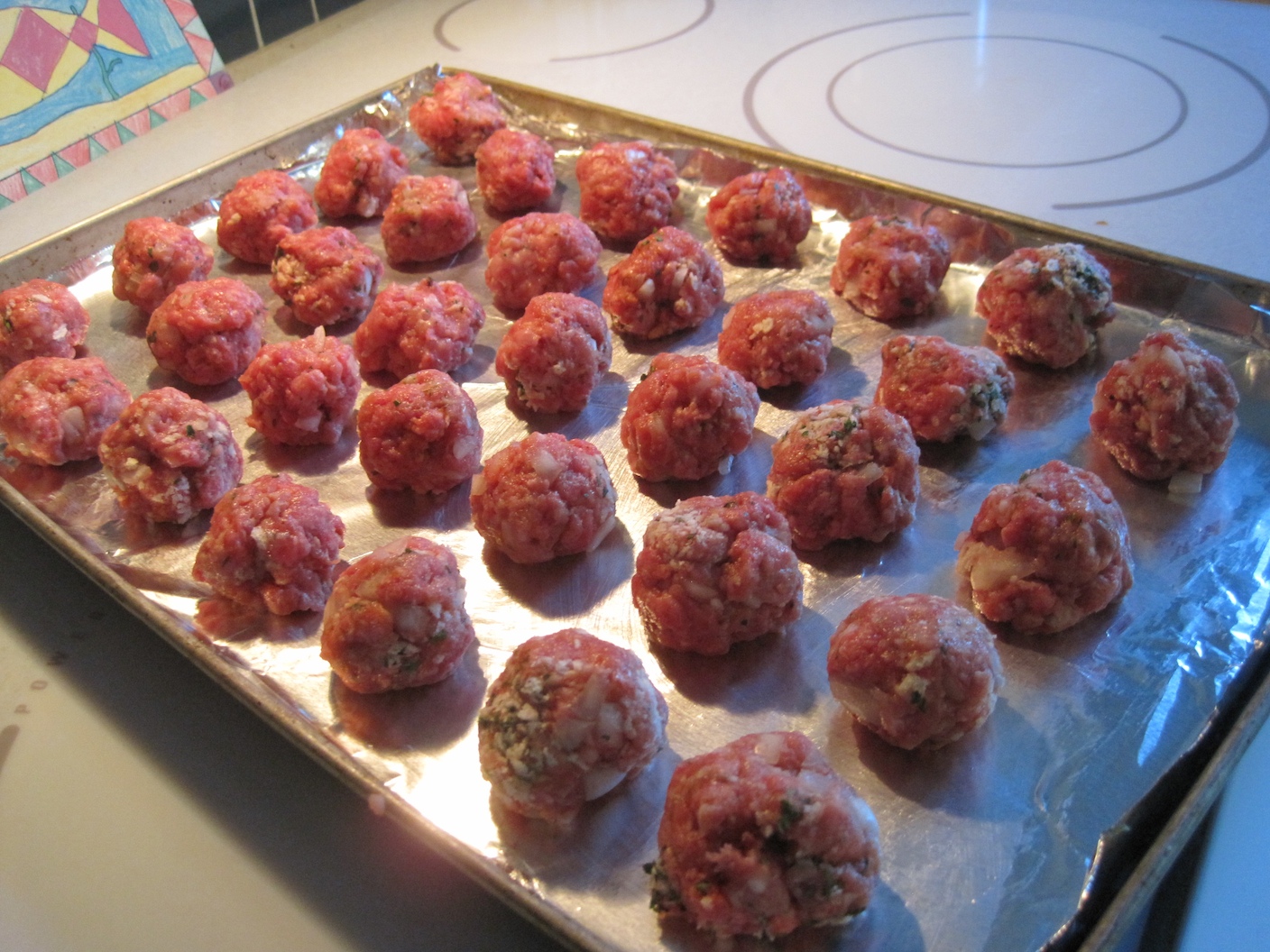 Sometimes I buy frozen packages of meatballs from Trader Joe's, but today I decided to make a whole lot of meatballs and freeze some. This is very unusual for me! My freezer is usually full of convenience food, bread, and ice packs of various sorts. (We threw out the 8 year old rolls of photo film when we installed our new refrigerator last month.)
For my meatballs, I used 2 lb. of grass-fed ground beef (the leanest) and a pound of whatever ecologically green ground pork Whole Foods had to offer. As a result, I did not spend less per meatball than at TJ's. But that's not what was driving me, anyway. I wanted to have some home-made meatballs in the freezer.
Above you can see one of the 2 trays of meat balls before I put them in the oven. And below, the still steaming meatballs just as they came out. This was the tray that went into 2 freezer boxes:

For dinner, I simmered the other tray of baked meatballs in some tomato sauce (this was from Trader Joe's but I added a dash of sugar and balsamic vinegar to it). We ate around half of it for dinner; I thought it was good:
 To make meatballs I use 1 egg and one-half to one small, finely chopped onion per pound of meat. Today I put in panko crumbs (I sometimes use other starchy stuff such as matzoh meal or oatmeal), parsley flakes, herbs de Provence, and a squeeze of tomato paste from my handy tomato paste tube. Sometimes I flavor them differently. Always salt and pepper, though. I don't measure all the seasonings, just eyeball it and feel it to see if it needs more crumbs. I mix it up thoroughly, gently form meat balls tucking the onion pieces inside the meat so they don't separate while cooking. I bake them at 475° for 12 minutes (less if they are to be simmered in sauce). Some of the frozen ones might end up in cardamom flavored white sauce or in some other arrangement.

For dinner, I simmered the other tray of baked meatballs in some tomato sauce (this was from Trader Joe's but I added a dash of sugar and balsamic vinegar to it). We ate around half of it for dinner; I thought it was good:
 To make meatballs I use 1 egg and one-half to one small, finely chopped onion per pound of meat. Today I put in panko crumbs (I sometimes use other starchy stuff such as matzoh meal or oatmeal), parsley flakes, herbs de Provence, and a squeeze of tomato paste from my handy tomato paste tube. Sometimes I flavor them differently. Always salt and pepper, though. I don't measure all the seasonings, just eyeball it and feel it to see if it needs more crumbs. I mix it up thoroughly, gently form meat balls tucking the onion pieces inside the meat so they don't separate while cooking. I bake them at 475° for 12 minutes (less if they are to be simmered in sauce). Some of the frozen ones might end up in cardamom flavored white sauce or in some other arrangement.
Thursday, November 03, 2011
Freaks

 I just read Candy Freak by Steve Almond. The book, as suggested by its title, is about Steve Almond's obsessions with candy bars. He spends a lot of time describing his childhood experiences with candy bars, but the main topic of each chapter is the exploration of candy bar factories, especially the small regional ones that make little-known candy bars with imaginative names. I've never heard of many of the brands he features, much less tasted them, but I googled around for photos to help myself imagine what he was talking about.
Almond is obsessed by the fate of these obscure candy bars, a sad declining fate which is pretty much sealed. Mars, Hershey, and Nestle pay tens of thousands of dollars to super markets and other mainstream candy sellers for the shelf space for their products (which Almond seems to have nothing against, just that they won't let him tour their factories). No matter how good or how locally popular obscure candy bars may be, the small and often eccentric manufacturers can't afford these fees. So they are sold in gas stations or dollar stores or mom-and-pop places where only candy freaks like the author or neighborhood kids or whatever will buy them. 


Almond is therefore very sad. He's a sad man, and he slowly introduces the reader to any number of sources of sadness and freaking out in his life. I don't want to go into this area of the book -- too depressing. Candy bars for him are an escape from what could be seen as neurotic self-absorption and messed-up memories. He calls his existential state "the loneliness, the creeping sense of failure," and he harbors the hope that "the pleasures of candy would help me beat a path from my despair." (p. 155) Jeez. For this he embarked on a nation-wide tour of candy factories.
Mostly, it's a very freaky book, but unlike a lot of books, it isn't guilty of misrepresenting itself: Candy Freak. Yes. 

The greatest writerly skill Almond displays is describing tastes of candy bars.
He bites into one and writes: "The dark chocolate shell gave way to an intense burst of sweet, chewy fruit. The texture was soft enough to yield to the teeth, yet firm enough to absorb the musky undertones of the chocolate." This candy bar turns out to be "a dried cherry, infused with raspberry and covered in a Select Origin 75 percent dark chocolate." (p. 104) Yes, a premium post-modern chocolate bar, photo at right.
But Almond is just as rapturous about dozens of other candy bars that have been manufactured pretty much the same way and on the same antique equipment for nearly a century, and are still made by the descendants of the founding candy-makers. And he describes each factory and each owner in great and remarkably varied detail.

For me, this is the worst week of the year to hear about all these candy bars, because Monday was Halloween, and I spent at least the last 2 weeks in October on a kind of Snickers and Butterfinger bender. Honest -- I only ate one Snickers bar between last Halloween and this October, and that was on the road when we stopped at a gas station that didn't really have any real food. But I digress from Almond's talents, and his great success in documenting the last of the small-scale candy makers. For this, he is in fact widely recognized and often quoted. Freaky!

Wednesday, November 02, 2011
Way Out West

The La Fonda Hotel in Santa Fe New Mexico, the splendid accommodations at the South Rim of the Grand Canyon, the Union Station in St. Louis, and the coffee shop in the Petrified Forest National Monument (now a museum -- see photo above) all have impressed me greatly at the various times in my life when I've experienced them. I just read a book that puts them all together: they were originally designed and developed by Fred Harvey. Author Stephen Fried's Appetite for America: Fred Harvey and the Business of Civilizing the Wild West -- One Meal at a Time is a good read. It successfully combines the biography of the man Fred Harvey (1835-1901), the historic development of the American west, and the history of the once-famous hospitality company, also named Fred Harvey, that he founded and that continued for decades under the management of his family after his death.
I knew two basic things about Fred Harvey before I read the book. First, I was aware that there were many restaurants and hotels by that name at some time in the past, which turns out to have been the era of development of tourism along the route of the Santa Fe railroad. Second, I understood that Fred Harvey Indian stores had traded for some of the highest quality rugs, pottery, and other artifacts, and had encouraged the Indians to develop their craft traditions.
Here are several additional interesting things I learned about the man and his company:
Harvey began by creating a chain of restaurants along the rail lines, where travelers could buy reliable meals without being cheated. He continued by improving the food and service in a number of ways, and by working with Pullman to develop dining cars when train technology made it possible to walk from car to car, and made the interiors of the trains more pleasant. His endeavor included many measures to ensure consistent quality, making Fred Harvey the first restaurant chain and a model for some that followed.
At the end of his life, Harvey and his sons began to expand into tourist hotels, and particularly to create the still-amazing hotels and tourist facilities at the Grand Canyon, the La Fonda Hotel in Santa Fe, and a few other spectacular places. They also took over all concessions at central rail terminals such as the Union Station in St.Louis that I remember. After the Depression, the only profitable part of the company was at the Grand Canyon, and the rest slowly shut down.
The Harvey company was ahead of its time in hiring women. The wait staff of the restaurants from quite early-on was entirely female, in jobs that had previously been mainly for men. These waitresses received intense training and promised to remain in service for a certain time (after which they often married the men on the frontier where they worked). Known as "Harvey Girls," they wore super-clean white aprons, and upheld the high standards set by Fred Harvey.
Women were hired not only as waitresses, but also in other roles unusual for that era. Mary Colter (1869-1958) was the chief architect and designer of the truly innovative buildings and interiors for the restaurants, gift shops, and tourist hotels for the chain. Beginning in 1902 she was the main visionary in developing what now seems to be a classic southwest style of architecture. Ironically, though, the women in the family were shut out of management by one inflexible member of the Harvey male line.
Finally, in 1946, the Fred Harvey heirs cooperated with the making of "The Harvey Girls," a Judy Garland movie about the early days of the chain. The movie was extremely popular (the book notes that it made more money in its initial year than the Santa Fe railroad, which was sliding into oblivion by then). The best-known song, "On the Atchison, Topeka and the Santa Fe," won an Academy Award. Like many films, this one cemented the collective memory of an era that was just about finished. I admit that I had not heard of the movie, though I do know the song.
I loved the book. Its appendix includes recipes from published Fred Harvey cookbooks and from surviving manuscripts used by the cooks in the restaurants, many of whom were brought over from Europe to innovate combinations of classic recipes with southwest cuisine -- especially at the La Fonda in Santa Fe. (In other words, the Coyote Cafe wasn't the first to put Santa Fe on the culinary map.) I may try some of them!
Wednesday, October 26, 2011
Dumas Celebrates Pork Month
 Alexandre Dumas is best known for the Three Musketeers (at least 29 different film versions listed on IMDB, as one measure of its popularity) and The Count of Monte Cristo (at least 18 versions) but he also wrote a gigantic work called the "Grand Dictionnaire de Cuisine." I just bought the little tiny abridged version, recently republished. It's not exactly a cookbook but he does give recipes, so in honor of Louise's Cookbook Game at Months of Edible Celebrations, I'm going to share a recipe in honor of Pork Month. That's what we do in this game: we pick a current MONTH, like Apple Month or in this case Pork Month, which is celebrated in October, and we find a recipe in a cookbook we like.
The recipe in the tiny version of the "Grand Dictionnaire" which is titled From Absinthe to Zest: An Alphabet for Food Lovers, doesn't just have any old entry for pork: it has "Young Wild Boar," which in French is "marcassin." The recipe is for "Quarter of wild boar with cherry sauce." You would surely want to make it, if you happened to have a "fresh tender quarter of a young wild boar." Dumas suggests that you start by dealing with the bone -- his description is detailed, on how to do this so that the bone protrudes properly from the meat. Then you put the meat in a litre of marinade, and let it macerate for two or three days, you cook it and baste it, drain it and "mask it with a thick layer of breadcrumbs (from black bread) which have been dried, pounded, sieved, mixed with a little sugar and cinnamon, and then dampened with some good red wine, but only enough to make them stick together." There are a few more instructions on cooking it, and finally putting "a paper frill around the protruding bone."
The Cherry Sauce for the meat is made separately, from dried, unpitted cherries, softened in water and then pounded in a mortar. Additional ingredients include red wine, cinnamon, cloves, salt, and lemon zest, all thickened with starch.
Sounds delicious, doesn't it?
The Cherry Sauce for the meat is made separately, from dried, unpitted cherries, softened in water and then pounded in a mortar. Additional ingredients include red wine, cinnamon, cloves, salt, and lemon zest, all thickened with starch.
Sounds delicious, doesn't it?
Saturday, October 22, 2011
"Pomegranate Soup" by Marsha Mehran
 I just read the novel Pomegranate Soup by Marsha Mehran. The book features descriptions of food and cooking, including one Persian recipe in each chapter. However, these descriptions are really the only feature of the novel that I find truly strong and enjoyable. The recipes for chicken with walnuts and pomegranates; various soups, yogurt drinks, and deep-fried pastries sound wonderful.
 The premise of Pomegranate Soup is like a well-known recipe. Take an insular village somewhere in northern Europe (here, Ireland). Invent some quirky inhabitants (quite a few here). Bring in an immigrant or two to found a restaurant or cafe (here, three sisters from Iran and an elderly Italian widow who had already been the outsider in a village for 40 years or more). Introduce the villagers to exotic cooking. They like it (a bit too fast here). Create some jealousy, greed, adolescent pranks, rivalry, and love interest (maybe a little contrived). Yup, yup, yup, a kind of a melodrama.
The portrayal of the sisters and how they fled the revolution in Iran is interesting and plausible. The portrayal of the Irish villagers and the Italian widow is pretty plausible too, at least at first. The events of the story start out not too bad. But as things progress, the story goes out of control -- spoiler coming.
The ending, where all the evildoers and mischief makers see the light, repent, and swear to be good, doesn't do much for me at all. Also, throughout the book the descriptions are often a bit over-written, sometimes with rather odd word choices that overreach to try to make it more vivid. In sum, it's a rather weak novel with really good food writing.
Thursday, October 13, 2011
It's School Lunch and Chili Month
October is School Lunch Month and also Chili Month. For me this is quite appropriate, because my first taste of chili was in the school cafeteria at Delmar Harvard Elementary School in University City, Missouri. This was exceptional: I normally brought a bag lunch consisting of a sandwich, an apple, and sometimes a treat like a cookie or a piece of candy. My mother made our lunches almost every day, so I can't remember how I was able to try the chili in the cafeteria instead of my sandwich. I'm sure it wasn't in the least hot, as no children in Missouri at that time would have been expected to eat spicy food. It was served in a heavy white china bowl with a little cellophane packet of crackers. I was always curious to try things that were different from what my mother made, and this was really different.
 Later when I had a kitchen of my own, I found the very bland taste of Campbell's Chili Beef Soup to replicate my school-cafeteria memories. (I put the Andy Warhol soup can image in this blog post to reinforce that memory.) By that time, I was living in California and trying out the inexpensive and maybe even somewhat authentic California Mexican restaurants in Berkeley (which was not yet the gourmet paradise that it later became). The familiar school cafeteria flavor didn't seem exotic at all.
I did have chili once at home -- that was later, when I was in high school. My Aunt Florence brought us some of her home made chili. I remember her describing what she put in: ground beef, canned beans and tomatoes, bell peppers, chili powder, and probably a couple of other things. Compared to my mother's cooking it was exotic.
 Later when I had a kitchen of my own, I found the very bland taste of Campbell's Chili Beef Soup to replicate my school-cafeteria memories. (I put the Andy Warhol soup can image in this blog post to reinforce that memory.) By that time, I was living in California and trying out the inexpensive and maybe even somewhat authentic California Mexican restaurants in Berkeley (which was not yet the gourmet paradise that it later became). The familiar school cafeteria flavor didn't seem exotic at all.
Then I got adventurous and began to make chili from recipes that I found one place or another, most likely starting with the recipe "Chilly-Night Chili" on page 16 of the I Hate to Cook Book by Peg Bracken. Instead of going right to the Campbell's Chili Beef can, it uses a can of tomato soup along with onion, beans, hamburger, and optional olives. Aunt Florence did it better, but pretty soon, so did I.
Here's a chili recipe that I posted a few years ago. This time I know where it came from, but it's not from a cookbook, it's from real people who at the time they gave me the recipe were really living in Texas. Alec, in fact is a native.
Ellen and Alec's "Texas Red" Chili
2 to 3 lb. lean beef cubes: trim off fat if necessary
2 chopped onions
3 cloves chopped garlic
Several fresh chopped chilies (such as jalapenos) or 1 can Old El Paso chopped chili peppers
1 to 4 tablespoons of chili spice (recipe follows — blend of spice is essential)
8 oz tomato sauce and 8 oz water
1 lb can of tomatoes, cut in pieces
Brown onion and garlic. Add fresh peppers (if using fresh). Remove from pan. Add beef and brown. Drain excess fat. Return meat to pan. (Add canned peppers.) Add spice, then tomato sauce, water, and tomatoes. Simmer several hours on top of stove or in 275 degree oven, until meat is soft.
One heresy is to add a can of corn, a can of black beans, and/or a can of red beans towards the end of cooking. I'm not enough of a heretic to make the beans or corn dominate the chili. That would be a different recipe.
Chili Spice Blend
In a mortar or spice grinder blend 1 crumbled bay leaf with 1 tablespoon of each of the following spices: Whole Cumin, Dried Oregano, Chili Powder. Optionally add 1 tablespoon each of onion flakes, parsley flakes, and dried basil. Add at least 1 tablespoon cayenne pepper, dried hot pepper, or hot pepper flakes.
2 to 3 lb. lean beef cubes: trim off fat if necessary
2 chopped onions
3 cloves chopped garlic
Several fresh chopped chilies (such as jalapenos) or 1 can Old El Paso chopped chili peppers
1 to 4 tablespoons of chili spice (recipe follows — blend of spice is essential)
8 oz tomato sauce and 8 oz water
1 lb can of tomatoes, cut in pieces
Brown onion and garlic. Add fresh peppers (if using fresh). Remove from pan. Add beef and brown. Drain excess fat. Return meat to pan. (Add canned peppers.) Add spice, then tomato sauce, water, and tomatoes. Simmer several hours on top of stove or in 275 degree oven, until meat is soft.
One heresy is to add a can of corn, a can of black beans, and/or a can of red beans towards the end of cooking. I'm not enough of a heretic to make the beans or corn dominate the chili. That would be a different recipe.
Chili Spice Blend
In a mortar or spice grinder blend 1 crumbled bay leaf with 1 tablespoon of each of the following spices: Whole Cumin, Dried Oregano, Chili Powder. Optionally add 1 tablespoon each of onion flakes, parsley flakes, and dried basil. Add at least 1 tablespoon cayenne pepper, dried hot pepper, or hot pepper flakes.
Thanks again to Louise at Months of Edible Celebrations for inspiring me and so many others in new areas of food blogging this month. I celebrate all the huge number of chili recipes and variations that I've ever tried, and the rather pathetic memory of the school cafeteria.
Monday, October 10, 2011
Really Retro
I just read about a tasting menu at the Getty Museum in Los Angeles that included American food representing several decades. It's arranged in chronological order from starters to desert. I'm unusually impressed by the right-on choices:A random photo of a mud pie:

- 1940s -- chicken liver and bacon paté with brandied cherries, watercress and pecan raisin bread
- 1950s -- poached lobster and asparagus casserole with crispy potato, shaved truffle and American caviar
- 1960s -- steak Diane with fingerling potatoes, caramelized onion, wild mushrooms and Bloomsdale spinach
- 1970s -- "Brie fondue" (puff pastry baked Brie) with brioche, orange marmalade and balsamic
- 1980s -- "mud pie," a coffee sabayon with chocolate crust and dark chocolate ganache.

Tuesday, October 04, 2011
Louise's Cookbook Party Game

At Months of Edible Celebrations Louise is having a fun month, challenging her readers to post a recipe in honor of one of the special foods of the month. Among the commemorations she lists for October is Cranberry Month. Great idea -- I hope cranberries start to show up in the markets soon.
I love cranberries. I substitute either dried or fresh for walnuts in chocolate chip cookies or even in brownies (shown above). I have made cranberry cornmeal cake, cranberry bread, and above all, cranberry chutney. I make it early so it will be aged enough for Thanksgiving dinner, so my celebration has to be deferred -- later, I make ordinary cranberry sauce for those who like it more traditional.
Louise requested that we specify what event we made our recipe for. She also asked where I got the recipe: good question. I don't remember, I've been making it for years. I hope these details don't disqualify me from her game!
Here's the recipe -- which I've posted before.

Cranberry Chutney
Use a total of 2 packages of cranberries -- 6 cups
Combine the following in a large pan and boil until sugar dissolves:

Cranberry Chutney
Use a total of 2 packages of cranberries -- 6 cups
Combine the following in a large pan and boil until sugar dissolves:
1/2 cup cider vinegar 2 and 1/4 cups brown sugarAdd and simmer 10 minutes:
3/4 tsp. curry powder 1/2 tsp. ground ginger
1/4 tsp. ground cloves 1/4 tsp. allspice
1/2 tsp. cinnamon 1 and 1/2 cups water
1 apple, peeled, cored, choppedUse the orange and lemon rind and the fruit -- pare rind with a vegetable peeler and chop or grate it. Discard the pith. Section and chop the fruit.
2 lemons and 2 oranges, prepared as follows
Add and boil 40 minutes:
Store in jars in refrigerator. Age this chutney about a week before using. It keeps for several months in the refrigerator. It's good as a side dish for chicken, turkey, or duck, or as a filling for halves of acorn squash, or as a relish on a cheddar cheese sandwich -- among other uses.
1/2 cup golden raisins 1/2 cup chopped dried apricotsAdd 3 cups more, that is the rest of the cranberries. I fool around with this recipe a lot. Sometimes I just put everything together and cook until it looks thick and done. Sometimes I use candied ginger.
3 cups cranberries
Store in jars in refrigerator. Age this chutney about a week before using. It keeps for several months in the refrigerator. It's good as a side dish for chicken, turkey, or duck, or as a filling for halves of acorn squash, or as a relish on a cheddar cheese sandwich -- among other uses.

Saturday, October 01, 2011
"Being inauthentic is a fact of America"
In an article by an immigrant from Thailand with evolving views of Thai restaurants in America, I read this thought-provoking paragraph about the emotions created by differences between the food in those restaurants and the food from childhood in Thailand:
"It’s a hard reality to swallow, but I’ve learned to live with it, because being inauthentic is a fact of America. To become American means to have been, at some point, uprooted from an ancestral world and reinvented free-style. I sometimes find myself counting in Thai, but most of my thoughts now bubble out in English. I go back and forth between the Thai way of eating in tandem with fork and spoon and the American way of picking at foods with a lone fork. What love I have for fish sauce equally goes to butter. If I can feel neither wholly Thai nor wholly American, how can I ask the same of a bowl of duck green curry? Now, when I look at a Thai restaurant menu, I don’t fume and think in expletives as much. I just breathe in and out, and let the food be what it can be." -- Learning to Love Thai-American Food by Pitchaya Sudbanthad
Wednesday, September 28, 2011
No pumpkin problem
 I've read that the floods in the Northeast are causing a pumpkin shortage. But there's good news! The shortage is local -- pumpkins grow in every state, and they travel well. Says the wonderful Consumer Reports blog The Consumerist --
 "That means if New York is having a tough pumpkin season, that's okay, Michigan will come to the rescue! Or California, or Texas! Worst case scenario, you might have to pay a little bit more or not get that mega huge one you usually go for, but isn't a magnificently carved jack-o-lantern worth a dollar more and a size downgrade? Charlie Brown would say yes."
Thursday, September 22, 2011
Challah
If you want to make good challah, I learned last night, you need to use good flour, good yeast, and water just the right temperature (not hot!). Recipes vary in proportions, method, and additions such as toppings and fillings. The finished loaf is brushed with egg which can be mixed with honey to make the crust sweet. Some people add chocolate chips, chopped apple, cinnamon-sugar, chopped onion, olives, and more either to the top or within the strands that are then braided.

Shaped dough topped with apples:

My finished loaf, baked after I got home:

Here are a few photos of some of the women who were also learning:
Forming strands of dough after first rise:
Forming strands of dough after first rise:
Shaped dough topped with apples:
My finished loaf, baked after I got home:
Tuesday, September 20, 2011
It's Just about the Food
The Oxford Symposium on Food and Cookery is a venerable event: I suspect it's the Gold Standard for food articles. Lazy me -- I haven't systematically read through the collected proceedings of these annual meetings where the best articles from each year since 1981 have been published. On a recent visit to the library, however, I checked out the 1998 volume, Food in the Arts. I was especially interested to read "Food in the Detective Novel" by Joan P. Alcock, and to learn how a professional food historian approaches the subject that I often return to.
After this introduction, the article continues with a survey in chronological order by the setting of the detective stories. Inspector Marcus Didius Falco in ancient Rome is her first example: readers hear of the value of peppercorns, the economics of the oil trade, and the lost herb silphium. She continues by tabulating the food references in detective stories set in the middle ages, such as Brother Cadfael "who is more concerned with growing herbs ... than with his stomach, for his herbs have healing powers." (p. 14) She continues with Renaissance-era detective fiction, such as the protocol and place settings for a feast in the work of Kate Sedley. Alcock points out:
"Food in the Detective Novel" begins with a quote from W.H.Auden's famous article on detective fiction, though in fact he says little about food. Alcock acknowledges that the most basic role of food in crime is "in relation to killing the victim," and the second place goes to "the contents of the stomach" for clues to the time of death. She continues:
"In recent years attention has been paid to the food eaten by the investigator, either as part of the story or to add background verisimilitude. This is evident in the historical whodunits, but it may also be a facet of the investigator. The number of cook/chef investigators is increasing." (p. 13)
"The feast is described in some detail but phrases such as 'I cannot remember at this distance of time more than a tithe of what was consumed that evening,' seem an attempt to avoid accurate description." (p. 15)
The article proceeds with a study of several series of detective novels set in the Mediterranean, including those of Donna Leon's Commissario Guido Brunetti of the Venice Questura:
"Chilled wine is sipped slowly while savouring views over Venice.... Prosecco or Fragolino are aperitifs; Soave is served with chicken and artichokes; Dolcetto with pasta fagioli and cotoletta; brandy or grappa with coffee." (p. 17)
A summary of French detectives' food follows -- "If Madame Maigret has a vice, it is drinking her cup of Balthazar coffee, which she takes every morning." Then the classic English detective novel, "mainly by women writers... Food was of little account in their stories." She finds a few meals of interest in the stories of Agatha Christie, Dorothy Sayers, and the less-famous Gladys Mitchell.
Alcock invents another category for the novels of Conan Doyle, Michael Innes, and Rex Stout: "The Abstemious and the Aesthete." I was surprised that she made no mention of Stout's Nero Wolfe novel Too Many Cooks, published 1938, where the subject is a meeting of 15 international master cooks. In it, Nero Wolfe gives a paper on American food; he consents to attend the meeting only because he wants to obtain a secret recipe.
And Alcock goes on to discuss women detectives, such as the work of Amanda Cross and others (somehow, Miss Marple isn't in this category, but in the Classic English category). She lists the foods eaten by each detective, without being distracted by other features of the tales. Only in her conclusion does she apply what I would think of as literary analysis:
And Alcock goes on to discuss women detectives, such as the work of Amanda Cross and others (somehow, Miss Marple isn't in this category, but in the Classic English category). She lists the foods eaten by each detective, without being distracted by other features of the tales. Only in her conclusion does she apply what I would think of as literary analysis:
"Other books than detective stories incorporate food, but it is obvious that the frisson between murder and food, between intellectual puzzle-solving and creating of dishes is eminently satisfying. ... The dinner party provides opportunities for endless twists in a murder plot, the murderer awaiting an opportunity, the victim calmly eating, unsuspecting of the final fate." (p. 29)
I wish she had been more explicit about how each author made use of the food details that she catalogued.
Subscribe to:
Posts (Atom)