Photos © 2024 mae sander
Showing posts with label cranberries. Show all posts
Thursday, November 28, 2024
Wednesday, November 24, 2021
Thanksgiving Prep
In Evelyn’s refrigerator you can see two ducks, chopped carrots, squash, turnip, onion, and celery plus prepped Brussels sprouts! Ready for making roast vegetables and bread dressing for Thanksgiving dinner tomorrow. Top shelf: cranberry sauce that I made before coming here. If you are wondering: this is the overflow fridge in the basement. The kitchen fridge is crowded with all the other food for the weekend.
Monday, November 30, 2020
In My Kitchen, November 2020.
What's new and nifty in my November Kitchen?
![]() |
| A new butter and cheese dish with a slot for the knife. |
![]() |
| Also new: tongs to replace a broken pair: useful & boring. We also bought some new spatulas -- also boring but useful. |
![]() |
| Round proofing basket for Len’s bread making. |
Cooking
During the month of November, as we've done for months during out long dark lockdown, we ate almost every meal at our own table, just the two of us, having cooked the food for ourselves. As the pandemic statistics rose to new heights, we even stopped going into the one or two little markets where we felt safe for a while. All our groceries came from deliveries or curb-side pickup.
We tried various combinations of new flavors.
Baking
![]() |
| We made frittata with Asian flavors, and finished the top with the kitchen torch rather than under the broiler. |
![]() |
| The frittata had eggs (of course) and broccoli, onions, mushrooms, and Asian condiments; garnished with cilantro, soy sauce, and hoisin sauce. |
![]() |
| Wild-caught gulf shrimp with fresh vegetables. |
![]() |
| We constantly make new kinds of pancakes from sourdough discard. Here: pancakes with raisins and dried apricots with a side of fried apple slices. |
Kitchen Essentials
| Essential kitchen item: Vlasic dill relish! Tuna salad without it is impossible. |
.![]() |
| Essential to have on hand: wine. The beverage for Elizabeth's weekly blogger get-together. |
Thanksgiving
Some good things we ate: mushroom gravy, pumpkin with garlic and cilantro, and a chicken with dressing made from wild rice, white rice, cranberries, and green onions. Then on Saturday night, we had a great gift: leftover duck and sides reserved for us from the Thanksgiving dinner of some relatives who quarantined for 2 weeks to be able to get together with each other.
![]() |
| Down the street, Kathy’s Bear also enjoyed a turkey dinner. |
Baking
![]() |
| For Thanksgiving, Len baked apple bread (shown) and rye-raisin bread. We ate some and gave some to several friends. |
Strangest Food Read of November
Earthlings by Sayaka Murata has some of the weirdest and most disturbing food scenes that I've ever read. I liked her first book, Convenience Store Woman (blogged here), but this new one was really horrifying! Both books are about characters that reject Japanese society in eccentric ways, but I think Murata has gone off some kind of deep end now!This concludes my kitchen roundup for the busy, though isolated, month of November. I’m sharing with a number of bloggers at the event “In My Kitchen” sponsored by Sherry’s Pickings.
Blog post and photos © 2020 mae sander for mae food dot blog spot dot com.
Labels:
bread,
cranberries,
Food in Literature,
Kitchens,
Thanksgiving
Friday, November 20, 2020
Thanksgiving Thoughts
Every November I post about Thanksgivings past and present. This year it's especially hard to think about what the holiday has meant over the years, and how intelligent and patient people are just having to wait out the pandemic, hoping for the effectiveness of a vaccine that will put us on track for the future. It’s even more painful to think about less patient or reasonable people who are insisting that gathering in family groups can't hurt them despite the huge jump in cases of coronavirus in recent weeks.
![]() |
| Cranberries, 1950s. |
![]() |
| Cranberries, 2020, ready to go. |
We belong to the cautious element of the population, and will be dining with just the two of us, though we will be sharing food -- exchanged at a distance -- with some relatives who are getting together after observing very strict non-contact rules for 14 days before the holiday. Whatever you are doing, I hope that you will have a wonderful holiday that’s appropriate for this year.
We have many things to be thankful for, even if traditions have to be adapted to current reality. For the next two days, I'm planning to re-post some of my favorite Thanksgiving posts. And here are some turkeys of past years, just to keep the spirit alive.
Wednesday, November 27, 2019
The Night Before Thanksgiving
![]() |
| Making avocado salad. |
![]() |
| Bread, avocado & tomato salad, cornbread with cranberries, cheese to garnish the chili. |
![]() |
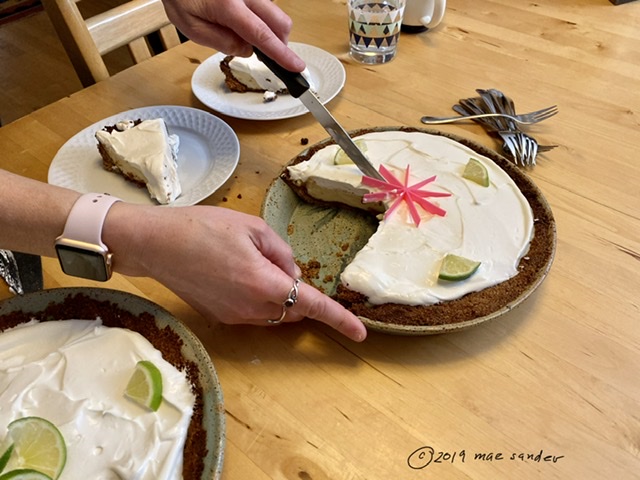
| Key lime pies for dessert. Note the special 3-D printed divider to make exactly 9 equal pieces of pie! |
Labels:
Chili and Texas Red,
cornbread,
cranberries,
November 2019,
Thanksgiving
Saturday, April 28, 2018
Grocery Stores
Recent reading: Grocery: The Buying and Selling of Food in America by Michael Ruhlman. Much in it is familiar to habitual readers of food books (like me):- Ruhlman's analysis of processed food and what's in it that shouldn't be.
- His tales of conflict between the profit-driven aspirations of big agriculture and the popular dreams of smaller, more sustainably grown meat and produce.
- And his discussions of the constantly changing advice and research about what food is good for you. I like his observation on this: "There’s little disagreement that Americans have a hopelessly neurotic relationship with what they consume." (p. 80).
Besides the familiar, however, a lot of the material in the book is different from these previous writers' stories. Refreshingly, the center of his book is Cleveland, Ohio. I'm always annoyed at the New-York-centeredness of so many food books. This is midwestern!
One interesting point: in a medium-size midwestern city -- like Cleveland -- typical American transportation has had a big effect on how people shop:
"One of the under-recognized facts of American real estate development is how our modes of transportation are the fundamental determiners of the way we create our residential and commercial spaces. The advent of the streetcar... brought about the creation of America’s first suburbs— with sidewalks and shopping districts within walking distance.... Spaces that were developed after the automobile became a predominant feature of American life are far from city centers and spread out. It was the automobile, and highways, that led to suburban sprawl. ....
"'From 1948 to 1963 large chains increased their share of the nation’s grocery business from 35 percent to almost half,' writes Harvey Levenstein in Paradox of Plenty. 'As early as 1956, the independent corner grocery store, while still visible, was a relic of the past.'" (pp. 51-52).Ruhlman presents his analysis of the grocery business through the experience of one family-owned grocery chain in Cleveland, along with his own memories of how his family shopped for food. Its current owners, the Heinen brothers are his main subject. Grocery also sketches the family background of the buisness -- the Heinens' grandfather and father expanded from a small butcher shop to a small market to a chain of supermarkets. A more general outline of the American retail food business supports the history of the Heinens' stores beginning with A&P and a few other 19th century institutions, and continuing up to recent changes in supply and demand for organic produce, natural meat, and similar goods.
While describing the grocery business from the inside, Ruhlman traveled with the Heinen brothers and some of their employees as they evaluated new trends and products at grocery trade shows. He accompanies them on visits to farms and ranches where owners are trying to return to traditional agricultural practices, and learns about the challenges of non-standard meat ranching. Also, Ruhlman discussed alternative health products with a doctor who advises the Heinens on the pills and supplements that they sell.
![]() |
| A happy memory! |
Ruhlman gives a summary the economic challenges of the food industry in America in the context of this one local business. He describes the details of how they make money on each section of the store. I enjoyed learning about the issues that particularly concern the local, family-run business. Unfortunately I can't enjoy the results of such efforts: the family chain where I used to shop was sold to Kroger's several years ago, leaving my town, Ann Arbor, with only national chains.
Personal memories of Ruhlman's lifelong experiences grocery shopping -- much of it done at the Heinen family stores create a vivid background to his descriptions. His own grocery-shopping habits contrast with those of his father in the 1960s through the 1980s. His father loved grocery stores and did much of the shopping for his own family during this time. Among many big changes since then: many people now purchase food for their homes at many stores, and don't stay loyal to one main store as was his father's habit. As a result, owners must constantly find new products and presentations to keep customers coming back.

But on the whole, I liked Ruhlman's book. Some of my favorite passages deal with the remarkably rapid changes in what shoppers want to get from their shopping and their willingness to shop around, as I mentioned. Constant reaction to change is required by his successful example, Heinen's, and other similar stores. Clearly, flexibility and innovation are required if a market is going to stay competitive in their very low-profit business. The Heinen brothers are aware of factors affecting the producers, not just the consumers -- presentation of these factors keeps Ruhlman's narrative interesting. For example when it comes to organic or naturally raised meat, one of their rancher-suppliers says of them:
"Heinen’s gets it. ...They take the majority of the animal, so we can do what we do and raise beef, and we’re not just pulling tenderloins out. They utilize different beef cuts and that helps make us sustainable. So when people talk about sustainability, it’s the chefs and the retail buyer just as much as it’s us on the ranch utilizing the compost." (pp. 190-191).Same point made by Dan Barber in The Third Plate, but more convincingly!
So many changes! For example, the implications of hydroponic growing of fruit and vegetables that can be hydroponically grown. Ruhlman lists:
"blueberries, strawberries, raspberries, cranberries, huckleberries, green beans, tomatoes, coffee, grapes; vine vegetables such as squash, pumpkins, okra, cantaloupe, and watermelons; peanuts, beets, carrots, onions, potatoes; critical grain crops such as barley, corn, wheat, and rice; and of course dozens of leaf lettuces and even more herbs." (pp. 227-228).Another big change: demand for ready-to-serve food. The grocery counters where people can buy food that requires no kitchen prep whatsoever are taking up more and more space in markets. From rotisserie chickens to pizza ovens to hot food that's equivalent to take-out from a restaurant, his example family chain and most other grocery stores keep developing recipes and specialties to keep their customers coming back. I was fascinated by the economic implications of selling prepared, ready-to-serve foods: according to the Heinlen brothers, it's impossible to actually make a profit on this department of the store, but it's absolutely necessary to have it!
Ruhlman's book also made me think about how fast the grocery business has been changing even since he published the book last year. Grocery appeared before amazon.com merged with Whole Foods, so he obviously didn't discuss the implications of this merger, which more recent commentators have speculated about quite a lot, and before the meal kit fad which is now going into stores (see my recent post). Who knows what's next?
In a couple of days, I'll be posting a follow-up to this post with observations about food in my kitchen, and how the many issues Ruhlman mentions affect me directly.
Update, July 16, 2018: the follow-up post is Reading "Grocery" in My Kitchen. The Culinary History Reading Group chose Grocery as the July selection.
In a couple of days, I'll be posting a follow-up to this post with observations about food in my kitchen, and how the many issues Ruhlman mentions affect me directly.
Update, July 16, 2018: the follow-up post is Reading "Grocery" in My Kitchen. The Culinary History Reading Group chose Grocery as the July selection.
Saturday, February 10, 2018
What did Benjamin Franklin Eat?
"In 1718, twelve-year-old Benjamin had been working for his father for two years and was well versed in all aspects of the candle business," writes Rae Katherine Eighmey in her recent book Stirring the Pot with Benjamin Franklin. To show the reader how Franklin and his father Josiah worked, she imagines a vignette where they bring a heavy handcart full of suet from Boston's Butcher's Wharf to their combined home and candle-making business. Besides the suet, which was to be rendered and made into dipped candles, she suggests that the Franklins could have purchased two ox cheeks to be made into a soup or stew for their dinner. Eighmey continues with a description of the way that Benjamin's mother Abiah and his sister Jane may have prepared an Ox Cheek Stew:
This quote illustrates the methods that Eighmey uses to create a detailed and vivid picture of Franklin's era to modern readers who probably have little knowledge of cooking over a hearth fire in an early colonial kitchen. She explains that the cooking technique described here is based on a contemporary household management book from 1717, and for the benefit of really curious readers, offers a recipe for Ox Cheek Stew -- the image of a large cooking pot is an illustration from the recipe. She suggests using beef shanks in case you can't find ox cheeks. (I once did try to find them, and it's difficult; the butcher at Whole Foods pointed out to me that each animal only has two cheeks!)
Stirring the Pot with Benjamin Franklin follows him throughout his 84 years and his several careers. Eighmey explores what he ate at each stage of the way -- including his brief time as a candle-making helper, his training as a printer, his development as a businessman and publisher in Philadelphia, his marriage, his fame (especially for creating "Poor Richard" and his famous sayings), his second career as an experimenter with electricity, his third career as a politician and diplomat in London and Paris, and finally his participation in the Constitutional Convention that gave us our current system of government. What a life!
I especially enjoyed reading about Franklin's dining experiences during his very long diplomatic stays overseas. Eighmey shows that he enjoyed London and Paris dining experiences, but also that he very much missed the American foods of his early life, especially the American varieties of apples and the many types of products made with corn. His wife Deborah, who never accompanied him, was often asked in letters to send food; for example, in one letter from London he mentioned that he seldom saw roasting apples: "I wish you had sent me some... Newtown Pippins would have been the most acceptable." Deborah did send him food, including apples, cranberries, and ham; in 1760 he wrote her: "The apples are a great comfort to me." (p. 161) Later, she also sent dried venison, smoked beef, specially prepared cornmeal called nocake, and other American products. (p. 187)
During the American Revolution, Franklin was extremely important in his mission to Paris, where he arranged crucial military and financial support for the American cause. He ran a large household, which eventually became the US Embassy. For this reason, he employed a professional cook; thus Eighmey was able to find ledgers of food purchases for his kitchens and details of meals prepared during that time. His chef, named Finck, in his employment application, provided a list of simple daily fare and also more elegant dinners that he agreed to prepare for the household and guests:
Recently, I also read Eighmey's earlier book about what Lincoln ate (blogged here: What did Abraham Lincoln Eat?) The Lincoln book to me was slightly more lively and vivid, but I find both to be very valuable food and history books.
"Abiah hangs one of her brass kettles on the bottom trammel hook, directly over the coals, drops in a bit of butter, or salt pork, to melt, then adds the meat to brown. Next she pulls a couple of 'middling' carrots from the root cellar, each about a foot long and two inches in diameter, and chops them into chunks. In like manner she cuts up other root vegetables -- onions, parsnips, beets -- and celery and adds all to the pot. She gives it a quick stir, raises the pot to the middle hook, and leaves them to 'roast' along with a small chunk of ham for seasoning. ...
"Abiah has the help of youngest daughter Jane. She is six years old. Abiah will keep an especially watchful eye over her youngest children in the kitchen area. Fifteen years earlier, the family lost a son, Ebenezer, who fell into the tub of washing suds and drowned at the age of three. By the time Abiah has finished cleaning up the porridge dishes from breakfast, set the kitchen area to rights, and made up the beds, the soup will be ready for the next step. She returns to the hearth, raises the kettle to the top hook, and adds ten quarts of water brought from the backyard well. Now it can simmer away all day, with an occasional check and stir." (pp. 21-22)
![]() |
| Colonial soup pot. |
Stirring the Pot with Benjamin Franklin follows him throughout his 84 years and his several careers. Eighmey explores what he ate at each stage of the way -- including his brief time as a candle-making helper, his training as a printer, his development as a businessman and publisher in Philadelphia, his marriage, his fame (especially for creating "Poor Richard" and his famous sayings), his second career as an experimenter with electricity, his third career as a politician and diplomat in London and Paris, and finally his participation in the Constitutional Convention that gave us our current system of government. What a life!
![]() |
| Another illustration from the book. |
During the American Revolution, Franklin was extremely important in his mission to Paris, where he arranged crucial military and financial support for the American cause. He ran a large household, which eventually became the US Embassy. For this reason, he employed a professional cook; thus Eighmey was able to find ledgers of food purchases for his kitchens and details of meals prepared during that time. His chef, named Finck, in his employment application, provided a list of simple daily fare and also more elegant dinners that he agreed to prepare for the household and guests:
"He agreed to supply a lunch, a dinner -- the main meal of the day served in the middle of the afternoon -- and an evening supper. The early meal consisted of porridge, bread and butter; sugar and honey, with coffee and unsweetened chocolate as beverages. For dinner, ... Finck specified hors d'oeuvres of butter, radishes, and cornichons -- pickles; a large entrée of beef, veal, or mutton; followed by a poultry course; a small 'in between' course, two 'plats d'entrements'; then two vegetable dishes. For dessert the menu suggested two plates of fresh fruit in the winter, four in the summer; two compotes -- cooked fruit frequently served warm in a sugar syrup; a selection of cheeses, cookie-like biscuits, and bonbons. Finally, a frozen dessert was to be served twice a week in the summer and once in the winter. So it appears that Benjamin Franklin ate ice cream, a popular eighteenth-century Parisian treat, less well-known in America or England." (p. 225)Some specific foods in Finck's repertoire: "soup and porridges, fat hens, roast pigeons, baby peas, fried artichokes, small pâtés, and chops, along with fruit -- peaches, plums and apricots." Also mentioned: turkey, the American native bird which Franklin was backing as a national symbol rather than the bald eagle.
Recently, I also read Eighmey's earlier book about what Lincoln ate (blogged here: What did Abraham Lincoln Eat?) The Lincoln book to me was slightly more lively and vivid, but I find both to be very valuable food and history books.
Subscribe to:
Posts (Atom)