Showing posts with label Chili and Texas Red. Show all posts

Monday, October 13, 2025

Food: Fast and Slow

 Fast: Breakfast

Pastry from the freezer. Breakfast in 5 minutes.


Another instant breakfast. Once in the cereal aisle of the grocery store we were making a choice. I said “I’m tired of Life.” A passer-by heard me and was alarmed until I explained that we were talking about the product, not the process.
  

Fast: Lunch

PB&J is very fast!

Great to have one more chance to eat outside under the trees.

Slow: Dinner


Stock cooks for a few hours. On Sunday when I cooked this, my goal was not only to have stock, but to get the odds an ends out of the freezer. We strained out the over-cooked veggies, added some white beans, and called it soup.

The Crock-Pot is slow by definition. I cooked the meatballs along with the red sauce.
Saturday: I slow-cooked this and we ate meatball sandwiches.
Monday: I added red and white beans along with some salsa, and it was chilli. 
Some time in the future: there’s a box of the leftovers in the freezer.

Pretty fast: Trader Joe’s falafel. A jar of olives.
Not too fast: home made yogurt sauce, sliced cucumber, and baba ganoush.

Fast: Dessert

Sara Lee Cake with premium ice cream from a local dairy.


Blog post © 2025 mae sander

Friday, January 21, 2022

New Cookbooks and Good Eats

Food happenings in our house this week include two new cookbooks, and some new ingredients that I haven't used before, including chickpea flour, berbere seasoning, and Ethiopian teff. I'm just getting started with these cookbooks, which are both fairly recent and have been widely praised by reviewers. Both of them offer a look at cuisines that are unfamiliar, and that I'm interested in learning about.

Afro-Vegan: Farm-Fresh African, Caribbean, &
Southern Flavors Remixed 
by Bryant Terry.
Published in 2014.

From Afro-Vegan: twice-cooked potatoes for
"smashed" potatoes with corn and peas.

The finished dish, with salad. The flavors were unusual, and nice.


Ethiopia: Recipes and Traditions from the Horn of Africa
by Yohanis Gebreyesus, Published in 2019. Kindle edition.
I haven't tried any of the recipes from this prize-winning book yet.

I've been experimenting with spices and ingredients from Africa, but not always with perfect results. For example, I tried making some chickpea-teff patties from a website. The flavor profile was great, but the "patties" didn't stick together and were more like crushed-chickpea hash. So no photos! And hopefully the books will have more reliable recipes.

Baking Bread This Week

Len made two loaves of pain de mie with pepper.
The recipe is from Poilâne: The Secrets
of the World-Famous Bread Bakery
by Apollonia Poilâne

Len also baked a French rye bread from the Auvergne region,
using a recipe from The Rye Baker by Stanley Ginsberg.
We sampled this bread with butter and jam. Delicious!

Ordinary Food

Salmon croquettes made from frozen salmon:
no recipe.

A pot of vegetarian chili: no recipe.

Lime and cilantro to garnish the chili.

Cornbread to eat with the chili.

Classic simplicity: French oil-based potato salad with
herring and tomatoes. We remember eating this often
in a VERY cheap restaurant when we were students:
the menu read "hareng pommes à l'huile."

Blog post and photos © 2022 mae sander.

Sunday, February 28, 2021

Kitchen Prep

In my kitchen in February we are still mostly in isolation, so I’ve been doing lots of food preparation and cooking. Some of the recipes are new, some old favorites, some improvised.  I’ve chosen some quotes from recent reading along with photos of my various food prep steps — reading and cooking are my two main isolation activities, along with an occasional walk around the neighborhood. Next month may be different!

This is simple food, mostly. Take a look — 
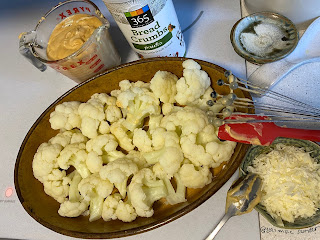
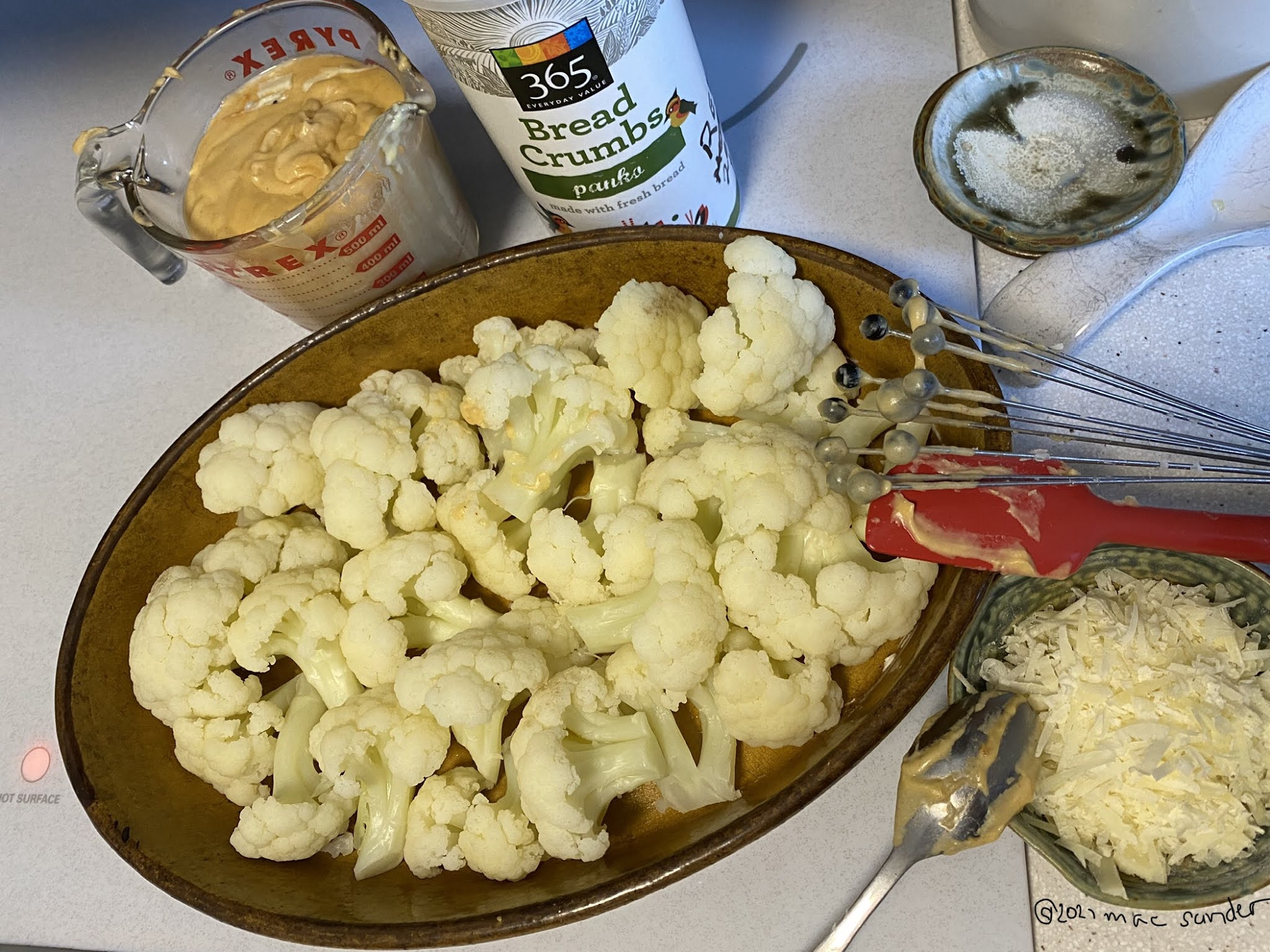
Cauliflower cheese in progress: steamed cauliflower,
cheese sauce, cheese and crumbs for topping.

In the oven.

From The Artists’ and Writers’ Cookbook, 1961: “Yes, I cook very conventionally — careful not to invade food with many flavors, even wine.” (Marianne Moore, p. 278)

A big bowl of vegetarian pasta just about ready to serve —
it lasted for three dinners! Note the fried mushrooms & cheese on top.
 
Slicing mushrooms and other vegetables for a different pasta dish — one without tomato sauce.

“Mushrooms are an indispensable part of hundreds of the world’s greatest dishes, prized for the delicious flavor, color, and bouquet they impart.” — Beard on Food by James Beard, p. 87.

Ingredients for a Mexican-flavored omelet: eggs, corn, scallions, 
red peppers, butter, and torn-up tortillas. Lime for garnish.

Quote from Roast Chicken and Other Stories by Simon Hopkinson: “The versatility of eggs is a constant source of amazement, and it upsets me sometimes when they are just taken for granted. The number of dishes that can be made from eggs, plus their many supporting acts, is, quite simply, magical.” (p. 110)

Clam chowder made from scratch with potatoes and canned clams.

A quote from The Artists’ and Writers’ Cookbook, 2014: “Don’t forget potatoes. They got you thorough the forest, through the sea voyage, through the tent on the dock. Now they can be used to make a soup that is surprisingly delicious. Call it what every you like. Call it the Recipe for Life.” (Alice Hoffman, p. 43)

Getting started on a pot of chili: black beans, corn, onion, herbs, peppers, tomatoes, and spices.

Quote from Roast Chicken and Other Stories:  “How many savory recipes are there that do not use onions? Their harmonious flavor pulls together good stews, rich and satisfying soups; roasted around a joint of meat, they lend their essential flavor to a fine gravy.” (p. 173)

Adding smoked salmon to a pizza with Len’s homemade crust.

From The Artists’ and Writers’ Cookbook, 2014: “Like most impoverished twentysomethings we treated pizza as a food group unto itself.” (by Nicky Beer, p. 70) — Len and I are far from being impoverished twentysomethings, but I think this is still a good definition of pizza.

Pancake batter.

On the griddle.
 
A quote from The Artists’ and Writers’ Cookbook, 1961: “You don’t cook pancakes. You make them. ... Don’t serve pancakes in any fancy way like putting ice cream on them or fruit, or brandy, or whipped cream. Just put a generous lump of butter on top of each pancake in the stack and then liberally pour either syrup or molasses over them.” (Evan Hunter, p. 263)

Making Broccoli-Egg salad with a dressing containing olives and peppers.

Prep for tuna salad  to go with broccoli slaw.
I cooked one head of broccoli and used it two different ways. 

Tuna salad ingredients ready for mixing with mayo.
Ingredients: celery, cilantro, water chestnuts.
The Wild Planet brand tuna that I use is pole-and-line
caught to protect dolphins and other by-catch.

"The tuna salads of yore bear a lot of resemblance to those today, made with assorted elements of crunch, piquancy, and moisture: celery, various herbs, pickle relish, grated onion, mustard, and mayonnaise, as well as some ingredients, like beet juice and whipping cream, that have since fallen to the wayside." (from Taste: "A Second Look at the Tuna Sandwich’s All-American History")

About to make sardine butter for lunch sandwiches.

Feeding the sourdough starters, wheat and rye.
 
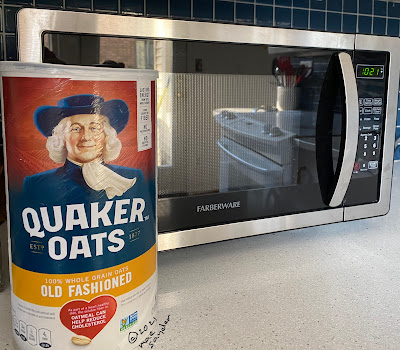
The old microwave fried itself. We bought this new one from amazon, to use for 
oatmeal and many other things. When shopping and installations become safer, we will replace 
our over-the-stove hood/microwave/lighting appliance, but this one is fine for now.

According to "A Mere Man" writing the preface to The Perfect Breakfast, an "accessory dish" for breakfast is "Porridge and its allies, Quaker Oats and other farinaceous foods. These may be eaten at the beginning of breakfast, as a foundation, or at the end, to fill up the cracks." (Cited in The English Breakfast, by Kaori O'Connor, p. 68) 

This kitchen blog post to be shared with Sherry and her blog event “In My Kitchen.” All photos were taken in my kitchen, and are copyright, © 2021 mae sander.
 

Sunday, March 22, 2020

Beans and Lentils: Food for our Time


"Ladies and gentlemen come to supper,
Hot boiled beans and very good butter." 

                -- Old English nursery rhyme.


First: a message from a park bench along the path where we walked this morning while keeping our distance from others.
Panic buying inspired by the coronavirus pandemic has emptied shelves at some markets, and has exhausted supplies of particularly in-demand commodities, especially medical supplies. Last night, a wonderful relative went to the store for us and restocked our freezer, fridge, and pantry. As a result, I have fresh food like produce, meat, and milk on hand for another week or so, I'm grateful to say.

However, I've been thinking about one particular type of food that many people have been stockpiling, thanks to fear that real shortages will emerge (or to some other fears that I am not sure I even know). This food is beans -- red, white, and black beans; garbanzo beans, soy beans, lentils, and a variety of others.

On my pantry shelf: several types of beans that I bought a few weeks ago because I had used up all my previous supplies.
This was a lucky break, since I now have quite a few cans on hand -- I've shown one of each type.
The New York Times today put it this way:
"Amid all the panic shopping, the growing demand for beans has stood out as an especially potent symbol of the anxious and uncertain times. ... To some suppliers, the sudden popularity of their once-unfashionable beans feels a little surreal." (New York Times, "A Boom Time for the Bean Industry," March 22, 2020).
I've been thinking of how many different types of beans have been cultivated throughout human history, and how many different ways to cook them have been devised in every cuisine imaginable. Maybe when you think of beans, you think of Tex-Mex chili, American lentil soup, Indian dal, Japanese edamame, Japanese red bean sweets, Middle Eastern hummus and falafel, Brazilian black-bean feijoada, Italian white beans with pasta, or bean dishes from some other cuisine entirely. Yet the article in the Times speculates that somehow, many of the people who have bought large quantities of canned or dried beans really don't especially want to eat them.

Traditional French Cassoulet recipe from Serious Eats. (link)
Beans can be fancy or not-so-fancy. For example, when we were students in France years ago, we would buy a can of cassoulet for Sunday dinner when the student restaurant was closed, and warm it on our camp stove in our poorly-heated kitchen. Now cassoulet has become a very high-end dish, which we've eaten at a very elegant restaurant in Paris. Duck confit and other ingredients that accompany the white beans make cassoulet very expensive and upscale.

My cans of beans will probably all be used in pretty unimaginative dishes, I'm afraid. Well, perhaps I'll think of a few that are really good. I've searched for images of really appealing bean dishes in case you or I or anyone needs to imagine some really good ways to cook them. I haven't tried any of these recipes but I chose reliable sources, and I'd like to try them.

Cannellini-Bean Pasta With Beurre Blanc: recipe
by Tejal Rao, New York Times. (link)
Hummus with cinnamon, lemon and ginger: recipe
by Yotam Ottolenghi. (link)
Red Lentil Dal recipe from the Food Network. (link)
Green Lentil Salad from the magazine
Cuisine et Vins de France. (link)
(recipe in French)
Brazilian feijoada from the magazine Cuisine et Vins de France. (link)
(recipe in French)
Chili Colorado from Gustavo Arellano's Road Trip in Eater. (link)
I figure no one needs a chili recipe: this is one of his faves from a diner!

Of course, if you don't want to cook, there's always the option of soup
from a box or a can. Thank you, Trader Joe!

Blog post and original photos © 2020 mae sander. Other photos attributed to their sources
.

Wednesday, November 27, 2019

The Night Before Thanksgiving

Chili and cornbread for dinner the night before Thanksgiving. And a few corn chips... All the guests are now together.
I suspect that more new-world foods are in this dinner than in the traditional Thanksgiving.
Corn, beans, cranberries, avocados, tomatoes, bell peppers, hot peppers, etc.
Making avocado salad.
Bread, avocado & tomato salad, cornbread with cranberries,
cheese to garnish the chili.


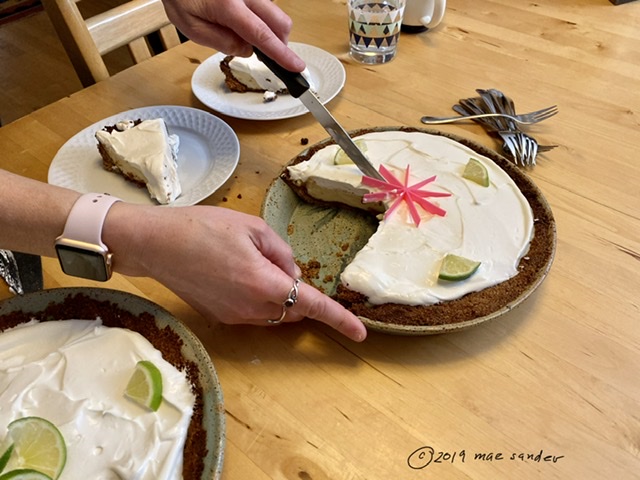
Key lime pies for dessert. Note the special 3-D printed divider to make exactly 9 equal pieces of pie!

Sunday, April 08, 2018

"Eight Flavors" in My Kitchen

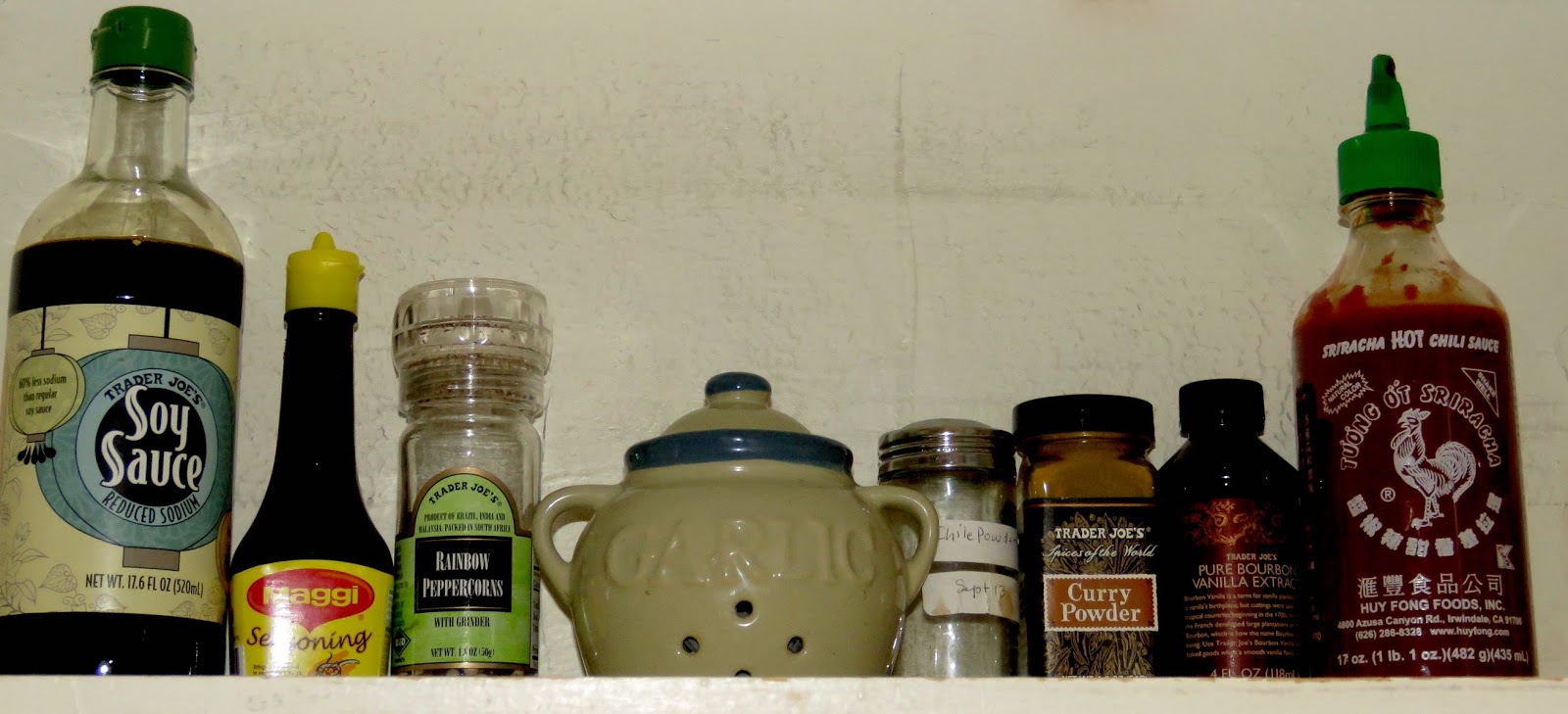
Sarah Lohman's Eight Flavors in my kitchen. Left to right: soy sauce, MSG (in the form of Maggi seasoning), black pepper
(in the form of Rainbow peppercorns), garlic, chili powder (an old jar becuse I usually make it from scratch), curry powder,
vanilla, and Sriracha Hot Sauce.

 "The American kitchen is not static; it’s cumulative, and it evolves. Ten years ago, I had not heard of Sriracha, and now it is in every refrigerator I open (at least, those refrigerators stocked by millennials). And in the next decade, or the next century, our cuisine will continue to change. Which means a new flavor will earn a permanent place in Americans’ hearts and stomachs." Eight Flavors: The Untold Story of American Cuisine (pp. 221-222).

Author Sarah Lohman identifies herself as a historic gastronomist: that is, she explores the way that cooks worked in the past, and re-creates old recipes. The eight flavors in the title of her book provide a route into American cooking from Colonial times (when black pepper dominated both sweet and savory recipes) to the present, when we retain the earlier flavors but continue to add new ones. Specifically, Lohman describes how Sriracha, a hot sauce of southeast Asian origin and California manufacture, has spread throughout our kitchens.

In every chapter of this book, I learned new things about the flavor featured there. As illustrated in my photo, I use every one of these flavors in my own cooking -- some more than others. Especially interesting was the idea that wartime exposure to the foods of a region often results in flavors being brought back to the soldiers' home country. Is Sriracha partly due to experience in the Vietnam war? Well, maybe!

A few things I found especially interesting:
  • Although careful well-executed studies have repeatedly found no ill effects from MSG, people still fear it and loath it! I think this is why Maggi seasoning doesn't explicitly name it on the label. The history of the discovery of the "fifth taste" -- umami is a fascinating one, and Lohman provides lots of insight into how adding MSG to food was at first a positive step, but became a problem because of a pervasive but mistaken view of the danger of this substance (which occurs naturally in many foods including human milk).
  • Vanilla, I learned, was rare and expensive until some time in the nineteenth century. Before it became widely available, the flavor that was most used in sweets like cake or cookies was rose water! 
  • Curry powder became popular long before Indian cuisine was well-known or served in restaurants. One chicken dish stands out -- "Country Captain Chicken is a common American curry dish that first showed up in Eliza Leslie’s 1857 cookbook Miss Leslie’s New Cookery Book. It was a popular dish in port cities of the South, where Americans who had sailed to India would have lived and traded." (p. 92). 
  • Garlic as a culinary flavor (rather than a medical remedy for many ills) became popular only in the twentieth century, as Italian-American food became mainstream and as French cuisine became well-known. "A clove of garlic, the part of the plant we cook with most often, is actually a leaf: a storage vessel that packs away energy for the next growing season. The energy stored in the cloves is in the form of sugar— specifically fructose— which is why a clove tastes sweet when it is cooked slowly and caramelizes when roasted." (p. 150).
Lohman's discussions of food history can be very intriguing. I was familiar with some of the history, such as the evolution of Italian-American food from the variety of Italian regional cuisines belonging to immigrants; the evolution of Chinese-American foods and thus the popularity of soy sauce; and the invention of chili powder and the role of the "Chili Queens" who sold a variety of Mexican street foods and thus popularized Tex-Mex cuisine. (I read about these areas in Hasia Diner's Hungering for America; Gustavo Arellano's Taco USA; and Haiming Liu's From Canton Restaurant to Panda Express -- blogged herehereand here.)

My kitchen is pretty quiet these days, as I recently returned from a long trip and I haven't started cooking very actively to date. Reading this book gave me an opportunity to present a feature of my kitchen for the blogging event titled "In My Kitchen This Month," hosted by blogger Sherry. Quite a few very interesting posts have already been added to the April list!

Update, June 20, 2018. My culinary book club read this as our June selection. Everyone seemed to enjoy it quite a bit. Favorite sections included the one on vanilla, on black pepper, and on Sriracha.