Showing posts with label Inuit. Show all posts

Tuesday, February 03, 2026

Recent Watching and Reading

We watched Dr. No — the very first time that Sean Connery played James Bond: 1962.
Better than we remembered it. The script was pretty faithful to the book (unlike some of the later films).
 

I’m still in the middle of reading some of these books, but I hope to finish them soon.

A.S. Byatt, Ragnarok
I expected a better narrative from A.S.Byatt than this book offers.
Not much more than a somewhat tedious retelling of the myths.
This one, I did finish — it’s short.

Edward Berenson, Perfect Communities: Levitt, Levittown, and the Dream of White Sububia.
There’s a lot of good social history in this book, but it’s way too long.
I was very interested in the final years of Levitt and his giant subdivisions of affordable homes.
Speculation: The author never saw a note card that he could bear to omit.

Victoria Redel, I Am You — still reading
A historical novel about a woman artist in the Dutch Golden Age.

Ryan Holiday and Stephen Hanselman: The Stoics
I didn’t read much of this book as it’s really more a reference work,
ho-hum summarizing what’s known of each philosopher.
I hoped for a readable account of these early philosophers’ thoughts.

Eskimo Folk-Tales and Memories

Eskimo Folk-Tales collected by Knud Rasmussen (1879 – 1933), 
a Greenlandic–Danish polar explorer and anthropologist

Small sculpture of a Tupiak, a monster that plays a role
in the Greenlandic Inuit folk tales.
We bought this when we visited Greenland a few years ago.

Inuit art that we saw in the museum in Greenland.

From Eskimo Folk-Tales: “A tupilak frightening a man to death in his kayak.”

Illustration of kayaks from Eskimo Folk Tales.
Caption on above photo: “Hunters encountering Sarqiserasak, a dangerous troll, who rows in a half kayak himself, and upsets all he meets with his paddle.” p. 35

A kayak demonstration that we saw in Greenland.

Blog post and photos © 2026, 2022 by mae sander 

Saturday, November 16, 2024

At Home This Week

Weekend Google Doodle

I loved learning about the history of kayaks on a trip to Greenland, so this Google Doodle celebrating the kayak was pleasing to see. The reason for this Doodle: 

“In honor of Native American Heritage Month, today's Doodle celebrates the kayak, a narrow watercraft originally created by Arctic tribes 5,000 years ago.” 

About the artist: 

“This Doodle was illustrated by Inuit Nunangat guest artist, Natashia Allakariallak.”   

We have enjoyed our own inflatable kayak as well as opportunities to go kayaking in several places. Kayaks of the more stable and recreational variety are offered on many of the National Geographic trips we have done, so we’ve seen lots of beautiful sights from a kayak. For the last few years, we have also owned an inflatable kayak, which gets us out on the very tame local lakes and rivers — nothing to compare to the incredibly dangerous conditions in which the Inuit kayakers hunted for large marine mammals in unbelievably cold Arctic seas!

On our trip to Alaska in 2013, we watched a bear fishing while we were in a kayak.

Watching a kayak demo in Greenland in 2022. The Inuit of Greenland contributed much to the development of kayaking.

A “Psychological Thriller”


None of This Is True by Lisa Jewell portrays a pathological woman who deceives everyone. Her victims may become suspicious, but she manipulates them to an uncanny extent, and the reader also doesn’t know where her fabrications begin and where the truth ends. A friend of mine recommended this book as a “psychological thriller.” The book definitely embodies a lot of tension, suspicion of coming bad things, cruelty, and growing horror at the layered revelations.

Actually, I’m not sure I’ve ever read anything like this book, and it’s not my usual type of reading. While I wouldn’t call it a supreme work of literary genius (it’s not), I think it’s unusual and very suspenseful.

Question: What is Consciousness?


Other Minds by Peter Godfrey-Smith explores two main topics: the working of our human minds and of the minds of the octopus and closely related species (the cephalopods). The author reviews the evolution that created both humans and cephalopods. He says:

“Cephalopods are an island of mental complexity in the sea of invertebrate animals. Because our most recent common ancestor was so simple and lies so far back, cephalopods are an independent experiment in the evolution of large brains and complex behavior. If we can make contact with cephalopods as sentient beings, it is not because of a shared history, not because of kinship, but because evolution built minds twice over. This is probably the closest we will come to meeting an intelligent alien.” (p. 9)

In attempting to compare the minds of these divers creatures, he probes the question of consciousness, a question that’s often asked and never really answered. He describes the early steps taken by these animals:

“Later … an integrated perspective on the world arises and a more definite sense of self. We then reach something closer to consciousness. I don’t see that as a single definite step. Instead, I see “consciousness” as a mixed-up and overused but useful term for forms of subjective experience that are unified and coherent in various ways. Here, too, it is likely that experience of this kind arose several times on different evolutionary paths: from white noise, through old and simple forms of experience, to consciousness.” (p. 97)

I reviewed this book in some detail in 2018 in a post titled Invertebrate Intelligence and decided to reread it during the past week. 

Stories for Our Time

A purely evil political leader appeals to the masses through his dramatic speeches. The large crowds of his followers go wild, howling with adoration and loyalty. He convinces them that they are superior beings, and that they should show no tolerance for those who differ from them. He promises that once empowered, he will expel or even exterminate their inferiors. His overwhelming appeal almost enables him to become the supreme ruler of the Wizard World. Luckily, a few brave opponents, especially Newt Scamander and Albus Dumbledore, prevent the deceptive and charismatic Grindlewald from achieving his evil plan. 

As we binge-watched the three recent Fantastic Beasts films (prequel to the Harry Potter story) I was overcome with dread because of the parallel to recent real life. Unfortunately, no one stopped the onslaught of our new dictator, and as he rapidly announces his coming regime, I fear that no one will stand up to his evil plan.

Not only are we without a magical hero to save us, we don’t even have adorable magical pets to cheer us up. However, these films are a good escape if you don’t take their political situation too seriously. Here are Newt Scamander’s two adorable pets:

A Niffler

A Bowtruckle

Blog post and original photos © 2013, 2022, 2024 mae sander. 
Movie images from Warner Brothers

Friday, June 23, 2023

Owls


Owl figurine from the Moche culture of Peru, 3rd-6th century.

Woodblock print of a horned owl sleeping on a maple branch, 1830s-1840s by Utagawa Hiroshige.

Reading What an Owl Knows by Jennifer Ackerman, I have learned much about owls in art and religious thoughts in human history. My earlier blog post about this book is here: Great Natural History.

The owl has been present in human drawings, paintings, and sculptures from the earliest prehistoric cave art to the most modern painters, and shows up in numerous cultures with a wide variety of meanings, sometimes happy, sometimes sinister. I found a number of images on the web that show all sorts of views of owls, some that were mentioned in the book, others not.

Picasso owls from a google search. According to What an Owl Knows,
Picasso (1881-1973) became fond of owls because of his pet owl Ubu.

Leonard Baskin (1922-2000). "Owls" (Philadelphia Museum of Art)


36,000 year-old owl image from the Chauvet Cave in France, (source)

Ancient Egyptian owl image. The hieroglyphic for the letter M was an image of an owl.

Owl on a Greek vase.

Owl on an Athenian coin (480-420 BCE). 
The owl was a companion of Athena, patron goddess of Athens. (Wikipedia)

Cochiti potter Juanita Irene Ortiz (1960-2008). "Mapuwana": a storyteller owl.
Source:  The Owl: A Nuanced Symbol in Native American Cultures

Kenojuak Ashevak (1927-2013). Preening Owl, 1995. (source)
Ashevak was a native of an Inuit village on Baffin Island. She created numerous owl art works.

Queenie McKenzie Nakarra, “Mook Mook Owls with Young,” (1996)
(source)

The story of this painting:

"In the Narrangunny (Dreaming story), an Aboriginal woman was sitting at a waterhole fishing for bream. After catching a few fish, she heard a fearsome noise coming from above. Thinking it was the 'devil-devil', she threw everything in the air and ran to her camp screaming. A few of the bravest men were dispatched to investigate the frightening sound, only to find, while checking a small cave above the fishing hole, owls, 'damboyn' sitting in the darkness making their 'mook-mook' call – the sound was merely being amplified by the cave walls."


Tsuchiya Koitsu. “Owl” (1930)
(source)


Owl Proverbs and Sayings


Francisco Goya (1746-1828). "The Sleep of Reason Produces Monsters."

Rembrandt van Rijn, “The Flute Player,” 1642. (Christies). The owl on the flute player’s shoulder suggests the proverb “To play Eulenspiegel’s flute" -- a reference to the trickster Til Eulenspiegel, whose name means owl. The flute player in this painting is playing a trick: looking up the skirt of the shepherdess.

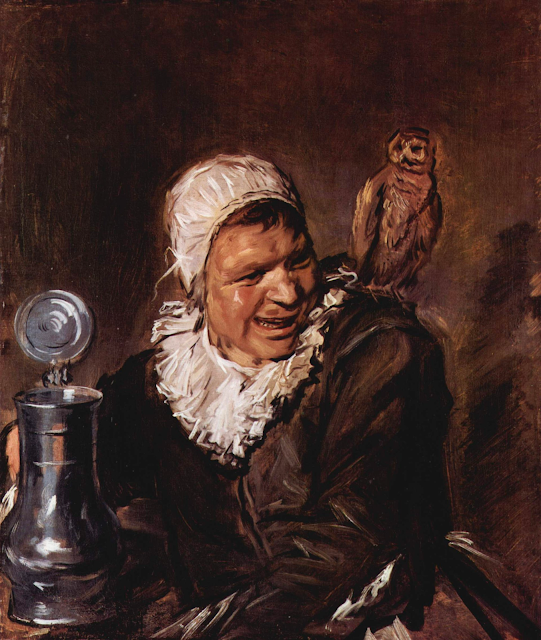
 Frans Hals. "Malle Babba," 1633. (Wikipedia)
This owl may illustrate the Dutch proverb "Drunk as an Owl."

Cornelis Bloemaert (1603-1692). "The Wise Owl."
"What good is candle or glasses when the owl does not wish to see?"

Hieronymous Bosch (died 1516). One of many disturbing and weird owl images,
which appear throughout the work of this very strange painter.

Wednesday, April 19, 2023

Authenticity in Cuisine?

"The famous Somali poet Warsan Shire once wrote: 'no one leaves home unless / home is the mouth of a shark / you only run for the border / when you see the whole city running as well.'”

Somali chef Ifrah F. Ahmed quotes this poem in a fascinating article: "On Fusion, Forced Migration, and Somali Food:How Somali food in the diaspora holds the history of forced migration." She describes her thoughts about authenticity in cuisine as she expresses it in her cooking for her popular food truck and pop-up restaurants in Los Angeles, Seattle, and Brooklyn. Because I am very fascinated by the concept of authenticity in cuisine and how this concept is often, in my opinion, misused and historically muddled, I found her thoughts about how migration affects cuisine -- and authenticity -- very insightful. I particularly like her conclusion: "there are millions of ways to belong to a diaspora and to live authentically within a culture."

Somali chef and writer Ifrah F. Ahmed from Hiiraan Online

Ahmed writes about her family's forced migration from Somalia when she was a child, and how they eventually settled in Seattle, where she grew up, learning an immigrant version of the traditional cooking that they brought with them. Her fascination with cooking led her to become a chef, entrepreneur, and food writer for the New York Times and other publications. She developed recipes that interpreted her family traditions and built on them, continuing with the tradition and flavors of her heritage. 

Many people, especially her fellow Somalis, challenged the authenticity of the very popular foods she served at her food truck, particularly reacting to her specialty, "a Somali-style wrap — spongy and sour anjero-wrapped breakfast burritos filled with soft scrambled eggs, fuul (fava bean stew), and spicy vibrant green basbaas (Somali hot sauce)." She explains the inspiration for the dish: "I grew up eating fuul, eggs, and anjero. For me, serving the burrito was an opportunity to share a favorite family breakfast that was reimagined in its design; the only difference was rolling the ingredients into the soft sourdough bubble-lined pockets of the anjero. The burrito was a new thing and yet the original contents were the same."

Being alienated from the land they fled resulted in efforts for her family and her fellow immigrants to cling to the memories and traditions of their native cuisine, and to object to any changes, which they suspect of being "fusion food," and of deviating from authenticity. "Forced migration made it so we clung to what was most familiar, while trauma made it so we felt that we needed to protect and maintain what we once knew, just as we knew it."

This experience of cultural change combined with efforts at continuity very much parallels my understanding of the evolution of many immigrant cuisines in the 19th century when America became the home of many ethnic groups and nationalities. Though their departures from their original homes may not have shared the extreme desperation of modern forced emigration in the face of wars and famines, the wish of the earlier groups to continue family traditions seems to me to have been parallel to the experiences that Ahmed's family shared. 

Ahmed's thoughtful definitions of authenticity in the face of the critiques of her fellow immigrants are very enlightening. She writes: 

"Our dishes and traditions remained unchanged by time as we became dedicated to preserving the classical and 'purest' forms of culture and cuisine, because that was the last thing we had known. Forced migration made it so we clung to what was most familiar, while trauma made it so we felt that we needed to protect and maintain what we once knew, just as we knew it. ...

"No wonder, then, that it’s mostly in the diaspora where cuisine could be considered 'classic.' This adherence to 'classic' forms of culture and cuisine is a bridge connecting those in the diaspora to their homelands, a thread sewing the lost to what they left behind."

The New York Times has published some of Ahmed's recipes, such as Fuul, the fava bean stew that figures in her breakfast burrito. I haven't tried it, but it sounds quite delicious, and looks good in the image from the NYT article. (Note that NYT recipes require a subscription, so you may not be able to see this recipe.)

Recently, I've been thinking a lot about the meanings and misuses of food history, and how the idea of authenticity is misused, so I found this excellent article very interesting. I've also been thinking about the current global refugee crisis, and Ahmed's family story is very relevant to this as well.

The Ongoing Global Tragedy of Forced Immigration

The tragedy of forced immigration, where families have to struggle to create a new life in a new place (or often live in desperate and impossible circumstances) is horrifyingly common and increasing. Most tragic is that millions of people have lost their homes and have nowhere to go at all. The wars in Ukraine and Syria, the dictatorship in Afghanistan, and the famines in Africa have created millions of desperate people displaced from their homes and in need of all necessities of life.

Somalia has been one of the most desperately affected areas for a long time, and according to the charitable organization Concern:

"At the end of 2017, there were over 986,000 [Somali] refugees. While the numbers went up a bit in 2022, at just over 799,000 it’s still a significant decrease compared to five years ago. However, the situation is nevertheless dire for many. For the last several decades, a cycle of crisis in Somalia has been fuelled by drought, conflict, and hunger. The country is at the epicenter of the current Horn of Africa crisis, which could lead to a new famine being declared in the region. Even if it doesn’t, the UN still estimates that the effects could be similar to the country’s 2011 famine." (source)

Wednesday, August 31, 2022

August: Away from My Kitchen


The forbidden space of the kitchen on the National Geographic Explorer lies behind the window in the photo. Only the kitchen workers are allowed inside (though in the past I believe they used to give tours to the ship's passengers). As a passenger on the ship, I received almost all my meals from July 31 through August 15 from this kitchen -- so this was and was not “my kitchen” in August. And I found almost every meal just delightful and found that among the several choices at breakfast, lunch, and dinner there was always something that I really enjoyed. In addition, during the pre-dinner cocktail hour and presentation time, the waiters would come around with big trays of hors-d’oeuvres that were very enjoyable.

Breakfast

A selection of meat, fish, and vegetables was available daily at breakfast.
Other areas of the buffet included many types of bread and pastry,
several kinds of fruit, cereal and oatmeal, and several specials.

Omelets were made to order almost every day — once there were waffles instead.

Cocktail Hour

Although I mostly drank wine, I tried one or two
mixed drinks from the open bar. My Margarita 
was nice with an hors-d'oeuvre of brie and jam.

A "White Lady" for me, sherry for Len.


Dinner

Most evenings, we sat down to beautifully set tables with white tablecloths and dinner napkins, and were given a printed menu and a glass of red or white wine (if we wanted it). Usually there were three choices of starters, often including a salad. Then, three choices of main course: a vegetarian dish, a fish dish, and a meat dish. A few alternatives like a steak or spaghetti with red sauce were always available. Lunch was the same as dinner, with a very light soup-sandwich-salad buffet served in the observation lounge as an alternative.

We most often chose fish, as it’s really well-prepared and varied on the Explorer. The kitchen also provides special items for people with special needs such as gluten free or vegan. On two occasions, we enjoyed a themed buffet dinner — once, a Filipino buffet and once, an Argentine “Asado.” Here are a few highlights from the lunch and dinner choices:

“The perfect egg”

Veal osso bucco with vegetables.

The Filipino buffet was in honor the kitchen staff who
are almost all from the Philippines. A suckling pig was the piece de resistance.

At the table showing our plates filled at the “Asado” buffet,
which offered grilled foods with an Argentine theme.

A vegetarian timbale with crisped greens.

Rice-encrusted squid.

Desserts

One dessert choice at lunch and dinner was usual, with alternatives of a brownie or ice cream or sometimes cheesecake. Fortunately the dessert portions were small! I’m sure we could have asked for more than one though I never wanted to do so. Here are a few of the many desserts, which were mainly quite delicious.

Passion fruit mousse.

Just part of the vast dessert buffet on Filipino night.

Crème Brûlée. 

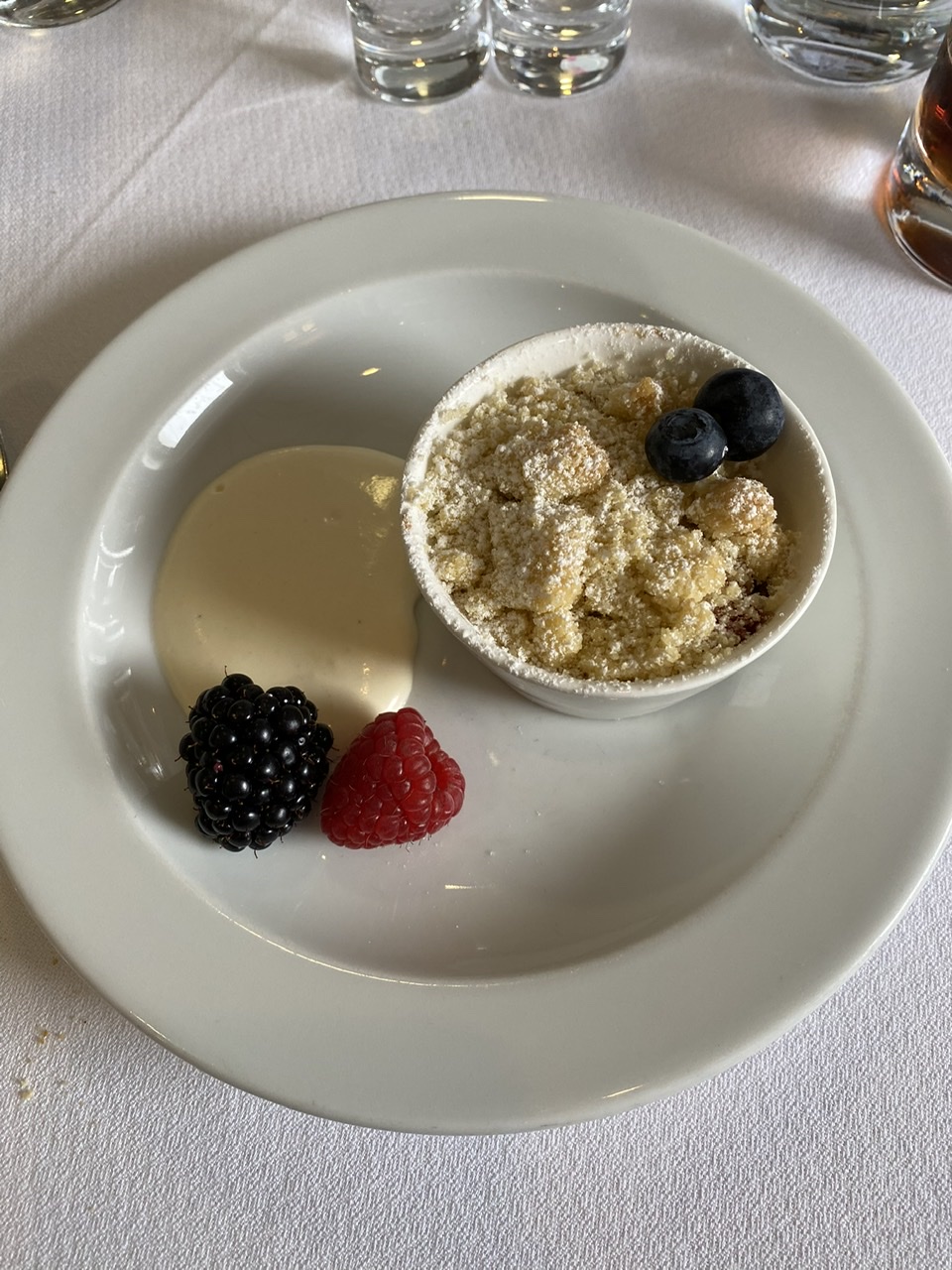
Rhubarb crumble.

The chef prepared this chocolate lava cake
during last year’s voyage too!

Back Home in My Own Kitchen


Iceland and Greenland magnets from this year and last year.
The boots are part of the traditional dress of the Inuit women of Greenland, still worn on special occasions.

Well, not much to say about the week or so that I’ve been home. Only one new thing — the usual magnets for the fridge! I’m sharing these kitchen thoughts with Sherry and her loyal bloggers who write a post each month on the theme “In My Kitchen.” 

We missed a lot of summer produce — but managed one plum cake.

Souvenir of Greenland: an Inuit Tupilaq bone carving.
Originally a tupilaq was a dangerous monster, but these creatures have
become the subject of traditional carvings that no longer have such significance.

Greenland was a beautiful place to visit!


Blog post and photos © 2022 mae sander