Showing posts with label Food Safety. Show all posts

Friday, February 14, 2025

Dislocations

My Country’s Capitol: Photos Over the Years

Departing on a plane…from the Washington Monument to the Capitol Building.

At a kite festival…

Walking by the Capitol on a beautiful autumn day.

Photos © 2007-2015 mae sander.

A Horror Show In Washington

Good things about our government: I read about a recall of canned tuna that was issued a few days ago. “Canned tuna sold at grocery stores in 26 states and in Washington, D.C., was recalled because of botulism risks, the Food and Drug Administration and Tri-Union Seafoods said on Friday.” I had a can of tuna from Trader Joe’s that I was worried about, so I looked on the FDA website. (“Canned Tuna Sold at Trader Joe’s and Costco Is Recalled Over Botulism Risks,” New York Times, Feb 12, 2025) 

My tuna wasn’t involved in this recall, but in retrospect, I started to worry about a much bigger issue: what’s going to happen to the FDA? Thousands of jobs in the Federal Government are being discontinued, and many services that I would say are vital are being “thrown in the wood chipper” (as Elon Musk himself describes it). I began thinking of all the ways the government contributes to my well-being and my life style. So many agencies do good things that I depend on: the FDA, the NIH, law enforcement, farm support and on and on. 

Will all inspection of food be discontinued, so that we have to accept whatever we get from the food processing industry? Will we have to trust slaughter houses to keep meat sanitary and safe? Who will track down the cause of a cluster of salmonella cases or e-coli outbreaks? Will auto safety measures and regulation be abandoned? Will drug manufacturers be allowed to release any drugs the choose, without even the limited testing that’s been done up to now? It’s been easy in the past to dismiss the benefits of government regulation in our lives, but if you think about it, we really depend on it. Do you trust the big food processors? Do you trust big pharma? 

Regulation of food and agriculture has been a response to public concern for over a century, with many emerging issues in the last few decades. I’ve been reading a book about the development of attitudes in the US about processed food, healthy eating, and the development of many ideas about what is safe and desirable. Specifically: 

“Concerns about the purity  and safety of the food supply had been around for a very long time,  but technological changes that accompanied twentieth-century  industrialization, such as the growing use of chemicals in food  production and the industrialization of agriculture, raised new concerns about risks related to everything from chemical additives, preservatives, and packaging to the use of antibiotics in  animal agriculture.” (Charlotte Bilekoff. Real Food, Real Facts: Processed Food and the Politics of Knowledge, p.55)

There are many valuable services at risk. I love to travel. The government supports the interstate highway system, the National Parks, National Wildlife Refuges, and National Seashores. The government enables the functioning of air travel through airports, air traffic control, and more. Like almost every senior in the US, I depend on Social Security and Medicare. If you live here, you can probably think of quite a few government programs that benefit you. What’s in jeopardy? We don’t know yet. The acquiescence of the Republican majority in congress to anything the President and his minions demand is a horror show in and of itself.

We are helpless, destabilized, and  bewildered, when confronted with so many attacks on government programs and the Constitutional rule of law in such a short time. In less than a month, we’ve seen the demolition of  cultural institutions; for example, the Kennedy Center (see Ann Telnaes cartoon left, from her Substack). International programs, particularly USAID, have been gutted. Support for assimilation of legal immigrants has been discontinued through defunding of welfare agencies, not to mention cancelling citizenship for American-born children. We’ve heard false accusations of fraud in many agencies and disruption of law enforcement  such as firings at the FBI and showdown at Justice. Alarming trends include cuts in funds for medical research supported by the NIH, ending fights against corruption such as shuttering the Consumer Financial Protection Bureau and cancelling other protections, and placing incompetent appointees in high positions (the anti-vax Kennedy for health is the most extreme) …and on and on — every newspaper has numerous articles about the destruction of organizations that were put in place by acts of Congress but are being destroyed by unprecedented fiat from the Executive branch.

We are also helpless in view of some extreme acts of cruelty towards immigrants, even if they are here illegally. We may have a bad conscience when we think about the knock on the door in the middle of the night, and the flights full of shackled people. Echoes of roundups of the Jews in Nazi Germany? I fear so.

I feel more helpless than ever as I watch this nightmare emerging —

“The pandemic reduced normal human interactions. Severed from one another, Americans deepened their parasocial attachment to social-media platforms, which foment alienation and rage. Hundreds of thousands of people plunged into an alternate mental universe during COVID‑19 lockdowns. When their doors reopened, the mania did not recede. Conspiracies and mistrust of the establishment—never strangers to the American mind—had been nourished, and they grew.” (Source: The Atlantic)

Did I miss anything? YES, absolutely. Every time I read the headlines there’s another outrage. A final quote:

“R.F.K. Jr. is now in charge of the F.D.A., N.I.H. and C.D.C., to which Americans said, ‘OMG,’ ‘WTF’ and ‘FML.’” — JIMMY FALLON

Blog post © 2025 mae sander, 

Monday, September 30, 2024

In and Not in My Kitchen

What’s New in My Kitchen


New Recipes

New Recipe: Using Frozen Dumplings

Grilled chicken skewers. Very nice.

From New York Times Cooking. 

Another NYT recipe. I like it because it’s flavored with lemon, no garlic or onions.

Classic Meals in September

Most of our cooking in September involved old favorites. Here are a few photos:


Smoked salmon and traditional potato salad with hardboiled eggs and mayo.


An old favorite using frozen Alaska salmon.

Len’s Breads

Recipe from the Poilâne Baking Book


Just out of the oven: Len’s sourdough bread and sandwich rolls.


More Favorites

Smacks are a life-long favorite of mine.
Don’t mention ultra-processing. I’ll love them forever.


Even our beverage choices are classics!

Food Safety: What’s NOT in my Kitchen

One September Saturday in Kroger’s we were standing in front of a double refrigerator case stacked with egg cartons. More choices than one can imagine: free-range, organic, cage-free, pasture-raised, cheap, expensive, Large, Extra-Large, Jumbo, brown, white… and each carton has the name of a “farm” (actually some mass handler of eggs). 

What do we do? We look on our phones for the names of the two “farms” which have recently shipped eggs poisoned with salmonella. We didn’t see any cartons from Milo's Poultry Farms and Tony's Fresh Market. That’s reassuring because those are the recalled brands. (For a list of these and other recent recalls, look here.)

Earlier in our big Kroger shopping trip we noticed the huge sign above the deli: “Boar’s Head.” We shuddered because the Boar’s Head company has been responsible for one of the largest episodes of food poisoning in recent years. The implicated factory has been indefinitely shut down after horrendous discoveries of filthy, unethical procedures. Ten deaths so far, plus many illnesses and hospitalizations are known, and even more of them unreported. I’ve already been (mostly) avoiding deli meat for a number of reasons — now this brand is on my “never” list.

The website Food Safety News lists recalls and warnings about the food supply. Recent alerts for the US and Canada include several pet food recalls for listeria and salmonella, which endanger both pets and human caretakers. There’s a warning about spoiled milk in Canada, and a warning about serious problems at a producer of mung bean and soybean sprouts. Salmonella in eggs triggered a recall in Maine, and salmonella poisoning affected diners at a Mexican restaurant in California. A serious situation, including over 160 cases of mushroom poisoning and two deaths resulted from dangerous chemicals in “edibles.” And that’s just in the last half of September! Note: for more info, the FDA maintains a list of recalls including foods, drugs, and medical devices. The government website FoodSafety.gov also offers advice.

I’m not alone in having a “never” list of products that are (with any luck) banned from my kitchen. I think that everyone has a personally developed list of unacceptably risky choices. In my kitchen, one such item is any kind of sprouts — look at just about any list of recalls, and there will be a problem with sprouts like mung-bean sprouts or alfalfa sprouts. Problems have even occurred with harmful bacteria harbored in seeds from which you can sprout your own sprouts! 

Bagged salads have been another frequent source of food-borne illness and recalls: I mostly avoid them. Another obvious example of repeated bacterial contamination is from unpasteurized milk: I’ll never buy or drink it! I also watch expiration dates, and discard food that’s unreasonably past its sell-by or use-by date, but that’s a little complicated and needs much more to be said about it.

Finally, I feel I should mention that a frequent source of contamination in home kitchens is carelessly handled poultry. A number of disease-causing microbes are frequently present in raw chicken, specifically: Salmonella Enteritidis, Staphylococcus aureus, Campylobacter jejuni, and Listeria. I follow the recommendations for cooking chicken. Specifically: I do not wash raw chicken before preparing it; I clean all surfaces and utensils after preparing chicken; and I make sure that chicken is fully cooked (165 ° F or 74° C) before serving.

A Gallup Poll recently found widespread unease about the frequency of food contamination scandals:

“Polling conducted by Gallup between July 1 and July 21 found that 37 percent of Americans reported discarding or returning food in the past year due to a product recall or food safety advisory. Just over half the 1,010 respondents—53 percent—said they have avoided buying specific brands or types of food because of a recall or advisory, while 26 percent expressed concern that they may have consumed contaminated food.” (link)

No Sprouts!
Well, I’m afraid this isn’t a very cheery way to tell you about my kitchen. Next time I’ll try to be more upbeat! Have a good month in your kitchen, and thanks to Sherry who hosts “In My Kitchen” on her blog each month.


Blog post and photos © 2024 mae sander


Monday, March 20, 2023

World Water Day 2023

Fresh water: a diminishing global resource. (Source: National Geographic)

Global Reality in 2023 from Pure Water for the World:

  • 1 in 4 people on our planet lacks reliable access to safely managed drinking water.
  • Waterborne illnesses continue to be a leading cause of death, with an estimated 829,000 people dying each year from water-related diarrheal illnesses.

Drinking water: something that’s easy to assume is always available. Yes, a few American cities have viciously caused their citizens to be denied this essential need, such as Flint, Michigan, and Jackson, Mississippi. However, most of us in the US don’t give drinking water a second thought. The unfortunate fact is that one quarter of the world’s population lack safe drinking water. 
This week is the United Nations’ World Water Day, March 23. The official website describes the global situation:

“Dysfunction throughout the water cycle is undermining progress on all major global issues, from health to hunger, gender equality to jobs, education to industry, disasters to peace. … Billions of people and countless schools, businesses, healthcare centres, farms and factories are being held back because their human rights to water and sanitation have not yet been fulfilled.”


Catastrophes Cause Water Crises

Wars, earthquakes, overcrowded cities, and many other misfortunes result in a lack of safe water for drinking and all other purposes. Although it’s been over a month since the earthquake in Turkey, clean water remains a serious problem for the huge number of people whose homes and cities were reduced to rubble. Relief efforts have brought drinking water to some areas; others are still in great need, such as the province of Hatay (source). Relief organizations include the Planet Water Foundation:

“Planet Water Foundation, a leading non-profit organization focused on providing access to clean, safe water, is deploying 12 of its disaster response water filtration systems in TĂĽrkiye as the country continues calls for global support to provide drinking water to earthquake damaged communities.”


Water was airlifted to Turkish earthquake survivors. (source)

The war in Ukraine has caused severe disruption of the supplies of safe water for the battle-ground cities. While some damage to water resources is a side-effect of the fighting, Russian invaders are also inflicting intentional damage on water resources as well as on other infrastructure. Some consequences of the fighting: “flooding of large areas due to dam breaches, pollution from untreated waste water spills, dumped ammunition, an increase in mine water levels, and a significant decline in the quantity and quality of water for drinking and agricultural purposes.” (Source: https://phys.org/news/2023-03-war-ukraine-threatens-freshwater-resources.html)

In Ukraine: collecting drinking water from a distribution point (source: NYT)

Climate Change and Water Supplies

“Climate change is already affecting water access for people around the world, causing more severe droughts and floods. Increasing global temperatures are one of the main contributors to this problem. Climate change impacts the water cycle by influencing when, where, and how much precipitation falls. It also leads to more severe weather events over time. Increasing global temperatures cause water to evaporate in larger amounts, which will lead to higher levels of atmospheric water vapor and more frequent, heavy, and intense rains in the coming years.” (Source: National Geographic)

 Blog post © 2023 mae sander. Photos as credited.
Shared with Elizabeth’s weekly blog party.

Sunday, September 05, 2021

Ruth Ozeki

Coming later this month!


Before reading Ruth Ozeki's new book The Book of Form and Emptiness, I decided to read an old one, from 2003 titled All Over Creation. I don't know why I didn't read it earlier, as I read and liked My Year of Meats, her first novel, and read and liked A Tale for the Time Being, her third novel as well.

All Over Creation is an ambitious but flawed book. Like My Year of Meats, it tells the story of farm families who are caught in the trap of choosing to grow genetically modified and other chemically altered crops or choosing less artificial ways to farm. The book is set on an Idaho potato farm in the late 1990s. At that time, many of these issues were really on people's minds, as they still are now.

As Ozeki's farmer-characters succeed and acquire more land, they are more and more pressured to purchase altered seeds and cuttings to fill their vast fields. In this book, the dilemma is: do they plant potatoes that have built-in insecticide? Or do they spray large amounts of commercial insecticides? Or can they find a better way entirely?

The characters tend to resemble the types of a morality play, with everyone designed to embody a message, even when they are individualized. A dying man, once a large-scale farmer, has been converted to the rightness of natural farming, and makes meaningful and poignant speeches about his belief. His wife, who came to Idaho as a Japanese war bride, grows and sells heirloom seeds, and talks to her plants with stereotyped Japanese insights. Their daughter, who ran away at age 14, has just returned to see them one more time, and is discovering her true identity. A group of protestors living in a trailer create theatrical events to call attention to the problems of pesticide and other evils in the food supply. Several articulate children play a role: I found the portrayal of these children especially annoying because they seemed to be too perfect in expressing the author’s message. Aging Flower Children, who had been idealist hippies during the sixties but have sold out their ideals, play a role in the many complications and dramas in the book.

I found it readable but contrived. Unfortunately, the issues raised in the book are worse than ever. I hope I like the new book better!

Blog post © 2021.
 

Wednesday, August 19, 2020

Eating Canned Tuna

Skipjack, albacore, bigeye, yellowfin, Atlantic bluefin, Pacific bluefin, and southern bluefin tuna are the principal species in the tuna family. They vary widely in size, in scarcity, and in culinary desirability. Bluefin tuna, mainly fished for their use in sushi, are very large, and very expensive -- and also under extreme threat of becoming extinct. Some of the smaller and more common tuna types, such as albacore, though heavily fished, are at much less risk. In general, tuna play a large role in ocean ecosystems. Tuna also play a large role in American nutrition. (source)

Lunch: tuna and white bean salad with local
tomatoes and garden herbs.
Ingredients: red onions soaked in ice water, lemon juice,
a can of tuna, a can of white beans, vinaigrette sauce made
with Edmund Fallot mustard.
In recent months, I've been trying to revisit my choices of foods, and to develop a better sense of responsibility in what we eat. I'm looking at the issues of health and nutrition, of ecology and climate change, and of the welfare of workers in the food industry including faming, fishing, food processing, transportation of food, and many jobs in food stores. It's a big job! Today, I'm thinking about tuna, particularly canned tuna, and I’ve been reading about the history and current state of the tuna industry.

Tuna canning in America began around the turn of the 20th century, and continued to grow for most of the century. Tuna was a staple for Americans from virtually all ethnic groups, with use by a very high percent of households: "For nearly nine decades, Americans ate more and more tuna out of tin cans. For nearly five decades — from about 1950 until 2000 — tuna, almost all of which was canned, was the most popular seafood in the United States." However, between 1990 and 2010, Americans' tuna consumption decreased from 4 pounds per person per year to just 2 pounds. As the industry grew over time, the original numerous small tuna canneries slowly consolidated into just a few, and began to engage in collusion to drive up prices. This year an executive of one company has even been convicted of illegal price fixing. (sourcesource)

After a decline in the early part of this century, tuna sales seem to be going back up now. Specifically a study from Fortune Business Insights reports: "Consumers are highly dependent on ready-to-cook and ready-to-eat food products due to the convenience of cooking offered by them. The rise in working women population and the less time spent on cooking has led to wide utilization of canned tuna. The millennial population is highly inclined towards such convenience food products as it is easy to prepare, nutritious as well as saves the food preparation time. Many manufacturers are focusing on launch of new products and certifications to provide the consumers with quality products and for serving them better." (source, source)

Despite the legal setbacks to specific producers, overall the market for canned and packaged tuna has been growing for a few years, and the market changes caused by the pandemic have driven up demand for all canned products, tuna included. Collectively, the tuna industry production totals in the tens of billions of dollars per year; though total consumption is still down, the value of tuna purchased is up because of higher prices and higher quality of the product. Here's a graph of recent and projected growth:


As for me: tuna salad is one of the easiest recipes in my repertoire -- a can of tuna with mayo, pickle relish, maybe chopped onion or celery, maybe hard boiled egg. We like it in a cold sandwich, as a classic tuna melt, or just as a salad with other veggies. We also like the Italian-style salad made with white beans and tuna. Another favorite: the French Salade Niçoise -- tuna, tomato, olives, green beans, pommes à l'huile (French potato salad), optional anchovies. A famous American classic, though I don't make it myself, is the tuna hot dish with cream of something soup and noodles. With all the challenges to grocery shopping we're facing these days, these pantry-shelf recipes are surely more valuable than ever. Tuna sandwiches (maybe made directly from a pouch, maybe by adding your own mayo) are still a mainstay of lunches throughout America.

Issues about the rights and wrongs of eating tuna are numerous. Is it safe to eat tuna? Especially, is there a risk of mercury contamination? Is tuna environmentally responsible? In particular, are dolphins being killed by nets that capture the tuna? And are the tuna in oceans throughout the world being irreversibly fished out, leading to many ocean-wide problems? Is the price going up, making it less and less affordable? Finally, are the fishermen on the tuna boats taking terrible risks of infection from coronavirus? Answers to these questions are disputed: the fishing industry trade association denies the warnings from consumer and environmental organizations, while most other organizations suggest caution with regard to mercury in tuna and strongly recommend responsible methods of fishing.

Except for the self-serving National Fisheries Institute positions, most analysts recommend pole-and-line or trolling methods of fishing, which would mean purchasing tuna labeled to have these methods, and recommend albacore or skipjack species of tuna. The extreme vulnerability of the bluefin tuna isn't relevant to the discussion of canned tuna, as these giant fish are used only for sushi (but you might want to think about this if you do eat sushi). The "Eat This Not That" website points out:
"Resources like the Monterey Bay Aquarium Seafood Watch Site or Greenpeace's canned tuna report, which ranks 20 well known brands for their sustainability, as well as ethical and fair trade practices, are good places to start making more informed choices with canned fish."
Yes, I’ve been buying recommended ethically fished and handled canned tuna brands, namely Wild Planet and Whole Foods 365 brand, for some time, but I try to revisit these decisions occasionally in case the situation changes.

Blog post © 2020 mae sander for mae food dot blog spot dot com. 


Tuesday, August 11, 2020

Corona Virus and the Food Industry

"As of August 10 ... at least 54,738 workers (40,476 meatpacking workers, 8,450 food processing workers, and 5,812 farmworkers) have tested positive for Covid-19 and at least 235 workers (187 meatpacking workers, 34 food processing workers, and 14 farmworkers) have died."

I've written before about our family decision to buy little or no meat because of the extreme carelessness of the meat-packing industry concerning worker health and safety during the pandemic. Today I decided to check into any progress in this issue. Unfortunately, if anything, it's getting worse. The major meat packing plants are the most egregious -- they continue to employ many minority workers in very terrible conditions, without adequate protection from the virus. (Note, however, that I do not believe that the meat itself is unsafe, in deciding to avoid meat, it's the workers I care about. )

Looking for updates on this situation, I found a continuously updated article "Mapping Covid-19 outbreaks in the food system" by Leah Douglas, which appears on the Food & Environment Reporting Network (FERN) website (https://thefern.org/2020/04/mapping-covid-19-in-meat-and-food-processing-plants/). Especially interesting is this graphic view of which companies have the worst record:

Covid-19 Cases By Company from FERN article.
The original diagram allows you to look at the numbers for each company.

Obviously, this is a terrible situation for the workers in a workforce that includes many immigrants and minorities whose desperation to have a job often overrides their desire to be safe. The abuse of this vulnerable segment of society is one more reason to question the business practices of the big meat processors, and to avoid their products.

The chairman of the board of Tyson's, the worst offender -- has published several guest editorials to justify or to hide the situation, and to assert that meatpacking is so essential to feeding America that it shouldn't be regulated. Smithfield, another of the major corporate offenders, has recently published advertisements to try to soothe the public reaction to their irresponsible policies.

About a full-page Smithfield ad in the New York Times last week, nutritionist Marion Nestle wrote a blog post titled "Hypocritical food ad of the week: Smithfield complains about its critics." She says:
"Smithfield is Big Pork. It complains in this ad of critics who, it says, are 'cynics and skeptics' who 'don’t understand the notion of responsibility to others' and are 'seeking opportunities to advance their activist agenda.'

"Smithfield, the ad says, puts its 'Smithfield family and country first. By implementing aggressive measures to protect their health and safety during this pandemic. By rewarding our team members on the frontline.'”

"The ad does not mention the number of Covid-19 cases among workers in its plants." (source: https://www.foodpolitics.com/2020/08/hypocritical-food-ad-of-the-week-smithfield-on-its-critics/)

Another answer to this campaign by the meatpacking industry titans came from Food Safety News writer Savannah Clay in an article titled "Change in the Time of COVID-19" published on July 6, 2020:
"If it was truly about feeding America, wouldn’t Tyson and Smithfield’s and JBS work with regulators to provide their essential workers with the appropriate PPE and restructure the working environment to allow 6 ft between each worker. Wouldn’t these big companies look at how their facilities are turning into hotbeds and take this not as an indication that there is a threat to their bottom line, but that there is a threat to their employees? It is not just the employees who are at increased risk in these facilities. Meat inspectors, who are required by law to be in facilities if these facilities want to run, are experiencing higher rates of infection. What do we do if there are not enough inspectors to adequately inspect the products these plants are producing?" (source: https://www.foodsafetynews.com/2020/07/change-in-the-time-of-covid-19/
You can see why Len and I are not changing our view that it's wrong to buy meat from the industrial meat processors, which produce most of the meat that we could get in the supermarket. We are definitely not "cynics" or "skeptics" or opportunists with hidden goals. We simply have a desire for justice towards people who are less fortunate than we are.

There's another questionable thing about eating meat as well: the farming of cattle and sheep, especially, but also of other meat animals, is seriously bad for the environment and contributes disproportionately to global warming. That, however is a topic for another time.

Blog post © 2020 by mae sander for mae food dot blog spot dot com.


Monday, June 15, 2020

Still eating our vegetables


Here's a summer meal we enjoyed recently: home-made cold leek and potato soup (also called Vichyssoise), lettuce & tomato salad, and white wine. At this point, Len and I are continuing with our decision to buy no meat, and very little chicken, because of the lack of worker safety the meat and chicken processors during the pandemic. Meat and chicken were always the center of most of our meals, so we are still adapting and trying new recipes. Note that we do not fear that eating meat will expose us to the virus; rather, our concerns are about the workers.

More vegetarian meals:

Outdoors: Rosé Wine with home-made Swedish rye bread.
The rye bread recipe suggested baking it for 2 hours,
creating a black crust. With the flavors of rye,
cardamom, anise, and orange peel, it was delicious.
Stir-fried bok choy and cherry tomatoes over silken tofu, which is underneath.
I have never tried preparing tofu before.
(recipe source: Silken Tofu with Soy-Sauced Tomatoes)
Using the other half of the can of cherry tomatoes: a more-familiar dish --
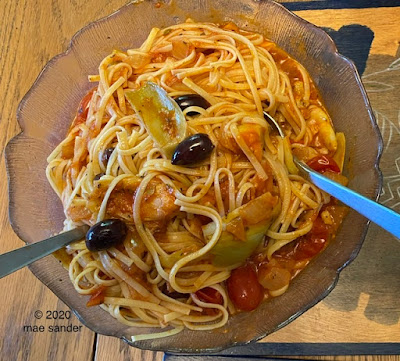
linguini with tomatoes, onions, olives, and artichoke hearts.
What I used: a can of artichoke hearts and a can of cherry tomatoes.
The news from the food processing industry remains very pessimistic. Major problems at large meat packing plants continue because employees on the production lines must stand very close to one another. Consequently, there are serious numbers of Covid-19 cases among these workers. Cases have also occurred on fishing boats and in fruit and vegetable packing plants; however, these industries seem to be making a better effort to protect workers.

From the L.A. Times last week:
"It’s a grim reality that’s playing out across the country as COVID-19 spreads beyond the meat processing plants that have captured the national spotlight. At least 60 food-processing facilities outside the meatpacking industry have seen outbreaks, with more than 1,000 workers diagnosed with the virus, according to a new study from Environmental Working Group. ...Fruit and vegetable packers, bakers and dairy workers are risking infection as the virus spreads through processing plants where employees deemed essential have mostly remained on the job during the pandemic, sometimes laboring in close quarters." -- Source: "Coronavirus outbreaks at 60 U.S. plants raise specter of more food shortages" 
From Alaska Public Media June 8:
"As America’s meat producers contend with thousands of COVID-19 cases among processing workers, seafood companies have drafted rigorous plans to ward off similar spread of the disease as their summer season looms in Alaska. But with that season still gearing up, the industry has already been shaken by its first major outbreak, aboard a huge vessel with an onboard fish processing factory." -- Source: "A Seattle fishing company has had more than 100 COVID-19 cases on its ships. They’re heading to Alaska this summer." by Nathaniel Herz.
From the New York Times this morning just before scheduled publication of this blog post, an article and video titled "We’re Feeding America, but We’re Sacrificing Ourselves:Poultry plants continue to run processing lines at a breakneck speed, making it impossible for workers to social distance" by Jerald Brooks and Lakesha Bailey, documenting that over 7,000 Tyson chicken processing employees nationwide have tested positive for the virus, but workers who stay home from fear of the virus lose their jobs. (We were already avoiding Tyson chicken before the pandemic because of worker abuse).

Vegetable main dish: bell peppers stuffed with kasha,
which I cooked as a pilaf according to the package directions.
Each pepper is topped with a slice of cheese.
In the longer term, besides the workers' welfare, there's another concern: the risky conditions in which cows, pigs, and chickens are raised:
  • Chicken houses and feedlots are very crowded, so any contagious disease can run rampant. 
  • Animals in these flocks and herds are often genetically very similar to one another, increasing the likelihood that pathogens will spread and evolve. 
  • The overuse of antibiotics to treat these diseases leads to the emergence of resistant bacterial strains. 
Although Covid-19 arose in wild animals, not livestock, industrial farming operations lead to a risk of a pathogen that can jump to humans and start the NEXT worldwide pandemic — or at least increasing the risk of some serious new human diseases. This is of course somewhat speculative, but many strains of human influenza have definitely incubated in pigs and chickens, and antibiotic-resistant bacteria from livestock are already a critical public health problem.

A long and detailed article about the dangers of the meat industry appeared in Vox last week. Here is a statement about the overall problem from Leah GarcĂ©s, the president of Mercy for Animals:
“We’ve been ringing the alarm bells for a long time. My deep hope is that now people will make the connection — factory farming is a catastrophic risk to our species — and that this permanently changes our behavior in the long term.” -- Source:  "The meat we eat is a pandemic risk, too" by Sigal Samuel, Vox, Jun 10, 2020.
Artichoke and lettuce salad using the rest of the artichokes.
Happily, cherries are in season.
Roasted vegetables.
I am aware that I should buy meat and seasonal produce from local small-scale farmers. These are available at a nearby farm market, but I have not yet organized myself to order from them.

This blog post and all photos © 2020 by mae sander for maefood dot blog spot dot com. 

Saturday, May 16, 2020

Responsible Choices in the Current Food Market

A worker at a coffee processing plant owned by a farmers' cooperative organization in Costa Rica.
We visited this plant last winter. Costa Rica supports very responsible agriculture and human welfare:
these issues are very important to me.
During my childhood and most of my adult life, the only motives driving our family's food choices were whether we liked the food, and whether it was good for us. Affordability was a distant third motive because in the United States, food has been kept very affordable for members of the middle class like our family. I'm aware that this is a privilege!

Recently, I've become aware of numerous additional reasons to choose or to avoid certain foods or classes of foods. These concerns lead me to ask myself many questions about my selection of food, and I take them seriously. Should I buy more locally grown produce and meat where available and in season? How can I make the most responsible choices for preserving the environment? Can my decisions be more humane? For quite a few years I've been attempting to buy climate-safe fish, following the recommendations of several watch-dog organizations, and I'm now avoiding meat from the packing plants where the workers are terribly abused and subject to infection from coronavirus. As I work through all this, my diet may continue to change. The current limitations on grocery shopping, as I stay out of stores to avoid contagious fellow-shoppers, are also affecting my ability to choose.

Beyond taste, quality, and nutritiousness, many other concerns have taken on critical importance. Here are the issues that seem important to me now:
  • Climate change has made us aware that some foods are very damaging to the long-term welfare of the earth. Clearing the rainforests of Brazil to graze more cattle can accelerate global warming. Clearing the mangrove swamps of southeast Asia to create shrimp farms is a disaster for the local and global environment (and these destroyed areas can only be used for a while but the environment is never restored). Raising cattle produces methane gas, some types of fertilizer poison the atmosphere, and so on. The term "carbon footprint" refers to the measurement of fossil fuel used to produce and deliver food products, and thus to estimate its impact on global warming.
  • Extinction due to over-fishing has threatened many important species of food fish. Shoals of cod once seemed inexhaustible, but now the cod is nearly absent from former fishing grounds; similar fates await other species. Several organizations rate seafood to help us avoid buying and eating the most threatened types of fish. Extinction of land-based wild animals is also a result of some of the actions that threaten to speed up global warming.
  • Cruelty to farmed animals motivates many people to avoid eating meat. The way this motive affects their choice of diet is varied, depending on whether they think all meat production is cruel or whether they think humane methods of cattle and poultry raising and slaughter are possible.
  • Welfare of American agricultural workers and food-processing workers, especially the workers in meat-packing plants, is another major challenge in our society. Should we buy meat when the workers are abused, exploited, and relentlessly subject to infection with coronavirus?
  • Welfare of workers in other countries presents a separate set of issues. Coffee, chocolate, sugar cane, bananas, shrimp on the Southeast Asian shrimp farms, and other imports are in many countries raised and processed with very troubling labor practices, including even slave labor.
  • Food safety is a multi-faceted issue. Is it a small bright-spot that coronavirus is not thought to cause contaminated food? We all know about warnings that romaine lettuce and other vegetables grown in Arizona or California may harbor pathogenic bacteria. Over-use of pesticide and other agricultural chemicals may result in contamination, which is hard to assess. We have to worry that oversight by US government agencies of both home-grown and imported food is becoming more lax. Some people worry about genetic engineering, but the impact on one's health of GMOs in food has been shown to be inconsequential, especially in comparison to other food safety issues.
  • Excessive processing of food has been a cause for concern for a long time. In my opinion, the healthfulness of highly processed foods seems somewhat less critical than other issues, because it only affects one's own personal health, not the welfare of the planet. That said, the corruption of US federal agencies by the current administration in Washington has more than ever favored the interests of big corporations over the interests of consumers and workers. So we may see the reintroduction of dangerous additives or careless food handling methods.
  • Religious requirements play a role in food choices in many worldwide communities, and deserve a mention here. In Muslim countries: no pork. In India, cows are sacred to Hindus and thus not acknowledged as a food source. In my own family, the generations who preceded my parents chose food with one main motive: it had to follow the religious laws of being kosher. Unlike the rest of the items on the list, this is not a personal concern for me.
I'll be coming back to some of these issues in future blog posts! And I will link up with Marg at 
Marg is the new host for Weekend Cooking, where bloggers share food-related posts from the previous week. This post and all posts on my blog are copyright © 2020 by Mae Sander for my blog, mae food dot blog spot dot com -- if you read this elsewhere it's been pirated! 

Friday, October 04, 2019

"Meathooked" by Marta Zaraska

"From our earliest days on the Paleolithic savanna, when our ancestors were showing off their kills to form alliances and gain social position, meat has always stood for luxury and for riches." (Meathooked, p. 112)

Do you want to learn about the history of creatures eating other creatures' flesh? From the earliest single-cell creatures to modern omnivores and herbivores? Marta Zaraska's book Meathooked: The History and Science of our 2.5-Million Year Obsession with Meat (published 2016) covers this huge time span. It seems highly relevant to this week's blockbuster news about food -- that meat eaters might not be taking risks as big as they've thought up to now. (For a summary see: Is eating beef healthy...)

My impression of this book: it's half good and half not so interesting. I'm sorry to say that I wasn't impressed much by the earlier chapters covering the first one-celled organisms that started eating each other and then quickly moving onward with the role of meat in human evolution. The author provides much information about the ways that a vegetarian or even in some cases a vegan diet can provide fine nutrition, and that meat-heavy diets can cause various health problems (obviously a few years ago when the author was writing, this was the mainstream view). But there's kind of a boring side to the way she makes her point. There are many many books that do a better job with this subject.

The later chapters were much more interesting, because the author tried to understand why humans love meat so much, and she especially explored the reasons why the vast and varied efforts to promote vegetarian diets have failed in America and in Europe ever since the earliest efforts in the 19th century. Her main point was that promoters of vegetarianism like Sylvester Graham and John Harvey Kellogg also hated strong tastes and made sure that the diets they proposed were very uninteresting to eat. Vegetables and grains were overcooked and spices were prohibited along with meat. And she repeatedly points out -- MEAT TASTES GOOD!!

Throughout the world today, more and more meat is being consumed: Meathooked has very interesting chapters on how and why this transition is happening. In China the rate of increase is enormous. Even in India with its tradition of a plant-based diet, more and more of the rising middle class are choosing to eat meat, even eating beef (which they sometimes say is water buffalo not sacred cow meat). Rising Indian technology workers and other educated Indians are rejecting the traditional food although it's almost ideal for complete protein without meat, and the taste is great -- "vegetables stewed with spices were served on scented rice, followed by dishes of flavored curd, saffron caramel, and sweet cakes with pomegranates and mangoes." (p. 121)

The health of the planet is very much a matter of concern in the final chapters of Meathooked. The author could easily be working with the current protest movement against the vast human activities that are accelerating disastrous climate change. The way she puts it is that if the growth of meat consumption continues as it seems to be going, we'll need another planet to grow the feed and raise the animals that are required to feed everyone on earth the amount of meat that Americans now consume.
Blog post copyright © 2019 Mae E. Sander for maefood dot blogspot.com

Tuesday, October 01, 2019

A Retro Dinner: Beef Stroganoff

"Public health officials for years have urged Americans to limit consumption of red meat and processed meats because of concerns that these foods are linked to heart disease, cancer and other ills.  
 "But on Monday, in a remarkable turnabout, an international collaboration of researchers produced a series of analyses concluding that the advice, a bedrock of almost all dietary guidelines, is not backed by good scientific evidence." -- New York Times, Sept. 30, 2019
UPDATE, January 7, 2020: The publisher of the cited study, "Annals of Internal Medicine," has issued a correction stating that  the chief researcher had an undisclosed conflict of interest. Specifically, he accepted funding from the meat industry through an institute known as AgriLife. Quote from Marion Nestle, who had already pointed to the conflict of interest: “From the outside, it certainly looks like AgriLife is in the pocket of the meat industry and hired someone who has made a career out of undermining the dietary guidelines.” (source)

My original post continues:
It's been a while since I wrote a blog post about cooking a meal. Here's a quick description of a recent dinner, meat and all -- just in time for the startling revelation that red meat isn't nearly as risky for health we've been hearing for years. Unfortunately the evidence that meat may be bad for the health of the planet still stands.

Beef stroganoff is a dish I haven't made for a while, though I used to do it
often. In fact, I guess I must have done it many times because I seemed to
remember each step of the way, beginning with sautéed onions & mushrooms.
I decided to broil the meat to save time and limit the grease spatters on the stove.
The newly published research that eating red meat doesn't increase your
odds of sickness or death is nice to hear!
Using some home-made stock and seasonings, I made a brown gravy for the
mushrooms and onions, added the meat, and garnished with sour cream.
While it was quite tasty, it didn't quite make a photogenic presentation.
The side dish, roasted delicata squash with rosemary, was a bit more presentable.

I have to consider the following reason, stated in the article on this new research, why we should decrease beef consumption:
"Questions of personal health do not even begin to address the environmental degradation caused worldwide by intensive meat production. Meat and dairy are big contributors to climate change, with livestock production accounting for about 14.5 percent of the greenhouse gases that humans emit worldwide each year 
"Beef in particular tends to have an outsized climate footprint, partly because of all the land needed to raise cattle and grow feed, and partly because cows belch up methane, a potent greenhouse gas. 
"Researchers have estimated that, on average, beef has about five times the climate impact of chicken or pork, per gram of protein. Plant-based foods tend to have an even smaller impact."
Much additional material has been published about these studies since I wrote this last night, and much more is likely to be said. An editorial in the journal summarized the articles very clearly in scientific but non-technical terms:
https://annals.org/aim/fullarticle/2752329/meat-consumption-health-food-thought 

This blog post and photos © 2019 Mae E. Sander for mae's food blog