Tuesday, May 15, 2018

Pythagoras Meets Tamales and Tuna-Noodle Casserole and Solves a Mystery

"Better to die happy than thin." (Quote from The Pot Thief Mysteries Volume One, Kindle Locations 644-645). 
"Tequila is now one of the most popular distilled spirits in the United States, but I wonder why people in Boston or Birmingham like it. Its prime appeal to me is that it tastes like the desert— saline, organic and slightly viscous like the juice of the cactus it’s distilled from." (Kindle Locations 388-389)
"I am awe-inspired by Pythagoras’ insight. You may find it confusing or even boring. Some people are awe-inspired by majestic mountains, some by poetry and others by abstruse mathematics. But whatever the source, we all need a little awe in our lives." (Kindle Locations 3068-3070).
J. Michael Orenduff in The Pot Thief Who Studied Pythagoras, has written a delightful crime novel set in Albuquerque, NM. It's full of variety, as illustrated by the above quotes. When the novel's narrator Hubert Schuze is not participating in a scheme to illicitly obtain a 1000 year old Indian artifact from a local museum he might be legitimately helping authorities solve a murder. Throughout the novel, he's reading "an anthology of articles about Pythagoras."

Further, Schuze loves Mexican food such as an "entire sack of breakfast burritos, a quantity so large it took half a bottle of New Mexico’s finest champagne to wash them down properly." (Kindle Location 530).

Schuze cooks great breakfasts of huevos rancheros verde:
"I set the oven on warm and placed a plate inside with two corn tortillas. I broke two eggs into the frying pan and cooked them over-medium with a pinch of cumin. I placed the eggs over the tortillas, poured on green chili sauce, sprinkled queso fresco on top and returned the plate to the oven. While the cheese melted, I extracted a bottle of Gruet Blanc de Noir champagne from the fridge and filled a flute." (Kindle Locations 1031-1034).
Here's how he describes his normal eating habits:
"I believe in starting the day with a hardy breakfast, meaning loaded with carbohydrates, animal fats and red or green chili. I may eat an avocado or a mango during the day, but I usually don’t have another meal until after the cocktail hour and often have both in the same chair. ... 
"I walked over to Dos Hermanas Tortillería at five .... As the name implies, it started out as a tortilla factory. In New Mexico, that means they sell mainly tamales and posole. And you probably thought they sold tortillas. Well, they sell a few, but the ones in the grocery stores are cheap and good, so most people no longer buy tortillas at a factory.  
"Tamales, on the other hand, are a pain in la cola to cook, so people buy them at their local tortilla factory. The ones at Dos Hermanas are to die for, and considering how much lard goes into the masa, that may be literally true. The masa in a Dos Hermanas tamale is like a Mexican Rolaids— it will absorb up to forty-seven times its weight in stomach acid. Or Drano for that matter." (Kindle Locations 633-641).
Well-crafted Margaritas are the cocktail he most likes to drink, though he mentions a few others -- he's usually quite a food lover. He quite thoroughly describes a meal of sage hen, a game bird, stuffed with morels. This dish he eats with a lawyer at the lawyer's country club. He hears about another meal of very trendy food that he disdains at "one of those places where the food is supposed to reflect a philosophy," but the philosophy in question is nihilism. (Kindle Locations 2129-2130).

The Plaza in Albuquerque, from one of our visits there.
Schuze's shop is located just off the plaza, which he often describes.
My own enjoyment of the novel also came from my familiarity with the locale.
Alternatively, Schuze makes terrible coffee for the customers in his not-very successful Indian ceramic shop.  And on a few occasions, he eats dubious casseroles made by Miss Gladys Claiborne, his elderly neighbor: a lovable stereotype. For example she gives him this wide-eyed run-down on her tuna casserole when he tells her she shouldn't have gone to all that trouble:
"'It was no trouble at all. You start with canned tuna. I always use solid albacore. Then you combine it with noodles, chopped green onions, a can of cream of mushroom soup and a package of grated cheddar and bake it in the oven.' Her pale blue eyes sparkled as she added, 'Since we moved out here, I sometimes put a can of green chili in it.' 
"I took a forkful of it. It wasn’t bad. But with every bite I kept thinking of all that mercury lodging in my brain." (Kindle Locations 618-621). 
On another occasion, he avoids Miss Claiborne's chicken tenders casserole ("a piece of the chicken I am not familiar with") but is forced to eat lime jello with crushed pineapple and miniature marshmallows. Much later, she brings another casserole to a potluck: "a steaming chafing dish full of Summer Squash Pie courtesy of Nuestra Señora de Los Casseroles" which contained frozen squash, crushed Ritz crackers, and more. (Kindle Locations 3047-3048).

Hubert Schuze is clearly an intriguing and likable character. He's anti-establishment, and he doesn't agree with the law against digging up ancient Indian pots on public land, but he's very much against digging on Indian land or most other types of crime. As a result, he cooperates with the authorities -- sort of. He's also a skilled potter himself, and can make a mean copy of a historic pot.

I'm avoiding retelling the quite suspenseful and entertaining story of the various museum pieces that appear and disappear during the course of the mystery, or of giving away the identities of the murder victims and perps because I don't like spoilers. But I'm thrilled to have learned about this delightful mystery series -- thanks to Evelyn!

Oh, yes, here's one more food description of a recipe from Schuze's old family friend Consuela that I couldn't resist. I might even try it:
"She made her corn and poblano soup. In one pan, she sautés chopped onions, poblano peppers, garlic and cumin. In a separate pan she uses a big knife to slice the kernels off ears of fresh corn into hot lard and then stirs like crazy until the corn softens. Then she combines the contents of the two pans in a large stockpot, adds chicken broth and lime juice and lets it simmer. When all the flavors have combined, she takes the pot off the heat, throws in fresh oregano and crema Mexicana and lets it sit two or three minutes before ladling it into bowls. She serves it with warm corn tortillas and cucumbers slices sprinkled with chili powder and pilon sugar.  
"Emilio and I both had four bowls of it and Consuela beamed with each refill." (Kindle Locations 1614-1620). 

Update: I have now read the second mystery in the "Pot Thief" series, and I do not recommend it at all. The author re-used all the jokes and the descriptions of the supporting characters, and did not do as good a job with plot and other details. 

Monday, May 14, 2018

Disappointed in Mark Kurlansky's Latest Book


Just published last week: Milk: A 10,000-Year Food Fracas by Mark Kurlansky. As a big fan of Kurlansky's earlier books -- including Cod and Salt as mentioned on the cover of Milk -- I'm very sad to say that he hasn't maintained his earlier standards. Milk is a poorly organized, disjointed, and badly thought-out book, in my opinion.

Maybe the topic is just too wide for a single book. After all, cows, goats, sheep, camels, yaks, water buffalo, mares, and other domestic and even a few wild animals have provided milk to many societies over the last 10 millennia. In several places, Kurlansky compares human milk and the milk of other species in terms of fat content and other nutritional values. He describes a large number of societies that use milk products. The early chapters are in more-or-less chronological order -- but not entirely consistently. Eventually the organization becomes even worse. For example, there are two separate discussions of the Icelandic dairy product skyr in widely separated chapters.

Many millennia is a lot of time for people to argue about whether it's healthy to consume dairy products, whether it's ok to feed babies animal milk rather than breastfeeding them, and a lot of time for humans to evolve away from lactose intolerance. These issues are also presented at great length -- somewhat beyond my tolerance. The same issues keep coming up again and again, but the narrative seems to jump around in a disconcerting way.

Humans have consumed a lot of milk as well as a lot of cheese, butter, ghee, yogurt, creamy soups and sauces, milky alcoholic drinks, and baby formula! In 10,000 years we humans have had vast experience with contaminated dairy products. We've put in a lot of effort to learning how to make dairy products safer. Disasters have afflicted the dairy industry -- up to and including Strontium-90 in the mid-20th century. Kurlansky covers these and many ongoing issues: GMOs. antibiotics, organic farming, "mad cow" disease, what it costs to run a dairy in America now, and more. But it doesn't add up to a coherent story, at least not in this book.

Recipes appear throughout the earlier chapters. They are often quite amusing, for example:
"TO MAKE A FINE SYLLABUB FROM THE COW"
"Sweeten a quart of Cyder with double refined sugar, grate nutmeg into it, then milk your cow into your liquour, when you have thus added what quantity of milk you think proper, pour half a pint or more, in proportion to the quantity of Syllabub you make, of the sweetest cream you can get all over it." (pp. 109-110).
Some recipes, like this one, really illustrate the ways that milk has been used in the past, though few of them would be any use in a twenty-first century kitchen. Eventually, the large number of recipes and some of the other details and repetitions make quite a few of the chapters seem padded, as if the author didn't really have enough to say about a particular time, place, or issue.

In conclusion: I'm disappointed!

Sunday, May 13, 2018

Friday, May 11, 2018

Warblers, Plovers, Birdwatchers, and a Sleepy Owl

Trying to wake up?
Golden Plovers and Caspian Terns at Howard Marsh Metropark, Toledo, Ohio
Numerous warblers migrate through Magee Marsh on Lake Erie in May.


Tuesday, May 08, 2018

Homemade or Industrial?

"In the first half of the nineteenth century, a revolution occurred in the preparation of breadstuffs. Once they escaped the limitations of yeast, American women were free to experiment, innovate, and create new kinds of food, removed from religion. This culinary revolution started with cake." (The Baking Powder Wars, p. 17)
"What [Michael] Pollan sees as a positive reversal of industrialism is a burden the nineteenth-century women were elated that baking powder, industrialization, and corporate America had lifted from them." (p. 184)
This spice cake, along with many similar cakes, originated in the 19th century. 
Served at afternoon tea or evening social events in the 19th century, sweet, soft layer cakes or molded cakes changed American tastes. These were made to rise with baking powder rather than yeast or beaten eggs, and were much easier and faster to make at home. The bundt pan, as shown in the photo, became popular in mid-20th century America, though tinsmiths made similar cake molds in the 19th C.

In the book Baking Powder Wars: The Cutthroat Food Fight that Revolutionized Cooking, author Linda Civitello shows how the popularity of such cakes was closely related to changes in household management, to expectations of how to be a good middle-class wife and mother, and to other social changes. Technology also enabled increasing availability and lower cost of high-quality wheat flour, which contributed to the ease of home-baking as well. Thus: an industrial revolution in the kitchen!

Peanut butter cookies date to the early 1920s. 
In 1796, Amelia Simmons first used the word "cookie" for round biscuits made with pearlash, a predecessor to baking powder. Throughout the 19th century, more and more types of cookies appeared in cookbooks and ladies' magazines as the effectiveness and ease-of-use of baking powder developed. You could say the peak of invention in cookies was the Toll-House Cookie, invented in 1931. Both modern baking powder, invented by chemists and industrial food manufacturers in the 19th century, and chocolate chips, also effectively an industrial product, made this recipe possible for easy baking.

Cobbler with biscuit-dough topping: first made in the 19th century.
Cornbread. One of the earliest baking powder dishes.
This and earlier photos are from my own kitchen.
"The Pancake Baker" by Adriaen Brouwer (WikiArt):
Pancakes were FLAT before baking powder!
Look at the pancake, another food that changed and became typically American. As illustrated in this seventeenth-century painting, and as reflected in events such as pancake-flipping races the day before Lent, pancakes are highly traditional in Europe and have been made for centuries. However, the expression "flat as a pancake," which Civitello quotes often, points to the change that happened when baking powder became available, and American pancakes began to be high and fluffy instead of flat.

Question: What do all these breadstuffs -- cookies, layer cakes, cobblers, biscuits, fluffy American pancakes, cake donuts, muffins, cornbread, and more -- have in common?

Answer: Baking powder is responsible for their unique texture, flavor, and ease of baking. It's the "indispensable, invisible ingredient." (p. 187) Further, they are all in fact American food innovations.

We think of these items as home made and traditional, but in fact their history is not as old as all that. Baking powder is a 19th century invention, and so are all the recipes made with it. Linda Civitello tells this story, beginning with descriptions of the hard labor needed to make bread from yeast or to enable cakes and biscuits to rise by other means -- but nowhere near as quick and labor-saving as baking powder. Yes, you could beat eggs for an hour to get a nice fluffy cake. Yes, you could make "beaten" biscuits, which required someone in the kitchen to beat the dough with a rolling pin for hours. (Hint: these were a popular Southern food. The person doing the beating was often a slave, or after the Civil War, a very poorly paid black servant. Civitello is always highly aware of the role that slavery and later racism played in the development of American cuisine.)

Baking powder is made from baking soda (sodium bicarbonate) and another rising agent, which varied during the time when the product was being developed; at first the two elements had to be added at different times in the mixing process, and timing was critical. Several chemists worked in laboratories and then invented industrial processes to deliver an easily usable product to home bakers and commercial bakers.

Big business always was responsible for baking powder. Several corporations with very colorful owners and promoters were rivals in an effort to corner the market for this profitable product. In the course of their rivalry, they engaged in some amazing antics. For example, one baking powder manufacturer bribed virtually every member of the Missouri legislature in the late 19th century to enable passage of a law prohibiting the key ingredient used in the products of other baking powder manufacturers. The "baking powder wars" involved early food and drug regulation, bribery, both national and state-level politicians, and many other fascinating machinations, made most vivid by Civitello's narrative.

The Baking Powder Wars is full of wonderful nuggets of food history and cookbook history, as well as industrial history. In the twentieth century, more and more cookbooks and recipes called for baking powder, which was not a standardized product until remarkably late. Civitello traces the way that baking powder took over most baking recipes in popular sources, especially The Joy of Cooking, first published in 1931 and revised many times into the 21st century. She also illustrates how the use of baking powder changed baking methods in other cultures, such as Hispanic cuisine in California and baking of traditional German biscuits that were previously raised with non-chemical leavening methods. And she lists how fast food makers use baking powder biscuits and similar foods -- just think of the Egg McMuffin! 

Sunday, May 06, 2018

Local Food, Cooked Outdoors: Must be Spring At Last

It's finally spring and local products are coming in after a long cold April. Here's our dinner:
Pork chops raised on Ernst Farms, local bok choy, local lettuce. Tomatoes grown in midwestern greenhouse.
The grilled pork chops.
Bok choy, also cooked on the Weber Grill.

Preparing to BBQ.

Pork chops in marinade. Just a few chives from our own garden!
We used a recipe from Epicurious, with several variations:
 "Grilled Asian Pork Chops and Baby Bok Choy."
Chops and bok choy ready to cook.
Our source again was Argus Farm Stop, a store quite near our house
that sells consignments from local farmers and producers.

GRILLING!

Instead of snow on the ground, we have fallen petals from a blooming tree.

Thursday, May 03, 2018

To Travel by Train

"There may be no better method of job creation ever invented than a railroad."
(from Train by Tom Zoellner, Kindle Locations 1026-1027).
The railroad, invented in England, was a major development of the industrial revolution, specifically invented to carry coal from the mines, but soon put to many other purposes. At first sight, humans found trains with their huge engines unnatural and often terrifying. They had never seen such a source of steam and fire, and they had never experienced such incredible speeds -- over 10 miles an hour to begin, and becoming faster and faster.

In Tom Zoellner's book Train: Riding the Rails That Created the Modern World-from the Trans-Siberian to the Southwest Chief the early reactions are described in a quote from the historian Thomas Carlyle, who never forgot his first rail journey:
"'To whirl through the confused darkness, on those steam wings, was one of the strongest experiences I have experienced,' he wrote. 'Out of one vehicle into another, snorting, roaring we flew: the likest thing to a Faust’s flight on the Devil’s mantle.'  
"These metaphors were dramatic, but they were correct in naming the railroad as an essentially chthonic machine, born underground. The primary fuel for its engine, the most important cargo, its entire economic reason for being— all of these critical elements were a direct result of the velvety rock that lay in shallow deposits under the soil of northern England." (Kindle Locations 379-383). 
"Chthonic" is a vivid and obscure word that refers to Greek gods or other spirits or demons that inhabit the underworld. Zoellner often choses such words to portray the effect of trains on a variety of countries and cultures. Railroads, as he documents them, have become important factors in these countries' economy, their landscapes, the creation of their cities, the transport of goods, their access to a varied diet, and the movement of people.

Zoellner talks about the 19th century railroad barons who made huge fortunes and then maybe lost them, but whose successes shrank the continents. He also talks about modern developments of bullet trains, and modern neglect of some of the once great passenger lines such as Amtrak and English rail lines. He discusses some of the famous palatial railroad stations and what's become of them. With great insights, I think, he discusses the force of the railroad as a way to create employment and contribute to economic well-being. Of freight trains he writes: "a central truth about the railroad: there remains no better mechanism for hauling heavy commodities." (Kindle Locations 3948-3949).

The heart of the book, however, is Zoellner's love of passenger trains. In each chapter he concentrates on his own personal journey on a train line of his choice. He weaves his experiences with the history and economic development of the rails in that country. In the UK Zoellner went by train from the north of Scotland to the farthest south he could. In the USA he traveled by the Acela from New York to Washington, DC, and then on Amtrak all the way to Los Angeles. In China he took the incredible rail line to Tibet. In India he experienced the national railway's filth; he witnessed its vast commitment to using human labor and not automation. In the Peruvian Andes he rode on the steepest train tracks on earth. Zoellner attempted the famous train ride from European Russia to the end of the trans-Siberian railway; however, his voyage was interrupted when a potentially rabid dog bit him and he rushed home for preventative treatment. All fascinating.

Zoellner's descriptions make his experiences vivid. He says little about the food (on Amtrak, he recommends the dining cars not for the cuisine, which he finds "reliably mediocre," but as a place to find people to talk to; in other countries, it's worse). But his descriptions of the aromas, odors, smells, and stinks of trains throughout the world are very revealing! Here are a few of his descriptions, including olfactory ones, to give you a sense of this enjoyable book:
"The Northeast Regional train to Washington lay idling like a silver python. I stepped onto it and immediately smelled the unmistakable fragrance of Amtrak: blue toilet fluid, old socks, a lacing of diesel fuel." (Kindle Locations 1720-1721).
"The Southwest Chief was called for a 3: 00 P.M. departure, and I went out onto the platform to board it. ... a lower berth, which smelled of the usual blend of diesel and bleach." (Kindle Locations 2322-2318). 
"Practically every rail journey from Moscow through Siberia starts from Yaroslavl station, a handsome hulk built in 1904 and designed to look like a Russian Orthodox convent. ... The bunks were coated in vinyl and padded with approximately two micrometers of stuffing. .... Though the train was not yet moving, a strong odor of coal smoke and human body pervaded the carriage." (Kindle Locations 3005-3015). 
"Laziness and dissipation are inevitable on the Trans-Siberian.... I had grown used to the smell of sour feet and onions and had done as almost everyone else was doing by the way of meals— that is to say, avoiding the dining car. Instead I bought cartons of sodium-soaked ramen noodles from the babushkas who gathered by the tracks." (Kindle Locations 3140-3146). 
"Riding through the Tibetan plateau inside a train compartment feels like cheating. ... All a traveler needs to do these days is gaze out the window at the unfolding subarctic plain where he never belonged but nevertheless has a kind of unlikely intercourse. ... A woman in a hooded garment was bending over to pick up a disk of yak dung which is used as everyday household fuel. I smelled some in a fireplace later, and it burns as clean and odorless as balsa wood." (Kindle Locations 3773-3784). 
"We soon came to the town of La Oroya [Peru], which is one of the filthiest places I have ever seen. The cliffs surrounding the town have been wiped clean of all vegetation and sport a bizarre white coating that looks as if ten billion tons of bird guano or cake frosting had been dropped on them and slowly oozed downward. This is the remnant of the sulfuric-acid clouds from a nearby smelter. ... A waiter came out to the back porch to serve cups of tea brewed from coca leaves, and it numbed the inside of my mouth. The air smelled of wet grass and fresh metal, and as we climbed, the sky became a weird pastiche of angled sun and clouds and snow." (Kindle Locations 3998-4018).

Thinking about train rides... 

A childhood memory: St. Louis Union Station with the Milles Fountain.
Image from Wikipedia.
In my own life, I've had a few memorable train trips. Zoellner inspired me to think about trains I have known.

In St. Louis, I was introduced to trains as a child, specifically by my first train trip which was 8 minutes long. We went from the Wabash Station at the west edge of the city to the big, downtown Union Station, an introduction thought up by a friend of my father. She accompanied me and my sister on this exciting first trip while my father dropped us off at the Wabash Station and then drove downtown to pick us up. Also, I remember the beauty of the sculpture by Carl Milles which still stands in front of the station, though it's now mainly used for other purposes.

Snacks on the train, California, 2014.
In the last several years, I've been lucky to make some interesting train trips. One was from Warsaw to Krakow and back the same day -- a very long day! On a different trip to Europe, I traveled by TGV (the French bullet train) from Paris to Avignon, on to Arles, and then back to Paris. In 2014 I enjoyed a beautiful train ride beside the Pacific Ocean from Santa Barbara to Delmar near San Diego and back. I also had a tormented night on a very late train from Germany to Paris, where our reserved seats were taken by other passengers. I don't think I'd have the patience or the nerve to do the ambitious train travel that Zoellner did, but I loved reading about it.

Monday, April 30, 2018

Reading "Grocery" in My Kitchen

American food, as explained by Michael Ruhlman's book Grocery: The Buying and Selling of Food in America, makes a very readable and relatable story. (In an earlier post I reviewed this book -- link). Inspired by Ruhlman, I'm going to explore the foods in my own kitchen and how I'm affected by the grocery store options that surround me. Ruhlman says that currently shoppers go to a number of stores, while in the past, most households had one main supermarket where they bought almost everything. At least some shoppers, he says, are much more conscious of where food comes from, how it was raised, and what health benefits it might confer. And grocery store owners, he points out, are very aware of how quickly they have to change as consumer demand changes. I think my experience as a shopper reflects these trends.

To check what drives my purchasing, I'm taking an informal inventory of how I cooked and what ingredients I've had on hand this month. I'm thinking about staple products that I always buy, where they were grown and processed, and which stores they came from, and what's in season. Of course winter isn't quite over here in Michigan -- our last snowfall was less than two weeks ago, so nothing is actually growing right now except in hoop houses!

Now for some details of what I cooked and where I bought the ingredients:

Curried chicken and vegetables. Ingredients: butternut squash from Argus Farm Market,
chicken breasts from Whole Foods (bought as 3 single-pound packages, stored in freezer),
a can of coconut milk from Trader Joe's, other vegetables.
Salmon patties made with frozen salmon from Trader Joe's,
onion from Argus, celery from Whole Foods, eggs, panko
bread crumbs, and spices. Served with hoop house lettuce
from Argus, cucumbers, and lemon from TJ's.
Other food in the freezer besides chicken and salmon includes:
  • Ground lamb from Argus (local producer: Ernst Farms).
  • New Zealand lamb chops from Costco.
  • Ice Cream from Target and TJ's.
  • Bread from Zingerman's Bakehouse.
  • A box of beef ragout that I made a few months ago for later use. Leftovers are always with us, including little boxes and glass dishes in the fridge.
Pantry and fridge ingredients for cornbread: corn meal, baking powder,
flour, butter, egg, sugar. I usually have all of these on hand all the time.
I buy them at any supermarket where I happen to be when I need them.
Using an LA Times recipe, I tried a new sort of cornbread, topped with brûlée sugar.
Interesting recipe: my usual cornbread includes hot peppers while this is a dessert.
A few more items that I almost always have in my pantry:
  • Cereal, cookies, and crackers mostly from Costco, TJ, Target. Not so healthy, but we still eat these items often. Cereal is only the second-most unhealthy food we use. (I think the worst is Diet Coke usually from Costco).
  • Dried fruit. I made some into fruit salad with tangerines to go with the cornbread. I use dried fruit for lots of other dishes as well. Costco sells only impossibly huge quantities of dried fruit so mine comes from TJ and Whole Foods.
  • Nature Valley Granola bars from Walgreen's -- not even a food store, but they always have the best sales!
Pantry and produce items going into a salad: tuna, white beans, olive oil,
vinegar, Campari tomatoes, parsley, celery, lettuce, bell pepper, zatar.
Tuna and white bean salad. With variations, I can almost always make this.
Besides fresh parsley (from TJ's), I used zatar, a Middle-Eastern spice blend which I brought back from Israel last month. Local summer tomatoes and peppers would of course be preferable for any salad -- if they were in season. I also recently made shakshouka, an Israeli dish of eggs poached in a spicy tomato sauce, for which I used the Israeli spice blend, Hawaij, another spice from my trip. My spice shelf is incredible if I do say so myself!

Ingredients for shakshouka: canned tomatoes, spices, garlic, bell pepper, eggs.
Produce that I have on hand now:
  • Hoop house lettuce and carrots from Argus.
  • Cabbage & celery from Whole Foods. 
  • Campari tomatoes -- my favorite for this time of year. They are small, but bigger than cherry tomatoes, and have a bit more flavor than other winter tomatoes. The same brand -- usually grown in Mexico -- is sold at TJs, Whole Foods, Target, and Costco. Prices and quantities vary!
  • Grapefruit, apples, lemons, bell peppers, & tangerines mostly from TJs and Whole Foods.
Finally, the refrigerator always has orange juice, milk, Diet Coke, eggs, jam, mayonnaise, catsup, mustard, peanut butter, butter, yogurt, industrial and artisanal cheeses, deli meat for sandwiches, and a large variety of other condiments and sauces for Asian, Mexican, Middle Eastern, American, and other dishes. Just as Ruhlman suggests about my fellow American cooks, I'm brand-conscious on some products and price-conscious on others. Of course, he also discusses the other Americans who aren't cooks, and who shop quite differently.

From the Argus Farm Stop Website.
Ruhlman believes consumers today utilize a number of markets: I think I exceed the number frequented by his typical American. I shop, as my photos and lists indicate, at several different types of food stores which are very conveniently located in my area. Big national chains where I shop include Costco (3.5 miles from my house), Trader Joe's (1 mile), Whole Foods (1.7 miles), Kroger (2.3 miles), and Target (3.6 miles). The Argus Farm Stop (half a mile from my house) is an innovative consignment shop where local farmers and small-scale processors bring products including meat and produce, locally fresh-ground coffee, honey, maple sugar, jams, eggs, dairy products, and various other foods. Zingerman's Bakehouse (located fairly close to Costco) is a local source of very good bread. There's another locally-owned specialty market nearby called The Produce Station where I shop less often. There are no local chain supermarkets here like the family-owned Cleveland chain Ruhlman describes: the last one sold out to Kroger a few years ago.

What's missing in my kitchen that Ruhlman finds most popular with shoppers today? That would be food from the ready-to-eat food counters at Whole Foods, the pre-made foods in Trader Joe's freezer and refrigerator cases, the ready-to-eat foods in almost every food department of Costco, and many types of takeout food. I rarely use these products except when I'm in a temporary vacation rental without a fully stocked kitchen. (I've had more Costco rotisserie chickens in Hawaii than at home.) I'm really not with the times in this respect.

The fact of the matter is that I do look carefully at the things in the deli and the hot food counters at Whole Foods and on the tasting tables at Costco. However, I use these sights and samples as hints for dishes I could cook. I've been doing this for a long time as the Paris Charcutiers offered very similar ready meals during my various long visits there. After purchasing these very appetizing treats, I realized that duplicating a beautiful salad or roast from these elegant counters was far cheaper and the results were often fresher. Same is true here and now!

I'll be sharing this post with a group of other bloggers who write about their kitchens and what they have that's new and different. You can find them all listed at a blogging event called "In My Kitchen This Month," hosted by Sherry's Pickings. Check the list here to see inside the kitchens of bloggers on several continents!


Note: none of the markets or product brands I mentioned is sponsoring this post in any way. I never take any money or products or books for any mention on this blog! I respect bloggers who disclose economic connections when they have them, and I avoid blogs where I see obviously unacknowledged financial connections.

Saturday, April 28, 2018

Grocery Stores

Recent reading: Grocery: The Buying and Selling of Food in America by Michael Ruhlman. Much in it is familiar to habitual readers of food books (like me):
  • Ruhlman's analysis of processed food and what's in it that shouldn't be.
  • His tales of conflict between the profit-driven aspirations of big agriculture and the popular dreams of smaller, more sustainably grown meat and produce.
  • And his discussions of the constantly changing advice and research about what food is good for you. I like his observation on this: "There’s little disagreement that Americans have a hopelessly neurotic relationship with what they consume." (p. 80). 
Familiar authors are his frequent sources: Michael Pollan, Marian Nestle, Mark Kurlansky, Eric Schlosser, Calvin Trillin, Richard Wrangham, John McPhee, Michael Moss, Dan Barber, and others -- authors whose books and articles I've read. He has predictable chapters with titles like "No Food is Healthy," "A Few of the Twenty Thousand New Products for Your Consideration," and "The Cooking Animal."

Besides the familiar, however, a lot of the material in the book is different from these previous writers' stories. Refreshingly, the center of his book is Cleveland, Ohio. I'm always annoyed at the New-York-centeredness of so many food books. This is midwestern!

One interesting point: in a medium-size midwestern city -- like Cleveland -- typical American transportation has had a big effect on how people shop:
"One of the under-recognized facts of American real estate development is how our modes of transportation are the fundamental determiners of the way we create our residential and commercial spaces. The advent of the streetcar... brought about the creation of America’s first suburbs— with sidewalks and shopping districts within walking distance.... Spaces that were developed after the automobile became a predominant feature of American life are far from city centers and spread out. It was the automobile, and highways, that led to suburban sprawl. .... 
"'From 1948 to 1963 large chains increased their share of the nation’s grocery business from 35 percent to almost half,' writes Harvey Levenstein in Paradox of Plenty. 'As early as 1956, the independent corner grocery store, while still visible, was a relic of the past.'" (pp. 51-52). 
Ruhlman presents his analysis of the grocery business through the experience of one family-owned grocery chain in Cleveland, along with his own memories of how his family shopped for food. Its current owners, the Heinen brothers are his main subject. Grocery also sketches the family background of the buisness -- the Heinens' grandfather and father expanded from a small butcher shop to a small market to a chain of supermarkets. A more general outline of the American retail food business supports the history of the Heinens' stores beginning with A&P and a few other 19th century institutions, and continuing up to recent changes in supply and demand for organic produce, natural meat, and similar goods.

While describing the grocery business from the inside, Ruhlman traveled with the Heinen brothers and some of their employees as they evaluated new trends and products at grocery trade shows. He accompanies them on visits to farms and ranches where owners are trying to return to traditional agricultural practices, and learns about the challenges of non-standard meat ranching. Also, Ruhlman discussed alternative health products with a doctor who advises the Heinens on the pills and supplements that they sell.

A happy memory!
In particular, I enjoyed the description of touring the small-scale cheese makers of Marin County, California, especially one that I remember visiting years ago: "Marin French Cheese, which bills itself as the oldest continuously operating cheese maker in the country, dating to 1865." (p. 270). When I can find it, I love their Camembert, called "Rouge et Noir"!

Ruhlman gives a summary the economic challenges of the food industry in America in the context of this one local business. He describes the details of how they make money on each section of the store. I enjoyed learning about the issues that particularly concern the local, family-run business. Unfortunately I can't enjoy the results of such efforts: the family chain where I used to shop was sold to Kroger's several years ago, leaving my town, Ann Arbor, with only national chains.

Personal memories of Ruhlman's lifelong experiences grocery shopping -- much of it done at the Heinen family stores create a vivid background to his descriptions. His own grocery-shopping habits contrast with those of his father in the 1960s through the 1980s. His father loved grocery stores and did much of the shopping for his own family during this time. Among many big changes since then: many people now purchase food for their homes at many stores, and don't stay loyal to one main store as was his father's habit. As a result, owners must constantly find new products and presentations to keep customers coming back.

Like Ruhlman's father, my father did almost all of our family grocery shopping.
Here's a photo of him in 1963, taking bags of groceries out of our Rambler
station wagon. At that time, he was probably shopping at A&P.
In reading Grocery, I noticed a few annoying errors of fact, a few slips of editing -- like in the passage above, Ruhlman says the streetcars became important "in the first and second decades of the nineteenth century" (p. 51) when he clearly means a time much later when electric power had become available. Or he says "granola doesn’t need much (if any) fat"  (p. 81) which doesn't correspond to average granola nutrition facts: its fat calories go up to 50% of the total. Or he says inaccurately: "Whole Foods and the like had a wide range of organic foods (but you couldn’t find Cheerios there)" (p. 17) -- Whole Foods definitely sells Cheerios, which were made non-GMO in 2014 probably just so that Whole Foods would keep selling them.

But on the whole, I liked Ruhlman's book. Some of my favorite passages deal with the remarkably rapid changes in what shoppers want to get from their shopping and their willingness to shop around, as I mentioned. Constant reaction to change is required by his successful example, Heinen's, and other similar stores. Clearly, flexibility and innovation are required if a market is going to stay competitive in their very low-profit business. The Heinen brothers are aware of factors affecting the producers, not just the consumers -- presentation of these factors keeps Ruhlman's narrative interesting. For example when it comes to organic or naturally raised meat, one of their rancher-suppliers says of them:
"Heinen’s gets it. ...They take the majority of the animal, so we can do what we do and raise beef, and we’re not just pulling tenderloins out. They utilize different beef cuts and that helps make us sustainable. So when people talk about sustainability, it’s the chefs and the retail buyer just as much as it’s us on the ranch utilizing the compost." (pp. 190-191). 
Same point made by Dan Barber in The Third Plate, but more convincingly!

So many changes! For example, the implications of hydroponic growing of fruit and vegetables that can be hydroponically grown. Ruhlman lists:
"blueberries, strawberries, raspberries, cranberries, huckleberries, green beans, tomatoes, coffee, grapes; vine vegetables such as squash, pumpkins, okra, cantaloupe, and watermelons; peanuts, beets, carrots, onions, potatoes; critical grain crops such as barley, corn, wheat, and rice; and of course dozens of leaf lettuces and even more herbs." (pp. 227-228).
Another big change: demand for ready-to-serve food. The grocery counters where people can buy food that requires no kitchen prep whatsoever are taking up more and more space in markets. From rotisserie chickens to pizza ovens to hot food that's equivalent to take-out from a restaurant, his example family chain and most other grocery stores keep developing recipes and specialties to keep their customers coming back. I was fascinated by the economic implications of selling prepared, ready-to-serve foods: according to the Heinlen brothers, it's impossible to actually make a profit on this department of the store, but it's absolutely necessary to have it!

Ruhlman's book also made me think about how fast the grocery business has been changing even since he published the book last year. Grocery appeared before amazon.com merged with Whole Foods, so he obviously didn't discuss the implications of this merger, which more recent commentators have speculated about quite a lot, and before the meal kit fad which is now going into stores (see my recent post). Who knows what's next?

In a couple of days, I'll be posting a follow-up to this post with observations about food in my kitchen, and how the many issues Ruhlman mentions affect me directly.

Update, July 16, 2018: the follow-up post is Reading "Grocery" in My Kitchen. The Culinary History Reading Group chose Grocery as the July selection.

Friday, April 27, 2018

Meal Kits? Not for me, thanks.

The latest trend in how to buy groceries may be meal kits. As everyone knows, these boxes of pre-measured ingredients plus recipe, delivered by mail or UPS, allow you to cook without premeditation, but with quite a bit of expense and commitment. I've never tried them, and probably never will. I keep a very fully stocked pantry and can follow a recipe (and know many without looking), but the idea interests me anyway.

Many articles have indicated is that instead of being ordered and delivered, meal kits are coming soon to a market near you! Why? Because customers who try meal kit plans usually drop out quickly, so the various food-kit-providers need a new way to sell their product. As the Wall Street Journal says: "Blue Apron Holdings Inc. will try to give its struggling business a boost by selling meal kits in stores, acknowledging that its subscription-only model isn’t enough in an intensifying fight to fill people’s dinner plates." (link)

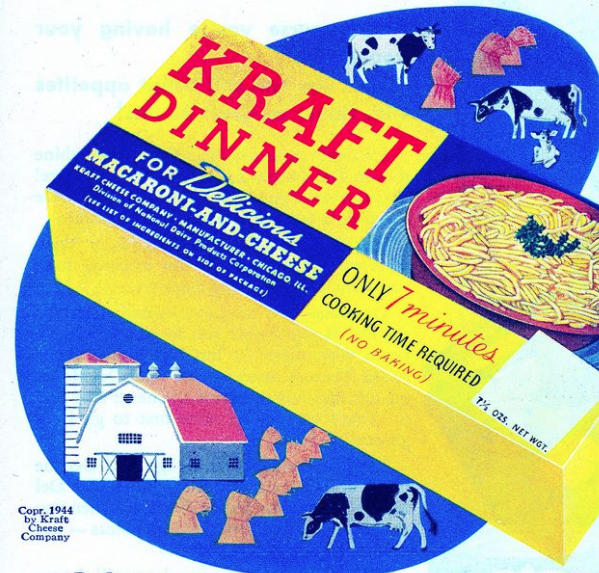
1944 Kraft Dinner Ad.
Curious about the trend I looked on amazon.com, to see if their partnership with Whole Foods was trying to fill this niche. I found no Amazon or Whole Foods branded meal kits -- but I was incredibly amused to see a "sponsored" link to the good old days: it offered me Kraft Dinner Mac and Cheese. I guess that actually is a kind of meal kit: everything you need in one box.

This got me to thinking. Twentieth-century food manufacturers really offered lots of "meal kit" products that enabled quick preparations from packaged food and didn't require a fully stocked pantry. Some were complete, some required the addition of meat. (The same is true for some of the meal kits now offered on Amazon.)

For example, from a newsletter for the food industry, I read:
"Meal kits for years have been a way to quickly prepare a family meal. The first packaged meal kit was most likely Kraft Macaroni and Cheese, created in 1937. Hamburger Helper was introduced in 1971 in response to a meat shortage and escalating meat prices." (source)
Curiously, I looked for ads for familiar "meal kits" from the past.

OK, you had to add meat -- but here's a coupon
for seven cents off the price of Hamburger Helper.
Chun King Chop Suey "meal kit" of cans dates from 1940s.
This painfully racist ad for a chop suey kit from La Choy
dates from 1955. My mother was a customer: I remember the little bottles
of soy sauce that would stay in the refrigerator forever. (source)
1960s ad for Rice-a-Roni, invented in the 1950s.
What more can I say?

Thursday, April 26, 2018

Last Chance Stuffed Dates with Ground Lamb

A split date stuffed with spiced ground lamb, garnished with parsley, lemon,
and toasted almonds. A creative Israeli recipe!
On our recent trip to Israel, we ate lunch one day near the Dead Sea at a restaurant called "The Last Chance." I ordered a very delicious dish which the menu called "Dates stuffed with meat, tahini, and silan." There was just a hint of tahini, and the ground meat spicing seemed vaguely North African (the restaurant's chef is of Tunisian background). Silan is honey made from dates -- in fact that's the honey that's meant in the Biblical verse about a land of "milk and honey."

When I got home, I searched and searched for a recipe for dates stuffed with meat, but found that dates are sometimes used to stuff lamb roasts; they are often stuffed with cheese or nuts; but the recipe I wanted just didn't show up in any of my cookbooks or web browsings. Finally, in a not-so-obvious page on the restaurant's website I found their actual recipe!

Stuffed date recipe from the restaurant website (link).
Making this recipe required that I do a bit of interpretation: for example, it's not clear about cooking the meat after you add it to the pan, and the spice quantities are pure guess-work. Nevertheless, I tried making the dish as best I could, and the results were satisfying. Adjustments:

  • I did not make an attempt to buy Silan, as it's hard to find. In any case, I thought it was a little too sweet for the meat dish as served in the restaurant. Using pomegranate molasses for garnish was enough sweetener.
  • Besides the spices called for in the recipe, I added a little of the Moroccan seasoning blend Ras el Hanout because I thought I had tasted some of those flavors. 
  • I used ground lamb from a local farm, but this would also work with ground beef.
Ingredients ready to prepare, cook, and assemble.
My serving platter, with the parsley, lemon, and a bit of tahini spread on the
surface as the recipe suggests, and as was done at the restaurant. Mint is
really not in season here so I sprinkled some dried mint on the tahini.
I made sure each date was set on the tahini.
Platter with the stuffed dates and recommended garnishes.