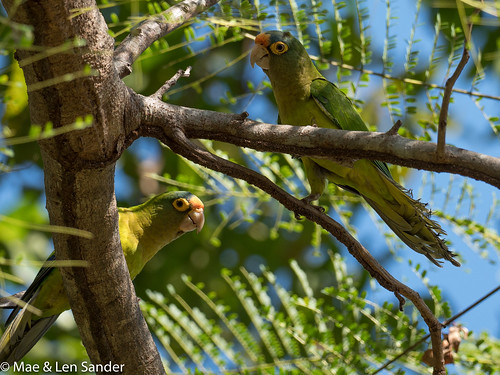
Len's photos of Costa Rican birds and wildlife are now available on his Flickr page!
Link: https://www.flickr.com/photos/len2000/

 |
| We visited two herb and vegetable gardens as we toured Costa Rica. At the hotel where we stayed in San Jose, a gardener named Chuse grew herbs for the two restaurants. Birds like this mott-mott loved these gardens,, and we loved watching them perch there. |
 |
| Raised beds for herbs and vegetables. |
 |
| The garden had tables in the middle for outdoor activities and dining. While we were there, it was not in use. |

 |
| As part of our cruise, we took a bus tour to a national park, with lunch at a resort hotel in the mountains.. First we visited the much more extensive greenhouses and raised beds of herbs and vegetables, where three gardeners work to supply the hotel. |
 |
| Some of the herbs grown at this hotel. |
 |
| Inside the greenhouse. |

 |
| A crocodile on a log, which we saw while taking a river boat tour. |
 |
| A porcupine hiding in a tree, spotted on a different river boat tour. I think this was an unusual sighting. |
 |
| A species of crab-eating raccoons live on the beach. They have learned to look for discards from human picnics, so they showed no fear of us. |
 |
| The coati is a member of the raccoon family. This one was picking up scraps at the side of the road, also evidently tamed by the presence of many humans. |
 |
| An emerald basilisk, one of several types of basilisk lizard found in Costa Rica. |
 |
| A little green snake. Poisonous? Yes. |
 |
| On this leaf: a tiny poisonous toad. Don't touch! |
 |
| We constantly noticed the fluttering motion of butterflies, mostly the famous blue morpho. But I particularly liked this very white one, about which I know nothing at all. |
 |
| A blue morpho just as it emerged from its cocoon. |
 |
| The jungle is full of big spiders! |
 |
| Another big spider. |
 |
| This seemed like a pretty strange caterpiller. |
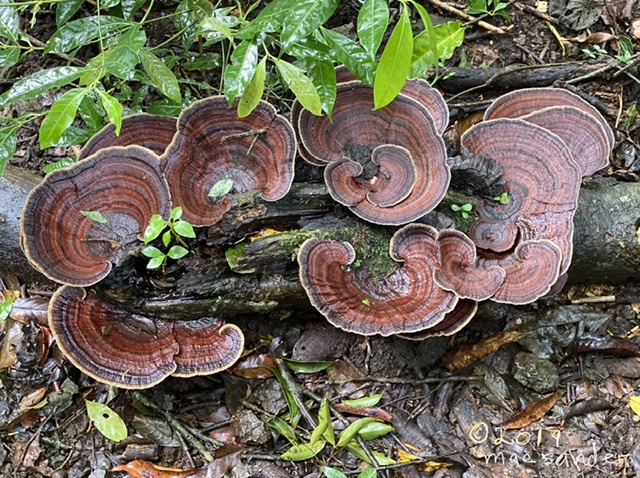 |
| The forest was full of interesting plants and trees, as well as creatures. We and our fellow-hikers were intrigued by this cluster of fungus. |


 |
| Each cart is hand-painted with unique designs. |

 |
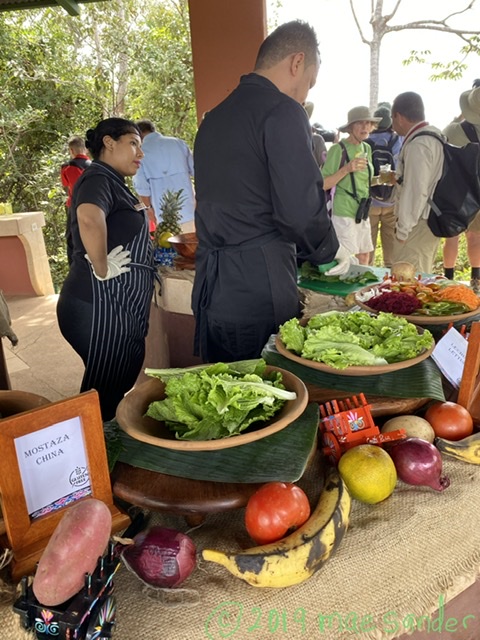
| A toy ox-cart decorating a salad bar. |
 |
| Farm-cart magnets for sale at a souvenir stand. (I didn't buy any.) |
 |
| Another decorated cart -- in the background is a modern version, not painted and with rubber tires. |

 |
| An oxcart in use from a mural at the coffee plant we toured. |
 |
| Also at the coffee plant -- you can see the bags of coffee being readied for shipment. |
 |
| Costa Rican shade-grown coffee has a global reputation for quality. Our last activity with the National Geographic trip was a visit to a coffee cooperative where 300 farmers bring their harvest to be processed. From the time it’s picked to the time it’s roasted, coffee undergoes a number of processing steps, including hulling, drying, and fermenting. |
 |
| Our guide began by describing the process of planting and cultivating coffee bushes, which are productive for up to 20 years. |
 |
| The coffee is shade-grown, which protects the plants from too much sun. The shade trees are also nitrogen-fixing plants, improving the coffee. |

 |
| The raw coffee beans (or “cherries”) are sun-dried and then kiln-dried. The surrounding seed-pods and fruit are made into mulch or burned in the kiln to produce heat. Little is wasted! |
 |
| A farm truck delivering the coffee beans. |
 |
| One of many murals in the coffee processing plant — this explains the steps in the process, as we saw it. |


 |
| Our ship, the National Geographic Sea Lion at sunset. |
 |
| We cruised the northern part of the Costa Rican coast for 5 nights and 4 days. Onshore we sometimes did beach activities like kayaking and snorkeling. |
 |
| One of many beautiful birds: the black-headed trogon. |
 |
| A beautiful hike included walking through several little streams of water. In this wooded area we saw the trogon. |
 |
| We loved the birds: these are oyster catchers that we saw from the Zodiac boats. |
 |
| This is Carlos, a naturalist, who was our bird guide on a number of walks and on one Zodiac cruise as shown here. |
 |
| A howler monkey in the forest. |
 |
| A capuchin monkey. |
 |
| Sunrise from the bridge deck of the Sea Lion. |
