Sunday, December 24, 2023

Alien Detectives

In 1953, Isaac Asimov’s Sci-Fi-Detective story “The Caves of Steel”
was set in the distant future when space travel to colonized planets would be the norm.
Many authors set detective fiction in rather exotic places: this one is extreme! (source)

Jean-Luc Bannalec is an author I’ve been reading recently, and I thought he was French. Nope. Turns out that Banalec is a pen name, and his real name is Jörg Bong. He is German. Bannaluc’s Brittany mystery series about Commissaire Dupin is his big international success. His police officer, Dupin, is from Paris, so we are seeing Brittany from the point of view of an outsider, but not a German! Dupin loves Breton food, which is described in every novel as part of the local color. 

Thinking about this made me consider how many other detective fictions are set in places not native to their authors, about detectives from very different backgrounds from their own. I’ve also noticed that in creating their exotic settings, many of these authors use local foods to create atmosphere and provide a background for the action — in several cases, cookbooks have been written to show what the detectives ate and how it was prepared. I’ve enjoyed reading books from each of these series, and recommend them all!


Martin Walker, born in Scotland, was a journalist who became a crime-fiction writer. His Bruno books are written in English about the Perigord area of France, where he and his wife have lived for some time. Bruno is an amazing cook. Walker has also written a cookbook about the fantastic French country cuisine that is described in every novel — I’ve been exploring his recipes.


Georges Simenon, author of a renowned series of police procedural novels, was actually from Belgium. His famous Inspector Maigret lives in Paris and works for the Paris police. Madam Maigret is a fantastic cook — and yes, there’s a Madam Maigret cookbook.


Donna Leon, inventor of Guido Brunetti of the Venice police force, was born in New Jersey. All thirty-two of her novels were written in English and have never been translated into Italian. Brunetti is another policeman who loves good food — and yes, there’s a cookbook.


Tony Hillerman invented the Navajo policemen Joe Leaphorn and Jim Chee. He lived not far from the reservation, but no way was he a Native American. Hillerman’s daughter has continued the series after his death. She’s also written guides — including restaurant guides — to the New Mexico area, though food is not as central in these books as in many others. Her book Santa Fe Flavors isn’t connected to the detective novels.

Jason Goodwin has written five novels about Investigator Yashim, set in Istanbul in the 1830s. Goodwin, who was born in England, identifies himself as "a novelist, historian and columnist; host, dragoman and hierophant." Yashim, while in the course of solving a crime, often spends time buying food at the market and then preparing it, which is described in great detail. Goodwin has published a collection of recipes titled Yashim Cooks Istanbul. (Note: a hierophant is a priest of esoteric mysteries.)

Louise Penny, born in Toronto, Canada, was a radio host; she is the much-loved author of a series of books set in Quebec, featuring French-speaking detective Armand Gamache. Yes, there is food: Penny has written a short cookbook titled The Nature of the Feast, which is available online from her publisher.

Sujata Massey, born in Sussex, England, grew up in St. Paul Minnesota from the age of five. She has written two series of novels featuring amateur women detectives. The first series is set in Bombay, India, in the early 1920s with detective Perveen Mistry. The second is set in Tokyo and Washington, DC, with a Japanese-American detective named Rei Shimura. Every one of these novels offers lots of food descriptions that create atmosphere and help define the characters.

Edgar Allen Poe was one of the first ever detective writers, and his most famous story is “The Murders in the Rue Morgue.” He never actually visited Paris. (Note that his detective, who also appeared in two other stories, was also named Dupin!)

Robert van Gulik may be the creator of a detective with the most totally different cultural background from his own. Van Gulik’s character, Judge Dee, based on a semi-fictitious Tang Dynasty government official, investigates a series of murders in various parts of China in the seventh century. Van Gulik was born in the Netherlands, and wrote both in Dutch and English. He got the idea for his series from a 19th century treatment of the character, but invented new plots and stories.


On TV?


I’m tempted to mention “Death in Paradise,” with its catchy Caribbean rhythms and beautiful island settings as well as numerous murder victims and police officers of various ethnicity. It’s filmed in Guadeloupe (though the TV island is the fictional Saint Marie) and made by English and French TV companies. The first episodes were made in 2011. Twelve seasons with a total of 98 episodes have now been released.

Blog post © 2023 mae sander


Saturday, December 23, 2023

A New Year is coming: let it be better than this one.

Birding allows me to enjoy the beauty of the natural world.
Yet anyone who appreciates the natural world has a lot to worry about.
This bird, the kingfisher, has long been a symbol of calm weather, peace, and love.

The Planet is in Trouble!

What is important to me this year? Global human and natural welfare are fragile. The future looks uncertain. My focus leans towards the US because that’s where I live, and I see many causes for concern, serious concern. Many of the issues that I worry about are closely linked to one another. And there are so many of them!

  • Climate change as an existential threat to humanity: arriving rapidly and causing a number of types of deprivation, desperation, natural disasters, and dysfunction in societies, especially causing food scarcity and famine or near-famine in the global south.
  • The war in Israel and the dreadful consequences if Hamas is not defeated.
  • Antisemitism in American life and on US university campuses — brought out by the war in Israel, but obviously evoked, not caused by the war.
  • Increasing inequality (both socio-economic and racial) throughout the US with a variety of bad consequences, combined with right wing repression of women’s rights and minority rights.
  • The war in Ukraine and the looming dominance of Russia as a consequence of a bad end to the war. 
  • Food shortages in many third world countries (much of it due to climate change) forcing large numbers of people to crowd into already overburdened cities and often to attempt migration to the global north.
  • Political success by the extreme right wing in many places. The large numbers of desperate people wanting to enter North American and European countries is one factor in growing right-wing strength in the global north.
  • Degradation of educational institutions in the US: a complex and multi-faceted issue.
  • The threat to world peace implicit in almost every one of the above issues.
  • In the US, we are also threatened with the end of democracy and the completion of a right-wing takeover of the executive, judicial, and legislative branches of the Federal government.
Notice that I don’t have any mention of AI or of any type of rampant and out-of-human-control technology on the list. I’m not very worked up about AI — maybe that will prove to be all wrong. And although I’m very interested in how our food choices and consumer choices collectively impact human life, my concerns for the future are expressed in a more general way. Similarly, fears that treasured creatures such as some species of birds, bats, frogs, polar bears, rhinos, fish, monarch butterflies, and many more may go extinct (or lose their natural habitat and exist only in captivity) is intrinsic in the concern about climate change. As the New Year approaches, all these thoughts perplex me.

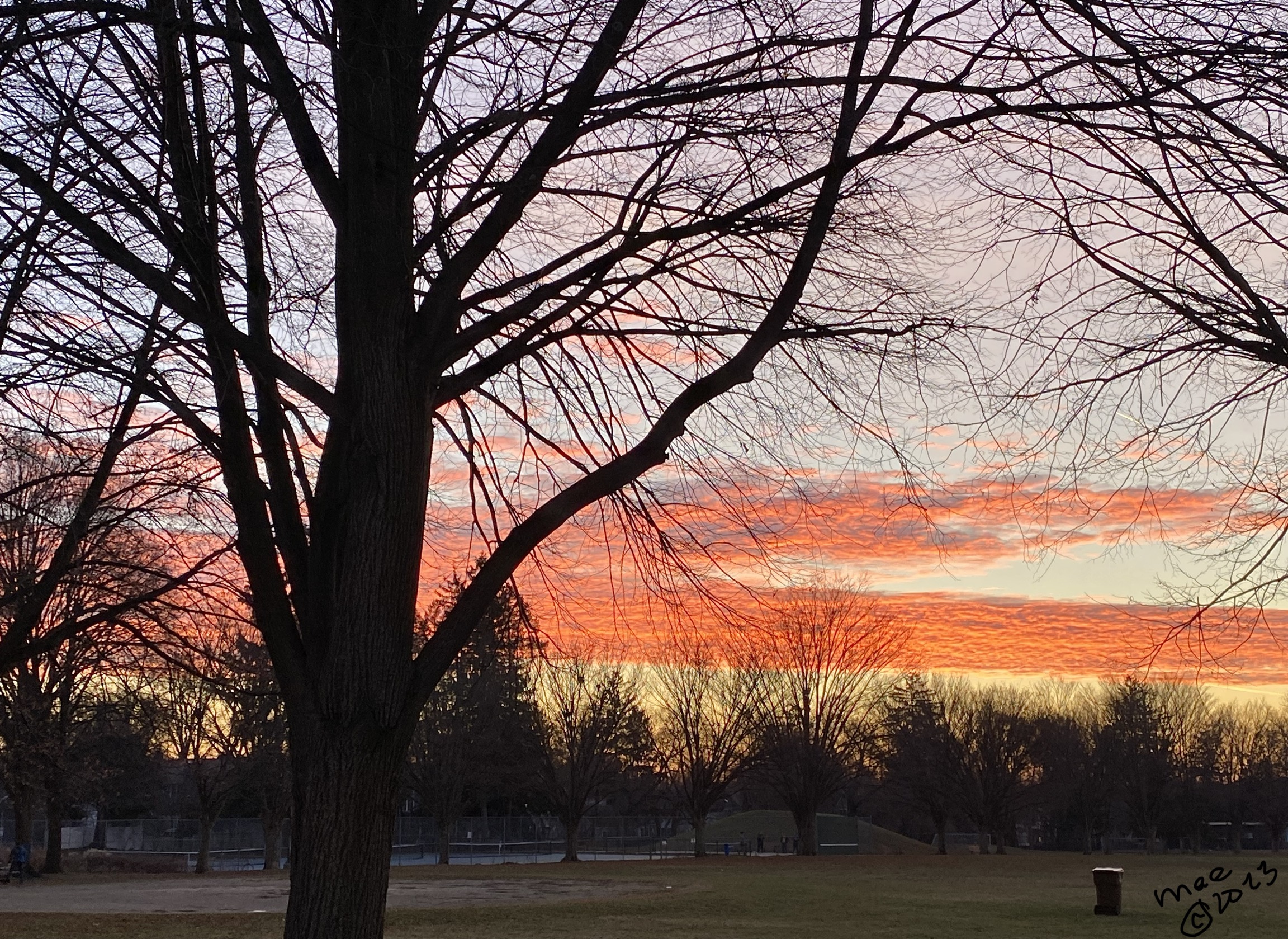
Sunrise on one of the shortest days of the year. We hope things will start to look better.

I've also reread a mystical novel based on Jewish traditions and folklore:
The World to Come by Dara Horn. Reading good books: another cosolation.


Blog post © 2023 mae sander
Shared with Sunday Salon at Readerbuzz 
and with Eileen's Saturday Critters 

Friday, December 22, 2023

Bruno’s Onion Tart


Continuing with our exploration of Bruno’s Cookbook by Martin Walker and Julia Watson, Len decided to make a rather complicated recipe: Red Onion Tarte Tatin. 

A classic French Tarte Tatin is a sweet pastry made with apples: a renowned dish where cooked apples are baked under a lid of flaky pastry and then flipped over for serving, so that the crust remains crisp. Walker explains that “it occurred to Bruno … that the method might be applied just as successfully to most vegetables.” Specifically, Bruno used this idea for baking with the abundant red onions that he grew in his garden. We were lucky to find beautiful red onions at Whole Foods, as we don’t have a garden — anyway, it’s fun to read fiction about one’s dinner. (p. 22)

Len has been wanting to try making simple flaky pastry (pate feuilletee facile) for quite a while. It uses flour, frozen butter, and ice water to make a flaky dough. Several other recipes in Walker’s book also use this preparation. If you watch the Great British Baking Show, the contestants constantly use this preparation for what they call “rough puff,” that is, a dough that is not repeatedly folded and layered, but that’s brought together quickly and only handled a little bit.


Grating butter for the pastry to make Bruno’s onion tart.


Roasting the onions — first on the stove-top, then in the oven.

Top the roasted onions with the pastry.


Beautifully brown, just out of the oven. The pastry is crisp and flaky.


Before serving, this tart is inverted on a plate, so that the onions are on top of the pastry,
and it’s garnished with goat cheese. The red onions become very dark, but are not charred.


Blog post and photos © 2023 mae sander

Thursday, December 21, 2023

Brittany in two Mystery Novels

“The simple question of who had a material benefit after a murder case – everyone always wanted to deflect it of course – might have seemed old-fashioned, but it was still elementary. Who got something out of the death? And what, exactly? ‘Traditional’ motives for murder still ruled the world: envy, humiliations and hurts, revenge, jealousy and greed dominated all statistics by a wide margin.” (Murder on Brittany Shores by Jean-Luc Bannalec, p. 148)


Jean-Luc Bannalec’s fictional detective, Commissaire Georges Dupin, wasn’t very careful to show respect for his superiors. In fact, he’s a bit contemptuous. This trait makes him a very good subject for a long series of novels — but isn’t very good for his career. Although he was Parisian through-and-through, he was banished from the Paris police force and sent to a small town in Brittany. At least he finds the food there good, especially at his favorite spot, the Amiral:

“It was true he loved Breton cuisine and the Amiral had all of the delicious Breton specialities, but nothing to Dupin’s mind, absolutely nothing, could beat entrecôte with chips (the real national dish of the Grande Nation – Dupin thought they should be very proud of it). There was nothing like it. Nothing even close after a day like that. And red wine to wash it down, a deep red Languedoc. Rich, velvety and smooth.” (Death in Brittany, p. 97)

He also finds good food in other restaurants as he investigates a series of crimes. Sometimes he enjoys these meals alone, sometimes with his fellow policemen:

“Madame Mendu had been looking after them, feeding them regional specialities: rillettes (scallop rillettes were Dupin’s favourite), paté, Breton goat’s cheese, various types of mustard, baguettes and a bottle of red Faugères. Dupin sat down and ate with them.” (Death in Brittany, p. 154)

I read these two books a couple of years ago, and decided to read them again. I must admit that I didn’t remember the details of either plot, so I enjoyed the suspense as Dupin questions the witnesses and suspects in the matter of multiple murders, while evading the demands of his more politically-oriented superiors. The atmosphere of the fishing villages and small-town life in both books is delightfully portrayed. I think I’ll read more of this series. 

One more unbearably delicious description of a dish you can eat only if you are on the Breton coast:

“The fish stew – you could never say fish soup – smelt indescribable. Dupin recognised all of his favourite fish: angler fish, sea bass, red mullet, gilt head, pollack, cod, hake and sole, his favourite shellfish: praires, scallops, blue mussels, palourdes grises and even better – palourdes roses – along with langoustines of various sizes and crab. It was in fact a huge, deep soup bowl with an impressive mountain towering upwards. More hurriedly than he’d intended, he poured the sauce over the fish and the potatoes. And ate. He tasted the whole sea. Incredible – the fish, but especially the broth, a concentrate that had been reduced for hours and hours.” (Murder on Brittany Shores, p. 316)

Blog post © 2023 mae sander


Wednesday, December 20, 2023

Why am I making Granola?


Crunchy and full of oats, nuts, and dried fruit.

In the oven

Normally, I wouldn’t bother to make granola from scratch, though it’s not that difficult, and I keep the ingredients (oats, coconut oil, honey, nuts, dried fruits, cinnamon, vanilla) on hand. This time is different: we were urged to return our Quaker granola cereal to Costco because it’s contaminated with salmonella. Costco, impressively, keeps track of one’s purchases so they both phoned us AND emailed us to explain the problem. Since we enjoy eating granola, I looked up a recipe.

Warnings!


A few of the many recalled products, including the one we returned.

Blog post © 2023 mae sander

Tuesday, December 19, 2023

Bruno’s Cookbook at Last

Inspired by Bruno’s Cookbook: roasted vegetables with salmon and browned breadcrumbs.

For a long time, I’ve been waiting for the English edition of Bruno’s Cookbook by Martin Walker and Julia Watson, and at last, I have my copy. As you probably know, Bruno is a detective in the small, fictitious town of St. Denis in the Périgord region of France, and Martin Walker is the author of this series of delightful books. I’ve read them all.

Bruno is not only a model policeman, he’s also a fabulous cook, and he and the other characters in Walker’s series are attributed as the creators of many of the recipes: after all, it’s BRUNO’s cookbook. 

Reading the detailed introductions to the sections of the cookbook and to the recipes is a little like reading fiction. The vegetables and herbs are grown by the people of the village, including Bruno. If there’s something they don’t grow, they can get it at the amazing local market. Bruno knows everyone, and always gets the best of everything. And he always solves the crimes that occur in the little village, while helping all his fellow citizens in many ways.

Bruno and his friends forage the local mushrooms. (I suppose Walker does too, as he includes many recipes for a variety of wild mushrooms.) Bruno loves the region’s famous truffles, which somehow he always seems obtain as gifts, despite their astronomical market value. The characters in the book (and we are told, the real friends of the author) buy cheese that’s made by a local cheesemaker, who also has connections throughout France, so he can procure artisan cheeses from other regions and sell them at his market stall. The locals, including Bruno, hunt wild boar and game birds. Eggs for perfect omelets come from the chickens raised in their back yards. Bruno’s Cookbook even provides the recipe for dog biscuits that Bruno bakes for his intelligent and devoted dog Balzac.

I am totally enjoying my adventure with this nearly-imaginary food. And I think there are a few recipes that I can follow even with the dried herbs, winter vegetables, inauthentic cheeses, and supermarket meats in my pantry and refrigerator. For my first such dish, I adapted a recipe called “Herb-Roasted Halibut on a Bed of Summer Vegetables.” Since it’s winter, I used winter vegetables, and I used salmon, which is listed as an alternative to the halibut — that’s what I had on hand. But I followed the instructions for seasoning the dish, and for a topping of breadcrumbs browned in olive oil. And it was delicious!


Not exactly following the cookbook, but I was inspired by this recipe for a dish of roasted vegetables and fish.
Blog post © 2023 mae sander

Monday, December 18, 2023

Images of the Seine

Renoir: "The Luncheon of the Boating Party" (Déjeuner des Canotiers). 
Renoir's famous friends drinking wine at a popular outdoor restaurant “La Maison Fournaise,” after boating on the Seine.
Sciolino points out that the restaurant still exists: you could eat on this terrace near the river!

As I read Elaine Sciolino's book The Seine, The River That Made Paris, I've been enjoying photos and images that she mentioned. The book includes a number of photos, but many of her chapters refer to other scenes as well, and I found some of them online. It's a very visual book!

The first photo below was taken during my most recent visit to Paris, a few short months before the April, 2019 fire that destroyed Notre Dame Cathedral. Sciolino points out that firefighters relied on water pumped from the Seine to fight the fire, and prevent even more destruction!

After that, I've included several historical photos, art works, and other images that were discussed in the book. I'm using Sciolino's text as a source of ideas for finding images; I’m not writing a real review.


A view of the Seine, November, 2018.

Historic Photos of the Seine

Emile Zola's hobby was photography: here is his view of the Seine around 1900.

Quai des Grands Augustins by Eugene Atget, 1920

Charles Nègre, 1855. Quai D'Anjou. Nègre is one of the earliest photographers of the city.

Charles Nègre, 1855. Construction of the bridge d'Arcole.

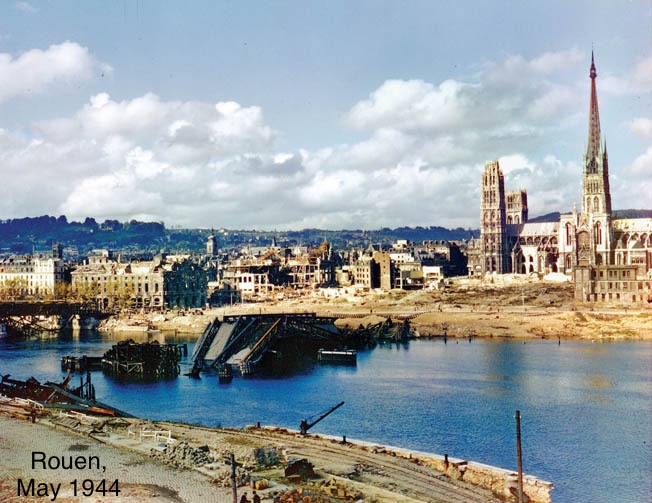
After describing the Seine as it flows through Paris, Sciolino continues towards the mouth of the river.
As shown here, Rouen, also on the Seine, was badly bombed during World War II,  especially the bridges. (source)

Bouquinistes and Bathers Along the River in Paris, 21st Century


"The BOUQUINISTES are the literary gatekeepers of Paris."
(Photo from Elaine Sciolino, 
The Seine: The River that Made Paris, p. 201).

“Bathers sunning themselves on the Right Bank of the Seine near the Pont de Sully and the Île Saint-Louis” (The Seine, p. 11)

At the mouth of the river

We paid a very brief visit to this small and picturesque seaport in 1976. The Seine here rises and falls with the tides: evidently we were there at low tide.

Inspector Maigret: Always Near the River


More Images of the Seine

Visiting Seurat's painting "A Sunday Afternoon on the Island of La Grande Jatte" 
at the Chicago Art Institute, 2017. La Grande Jatte is an island in the Seine.

Claude Monet: The Break-up of the Ice on the Seine, 1880. Monet painted the river very often.
This painting is very familiar to me because it belongs to the University of Michigan Museum of Art.

The Louvre beside the Seine, long before the elaborate creation of stone riverbanks. 
From the "Très Riches Heures du Duc de Berry," 1412-1416.

Paris in 1553: a map by Olivier Truschet and Germain Hoyau. (Wikipedia)

The Seine in Paris in the seventeenth century. (Wikipedia)


Blog post and original photos © 1976, 2018, 2023 mae sander

Saturday, December 16, 2023

Yet Another Quiet Week

 A late afternoon walk around the pond


A New Café: Tous les Jours

New to Ann Arbor: a franchise of the Asian/Korean chain Tous les Jours.

What we ate with our coffee: an Asian-style filled donut with mango cream and a croissant. The overall style is a version of a French pastry shop, which is a very good thing! For example, another choice of filling is red bean paste.

Besides a variety of bread, individual pastries, and a selection of coffee: a case of decorated cakes.


Our Neighborhood Getting Ready for Christmas


The Last Night of Chanukkah


Reading Another Book About Paris

Elaine Sciolino: The Seine:The River That Made Paris.

Blog post © 2023 mae sander