Thursday, June 13, 2019

New from Martin Walker: Another Bruno Chief of Police Book


The latest in the long detective series about Bruno, the chief of police in an absolutely ideal little village named St. Denis in the south of France, was published last week. If you haven't read any of this series, you have some fun in store. The new book is good -- but if they are all new to you I would suggest starting at the beginning and continuing until you tire of them. (The Penguin website lists all 14 of the Bruno books they have published.)

The Body in the Castle Well includes most of the themes that I have enjoyed in the earlier books. The delightful local foods of the village, politics and police business, the suspense of the investigation of a suspicious death, many vivid characters, and the weight of 20th century history all play a major role in creating a readable detective story. Every book offers tons of local color, including Bruno's daily pastimes of horseback riding and rough-housing with his dog Balzac -- and especially his cooking. But there's always a new plot, new twists in the relationships of Bruno and his friends, and new foods to savor. I'm always ready for Walker to spin the latest tale!

FOOD! As always, the new book offers mouth-watering restaurant descriptions and a few market visits, but not as many as in other books. Bruno cooks for his friends, for visitors to the village, and in this book makes dinner for the children of one of his friends. Details of how he cooks each course of a meal, as well as the wines he serves with each course, are a highlight of the book. You could almost follow the steps and make the food yourself, if you could get the remarkable local ingredients. I read them all with relish, most of all the preparation of his very elegant dinner with a lamb navarin which required several days of preparation and many vegetables fresh-picked from his garden.

I really loved the description of Bruno's cooking for two small children for whom he agreed to baby sit for an evening when their mother, one of his many friends in the village, can't find anyone else. The dish he makes them is spaghetti -- and his approach to this task was quite different from other food prep scenes in this and the many previous books:
“But first, which of you is going to teach me how to cook?” he asked.  
“You cook all the time,” they cried.  
“But this is magic spaghetti, and I don’t know magic. Balzac hasn’t taught me yet, but he says you two know how to cook it. Should we go in the kitchen and find out? Then we can have dinner and read a story before bath time.” 
“I only know the simple stuff,” said Bruno, washing his hands before peeling and chopping two onions and then cutting three tomatoes into rough chunks. “You two have to find the saucepan and the frying pan.”  
The children began to forage in cupboards.
“Now I need salt and pepper,” he said, and Daniel climbed onto a stool and pointed to where they stood on the table. Bruno found duck fat in the fridge and began frying the onions and put a kettle on to boil. 
“Where does Maman keep the spaghetti?” Dora pointed to a cupboard. 
“That’s where she keeps the ordinary spaghetti, but we don’t know where the magic one is.” 
“Balzac will tell us,” said Bruno, tossing the meat into the softening onions, adding salt and pepper and stirring the pot. “He only eats the magic spaghetti. Now you need to break up the spaghetti sticks so the bits are each as long as your finger, otherwise Balzac won’t eat them. Now can you set the table, a plate for each of us, a fork and spoon, and a plate for Balzac. If you want apple juice, you need to set a glass by each plate.” 
The water was boiling, so he poured the contents of the kettle into the saucepan, added salt and then the strands of spaghetti, now broken into child-sized pieces. He added the chunks of tomato to the mixture of meat and onions and began stirring, then he brought two stools close to the oven and stood a child on each stool so they could watch. 
“Ladies first,” he said, picking up Dora and giving her a wooden spoon and holding her so she could stir the meat. Then he picked up Daniel, gave him another wooden spoon and let him stir the spaghetti. 
“Now we say together after me the magic spell.” He began to chant, making up the rhyme as he spoke: 
"Les pâtes nous remuons.
Afin que nous mangions.
La sauce deviendra magique
Sinon c’est très tragique." [
“We stir the pasta so that we can eat and the sauce becomes magic. If not, it’s very tragic.”] -- (p. 223). 

SUSPENSE! Which of the suspects pushed the murder victim, a charming young American, down the castle well? Or was it a tragic accident? Bruno has to interview a lot of people, understand their complicated motives, and figure it out. He has to deal with his superiors in the French police system, and convince or ensnare them to do what he needs them to. As always, there are special challenges: here especially because the dead woman was an American and her family were very highly connected, so he has to deal with their interference. In the end, the solution to the mystery was so complicated that I had to work hard to follow what had happened -- a tiny bit disappointing on this level. But I enjoyed it.

POLITICS! Walker makes use of every possible area of political conniving and power struggles -- within the police force, on a national French level, on a local level among the villagers (rivalries, ideologies, race relations, etc.), in union elections of local high school teachers, due to residual resentments leftover from people's school days, and more -- in this book, even American politics. I always find that the political challenges to Bruno's investigation are very amusing and interesting.

HISTORY! In this case, the historic background of the novel's key characters includes World War II, the Algerian war and its aftermath, the French colonial war in Vietnam (which as you probably know was prior to the American Vietnam War), the lasting importance of De Gaulle, modern political ideologies and how they relate to past events, and international relations especially with Americans.  In this book, art history and the provenance of paintings also had an important role. As always, Walker informs the reader painlessly what all this history might mean to the residents of the small town where Bruno works. And makes it rather intriguing.

BRUNO AND THE TOWNIES! The only thing that's less prominent in this book is that Bruno, who is of course central to every one of the books, has only a bit of interaction with the local farmers, aristocrats (except those directly involved in the mystery), and townspeople than in other books. This time we don't see him coaching sports, helping the needy, buying fresh produce and game or trading with the producers for things he makes himself, or helping out with kids' activities. He does belong to an association for judging and promoting the local foie gras, but the description doesn't have as much passion as that of the local events in other books. Another village event he is involved in, a concert, doesn't play as big a role as similar events in earlier books.

I avidly read each new Bruno mystery for the suspense, for the vivid characters, and for the idealized view of this rural French village that's really Walker's greatest invention. It's the village everyone hopes to find on a trip to France, which preserves all the wonderful old time rural happiness and virtually none of the downside, and introduces only good things from modern life: like cell phones! The perfect honesty, personality, resourcefulness, and ideals of Bruno, of course, are always central. It's a pity there has to be at least one murder victim in each book, but that's the price you have to pay for such a fun read.
This post is written and published by maefood dot blogspot dot com.

If you see this posted at another blog, it's been stolen.

Tuesday, June 11, 2019

Wild Blackberries in Shenandoah

"Blackberries are all over the mountain," said the bartender who brought us this delicious piece of blackberry ice cream pie.
As we hiked in the park, we didn't see any blackberries, as they won't be ripe for months.
The ice cream had a really fresh flavor, even though it must have been made from frozen or otherwise preserved fruit.
I tried to find out what blackberry plants look like in early June, but I'm
still not sure. Was this bunny nibbling on blackberry leaves?
These deer were eating rotten wood from a fallen tree (or maybe grubs)?
But were there blackberries all around them?
Are these blackberry bushes that we saw near the trail?
Are some of the plants around the waterfall blackberries?

Or here? All the guides to foraging along the Appalachian Trail mention blackberries!
Whichever plant produced the blackberries, they were delicious. On our second night in the Skyland Resort, we again ate
dinner in the Taproom, and ordered the blackberry cobbler, with the same blackberry ice cream on top.
Skyland was founded in 1888, long before the National Park took over the area. I wonder how old the recipes are.

All photos Copyright © 2019 by Mae & Len Sander.
Published by maefood dot blogspot.com.
If you see this posted at another blog, it's been stolen.

Monday, June 10, 2019

Fallingwater

On a tour of Fallingwater -- Frank Lloyd Wright's amazing masterpiece -- the first look we had at this amazing home was
a view of the cantilevered living room over the stream. At right you can see an ongoing restoration of some of the
concrete structure of the building. I suspect that Fallingwater is not only one of the most remarkable single-family homes
ever built, but that it also probably the highest maintenance of any home ever!
Wright designed Fallingwater for the Kaufman family in the 1930s. It was a weekend retreat for Edgar Kaufmann, Sr. and his wife and son. Kaufmann owned and ran a large department store in Pittsburgh. He purchased the property as a retreat for his family and the employees of the store. His son, Edgar Kaufmann, Jr,  was a student of architecture. He studied with Frank Lloyd Wright, and arranged for Wright to design the home beside the waterfall on the property. With his usual incredible originality, Wright placed the home over the waterfall rather than beside it.

Fallingwater is located 50 miles southeast of Pittsburgh. We toured it on our way home from Shenandoah National Park.

The sitting area that's in the cantilevered room in my first photo. Edgar Kaufmann, Jr. donated the house, its furnishings,
and the impressive art collections it housed, to the Western Pennsylvania Conservancy in 1963. Thus it is maintained
as a museum with a visitor center and numerous daily tours. 
One of the innovative features: the natural boulders at the site were incorporated into the structure.
This 8th-century Indian statue of the Hindu goddess Parvati is incorporated into the natural rock. Water seeps into the
wall when it rains, and runs over the rocks and into a carefully contrived crack in the floor.
The Fallingwater kitchen, used by the cook who traveled with them for weekends at the house. The formica topped counters
were an innovation: the material had not yet been released, but Wright knew people who made it available to him early.
Two maids and a chauffeur completed the Kaufmann's staff on visits to the house. (Source)


The story of Fallingwater, the Kaufmann family, and the accomplishments of Frank Lloyd Wright is very complicated. Many articles and books on Wright evaluate his major contributions to architecture and design. I've only presented my brief impressions from the tour of Fallingwater, which I found to be an incredible and wonderful experience.

All photos Copyright © 2019 by Mae & Len Sander.
Blog post created and owned by Mae's Food Blog: maefood dot blogspot dot com.
If you see this post at some other blog, it's been stolen.

Saturday, June 08, 2019

Dark Hollow Falls, Shenandoah National Park


Dark Hollow Falls poster in the gift shop


Friday, June 07, 2019

Shenandoah!

Beautiful Shenandoah National Park! We've now left Fairfax and are here for the weekend.

An Indigo Bunting. 
Mountain Laurel blooming on the Appalachian Trail.

Our very brief walk on the Appalachian Trail.

Thursday, June 06, 2019

Mama Chang, Fairfax, VA

Scallion Bubble Bread, about to be delivered to our table at Mama Chang
Restaurant in Fairfax, VA. We could see the kitchen from our table, which
I find a bit unusual in a Chinese restaurant!
Mama Chang was named best new restaurant in the Washington Post's
Spring 2019 Dining Guide. (LINK TO ARTICLE)
We had a very enjoyable experience eating here.
Beef stew with potatoes. 
Noodles fried with vegetables. 
Sweet-sour lotus root. This was really delicious and completely new to me.
We also had pork belly with lotus root, which has a very
different flavor profile and is also good.
Very spicy deep-fried flounder with cumin. I found this a little too spicy.
The bones (which were mentioned on the menu) made it a little hard to eat.
Every table seemed to have a totally different selection of dishes,
including many types of steamed buns, which we didn't try.
All photos Copyright © 2019 by Mae & Len Sander.
Blog post created and owned by Mae's Food Blog: maefood dot blogspot dot com.
If you see this post at some other blog, it's been stolen.

Wednesday, June 05, 2019

Miriam's Graduation


This post by Mae at maefood.blogspot.com
All photos copyright Mae E. Sander.

Sunday, June 02, 2019

"Moonglow" by Michael Chabon

Michael Chabon's Moonglow is a really enjoyable book. Despite some of the more depressing elements of the plot, it has a light touch and often is very amusing. Although Chabon pretends that his narrator's story of his grandfather is a memoir, it's clearly fiction. I enjoyed the way the novel jumps around in time and space, playing on the various themes and memories that are being developed. As the reviewer in the Guardian wrote:
"This is a novel that, despite its chronological lurches, feels entirely sure footed, propulsive, the work of a master at his very best. The brilliance of Moonglow stands as a strident defence of the form itself, a bravura demonstration of the endless mutability and versatility of the novel." (Review by Alex Preston, Jan. 10, 2017)
The grandfather had always been a reticent character, but during his final illness, he offers a number of stories to his attentive novelist grandson -- suggesting that this be written down. I guess this makes this a little bit of a meta-novel, emphasizing the irony of its being a pretend memoir. Although there are very serious themes throughout the book, I liked the context of lightness in which they are developed.

I'm so grateful to my friend Margo who
loaned me Moonglow!
Combining his own memories of both his grandparents with his grandfather's final confessions, the narrator is able to detail his grandfather's life. The stories include the grandfather's early days in Baltimore and Philadelphia, his experience with the American troops at the end of World War II, and his relationships with his parents and his brother. A highlight was the meeting of his grandfather and grandmother, but also the grandfather's unfortunate prison stay in the mid-1950s, the consequences of the grandfather's obsession with space travel, and quite a bit more. All captivating, I would say.

Both the narrator's grandfather and his grandmother were fascinating people, and the portrait of the grandmother -- who suffered from crippling mental illness -- was incredibly rich and intriguing. Along with her very small daughter (who became the narrator's mother), she came to Baltimore as a refugee from France, her native land, just after the war. Needless to say, she had suffered a number of traumas that come out in the narrative. Mother and child were sponsored by a synagogue that wanted to help the victims -- the grandfather wanted no part of synagogue social life, but was persuaded to attend the Purim party where they met. The love story of this couple is at times tragic, but not always. The whole story is full of irony and improbability, which makes it very good to read.

As always, I like to see how authors use food to help tell a story, and Chabon provides a variety of examples of this throughout the story, especially the mentions of his French grandmother's very skillful French cooking (like the time she made him a tarte Tatin and he ate it all). Or the fact that the narrator has lost the omelet pan that he had inherited from his grandmother, though he still makes some of her recipes.

At the end of his grandfather's life, after the death of his wife, he moves permanently to Florida. The tragic elements of his story seem less tragic and the comic parts seem more comic: at least until his final illness sets in. He meets a widow named Sally, and their relationship, it's a relief to say, is pretty amusing. For example, he invites her to dinner at "an overpriced crab house in Boynton Beach, a rope-trimmed tourist trap that my grandmother had despised." He suffers gastric distress which seems "as though her ghost had poisoned his chowder," though eventually he decides it's his nervous lack of confidence in his date with Sally. I especially found this amusing because I've visited relatives who have retired to Boynton Beach.

Saturday, June 01, 2019

At a Coney Island Diner in Ann Arbor

Mural on the wall of Uptown Coney Island in Ann Arbor. This is definitely retro art as the diner was founded in 1990,
and the images are obviously meant to be from the 1960s. Some reviews mention the mural but don't name the artist.
In case you don't know this: Coney Islands are a special type of Greek restaurant, mainly in Michigan and a few other places. Some of the Coney Islands are chains, but Uptown Coney Island has only two restaurants: one in Ann Arbor, one in Chelsea. The central offering of all Coney Islands is the Coney Island Hot Dog on a bun with chili, onion, and yellow mustard.

I ate breakfast at Uptown Coney Island recently because it's next door to the car dealer where my car was being serviced.  I only had some cinnamon toast (good!), but the menu has all the classic diner favorites -- tuna melts, burgers, gyros, waffles, meatloaf, and every kind of egg for breakfast. I would like to try their Monte Christo sandwich some time. Also the corned beef hash. The hot dog? Not for me, thanks.

Friday, May 31, 2019

In My Kitchen: Not Much!

My kitchen this month has only basic activities: not much new or sharable. However, my back yard and basement storage areas, which serve as kitchen extensions, have a few things going on. I like to wrap up each month with a look at my kitchen and many other bloggers' kitchens, all shared at Sherry's blog HERE.

New basement shelves help us organize things we buy in larger quantities. Mostly at Costco!
This basement storage feels as if it's an extension of our kitchen.
Potted herbs make summer meals more delicious. By the end of May, they are safe from frosts and we can start a few of them. As summer arrives, we're also grilling outside more and more, as I've depicted many times. Our chives didn't
seem to enjoy our deeply cold winter. Luckily, my friend Margo gave me a bunch more chives since I took the photo.

In May, I spent a week on the National Geographic Orion on a cruise in
French Polynesia. The main activities were morning and afternoon expeditions
to look at the islands or to snorkel. But who wouldn't want to have this
breakfast instead of facing one's own kitchen every morning? I love vacations!

Close up of the new items.

What I really don't like in my kitchen this month: washing all the dishes by hand. I had to get out an old dish drainer from underneath the sink. What I expect to like next month: a replacement for my very old and up-to-now trustworthy dishwasher. It lasted something like 14 years -- that's 98 in dog years.

All photos Copyright © 2019 by Mae & Len Sander.
Blog post created and owned by Mae's Food Blog: maefood dot blogspot dot com.
If you see this post at some other blog, it's been stolen.

Wednesday, May 29, 2019

Polynesian Birds

PolynesiaBirds-7

During our expedition to several Polynesian islands, we saw very few local land birds. In fact, the islands' natural history and human history has been very hard on land birds -- in contrast to other island groups like the Galapagos and the Hawaiian Islands. On one island, Makatea, we saw three endemic birds including this Polynesian Imperial Pigeon. This species once lived on a few other Polynesian islands, but is now extinct everywhere but Makatea, so we were thrilled to get this photo of it. (Note this word for Wordy Wednesday: a bird is endemic if it is found only in one native place, like this one.)

PolynesiaBirds-8

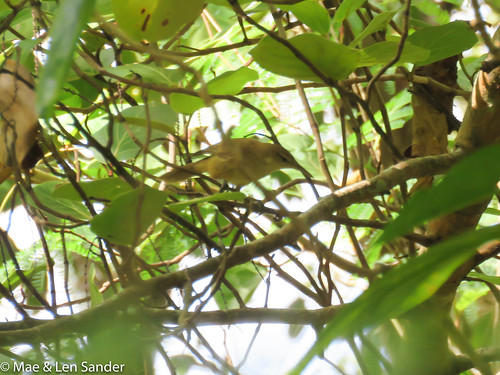
This is the Tuamotu Reed Warbler, which also now survives only on the island of Makatea. A third endemic species is a type of fruit dove, which we saw but were unable to photograph.

Two more bird photos:

PolynesiaBirds-4

The fairy tern, above, is an oceanic species that lives in many parts of the Pacific. They are quite beautiful when they perch in the trees, as well as when they are flying. This one was on Makatea very near the beautiful fresh-water grotto where we swam through a deep cave.

PolynesiaBirds-2

We saw many Lesser Frigatebirds, which are also found throughout the Pacific region. This one was on the island of Fakarava. All of these photos are from Len's Flickr set. If you click on one of them, you can see the rest of the birding and snorkeling photos from our recent trip. 

All photos Copyright 2019, Mae and Len Sander.

Monday, May 27, 2019

Our Ship: The National Geographic Orion

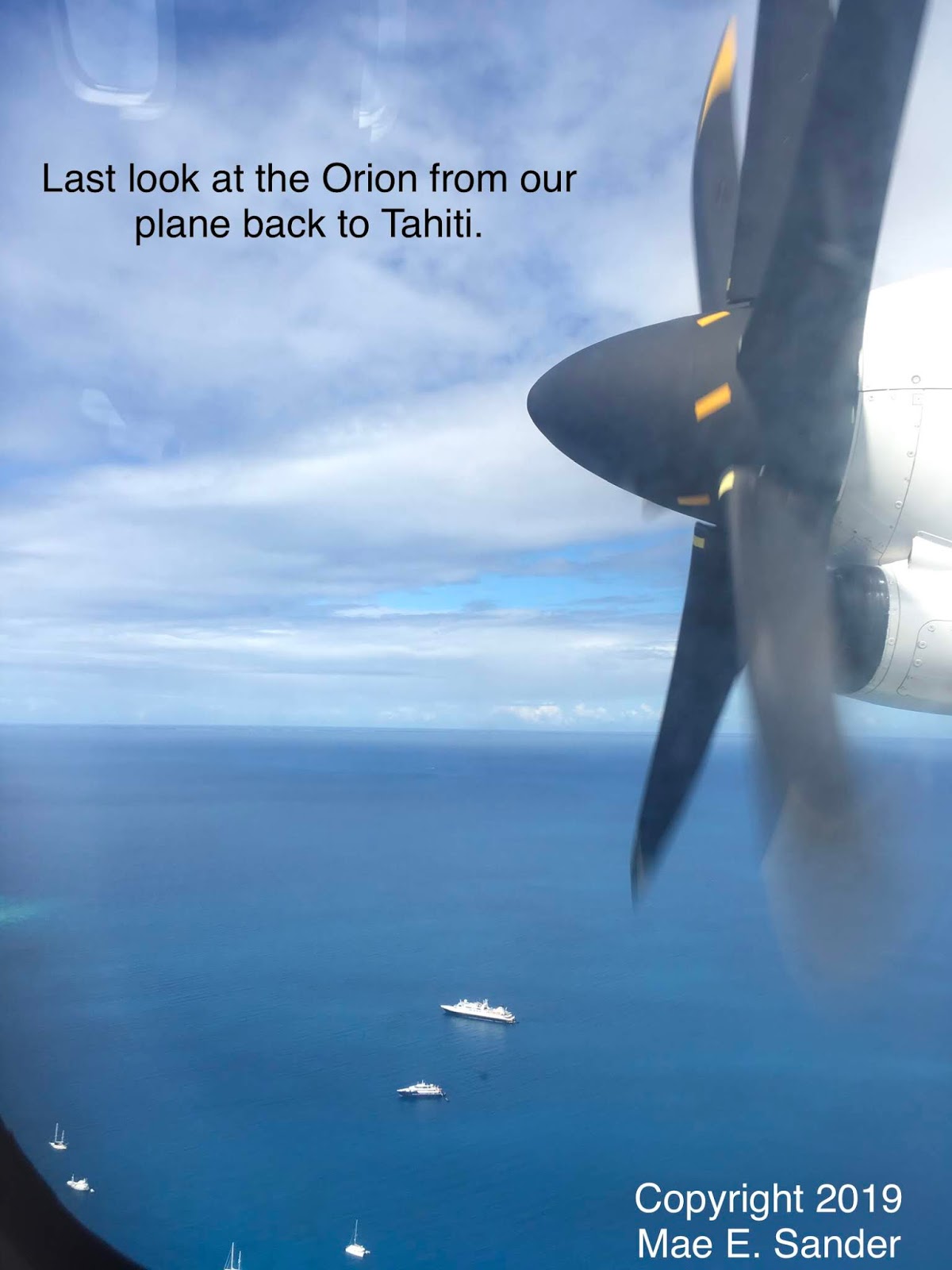
Our ship for the week of May 10 through May 17 was the National Geographic Orion. The view of the ship we saw
most often was from the zodiac boats that took us to all of our excursions to the islands of French Polynesia.
The most exciting navigation on the ship was the passage through several narrow gaps between islands on remote
atolls, where the sea is rushing into or out of the lagoon, and there's only a very narrow channel.

All National Geographic/Lindblad expeditions have a policy of open bridge -- you can go in and see how the ship is being
handled by the crew. At right in this photo is Heidi Norling, the ship's Captain. At left, the first mate and the expedition
leader. Heidi is from Stockholm, Sweden, where she began her career on cargo ships and ferry boats.
Another photo of Heidi with the Hotel Manager, who is in charge of
rooms and food service. Heidi's biography HERE.

The ship's lounge has rather distracting mirrors on the ceiling.
We rarely had time to enjoy a moment on the top deck. This was the
last day -- we had just returned our snorkel gear.

A very important functional apparatus: the anchor!
I didn't take many photos of the crew, the hotel staff of cleaners, or the waiters and kitchen staff at work. But when we got off the ship to take a  walk on the island of Fakarava, a zodiac brought a group of workers who headed for a covered basketball court and a quick game. Note the second-from-left player's NatGeo shirt.