Tuesday, February 16, 2016

Florida Fish Dinners

An anhinga  (also called the snake bird) catching a fish.
Wakodahatchee Wetlands, Boynton Beach, Florida.
Feeding fish to the young anhingas.
Barb, Joe, and Len ready for fish dinner,
Sarasota, Florida.
Our fish dinner.
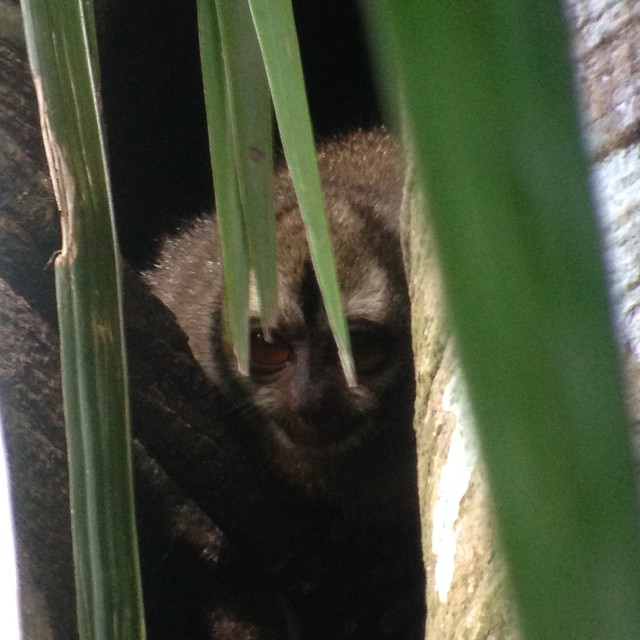
And maybe he's thinking about a fish dinner. Or just flashing a Mona Lisa smile.

Monday, February 15, 2016

Home Grown Tomatoes (and birds)

Wood Stork at Green Cay, Boynton Beach, Florida. 
Purple swamphen at Green Cay -- this individual is home-grown but the
species was introduced to Florida when some escaped from a zoo.
Little Blue Heron (immature) at Arthur R. Marshall Loxahatchee National Wildlife Refuge.
Fresh Florida produce (tomatoes, peppers, and pommelo)
from a farm stand and you-pick place near the wildlife refuge.
Florida salad for lunch at Jean & Jack's house. Dinner will be BBQ Ribs, photo to follow if I don't forget!

UPDATE: The barbecue photos:
Jean and Jack waiting for Florida BBQ ribs. 

Today's special: a rack of ribs with selected sides, $15.
Len and I shared this platter.

Sunday, February 14, 2016

Night and Day

A Wooly Possom that we saw on our night adventure last Wednesday in Panama.
Florida! We flew here from Panama yesterday. The chaos in customs & immigration at the Miami airport was horrendous. Now we're visiting Jean and Jack in Boynton Beach. We are taking the day off of birdwatching -- though we just watched a cormorant, a vulture, and an egret fly by from the porch. It's nice to have a little downtime after 5 days of nonstop birding.

Panama birdwatching and creature watching, in retrospect, was fantastic. I scarcely had time to post photos, and Len is still working on adding the bird IDs to his photos. These night creatures were the highlight of our owl search on Wednesday night. Though the owls didn't show up, we saw 5 kinds of mammals and one unusual bird. I'm posting three of them here. The sloth photos from the daytime were better, so I didn't include the two kinds of sloth we saw on the night trip.

A Kinkajou, also at night
An Armadillo (or at least part of him).
The Pauraque, sitting on the ground. It's a tropical relative of the Whip-poor-will that's seen in the US.

Friday, February 12, 2016

Two Monkeys

IMG_1348

Above is a night monkey, which we saw peering out of its hole in a tree late this afternoon. I wasn't even aware of this species until this week's guided tour of the wildlife in Panama. When I saw it on the list of animals we might find, I really hoped to see it. And today, our last day here, we saw both the night monkey and the Capuchin monkey (below). We also had a remarkable view of an anteater, which was scratching itself all over with its long arms. Though we watched the anteater for quite a while, we didn't get a photo. We also saw a few more sloths.

day-PM 6 1

I haven't written much about the food we've been eating during our stay in Panama. We have been staying at the Canopy Tower, where all meals are included, and where the meal times are coordinated with the guided birdwatching and wildlife tours.

I haven't been hungry at breakfast which we've been eating at 5:15 or 5:30 AM in order to be ready for early morning wildlife observation. I was disappointed in the orange juice, which is reconstituted from some sort of chemical-tasting powder. The bread for toast was mass-produced white or raisin bread. Thus, I've mainly eaten fruit for breakfast. My fellow birdwatchers seemed pretty happy about the bacon, eggs, pancakes, cereal, yogurt and other offerings.

Lunches and dinners fortunately always included salads, which usually had lettuce and some fruit or vegetables. Examples: dates with avocado; bananas with white cheese; pico de gallo (chopped tomatoes, peppers, onion); once a classic caesar salad, and others. The dressing was always the same: oil, vinegar, and chopped onion.

A meat course, rice, and one or two vegetable sides served buffet-style in covered metal chafing dishes were on almost every buffet for lunch and dinner.  No choices. If beef was served, you ate beef unless you had specified in advance that you didn't eat red meat. If chicken was served, as it very often was, you ate chicken. For non-meat eaters there was almost always some sort of fish, and we were always warned not to take the fish if we had not pre-ordered it. Some of the dishes were very nicely spiced; others were somewhat bland, but small dishes of hot sauce were always on the table. No other condiments except bbq sauce at the one outdoor barbecue dinner. My favorite was a beef stew made with prunes and olives. A rice casserole with what I suppose was leftover meat was also tasty.

In sum, the food ranged from ok to rather nice, but wasn't exciting, and no one was here for the food, we were all here for the wildlife.

Capybaras at last!

day-AM 6 3

Capybaras are so intriguing -- the largest rodent species on earth! I really wanted to see a capybara, and today, our last birdwatching day, I finally did! We also saw a tree rat looking out of its hole in a tree, so along with the agoutis that have been grazing in several places, we have now seen three rodents, as well as 2 kinds of sloth, 2 kinds of monkey, an armadillo, and a kinkajou. Plus hundreds of kinds of birds. Eventually Len and I will post more photos.

day-AM 6 5

Above: just before the bridge across the Chagras River, there's a  house covered with graffiti.
Below: my favorite bird of the day: a blue-black grassquit, singing next to the railroad tracks -- you can see the chain-link fence behind him.

day-AM 6 2


This morning we saw quite a lot of birds walking along the pipeline road again. To see more on Flickr... click on these photos.

Thursday, February 11, 2016

A Very Long Day

day 5 1
Favorite bird of the day: the Great Jacamar.
We watched birds for 11 hours today, along the Pipeline Road parallel to the Panama Canal. The pipeline was to be a backup for transport of oil in case the canal was bombed during World War II, but it was never used. Since then, the road has barely been maintained, but has wonderful birds to see. Eventually I'll post more photos of them.

day 5 2
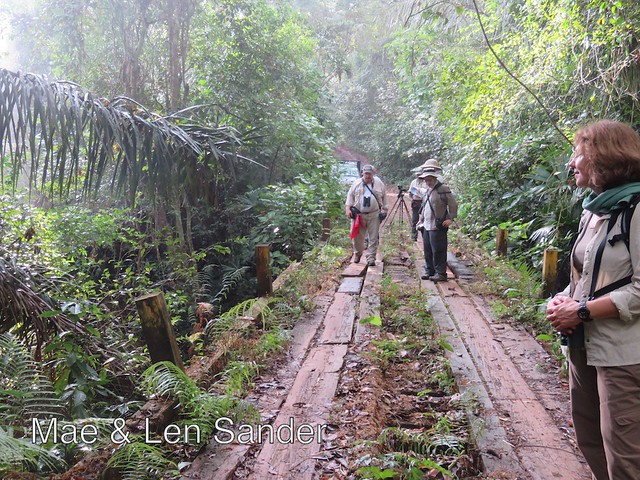
A typical bridge across one of the creeks that go under Pipeline Road. You can see the water through the open beams
between the tracks that cars drive on. Four-wheel drive only! 

Wednesday, February 10, 2016

Having fun in Panama!

day 3 2

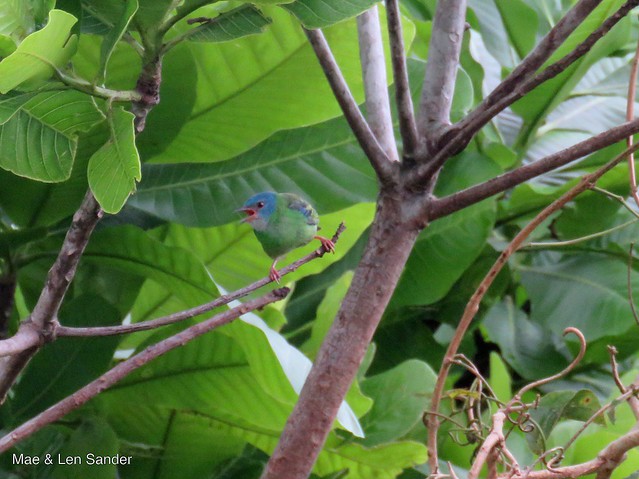
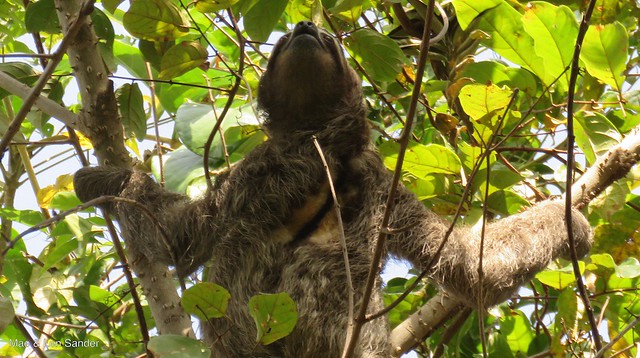
We are seeing lots of great things ... click on the photos to see my Flickr photos, and watch this space for more birds and animals. Above: a female blue dacnis, a bird I'd never even heard of. We saw it at an amazing tower that allowed one to watch birds from above the tree canopy, as our hotel also does. Below, a sloth that was making his way slowly up a tree this morning.

day 4 8

Monday, February 08, 2016

Monkeys, Rodents, and More

A 3-toed sloth with a baby. 
An agouti (a local rodent) with a nut in its mouth. 
A coati crossing the road. (A member of the raccoon family)
A howler monkey just outside our bedroom.
On this morning's walk here in Panama, we saw numerous birds and a few mammals. Birds will be posted later!

Sunday, February 07, 2016

Hummingbirds in Panama

White-necked Jacobin Hummingbirds. 

Late this afternoon, we arrived at the Canopy Tower, an old radar station in the tropical forest high above the Panama Canal and less than an hour from the Panama City Airport. In the trees outside the upper windows were several marmosets: small black and white monkeys with a long tail -- I'm not sure what type. And as we expected, several hummingbird feeders around the door of the tower were crowded with birds.

The tower building.
We can hear lots of other creatures in the forest as well. It's quite an unusual place, with small rooms surrounding the stairway of the old radar tower, a dining-room/meeting-room at the top indoor level, and a viewing platform surrounding the old dome. We'll be on naturalist-led walks and excursions for the next several days.

Friday, February 05, 2016

Spicy Dinner

Last night's dinner.
West-Indian curries are distinctive and delicious. The Indian spices and spice blends they use were introduced to Caribbean cooking during the time that the British Empire included both India and several islands in the West Indies. Though I believe many of the people of Asian-Indian descent (whose grandparents settled in the islands long ago) have left the area, the spices remain in places like Jamaica, Trinidad, and Saint Lucia. Last night I made a West Indian chicken curry, using a recipe somewhat like the one I linked to in yesterday's blog post. I promised a couple of people that I would post the recipe.

West Indian Chicken Curry

3-4 tablespoons spice mixture (see below)
1 Tbsp vegetable oil
6 whole chicken thighs with bone in & loose fat cut off & discarded, some skin left on
1 chopped red onion
1 tablespoon minced garlic
2 teaspoons grated fresh ginger
1 jalapeño pepper, seeds & pith removed, sliced (or hotter peppers if you prefer)
1 cup chicken broth
1 tablespoon brown sugar
1 can of chick peas
1 single-serving container of Greek yogurt (like Fage)

Brown the garlic and ginger in the oil on medium high heat. Brown the chicken next, and sprinkle the spice mixture on it, being careful not to burn anything as you turn it. Add onion and  jalapeños, brown a little more. Add chick peas; stir a bit. Add stock & brown sugar. Simmer for 40 minutes or more. Remove the chicken and vegetables to a serving dish and reduce the sauce for a few minutes.

Off heat, stir the yogurt into 1 cup of the sauce, then add the remaining sauce slowly to keep yogurt from separating. Pour this sauce over the chicken and vegetables and serve with flatbread (such as West Indian Roti or pita bread or tortillas) or with French bread (which I used).

NOTES: 
*Optional garnishes: sliced tomatoes, sliced hot and mild peppers, fresh cilantro sprigs, or other fresh vegetables; chutney.
*Alternate to yogurt: use coconut milk instead. Add this to the pot along with the stock and continue cooking as above.
*I used Whole Foods air-chilled chicken thighs. Cutting off the excess fat is very important because too much fat overwhelms the sauce.


My spices are in very miscellaneous containers
which I refill often from bulk spice sellers.

Spice Mixture

2 tablespoons ground turmeric
1 tablespoon crushed dried chili flakes (or smoked hot Paprika)
1 tablespoon cumin seeds or ground cumin
1/2 tablespoon coriander seeds or ground coriander
1/2 tablespoon whole or ground cloves
1/2 tablespoon ground ginger
1/2 teaspoon whole or ground allspice
1 tsp dried thyme
1/8 teaspoon ground cinnamon
2 teaspoons salt

Standardized recipes call for some spices to be used whole, others to be used pre-ground, and are usually very specific about the amounts to use. I use either ground or whole spice, depending in each case what was on my shelf. I grind up the whole spices and the salt with a spice-grinding mortar & pestle (which Arny & Tracy gave me for Christmas). I combine this mixture with the already-ground spices. I use amounts of each spice that look good -- around 3-4 tablespoons total spice mixture.

Thursday, February 04, 2016

I want to cook!

All the while that I need to be packing and preparing for a trip next week, I find myself daydreaming about cooking and baking. Reading recipes on the web, I found several that really appeal to me -- not a single menu, but dishes for several meals, which I have no time to do now!

Here are my links, with screen-shots to show you my dreams:

Thai celery salad with peanuts from Epicurious
Celery, scallions, and red pepper tossed with peanuts and a dressing of lime juice, fish sauce, and oil. Sounds delicious and really quite simple.

Last night, I made a sort-of beef salad with lettuce, tomato, sliced carrots and other vegetables, soy sauce, toasted sesame seeds, and oil. Mixed in at the last minute: grilled beef sliced thin and tossed with stir-fried onions and hoi-sin sauce. Made me want more Thai-type salads!

From Chef Marcus Samuelsson's Blog: Trinidadian Chicken Roti.
Ever since we spent a week on the island of Saint Lucia, I've thought about the taste of this Caribbean-East Indian fusion dish. I found a very complicated recipe and made it once; if I did it again, I'd think about a slightly simpler version. This one includes the recipe for the roti, a flatbread; I might be tempted to buy some naan bread ready-made instead... just dreaming!


"Open sesame: Yotam Ottolenghi’s tahini recipes"
From the Guardian -- my screen shot is of his "Roast cauliflower and chickpeas with warm tahini yoghurt." I was already inspired to make a salad dressing from yogurt, tahini, and lemon juice -- I started with half a container of plain yogurt and added the other ingredients until it was salad-dressing consistency. My simple cold salad was cubed roast chicken, apples, prunes, and lettuce. But his combination of warm cauliflower, chick peas, eggs, and spices sounds wonderful!

"Better Than Starbucks Lemon Loaf" from blogger Patti.
As it happens, I do like Starbucks' lemon cake slices, and eat them when we stop at Starbucks on the road, mainly. This recipe calls for lemon oil as well as the more predictable lemon zest and juice. I would love to eat this! Since there's a Sur La Table store just across the street from my local Whole Foods, I have a chance to get the exact brand of lemon oil Patti recommends.


Will I ever get around to such cooking and baking? Well, sometimes I do, and sometimes I just collect the recipes and dream.

Wednesday, February 03, 2016

The Amazing Tacopedia

How many kinds of tacos are there? I'd heard of tacos al pastor and fish tacos, but I learned about a lot of other tacos in the all-encompassing and sprawling presentations of the Tacopedia. Authors/creators  Deborah Holtz and Juan Carlos Mena have a fantastic sense of humor. Sixteen categories of tacos -- including insect tacos -- appear in the main section.

Where do taco ingredients and methods come from? Corn, tomatoes, and chili were all in Mexico before 1492, but beef, pork, and metal grills and griddles used for cooking are all European, originally:
"Pork carnitas is one of the most famous dishes in Mexican cuisine. .... Without a doubt, the flexible tortilla and the tender pork come together to provide an unparalleled culinary performance: that corn dough with which the gods created the first man in the Americas meets the pig, an animal that in New Spain in the sixteenth century was eaten as proof of adherence to the Catholic faith." (p.143)
The role of technology in tacos? Taco-making depends on a variety of inventions. For example, "basket tacos" are carried from taco kitchen to customers in bicycle baskets; during the ride, the tacos finish cooking by being steamed while they are all packed together. And tacos al pastor were originally (and sometimes still) made on a gyros vertical grill introduced to Mexico by Middle-Eastern immigrants around a century ago. Overall, the authors' casual way of looking at food history is delightful.

How do Mexican idioms incorporate food metaphors? Check out the amusing image above left. Even though I don't know Spanish, I found these little illustrations very entertaining.

Where can you get the best of every kind of tacos? And how would you make them yourself? In this encyclopedic book, each description of a type of taco is accompanied by a page of recommended taco stalls, food trucks or restaurants in Mexico, as well as by a variety of recipes. The more obscure ingredients and spices are also explained and pictured.

Tacopedia is a colorful and very playful book, illustrated with original drawings, photos, and reproductions of many classic images ranging from Aztec codex drawings to works by Diego Rivera and other Mexican artists. The layout is either chaotic or creative, depending on how you look at it. It's printed on a rough-textured paper, as if it's a phone book or some such informal document. Also, it's full of statistics about consumption and production of food in Mexico. And funny little facts like this: "In the Second World War, the pilots of the Mexican 201st squadron wrote on the side of a missile: 'Take this Taquito, Hirohito.'" (p. 168)

The authors feel that tacos are a key to their culture, and they show enormous respect for the makers and innovators of this food. As the introduction puts it: "there must be something deeply rooted in our culture that makes tacos this culinary wonder loved by the whole world... unlike any other dish, tacos are one of the most definitive traits of Mexican culture." (p. 9)

I've read a few books on tacos and their close culinary relatives by North American writers. Tacopedia is a welcome addition to my library and to my knowledge. More books --

  • Taco USA: How Mexican Food Conquered America by Gustavo Arellano.
  • Planet Taco: A Global History of Mexican Food by Jeffrey M. Pilcher.
  • Que vivan los tamales!: Food and the Making of Mexican Identity, another by Jeffrey M. Pilcher.
  • And I haven't read yet, but on my list: Tortillas: A Cultural History by Paula E. Morton.

Tuesday, February 02, 2016

"The Rise and Fall of American Growth"

“The greatest thing on earth is to have the love of God in your heart, and the next greatest thing is to have electricity in your house.” (Gordon, The Rise and Fall of American Growth, Kindle Locations 2273-2274). 
Technology has changed everyday life and work life for almost everyone in the United States, and in fact for most people in the rest of the world. This is a truism, but there are lots of questions about how, when, and why it happened. In The Rise and Fall of American Growth: The U.S. Standard of Living since the Civil War, economist Robert Gordon combines descriptions of American life in the 19th, 20th, and 21st centuries with quantitative economic data defining exactly what changed and how much. It's a long book, with lots of technicalities, but nevertheless I found it amazingly readable and once I set myself the task, I read it pretty carefully.

I found the descriptions of the way the American diet and foodways reflected the changes in technology very fascinating. I loved the descriptions of the impact of telephones, radio broadcasting, and electric lighting. And I was really interested in the overall discussion of household appliances -- but since I've read quite a bit about this part of history, I found the descriptions of changes in health to be more of a revelation. Specifically: "the annual rate of improvement in life expectancy was twice as fast in the first half of the twentieth century as in the last half." And "By one estimate, life expectancy at birth in 1900 was 46.0 years for white rural males and 39.1 years for white urban males, with the rural/ urban differential about half that for white females." (Kindle Locations 4103-4104).
"The average American in 1950 enjoyed twenty-five years’ longer a life expectancy at birth than in 1880. By 2008, average life expectancy at birth had gained about nine additional years from the 1950 figure. Even within the postwar period, life expectancy manifested apparent diminishing returns. A newborn in 1975 could be expected to live nearly eight years longer than one thirty-five years earlier; thirty-three years later, however, additional life expectancy was only five years more than in 1975. In short, lives were extended more before World War II than after." (Kindle Locations 8951-8956).
Clean water and sanitation were obviously at the top of the list of contributors to this increase in health and longevity. In 1870, when Gordon shows that technological changes were getting started, virtually no running water or sewer lines were available in American homes. This meant people seldom bathed (they had to carry in water and fuel to heat it and then carry it out of the house for disposal) and general cleanliness was problematic. Drinking water was often badly polluted by sewage or industrial waste. Clean water and sewage treatment plants made an enormous impact on overall health during the first half of the 20th century. A small effect of water-treatment plants more recently is the high effectiveness of fluoridation on tooth decay, a significant health issue: "fluoridation was shown to reduce tooth decay by 56 percent." (Kindle Locations 9445-9446).

Food was often contaminated or adulterated, as there was not yet effective refrigeration or food safety regulation. "Avarice and greed by food manufacturers combined with new chemical processes that could accomplish the adulteration and disguise the results with coloring agents. Consumers were helpless, for most food items were subject to adulteration." (Kindle Locations 4357-4359).

"The historic decline in infant mortality centered in the six-decade period of 1890– 1950 is one of the most important single facts in the history of American economic growth." Clean water and unadulterated milk, as well as successes against infectious diseases were major contributors to this important improvement in public health. (Kindle Locations 4148-4149).

The automobile made an impact on health that I wouldn't have thought of: the earliest adopters in large numbers were physicians, who could then reach their patients quickly. Another health contribution of the automobile was to free streets from the horrendous quantities of waste from the horses that previously provided transportation -- air pollution from autos was minor compared to horse manure! Further: the telephone, which went from almost nonexistent to almost total penetration by 1929, enabled people to make appointments with doctors and above all to call for them in an emergency, rather than having to send a messenger to track down the doctor's whereabouts.

One surprise is the very high impact of air conditioning on health: "A study of the temperature-mortality relationship emerged with two primary findings. First, the mortality impact of days with a mean temperature exceeding 80° F has declined since 1960 by almost 70 percent. Second, this entire decline in heat-related fatalities can be attributed to the diffusion of residential air conditioning." (Kindle Locations 9409-9411).

The Rise and Fall of American Growth is a fascinating study of economic history, written appropriately for the common reader, though I'm sure it's also of great interest to the experts. It combines the expected with the unexpected in a most fascinating way --

Hewers of wood? Drawers of water? Women's work never done? Gordon both describes and quantifies the labor of housewives before technology reduced the heavy labor involved in keeping a household provided with cooked food, heat in winter, warm bath water, and sanitation:
"According to one calculation made in 1886, 'a typical North Carolina housewife had to carry water 8 to 10 times each day. Washing, boiling, and rinsing a single load of laundry used about 50 gallons of water. Over the course of a year she walked 148 miles toting water and carried more than thirty-six tons of water.' Not only was the water carried in, but dirty water had to be carried out, not to mention the unpleasant task of emptying chamberpots.  
"But that was not all the carrying that needed to be done. In 1870, the gas or electric stove had not been invented, so all cooking involved wood or coal. Fresh wood and/or coal had to be carried into the house— and spent ashes carried out. 'Paper and kindling had to be set inside the stove, dampers and flues had to be carefully adjusted, and a fire lit. Since there were no thermostats to regulate the stove’s temperature, a woman had to keep an eye on the contraption all day long…. Keeping a fire burning all day required 50 pounds each day of coal or wood.'” (Kindle Locations 1195-1203).
For a much more expert and comprehensive review, see "Paul Krugman Reviews ‘The Rise and Fall of American Growth’ by Robert J. Gordon" in the New York Times Book Review, January 25, 2016.

Sunday, January 31, 2016

In my Kitchen This Weekend

Whole Foods had a sale on Whole Snappers, so that's what we had for dinner last night.
After filling it with aromatics and wrapping it with lettuce leaves, I roasted
it for around 30 minutes, then removed the fillets and served it... 
We enjoyed eating it, too, with white wine, boiled potatoes, bread & butter, and salad.
Meanwhile, I've been trying to reduce the clutter in the pantry, especially on the floor.
There's still quite a lot of stuff there, but not as much as before my project.
(What looks like a brown stripe on the wall is actually the shadow from the camera's flash.)

Saturday, January 30, 2016

High Cuisine, Middle Cuisine, Low Cuisine

A Traiteur now on Rue du Commerce, Paris, 15th arrondissement.
The word traiteur can mean a seller of ready-made food or a caterer.
During two long stays in Paris, I cooked in tiny apartment kitchens, and enjoyed every trip to the many markets and shopping streets in my area. Before digital cameras, I took very few photos, so I've googled a bit to find the above photo of a current traiteur on Rue du Commerce, which was just around the corner from the earlier of our two apartments, and just a few blocks from a later apartment. Here's what I would do when I was living there: I'd look in the windows of the traiteur's shops and get ideas for things I could make myself.

For example, I was startled at the popularity of corn salad, made, I believe, from canned corn with peppers and raisins. Or, contemplating the salads in the traiteur's window, I realized how easy it is to open a can of palm hearts, add some sliced tomatoes and chopped parsley: some traiteurs shocked me by using dried parsley! Of course there are high-end traiteurs (most famously, Fauchon's in Place de la Madeleine) and middle-class traiteurs like the ones on our middle-class shopping street, and even lower-end offerings at supermarkets and the like. Also, open-air markets throughout Paris, such as one quite near Rue du Commerce, have quite a few stalls with the same types of food.

Traiteur Jeusselin on Rue Cler.
A current photo from the street where our friends Chris and Liz lived for many years.
I was thinking about traiteurs in Paris while reading the current Consumer Reports article listed on the cover as "Supermarket Prepared Food Shocker," and titled inside "Under the Plastic Wrap: What's really in supermarket prepared meals?" about ready-made meals at American supermarkets. (March, 2016, pages 38-47)

The prepared food article
does not seem to be available
online at this point, only in paper.
Their review includes such things as rotisserie chicken, salads, mashed potatoes, and many side dishes. It's funny to realize how similar traiteur's foods are to these seemingly innovative supermarket offerings (though rotisserie chickens, ubiquitous in Paris, are not sold by traiteurs, but by poultry butchers). And when I go to Whole Foods, I still do exactly the same thing: looking in the elegant prepared food cases to get ideas for what to buy and assemble in the produce and canned-goods departments!

The Consumer Reports article includes analysis of ready-made foods from a health standpoint -- especially in a section titled "Pass the Salt, Again and Again and Again." They note that not all ingredients are necessarily fresh nor made on the premises; in fact some use canned or bottled products that (obviously) you could buy and use for your own preparations. They also compare prices: typically, as I always suspected, you could make the same dish for half or less than half the price -- or as they say: "The Cost of Convenience is Steep." They have several useful tables, especially one comparing popular prepared meals from Wegman's, Costco, Whole Foods, and a couple of other chains, and a classic Consumer Reports "ratings" section from Wegman's (the top satisfaction rating) to six at the bottom including Target, Walmart, and Aldi.

Frequently seen in traiteur's windows: individual aspics.
This would be harder as a do-it-yourself project!
A salad bar from the website of Traiteur Jeusselin.