Monday, February 02, 2015

Van Gogh: from Bread Crusts to French Cuisine

Van Gogh's Table: At the Auberge Ravoux provides a fascinating study of Vincent Van Gogh's developing relationship to food and how it was reflected in his art. The biographical chapter of Van Gogh's Table is by Fred Leeman, a former director of the Van Gogh museum in Amsterdam. A chapter by Julia R. Galosy documents the post-Van Gogh history of the Auberge Ravoux, in Auvers, France, where Van Gogh boarded and painted at the end of his life. In addition, a chapter of food history and recipes by Alexandra Leaf demonstrates three types of French food that Van Gogh may have eaten: popular cuisine, bourgeois cuisine, and country cuisine from locally sourced ingredients.

Leeman's biography begins with a description of Van Gogh's early life, when he aspired to paint and also to be a Christian preacher like his father. As a young man, Van Gogh lived with poor people in his native Holland, and ministered to them as well as sketching or painting their lives. "The Potato Eaters" thus reflects not only his emerging artistic vision, but also his belief that bread -- that is, very simple peasant food -- was an appropriate diet for a person of his spiritual and religious temperament. His letters from this time express his views, documenting that he often lived on crusts of dry bread, coffee (which the peasants in the painting are also drinking) and little else, often going for long times between enjoying warm meals.

Van Gogh: "The Potato Eaters"
Later, Van Gogh lived in the south of France and ultimately in Auvers, a village just outside Paris, where he died. His emergence as a mature and innovative artist during this time is well-known, as he invented his characteristic use of color, light, and human hands and faces. For example, the Van Gogh museum in Amsterdam, which I visited last summer, is currently organized around his biographical and artistic development.

Toulouse-Lautrec: "Portrait of Vincent Van Gogh
in the Cafe du Tambourin", Paris, 1887.
Van Gogh appears to have a glass of absinthe.
Van Gogh: "A Table in Front of a Window
with a Glass of Absinthe," Paris, 1887
As Van Gogh encountered French artists and French culture, he also became familiar with a variety of foods in cafes and various types of restaurants frequented by his fellow artists -- meals there frequently consisted of meat dishes, bread, vegetables, cheese, and simple desserts. Van Gogh's Table has reproductions of a large number of paintings in which he depicted cafes, restaurants, diners, and other food imagery. In Auvers, Van Gogh lived in the Auberge Ravoux where he paid 3.5 francs per day for room and board. He feared that his earlier abstention from all but a minimum of food had harmed his health -- which also had suffered from his increasing consumption of wine, absinthe, and copious quantities of coffee.


Dr. Gachet, whose face is familiar from Van Gogh's portrait of him (above), played a large role in the last months of the painter's life when Van Gogh lived in the Auberge Ravoux. The chapter titled "Sunday Lunches with Dr. Gachet" by Leaf is especially informative. Van Gogh was a patient of Dr. Gachet, but also engaged in a warm relationship with the doctor's family, and dined at their home once or twice a week. "Feeding the painter was part of the doctor's therapy," as he presided over conversations about "art, politics, free love, and homeopathy."

One Sunday dinner in June of 1890 at Dr. Gachet's home included the doctor and his wife and son Paul, Vincent, his brother Theo Van Gogh, Theo's wife Johanna, and a Madame Chevalier. Theo and Johanna's baby was with them, though not at the table, evidently. "An atmosphere of joy generated by fine food, excellent wine, and freely flowing conversation reigned that day, as later recounted by Johanna, Paul Gachet, and Van Gogh."
Van Gogh: "Margurite Gachet in the Garden," 1890.
On another occasion a few days later, the Gachets invited Vincent to celebrate their son's 17th and daughter's 21st birthdays in their garden. Leaf's recipes for cuisine bourgeoise suggest what might have been on the menu at Dr Gachet's house: she gives recipes for asparagus with Hollandaise sauce, Fillet of Striped Bass with Panfried Leeks and Buerre Blanc, Roast Duck with Chanterelle Fricassee, and Cherry Clafouti.

The book also includes an extended history of the Auberge Ravoux itself, which was never much changed after Van Gogh's famous death there. In the 1950s and later, it was used as a set by several famous film-makers, and has become a tourist attraction for Van Gogh fans.

Van Gogh, "Bowl with Potatoes," Arles, 1888.
Contrast this to the images of the "Potato Eaters."
The link between Van Gogh's creative development and his changing views on eating makes this one of the most fascinating books about food and art that I've read.

That Van Gogh in France not only discovered color and light but also at least to some extent became aware of the taste of food, and thus reduced denying himself the enjoyment of eating is amazing! No less amazing is how productive Van Gogh was in Auvers: in 70 days there, he painted approximately 70 masterpieces, as I learned at the Van Gogh museum.

It would be fascinating to try to recreate one of the dinners documented in the recipe chapters!

Sunday, February 01, 2015

Toulouse-Lautrec Cooks!
At the Museum of Modern Art in New York last week, a major exhibit displayed the museum's Toulouse-Lautrec collection. I enjoyed the intimacy of the portraits, the sweeping lines of the sketches, and the beautiful way he captured the action in cafes and dance-halls. Much to my surprise, I discovered that Toulouse-Lautrec was a decicated cook, and published a collection of recipes:

Toulouse-Lautrec collaborated with a friend, Maurice Joyant, on this collection of his
favorite recipes, which reflect French cuisine of his era, obviously.


Saturday, January 31, 2015

Cezanne: Painting and Dining

A highlight of my recent visit to the Metropolitan Museum in New York was an exhibit called "Madame Cezanne" that included all of his paintings and sketches of his wife. Several of Cezanne's wonderful still-lifes and landscapes are also in the Museum of Modern Art. So I've been thinking about Cezanne in a number of ways, including a fascination with his influence on the cubists.

Always, I am fascinated by connections between food and art, so I searched for additional artist-cookbook combinations that seemed to reflect a scholarly approach. (Sometimes one finds cookbooks that are only very tenuously based on a subject -- let's not talk about them!) I found a very nice one about Cezanne.
Cezanne loved to paint fruit, but he needed durable subjects like apples
(not peaches) because he took such a long time to complete his work.
Sometimes he even used artificial flowers.
These things I learned from my new cookbook:
The main text of the book is a fairly standard biography, but the illustrations are very
expressive, and the recipes are appealing.
Provencal recipes maybe really reflect Cezanne's taste or actual foods he's known to have eaten.
Potatoes cooked in olive oil was a documented Cezanne favorite.
Inspired by this, I made potatoes in olive oil for dinner a couple of nights ago.
And I might try this duck recipe some time.
Illustrations include both photos of Cezanne's environment and reproductions of his art.
From the book: I liked this self-portrait.
Cezanne's studio, preserved in a museum now made from his Provencal home.

Wednesday, January 28, 2015

Around the World for Cookbook Wednesday


As you know if you've been following my posts for Cookbook Wednesday, I love international cookbooks. Today is the last episode of this blogging adventure, sponsored by Louise at Months of Edible Celebrations. As a finale, I decided to make a quick cookbook tour of the world, at least the parts I haven't covered in my posts so far -- I've already written Cookbook Wednesday posts on Australia, Eastern Europe, the Caribbean, Israel, and several regions of the US. I tried to pick cookbooks that really were written and published in the country they were about, or written by people who had lived there.

Starting with Europe and Africa:

Classic European Cookbooks:
Anne Volokh, The Art of Russian Cuisine. Bayerishes Kochbuch (belongs to my daughter & Bavarian son-in-law).
Sicilian cuisine: Mary Taylor Simeti, Pomp and Sustenance; tourist pamphlet, "Palermo Cooking."
France: Ginette Mathiot, La Cuisine Pour Tous; Raymond Oliver: La Cuisine.
I have many other European cookbooks, especially French and Italian cookbooks!
Specialities of Turkish Cuisine,
purchased in Istanbul, 1990.
One of my newest books: Couscous by Paula Wolfert -- I hope to experiment with North African dishes soon.
And Anetta Miller, African Flavors: Recipes with Proverbs, a most intriguing book.
I have tried various Asian cookbooks. Here are two that really came from there:

A Chinese cookbook published many years ago
by the Chinese government. Sort of propaganda.
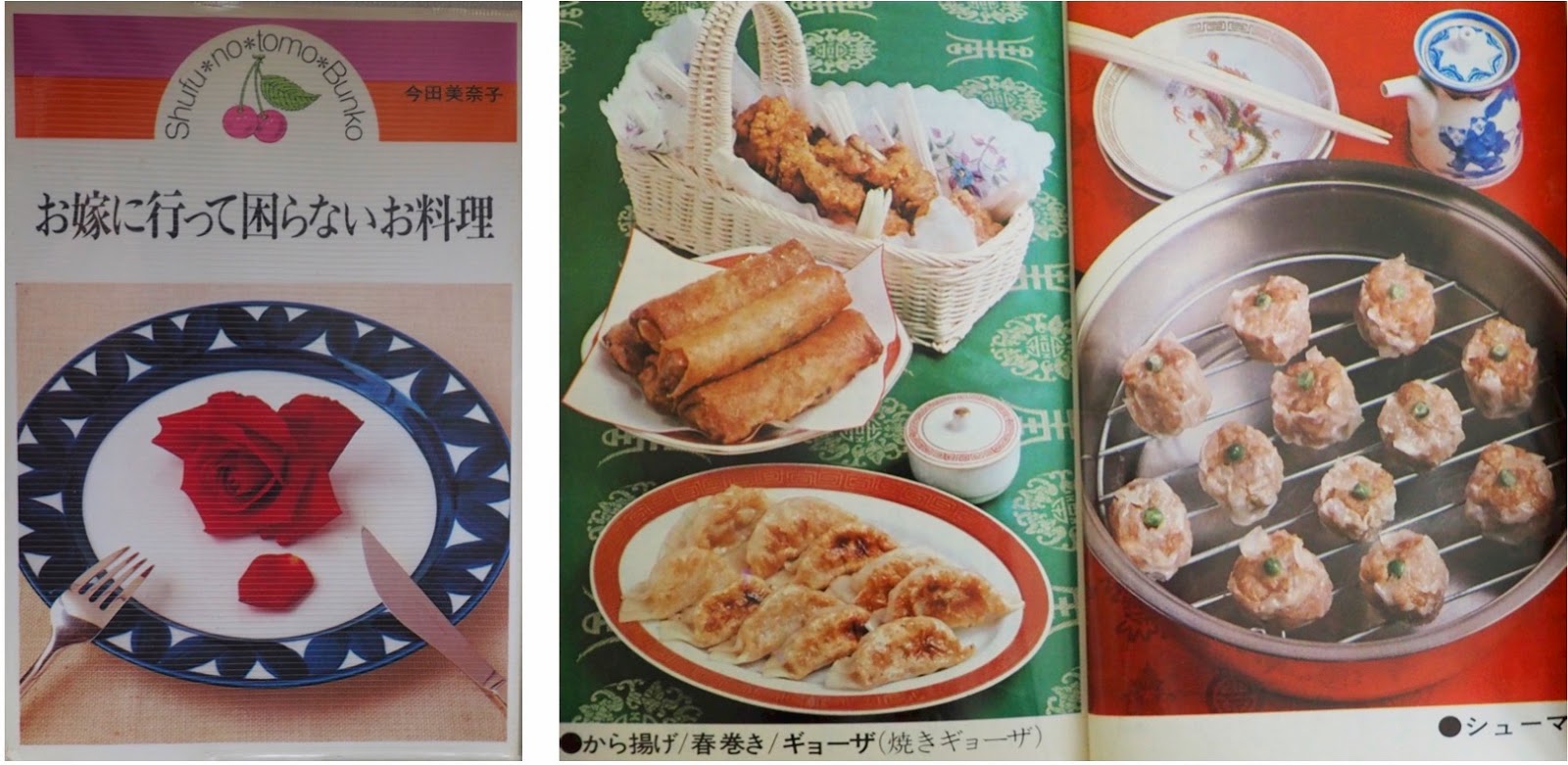
A cookbook in Japanese. Cover, left; sample 2-page spread, right.
brought to us by our international exchange student. (No, I have no idea what it says.)
And now a few from the Americas -- remember I've already written about California, Louisiana, the Southwest, and a few other places:
Favorite recipes from Miss Hullings Cafeteria, the popular, long-gone
St.Louis downtown eatery: a no-longer-existing type of restaurant!
Very early American cookbook by Sarah Josepha Hale
who worked to establish the Thanksgiving holiday.
This is a Canadian cookbook, a gift from my friend Kappu
who has lived in Toronto for many years.
I see Toronto as an incredibly international city!
Latin America: Elizabeth Lambert Ortiz, Latin American Cooking;
Cocina Judia a recipe collection from a synagogue in Buenos Aires;
and the classic Diana Kennedy, The Cuisines of Mexico.
Have I tried recipes from all of these books? Well, not quite, but I've tried a lot, and I really love them. I'll miss the fun of Cookbook Wednesday, and hope Louise comes up with a new challenge for her dedicated readers and blogging family.


Tuesday, January 27, 2015

New York Meals

Obviously we are very happy to be at home with the near-miss blizzard today in New York. We did eat some very nice meals there -- here is a brief report on a few restaurants I haven't mentioned in earlier posts:

We had a nice lunch at Westville on Hudson St. shortly after checking into our nearby hotel:
Inside Westville
A big selection of roasted vegetable, served several to a plate.
(Photo from the Westville website.)
Len's sandwich

At AQUAGRILL on Spring Street we enjoyed a really appealing dinner:

Three kinds of local oysters -- there are 33 kinds on the menu.
I ate two of them before taking the photo, so two shells are empty.
Len's Bouillabaise -- I had scallops.
Pear Tarte Tatin for dessert


We had brunch at Stage Door Deli near B&H Photo (where we shopped):
Coffee, a tiny juice, and French toast with strawberries all for $8.75.
City Winery actually makes wine in downtown New York City, and serves it with a variety of food. They also have a large performance space, which wasn't offering any entertainment the night we ate there.
I ordered meatballs. Very nice.

Sunday, January 25, 2015

Picasso's Kitchen


Visiting the Museum of Modern Art in New York was incredibly enjoyable and full of surprises, as well as many very familiar works of art. I was amazed to discover a Picasso painting titled "The Kitchen," painted in 1948. According to the documentation it's a very complicated work, with echoes of a number of related ideas that Picasso was thinking about at the time:


MOMA Sculpture Garden. Near front: "She-Goat" by Picasso, 1950.

Friday, January 23, 2015

Neue Galerie, New York

This afternoon in New York we walked across Central Park to the
Neue Galerie, a small and elegant museum dedicated to the arts of Vienna in
the early 20th century. The Shiele exhibit was utterly fascinating.
Klimt's portrait of Adele Bloch-Bauer is the most important work in the
collection. Recently regained by the Bloch-Bauer family after a long struggle,
the painting was purchased by Ronald Lauder for the Neue Galerie.
The museum cafe specializes in Viennese treats, with whipped cream of course.
The Klimttorte (lower right) is decorated with gold.
The Sachertorte (upper right) is traditional.
At the cafe. Unfortunately there is no photography in the splendid rooms of
the museum, which is in a 5th avenue mansion.
Earlier in the day, we shopped at B&H photo and spent a few hours at the American Museum of Natural History.

Thursday, January 22, 2015

A Day at the Met

From the Medieval Collection.
NY-Metropolitan-museum 3
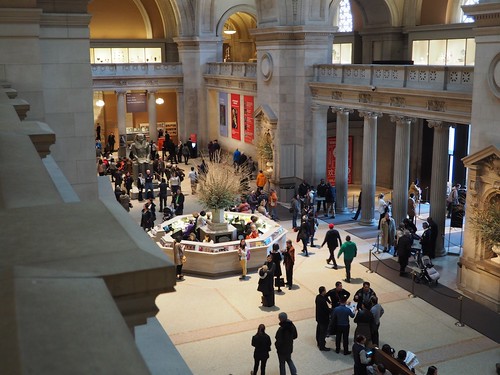
Looking down into the lobby of the Metropolitan Museum in New York where
we spent most of the day, seeing several special exhibits and some of the permanent collection.
NY-Metropolitan-museum 9
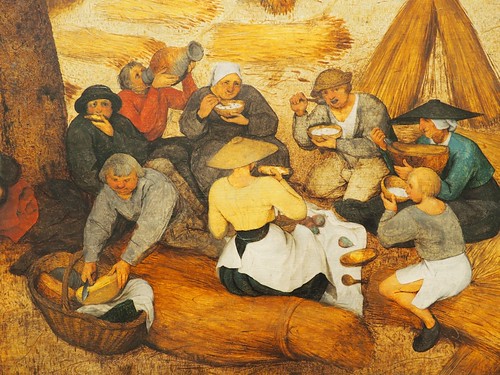
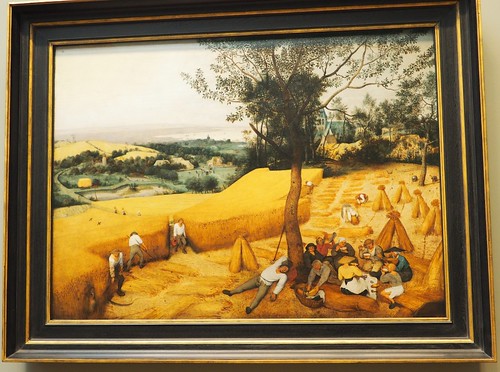
Pieter Bruegel the Elder: "The Harvesters."
Though a fan of Bruegel, I was unfamiliarwith this incredible work from 1565. The harvesters are eating
lunch in the lower right corner, and working at left, while the background goes all the way out past the fields
 to the sea. A treehides a church and perhaps a village. I sat and contemplated this work for a long time.
NY-Metropolitan-museum 8
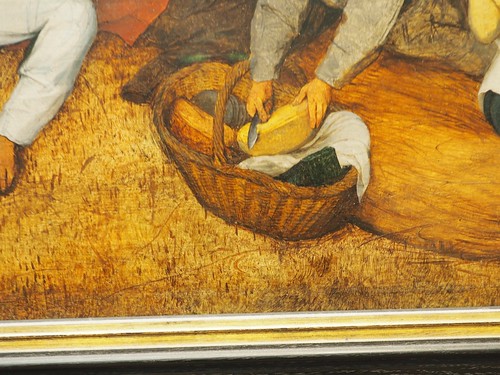
One of the harvesters, cutting bread.
NY-Metropolitan-museum 7
The open-air meal.
We managed to see the costume institute's special exhibit on mourning dress in the 19th century, an El Greco exhibit; "Madame Cezanne" containing all Cezanne's portraits of his wife; a recently restored mural by Thomas Hart Benton; and the Lauder collection of cubist paintings by Picasso, Braque, Gris, and Leger. We spent quite a bit of time in the permanent collection of Dutch Golden Age art including works by Rembrandt, Hals, and Vermeer, as well as Breugel. I've posted a few here, more may be on the way eventually.

Exhausting day, but worth it!

Wednesday, January 21, 2015

Museum of Modern Art, New York

NY-MOMA 12
MOMA: Minimalist Painting
NY-MOMA 11
Fifth Floor Cafe, coffee at lunch
NY-MOMA 5
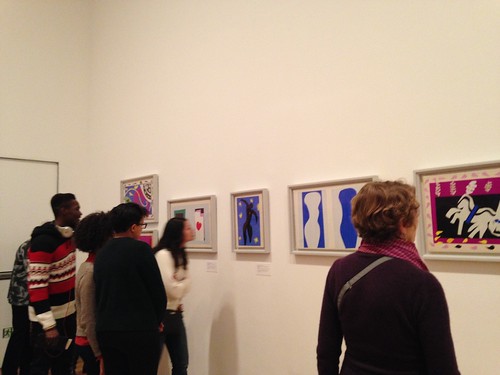
Matisse Cut-Out Exhibit
NY-MOMA 2
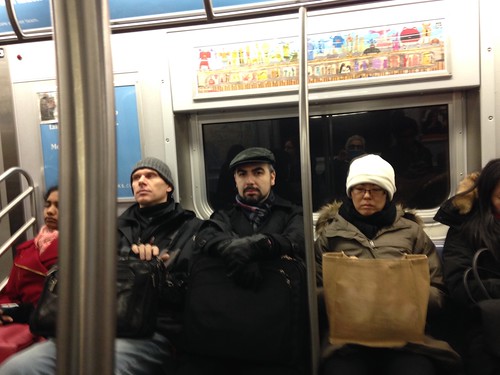
Riding the Subway to get to MOMA: I figured it out!

For more see my Flickr album: "Day at MOMA."