Sunday, July 09, 2017

How Times Change

Recently, I was listening to some Woody Guthrie songs sung by Cisco Houston, and thinking about how our view of taming nature has changed over time. I'm not going to comment about the details: the point seems obvious in these, the final verses from "Grand Coulee Dam," which Guthrie wrote in 1941:

At Bonneville on the river
there's a green and beautiful sight,
See the Bonneville Dam a-rising
in the sun so clear and white,
While the leaping salmon play along 
the ladder and the rocks,
There's a steamboat load of gasoline
a-whistling in the locks.

Uncle Sam took up the challenge
in the year of 'thirty-three,
For the farmer and the factory
and for all of you and me,
He said, "Roll along, Columbia,
you can ramble to the sea,
But river, while you're rolling,
you can do a little work for me."

Now in Oregon and Washington
you can hear the factories hum,
Making chrome and making manganese
and light aluminum,
When you see that flying fortress
wing her way across the land,
Spawned upon the King Columbia
by the big Grand Coulee Dam.

A 1940s post card of the Bonneville Dam. (For a complete summary
of the history of the dam, see this website: source)
Guthrie wrote quite a few songs about the Coulee Dam project -- hired and paid by the Bonneville Power Administration, builder of the dam. Last year for the seventy-fifth anniversary of these songs, the BPA sponsored a celebration.

From the BPA website:
"During his month of employment in the spring of 1941, Guthrie traveled across Oregon and Washington and visited towns, farms, Native American locales and the construction site of Grand Coulee Dam in northeast Washington. Inspired by the people he met and his own observations and experiences, Guthrie wrote a collection of songs about the Columbia River and the benefits new federal hydroelectric dams would bring to the people of the Northwest." 
Here are verses from "Roll on, Columbia," another of the 26 songs which he wrote for them:

At Bonneville now there are ships in the locks
The waters have risen and cleared all the rocks
Shiploads of plenty will steam past the docks
So roll on, Columbia, roll on.

And on up the river is Grand Coulee Dam
The mightiest thing ever built by a man
To run the great factories and water the land
So roll on, Columbia, roll on.

These mighty men labored by day and by night
Matching their strength 'gainst the river's wild flight
Through rapids and falls, they won the hard fight
So roll on, Columbia, roll on.

Another postcard view of the dam, also from the 1940s.
An NPR story about Guthrie's Columbia River songs summarizes the point of view during the time he wrote them: "Guthrie's songs echoed this optimistic period in the West. Few were thinking of the salmon the dams would sacrifice. Instead, it was all about harnessing nature's power to help people."

While the song lyrics praised the technology of man harnessing the river, Guthrie himself was an embarrassment to the government agency that had hired him. During the anti-communist witch hunts of post-World-War-II era, the BPA destroyed much of the evidence that they had hired Guthrie and paid him $266.66 for his 30 days of work -- including a documentary film with Guthrie singing his songs. However, in the 1980s, a BPA employee retrieved some of the material, described in another post on their website here.


Friday, July 07, 2017

Curious George Escapes from Wartorn Paris


Curious George is one of many beloved characters who inhabit children's books and children's imaginations. Curious George may not have actually visited Paris as part of his delightful adventures. However, the author H.A. Rey and his wife had a very real and dangerous Paris adventure: escaping from the German invasion of Paris in May through August, 1940. As they fled for their lives, they carried an early draft of the first Curious George book with them. They were fortunate, as their escape was successful, and they eventually came to the US where they published a number of successful children's books.

The Journey that Saved Curious George: The True Wartime Escape of Margret and H.A. Rey by Louise Borden describes the history of their lives in language that children could understand. Both of the Reys were German Jews, who had already fled from Germany and the Nazi persecutions. Unfortunately, they were in Paris when the German armies marched in. They managed to obtain needed papers, cash, and bicycles for the journey. They traveled through France by bicycle and by train, managed to cross the Spanish border, and then took a ship across the Atlantic. The book tells this story in detail, with illustrations from the archives of H.A. Rey and additional illustrations by Allan Drummond.

The house in Paris where the Reys were living.
Paris.
H.A. Rey managed to acquire bicycle parts and make two bicycles for their escape.
For the summer blog event "Paris in July" I am reviewing visits to Paris by some well-known characters in children's books. This is no doubt the most surprising Paris connection of any such character, I would say! To see what Parisian adventures and locals the other bloggers are exploring, check the blog Thyme For Tea where Tamara, a lover of Paris who lives in Australia, is hosting this event.

Wednesday, July 05, 2017

On the Fourth of July

The Fourth of July: chips, salsa, hot dogs, potato salad, broccoli salad, white wine, s'mores, fireworks. 

Nat, Len, Carol.

Broccoli salad: broccoli, black olives, bell peppers, scallions, egg, lemon vinaigrette. Carol's Salad Olivier. 


In our nearby Burns Park, there's usually a celebration: bring-your-own-fireworks.
We didn't bring any, but enjoyed the show.

Tuesday, July 04, 2017

Happy Fourth of July

Fireworks, July 4, 2012, Santa Barbara Harbor

Monday, July 03, 2017

A story of Modern French Chocolate and its Inventors

"Chocolate taste ... beginning in the 1980s took its substance from the nouvelle cuisine then dominant in the French culinary establishment. ... The new chocolate cuisine mandated fresh natural ingredients, novel but simplified flavorings, and healthy, dark chocolates with less sugar.  ... Connoisseurs now insist that choice French candies be made from fresh regional products such as chocolate from the best cacao growths, butter from Charente, cream from Normandy...; that they incorporate exotic flavorings and foodstuffs of distant locales such as citrus fruits, coffee, tea, spices, and even chocolate itself." (Terrio, pp. 57-58)

Crafting the Culture and History of French Chocolate by Susan J. Terrio is a scholarly study of artisan chocolate makers in France in the 1990s. Under the leadership of Robert Linxe (1929-2014), new flavors of artisanal chocolate had been popularized in France in competition with growing industrial production. In particular, French taste in chocolate evolved to prefer dark chocolate rather than milk chocolate, and to favor more exotic spices and fillings. In 1977, Linxe founded the Paris chocolate shop La Maison du Chocolate, which subsequently opened boutiques in Paris, New York, London, and other world capitals, and was thus the most successful of the French artisan chocolate houses.

The people in Terrio's study were owners of small but successful chocolate-making shops in towns on the Basque coast of France. These craftsmen/owners were aware of Linxe and his success -- in fact, his native town was in their region. However, they also had their own particular challenges dealing with local customers and with the large number of tourist customers who spent summers there. In each shop, the craftsman/owner hand-formed chocolate candies in a workshop adjacent to the sales area, where the wives managed presentation of the products and interacted with customers. It was impossible for an independent chocolate shop to succeed if both husband and wife were not dedicated to their expected roles.

The author systematically describes the details of these shop owners' history and education, their social position, their family life,  and the succession of ownership and craftsmanship from one generation to the next. For any reader interested in French society and its class structure, educational institutions, and priorities, this book offers fascinating insights.

Collective efforts at development of craft and professional standards were a major goal of some of the chocolate craftsmen, particularly their efforts to create guild-like organizations. The author describes the interaction between the craftsmen and government regulators, as well as a few memories of the way that chocolate makers dealt with the hardships of World War II. The history of chocolate in the region dates back to the introduction of chocolate to France several hundred years earlier by Jews fleeing from Spain; some time later, guilds (in which membership was open only to Christians) forced the Jews out of the trade. Terrio shows how this part of history has been revised interestingly to match contemporary needs for a useful origin myth. (pp. 72-79)

One of the most interesting elements of the history is how these chocolate makers have very recently redefined their craft. In particular, French choices in chocolate types developed quite a bit in the last quarter of the twentieth century -- the era of concentration of this book. The development of these tastes helped artisan chocolate makers compete with growing pressure from mass-produced chocolates that looked the same but were not made with the same craftsmanship. I was especially fascinated by the way that taste tests often disclosed that many people really preferred sweeter milk chocolate, but that the taste makers essentially imposed the theoretically more refined taste for dark chocolate and exotic flavors.

Although Crafting the Culture and History of French Chocolate is written in a very academic style, with much social science jargon, I nevertheless found it readable and often remarkably interesting. I am very curious about the subsequent history of artisanal chocolate in France since the book was published in 2000. The author appears to have moved on to study other aspects of French culture, and not to have followed up with the subjects of her book.

In my own travels, I tend to concentrate on pastry shops more than on candy shops, though I have very fond memories of at least one chocolate shop in Lyons and one in Paris. The screen shot from a google search for "Bayonne France Chocolatiers" suggests that chocolate makers there still offer some very tempting candy.

Saturday, July 01, 2017

Visiting Paris in my Imagination

"Paris in July" starts this week: a blogging event that I have often enjoyed. My most recent trip to Paris was a little over a year ago, and I love to imagine going back Paris, so I'm definitely looking forward to the posts that other bloggers share. This event is sponsored by Tamara who blogs at Thyme For Tea -- her first post is "Paris in July -- Officially Starts!"

As I began imagining a visit to Paris, I recalled how the central characters of several children's books enjoyed some time in the City of Light. Obviously, the first character that comes to mind is little Madeline, creation of writer/illustrator Ludwig Bemelmans. Madeline made her debut in 1939.

Madeline indeed may be the most famous fictional child in an English-language book about Paris.
In one of Madeline's TV adventures she climbed the Eiffel Tower -- and as always got into mischief.
Miss Clavel, head of Madeline's school in Paris, also accompanied her charges on the Paris Metro.
Eloise, another fictional child, was mostly known for her life in the Plaza Hotel
in New York. However, she did make a visit to Paris as well in this sequel.
Hilary Knight, the illustrator of the Eloise books, is now 90 years old, and very active -- subject of a big exhibit documented here: "Remarkable. Extraordinary. Eccentric: The Man Who Drew Eloise Recalls His Muses." I have lots of memories of Eloise. She was very popular when I was younger, though I don't think she's completely forgotten yet. I bought a copy of this book for this month's blog event, so I may have more to say about it later.

Babar the Elephant gave some advice about Paris to his daughter who  was planning
a visit. I'll be back with more about Babar in Paris. The Babar books were originally
written in French by Jean de Brunhoff and his son Laurent de Brunhoff. 
A few years ago, in a TV series, Paddington Bear visited Paris where he participated in the Tour de France.
Here's Paddington with his loaf of French bread -- probably the most characteristic of French foods!
This TV series seems to have gone beyond most of the Paddington adventures, which in the books take place in London.
Sadly, Paddington's creator, Michael Bond, died this week -- his NPR Obituary is HERE.
I suspect that many other well-loved children's characters have visited Paris, but for now, that's my first contribution to Paris in July. No idea what I might do later!

Note: all screen shots are from YOUTUBE.

Friday, June 30, 2017

In My Kitchen, June 2017

Most of June, I was on the road, never in any kitchen at all. During the past week, however, I've been cooking and shopping again, and thinking a little bit about the history of a few of the foods that I have in my kitchen now. I frequently write about New World foods, but in this post, I'm concentrating on Old World produce.

Tabbouleh and Other Foods from the Middle East


I'll start with some middle eastern foods in my kitchen now that are now pretty standard in US supermarkets. Above is a photo of a tabbouleh salad I made this week, using bulgur "the traditional grain of the Levant" according to the package from Bob's Red Mill. "The Levant," as you probably know, is an older term for the eastern Mediterranean region, or middle east.

I prefer to make my own tabbouleh because the tomatoes and chopped herbs need to be fresh: in packaged tabbouleh, they're often kind of tired and tasteless. Obviously, the fact that this grain comes from Bob's Red Mill, a natural foods company in Oregon, shows that this is a pretty Americanized product! (The tomatoes and bell peppers you see in the salad illustrate how New World foods have been adapted by middle eastern cuisines.)

In my kitchen: Baba Ganoush and Hummus from Whole Foods.
Both can be made with tahini, a paste made from sesame seeds.


We ate the tabbouleh and also pita bread, baba ganoush, hummus, charcoal-grilled meat, and salad with olive oil for dinner one day this week. Other middle eastern foods now appearing on American tables including mine include olives, several sorts of cheese, falafel, lentil salads, stuffed vegetables, and more. Quite a few of these foodstuffs are mentioned in the Bible and other early works of literature from the Mediterranean region.

The history of the names of these foods (which often have multiple spellings) also points to their origin in the middle east. Tabbouleh is a word of Arab origin, meaning something like "seasoning." Hummus is the Arab word for chick peas, the primary ingredient of the dish. Sesame has its word roots in Arabic, Coptic, and early Egyptian languages. Tahini means crushed -- as in crushed sesame seeds. Baba Ganoush also comes from Arabic: baba can mean father or daddy and gannuj can mean coquettish or pampered (source).

In Israel, I've enjoyed these foods at a variety of places, especially the famous restaurant in the Arab-Israeli town of Abu Gosh, as well as in people's homes. A generation ago, they were pretty exotic in America, but now it's normal to find them in American supermarkets both packaged and in delis such as the Mediterranean counters at Whole Foods. People serve them all the time, bring them to potlucks, etc. So my kitchen isn't particularly unusual.

A refrigerator case full of hummus etc, in a small supermarket
near Tel Aviv, Israel. I think our markets are catching up with this selection.
-- (My photo from 2016)
A quick bit of history of two common ingredients:
  • Chick peas were among the "founder crops" of the fertile crescent, where Eurasian farming began. They began to be cultivated something like 11,000 years ago, so they have been a basic foodstuff throughout the history of the region and the places to which cultivation spread. (source)
  • Sesame seeds have been cultivated for at least 5000 years. In China sesame oil was used in making ink. In Africa sesame seeds have long been an important foodstuff. And in the middle east they have been used for cooking oil and in tahini and the candy halavah. 
"The earliest recorded use of a spice - sesame seed - comes from an Assyrian myth which claims that the gods drank sesame wine the night before they created the earth." (source)

Cherries

California Cherries in My Kitchen this month.
It's cherry season. Our first cherries, as usual, came from California, but this week at the farmers' market the first Michigan cherries appeared. Cherry trees in the Old Mission Peninsula of northern Michigan date to 1852, when a Presbyterian missionary named Peter Dougherty planted them -- this area has a micro climate good for growing fruit. Commercial production there began in the 1890s. We have visited there several times: a very beautiful place -- maybe some day we'll get there for the Cherry Festival! (source)

Cherry trees are native to Europe, Asia, and the middle east. They've been around so long that quite a few places claim them. Probably they were first cultivated in central Anatolia, but were known to the Greeks and Romans and highly valued in many parts of the world, including ancient China and Japan.

In My Kitchen: a magnet from the Washington, D.C.
Cherry Blossom Festival.
The Cherry Blossom Festival in Washington celebrates trees that were a gift to the US from Japan a little over over 100 years ago. These trees, which surround the Tidal Basin near the major monuments of Washington, are very beautiful during their brief blooming season in early spring. Huge crowds enjoy the sight of the blossoming branches reflected in the water along with the Jefferson Memorial and other buildings. 

The Japanese cultivation of cherry trees began over 1300 years ago. Early cherry blossom viewing festivals were part of ancient Japanese nature worship: "every spring, the mountain deity traveled down to the fields on the falling petals of cherry blossoms and transformed into the deity of the rice paddies, a critical crop for Japanese agriculture and productivity." Each era refined and developed the meaning that the fleeting moment of cherry blossom time embodied. In the 19th century, cherry blossom viewing played a role in Japanese nationalism. (source)

 Lemons 

I try to keep lemons in my kitchen all the time. They add
flavor to a wide variety of foods.
I've written a few previous posts about the history of citrus fruit, especially the book Hesperides by Samuel Tolkowsky which I wrote about here. According to Tolkowsky, citrus fruits were mentioned in China in a compendium dated around 500 BCE, and in a number of older works that refer to the fruit. Citrus fruits were known to the Jews in Israel as early as the time of the Maccabees (around 136 BCE). The word origins of lemon trace ultimately to east-Asian languages, as lemon cultivation began there and slowly spread through Persia, the middle east, North Africa, and Mediterranean Europe. (source)
Genetic scientists are still analyzing the exact ancestry of the many varieties of lemons, citrons, oranges, grapefruits, and other citrus fruits. According to an article in Science Daily published in 2011, bergamot and lemon species came from citron and sour orange. The article explained:
"Even with a documented history of cultivation spanning more than 4,000 years, the exact genetic origins of cultivated Citrus species such as sweet orange, lemon, and grapefruit have remained obscure. Chinese researchers used a combination of analyzed amplified fragment length polymorphism and Chloroplast DNA data to identify the exact genetic origin of cultivated citrus." (source)
Obviously I have many other foods in my kitchen, which no doubt have histories and word origins at least as complex and intriguing as these. However, I think this post about what's in my kitchen this month has gone on long enough. I'll be posting it with Sherry's Blog for the monthly In My Kitchen event where bloggers from many lands share their new and favorite kitchen things.

Kitchen wrap-up: The top shelf of my refrigerator.

Wednesday, June 28, 2017

A Restaurant in Santa Fe

Restaurant Martin in Santa Fe, New Mexico, was the best place we ate during our recent long trip west. It's classified as "progressive American cuisine," and the chef-owner, Martin Rios, is a longterm resident of Santa Fe who was born in Guadalajara. The location is outside the main tourist area, but in easy walking distance of the central hotels. I was too busy to document our meal there at the time, but now I want to show some of the beautiful and delicious dishes we ate there, in a very charming and relaxing outdoor setting.

Roasted asparagus. The menu offers a very elaborate asparagus dish as a
first course, but I requested asparagus only, which is technically a side dish.
Chilled pea and mint soup with various garnishes.
Duck breast with various vegetables on a bed of duck confit.

Dessert: panna cotta with fruit and sorbet.
For more information, the restaurant website is here: https://restaurantmartin.com/about/

Sunday, June 25, 2017

Un-Pasta


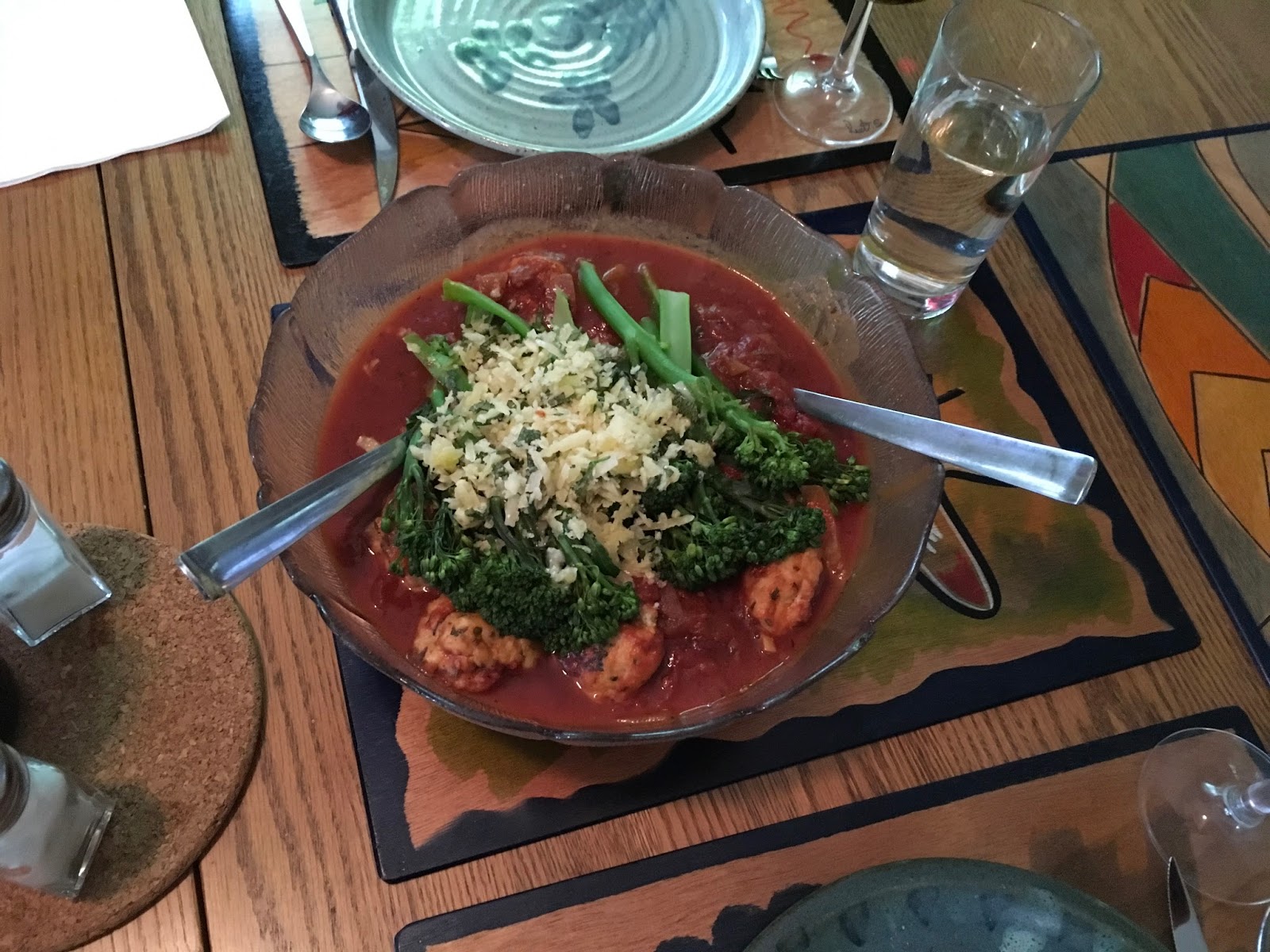
Home-made tomato sauce from a can of Italian peeled tomatoes, onions, red wine, etc. Turkey meatballs with a mushroom sealed inside each one. Steamed broccolini. Freshly grated Parmesan mixed with garden herbs and olive oil. And no pasta.

Saturday, June 24, 2017

"The Nix"

Reading The Nix by Nathan Hill often made me laugh out loud, which was awkward when I was reading the book and also sitting on my yoga mat while waiting for class to start. The more I try to capture the extraordinary humor of the book the less successful I am. However, here's a brief review of what I liked and the small area I didn't like as much.

The book covers several generations of one family, but not in chronological order at all. Besides the grandfather and parents of the central character Samuel, there's a penetrating though also funny description of his childhood friend Bishop, who defies authority and figures out how to stop the class bully, of Bishop's beautiful sister, and many others. Some reviewers have referred to this as a "Great American Novel," which fits when you consider that Hill covered so many quirks of American life through these four generations.

One of my favorite characters is Samuel's vengeful student Laura Pottsdam, a habitual cheater. Laura uses every buzzword in the college lexicon to avoid the consequences when Samuel catches her submitting a free-on-the-internet paper about Hamlet. Laura has hilarious encounters with her boyfriend and his strange demands on her (which I won't quote because I'm embarrassed), and also spends a lot of time on a social media app called iFeel. "The thing about iFeel was that she could broadcast how she felt at any given moment to her huge network of friends, and then their apps could auto-respond to her feelings with whatever message was appropriate... She could select an emotion from the fifty standard emotion choices and post a little explanatory note or photo or both, then watch the support roll in." However, she is challenged when she feels doubt. Nothing like it appears on the list. (p. 423)

The otherworldly life of compulsive computer gaming is critical to several of the characters, including Samuel himself, who is immersed in an online game called Elfworld, where he joins a number of anonymous players including the unemployed and divorced Pwnage, whose life is nothing but gaming and trying to stop. Pwnage wants to switch from a weirdly cheap diet to organic health food while he is literally starving himself nearly to death by never getting up from his screen. Pwnage:
"See, what's important for me is to be frugal. I'm saving up. Do you know how expensive that organic health food stuff is? A sandwich is seventy-nine cents at the gas station but like ten bucks at the farmer's market. Do you know how cheap, on a per-calorie basis, nachos are? Not to mention the Go-Go Taquitos or Pancake and Sausage To-Go Sticks or other food that have no organic equivalent that I get for free at the 7-Eleven down the street. ... Of course eating these food items is not what I might describe as pleasant, since they're tough and scorched and moistureless from their all-day cooking on high-temperature rollers. Sometimes biting through a burrito's thick tortilla casing can feel like chewing through your own toe calluses." (p. 224)
Samuel is forced by a chain of events to engage in a detailed quest to learn about the secret life of his mother, Faye, who abandoned him and his father when he was eleven years old in 1988. He discovers her frustrating life in high school in Iowa, and how she escaped for just one month to Chicago, where she was caught up in the violent protests during the 1968 Democratic Convention nominating Hubert Humphrey, a mostly-now-forgotten horror show which Hill brings back to life. Excessively, I thought. The last 200 pages of the book where the book turns from satire into a historical novel was the part I liked the least. On the other hand, I much enjoyed Faye's high school experiences including home-ec and her very proper teacher Mrs. Schwingle:
"Mrs. Schwingle teaches them how to host a dinner party, how to cook for a dinner party, how to make pleasing conversation with dinner guests, how to create the sophisticated dishes she insists the wives on the East Coast are right now making, mostly involving some kind of gelatin, some kind of lettuce trim, some kind of food-within-another-food conceit. Shrimp salad in an avocado ring mold. Pineapple in lime gelatin served with cream cheese. Cabbage suspended in jellied bouillon. Peaches split and filled with blueberries. Canned pear halves covered in shredded yellow cheese. Pineapple boats filled with cocktail sauce. Olive pimento mousse. Chicken salad molded into white warheads. Tuna squares. Lemon salmon towers. Ham-wrapped cantaloupe balls. ... America has fallen in love with these foods: modern, exciting, unnatural." (p. 288-289)
The Nix has a kind of a message, embodied in a Norwegian folk tale about a supernatural being called a Nix. The message is that we are destroyed by what we love the most, or "Don't trust things that are too good to be true." Or the last sentence of the book: "Eventually, all debts must be repaid." Fortunately, the message is carried by a series of wonderful and mostly very funny tales of life in America, the good and the bad, the political horrors and the merely commercial. (p. 115 and 732)

Tuesday, June 20, 2017

Back Home


... for our first lunch at home: grilled eggplant, red bell pepper, fresh herbs and tomatoes.

How the herbs grew while we were gone!

Sunday, June 18, 2017

Four Fathers Celebration

A photo of our "four fathers" celebration. The fathers are: Brian, Jack, Jay, and Len. Also a few moms & kids.
Update: the original of this family photo from 1982. Same location, some different family members, some the same.

Wednesday, June 14, 2017

On the Road Again: Albuquerque

Aliens at a rest stop between Flagstaff & Albuquerque. 
A long convoy of tanks was also stopped at the Rest Stop. 

Lunch in Albuquerque, at a place we've enjoyed before, the Church Street Cafe. The decor is very beautiful. Then we did a few more gallery visits. Tomorrow: a long drive. The next day: another long drive.


All photos and text copyright 2017 by Mae E. Sander. Published at maefood dot blogspot dot com. If you read this elsewhere, it has been stolen.